
 Worksheets
Atomic Structure and Key Experiments
Total questions: 100
Worksheet time: 2hrs 2mins

Which scientist was the first person responsible for proposing the idea of atoms?
Democritus
John Dalton
Ernest Rutherford
J.J. Thomson
Niels Bohr

Which scientist was the first person responsible for proposing the discovery of the electron?
Democritus
John Dalton
Ernest Rutherford
J.J. Thomson
Niels Bohr

Which scientist was the first person responsible for proposing the discovery of the nucleus?
Democritus
John Dalton
Ernest Rutherford
J.J. Thomson
Niels Bohr

Which scientist claimed that the atom was a small, dense, solid sphere?
Democritus
John Dalton
Ernest Rutherford
J.J. Thomson
Niels Bohr

Which scientist's model is referred to as the Plum Pudding Model?
Democritus
John Dalton
Ernest Rutherford
J.J. Thomson
Niels Bohr

Which scientist's model is referred to as the Planetary model?
Democritus
John Dalton
Ernest Rutherford
J.J. Thomson
Niels Bohr

Which scientist proposed the idea that the electrons orbited the nucleus on fixed paths with designated energies?
Democritus
John Dalton
Ernest Rutherford
J.J. Thomson
Niels Bohr
Which scientist proposed that the atom was indivisible using the word "atomos"?
Democritus
John Dalton
Ernest Rutherford
J.J. Thomson
Niels Bohr

Which model of the atom is the most up to date model?
The Billiard Ball Model
The Plum Pudding Model
The Planetary Model
The Wave Mechanical Model
The Nuclear Model

Which model of the atom describes the location of electrons as probable within a dense "cloud" surrounding the nucleus of an atom?
The Billiard Ball Model
The Plum Pudding Model
The Planetary Model
The Wave Mechanical Model
The Nuclear Model
Which scientist claimed that compounds consist of atoms in a fixed ratio?
Democritus
John Dalton
Ernest Rutherford
J.J. Thomson
Niels Bohr
Which scientist performed the Cathode Ray Experiment?
Democritus
John Dalton
Ernest Rutherford
J.J. Thomson
Niels Bohr
Which scientist performed the Gold Foil Experiment??
Democritus
John Dalton
Ernest Rutherford
J.J. Thomson
Niels Bohr
Showed the atom was mostly empty space, and that the nucleus was small, dense, and positively charged.
Rutherford
Thomson
Bohr
Democritus
The area of probability of finding an electron.
Alpha
Orbital
Cathode
Nucleus
Who discovered that the atom had an small, dense, positively charged center?
Ernest Rutherford
J.J Thomson
Robert Millikan
John Dalton
Who named the positive center of the atom the "nucleus?"
Democritus
Dalton
Thomson
Rutherford
Which scientist discovered that the atom has parts - which means it can be divided?
Democritus
Dalton
Thomson
Rutherford

In the atomic model nicknamed the "plum pudding" model, what do the plums represent?
the nucleus
the atom
the electrons
the positive material
Which one of these is Dalton's Model?


Which model was created after the discovery of the nucleus?
Dalton's

Rutherford's

Quantum Mechanical
Plum Pudding
Which model was created after the discovery of the electron cloud?
Dalton's
Rutherford's
Quantum Mechanical
Plum Pudding
Who used the Cathode Ray Tube Experiment to discover electrons?
Rutherford
Bohr
J.J. Thomson
Democritus
Who was the first contributor to the atomic theory?
John Dalton
Ernest Rutherford
JJ Thomson
Democritus
Neils Bohr

What was Ernest Rutherford's contributions to atomic theory?
Discovered the nucleus- did the gold foil experiment
Used the cathode ray tube in his discovery
Discovered the electron
Discovered the neutron



What is Neils Bohr's contribution to the atomic theory?
Created the atomic theory
Created a model of the atom with electrons moving around the nucleus in a fixed orbits
Discovered that the proton had a positive charge
Believed that atoms of a given element are identical
Discovered the electron
What model is the current model of the atom?
Rutherford's
Bohr's
The Quantum Mechanical Model
Dalton's

Which scientist is credited with discovering the neutron?
J.J. Thomson
Ernest Rutherford
Niels Bohr
James Chadwick
Who proposed that electrons move in specific energy levels around the nucleus?
Bohr
Rutherford
Chadwick
Dalton

John Dalton said that all atoms of the same element are _________________.
identical
indestructible
indifferent
ironic

What was the name given to John Dalton's atomic model?
basketball
billiard ball
football
cue ball

What did Erwin Schrodinger do to help with atomic theory?
He developed the Electron Cloud Model.
Made the Bohr Model.
Discovered the Protons.
None of the Above.
Millikan's oil drop experiment allowed this to be discovered...
charge-to-mass ratio of electron
Mass of the electron
Velocity of an electron
charge of an electron.
According to Max Plank, a particle of light is called a photon.

The diagram shows a cathode ray tube. Name the parts of cathode ray tube: 1-..............................and
2- .......................................... (write the answer in the singular)
(a)

The diagram shows a cathode ray tube. Name the parts of cathode ray tube: 3-................... ............and
4- .......................................... (write the answer in the singular.) .
(a)

The diagram shows a cathode ray tube. What is shown at number 5-.............................. .............................
(a)
Cathode rays are streams of (a) observed in vacuum tubes
The operation of CRT is based on ............................... ............................... .
(a)
Which of the following is not true for the cathode rays?
They are deflected by magnetic field.
They are positively charged.
They cause mechanical motion.
They produce heating effect.
They travel in stright lines.
At room temperature, the electron cannot escape metal surface due to
attractive forces of nucleus
repulsive forces of electrons
repulsive forces of nucleus
pulling force of protons
If an electric field is put across the beam with the positive plate on top and the negative plate below.
The beam will bend ...............
right
left
up
down
Why is a vacuum needed in the tube?
It makes the process more efficient.
It impedes or slows down the electrons.
It allows the electrons to flow unimpeded.
It allows the electrons to be made into a beam.
How is the electron beam detected?
Using an electron microscope.
By deflecting the beam of electrons with an electric field.
By deflecting the beam of electrons with a magnetic field.
Use of a fluorescent screen.
What happens when cathode rays strike the fluorescent screen ?
electron bounces back
nothing happens
emit light
produce current
how to increase the rate of thermionic emission
immerse metal in an electrolyte
increase the surrounding pressure
decrease the temperature of metal to stabilize electron
increase the surface area of the metal
What is the purpose of connecting anode with high voltage d.c power supply?
to deflect or change the direction of the electron
to accelerate the electron
to deceleration the electron
to increase the rate of thermionic emission
Cathode rays carry ..........
neutral particles
electrons and protons
negative charge
positvie charge
Which particle is cathode ray?
Electron beam
Gamma ray
Neutron
Alpha particles
Thermionic emission is dependent on temperature.
True
False
Which of the following is false with respect to thermionic emission.
At ordinary temperatures, the free electrons of a metal do not have sufficient energy to come out.
.
When a metal is heated to a high temperature, electrons escape from its surface.
The electrons coming out are called as thermions.
At ordinary temperatures, the free electrons of a metal have sufficient energy to come out.
Who Discovered Electron?
Robert Milikan
J .J .Thomson
Ernst Rutherford
Choose the correct description of J. J. Thomson's Model of an Atom.
The model is a indivisible and indestructible sphere
The model is a sphere in which negatively charged particles - electrons- immersed in a positively charged space of the sphere.
The model is a sphere in which negatively charged particles - electrons- move around the center of an atom creating an electron cloud
The model is a sphere in which negatively charged particles - electrons - move around the nucleus of an atom in a defined passes, called orbits, like planets around the sun
What is the name of J.J. Thomson's Model of an Atom?
Jimmy Neutron Model
Solar System Model
Plum-Pudding Model
Quantum mechanical Model
Who was Ernset Rutherford?
English Science teacher who developed the first Atomic Theory
English physicist who discovered an electron
German physicist who discovered a proton
New Zealand born physicist who established existence of a positively charged nucleus in an atom
Why did Ernest Rutherford and his colleagues perform the Gold-Foil Experiment?
They wanted to test and confirm the Plum-Pudding model
They wanted to test John Dalton's Model
They were looking for electrons
They wanted to come up with their own Atomic Model
What is an alpha particle?
It is a dominant particle in a subatomic world
It is a particle that has 2+ charge
It is a particle that has 2- charge
It is a helium atom without a charge
What results did Rutherford expect to see if the Plum-Pudding model is correct?
He expected that most of alpha particles would go through a gold-foil and small number of particles would deflect sightly
He expected that most of alpha particles would not go through a gold-foil and will stop on one side of a foil.
He expected that most of alpha particles would ricochet back after hitting a gold-foil
What results did Rutherford observe in his Gold-Foil experiment?
He observed that all alpha particles did go through a gold-foil in straight lines
He observed that most alpha particles did not go through a gold-foil and stopped on one side of the gold foil.
He observed that a small number of alpha particles bounced off the gold-foil at very large angles
He observed that all alpha particles slightly deflected from the straight line when going through a gold-foil
Choose one of the conclusions that Ernest Rutherford made based on the experimental results of his Gold-Foil experiment
He concluded that the atom is indivisible
He concluded that the atom is mostly empty space
He concluded that the atom has neutrons
He concluded that the atom is tightly packed with subatomic particles all mixed together
Choose one of the conclusions that Ernest Rutherford made about the mass of the atom, based on the experimental results of his Gold-Foil experiment
He concluded that almost all mass of the atom is distributed evenly among subatomic particles
He concluded that almost all mass of the atom is distributed among electrons
He concluded that almost all mass of the atom is concentrated in a small region, in a center of an atom, that has a positive charge
He concluded that almost all mass of the atom is concentrated in a small region, in a center of an atom, that has a negative charge
Based on the experimental results of his Gold-Foil experiment, Ernest Rutherford concluded that
The very dense center of the atom has a positive charge
The very dense center of the atom has a negative charge
The very dense center of the atom has no charge
The atom doesn't have a center and all particles are distributed evenly like in a chocolate chip cookie
What is the nucleus of the atom?
It is a centra organel of a cell
It is a center of a fruit
It is a very dense cenral core of an atom that has a positive charge
It is a very dense cenral core of an atom that has a negative charge
What subatomic particles are in the nucleus of an atom?
Only protons
Protons and neutrons
Only neutrons
Only electrons
Protons and electrons
Based on Rutherford's model of the atom, electrons in the atom are located
inside of the nucleus of the atom
outside and around the nucleus of the atom
outside and inside of the nucleus of the atom
What is the average size of an atom?
1 nm
1 m
1 0A
1 pm
If the atom has 25 electrons, how many protons does it need to have to be neutral?
5 protons
25 protons
it doesn't need protons
15 protons
If one of the reagent of a chemical reaction is a piece of copper metal, what would happen with copper at the end of the reaction?
Copper will transform into another metal, like gold
Copper will stay copper but may combine with atoms of other elements in the reaction, forming a new substance
Copper will not combine with atoms of other elements and we will be able to get it back by simple filtration
The three main types of nuclear radiation are alpha, beta, and gamma. Which of the following lists these types of radiation from highest penetrating power to lowest penetrating power?
alpha, gamma, beta
beta, alpha, gamma
beta, gamma, alpha
gamma, beta, alpha
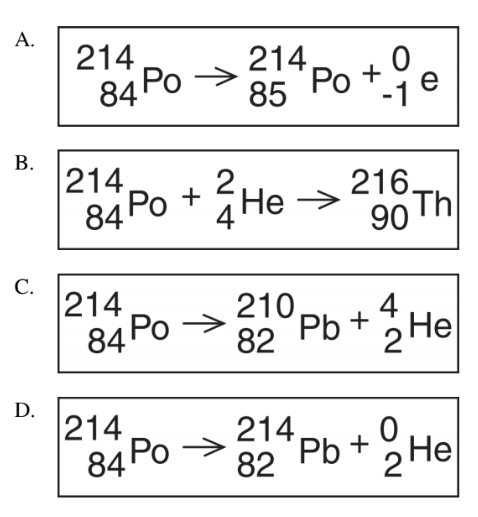
Which equation correctly represents the alpha decay of polonium-214?
A
B
C
D
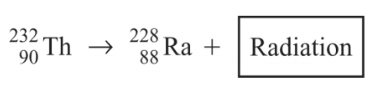
This equation shows the radioactive decay of thorium (Th). Which of the following particles is released in this reaction?
alpha
beta
neutron
gamma

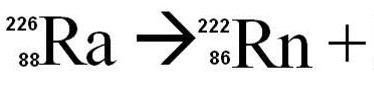
20985At = ___ + 42He
6027Co = ___ + 0-1e
94Be + 11H → _____ + 42He

Complete the nuclear reaction
42He
0-1 e
00Y
178O
What does the 4 in He-4 represent?
the mass number
the atomic number
the number of protons
the number of neutrons
Np-239 emits a beta particle. What element is the other product?
Th-239
U-239
Pu-239
Pu-238
The spontaneous disintegration of a nucleus into a slightly lighter and more stable nucleus, accompanied by emission of particles, electromagnetic radiation, or both, is
nuclear fusion
nuclear fission
radioactive decay
nuclear decay
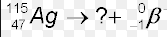
In the symbol 20682Pb what does 82 stand for?
Mass number
Atomic number
Atomic mass
Number of protons

What is false of the penetrance of different types of radiation?
Alpha blocked by paper
Beta blocked by aluminum
Beta blocked by paper
Gamma blocked by lead

