
 Worksheets
Cells Review Game
Total questions: 64
Worksheet time: 1hrs 6mins
Name
Class
Date
1.
surrounds the cell; regulates what enters/leaves cell; maintains homeostasis
a)
vacuole
b)
cell wall
c)
cell membrane
d)
lysosome
2.
control the cell's activities; contains the cell's DNA
a)
mitochondria
b)
cell membrane
c)
nucleus
d)
golgi body
3.
breaks down glucose to release energy for the cell
a)
nucleus
b)
lysosomes
c)
mitochondria
d)
vacuole
4.
What is the cell organelle that stores water, food and waste called?
a)
The cytoplasm
b)
The lysosomes
c)
The vacuole
d)
The mitochondria
5.
What is the main
difference between prokaryotic and eukaryotic cells?
a)
Prokaryotic cells have a nucleus and Eukaryotic cells do not
b)
Prokaryotic cells are unicellular and Eukaryotic cells are multicellular.
c)
Prokaryotic cells do not have a nucleus, Eukaryotic cells do have a nucleus.
d)
Prokaryotic cells are plant cells and Eukaryotic cells are animal cells.
6.
The main function of chloroplasts is:
a)
To control what enters and leaves the cell.
b)
To break down food to release energy for the cell.
c)
To control all activities of the cell.
d)
To produce food for the cell using the sun's energy.
7.
The cytoplasm
a)
Is the gel-like fluid that holds other organelles in place.
b)
Breaks down food to produce energy for the cell.
c)
Is known as the "brain" of the cell.
d)
Is where photosynthesis takes place.
8.
Which statement is NOT part of the Cell Theory?
a)
Only animals are made of cells.
b)
Cells are the basic unit of structure and function in all living things.
c)
All living things are made of cells.
d)
New cells come from existing cells.
9.
Identify which of these is NOT a major difference between plant and animal cells.
a)
Only plant cells have a cell wall.
b)
Only animal cells have mitochondria.
c)
Animal cells do NOT contain chloroplasts.
d)
Plant cells have a large central vacuole.
10.
Ribosomes are the cell organelle that
a)
Break down food to produce energy for the cell.
b)
Produce proteins for the cell.
c)
Break down broken cell parts.
d)
Make food for the cell using the sun's energy.
11.
Which types of organisms are Prokaryotes?
a)
Animals
b)
Plants
c)
Fungi
d)
Bacteria
12.

Using this image, what organelle is D?
a)
Endoplasmic Reticulum
b)
Flagella
c)
Rough ER
d)
Smooth ER
13.
Using this image, what organelle is G?
a)
Vacuole
b)
Flagella
c)
Rough ER
d)
Nucleus
14.

Using this image, what organelle is N?
a)
Centrioles
b)
Cell Membrane
c)
Golgi Apparatus
d)
Ribosome
15.

Using this image, what organelle is C?
a)
Cell Wall
b)
Mitochondria
c)
Large Cell Vacuole
d)
Chloroplast
16.
Using this image, what organelle is G?
a)
Cell Wall
b)
Mitochondria
c)
Vacuole
d)
Chloroplast
17.
Using this image, what organelle is E?
a)
Cell Wall
b)
Nucleus
c)
Vacuole
d)
Chloroplast
18.

What is the difference between rough and smooth ER?
a)
There is no difference.
b)
Plants have rough ER, animals have smooth ER.
c)
What type of injuries the Doctors treat.
d)
Rough has ribosomes, smooth does not.
19.
What is the correct order of organization
a)
tissues-cells-organs-organ systems-organism
b)
cell-tissue-organs-organ systems-organism
c)
organism-cells-tissues-organ systems-organism
d)
tissues-cells-organs-organ sytems-organism
20.
Which cell type contains organelles that do different jobs?
a)
prokaryotic cells
b)
eukaryotic cells
c)
both
d)
neither
21.
My job is to package proteins for transport throughout the cell.
a)
ribosome
b)
Golgi complex
c)
endoplasmic reticulum
d)
nucleus
22.
Which of the following pairs INCORRECTLY matches a cell structure with its function?
a)
cell membrane: protein synthesis
b)
nucleus: information (DNA) storage
c)
vacuole: storage
d)
chloroplast: energy conversion
23.
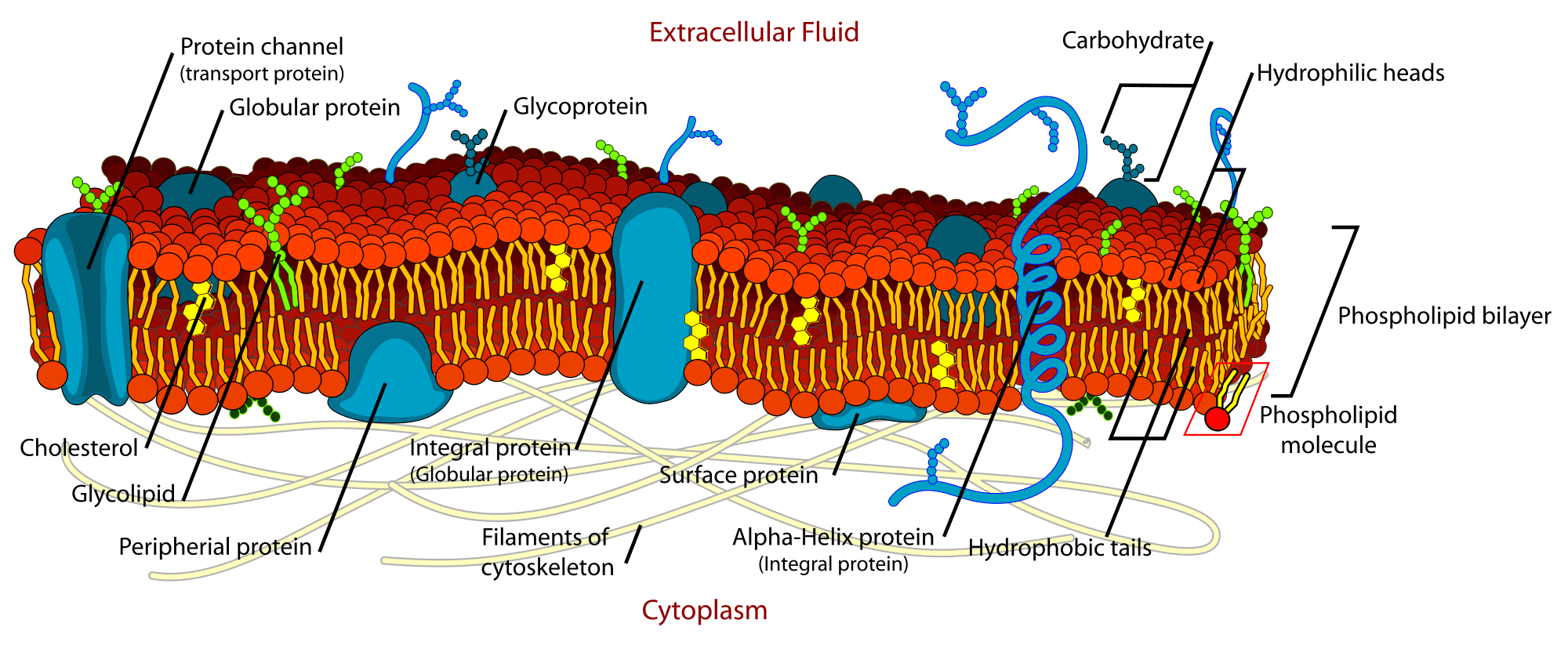
What is this image?
a)
cell membrane
b)
proteins
c)
carbohydrates
d)
lipids
24.
The function of the plasma membrane is....
a)
to regulate what enters and leaves the cell.
b)
fight bacteria and viruses that enter the cell.
c)
provide rigid support and protection to the cell.
d)
make sure each cell can move
25.
What is NOT TRUE about the cell membrane
a)
It controls what enters and leaves the cell
b)
Semipermeable
c)
Phospholipid bilayer
d)
Contains digestive enzymes
26.
Most of the cell membrane is made of...
a)
Lipids
b)
Carbohydrates
c)
Proteins
d)
Nucleic acids
27.
What is embedded in the phospholipid bilayer?
a)
proteins
b)
salt
c)
water
d)
trapped animals
28.
Osmosis is the movement of _____ across a membrane.
a)
food
b)
energy
c)
oxygen
d)
water
29.
Which is true about active transport?
a)
It requires energy
b)
it does not require energy
c)
It moves substances down the concentration gradient
d)
it moves material from high to low concentration
30.

This picture represents which type of cellular transport?
a)
passive transport
b)
endocytosis
c)
exocytosis
d)
osmosis
31.
Food is moved into the cell by ________________________.
a)
endocytosis
b)
pinocytosis
c)
exocytosis
d)
osmosis
32.

The cell below is in a _________ solution.
a)
Hypotonic
b)
Hypertonic
c)
Isotonic
33.

The cell below is in a _____________ solution.
a)
Hypertonic
b)
Hypotonic
c)
Isotonic
34.
A cell in a hypotonic solution will
a)
swell
b)
shrink
c)
stay the same size
d)
impossible to tell
35.
A cell in an isotonic solution will
a)
swell
b)
shrink
c)
stay the same size
d)
impossible to tell
36.

What type of transport is this?
a)
facilitated diffusion
b)
active transport
c)
diffusion
d)
osmosis
37.
What are two types of passive transport?
a)
endo and exocytosis
b)
cookies and milk
c)
active and passive
d)
Osmosis and diffusion
38.
In what direction do particles naturally diffuse?
a)
Up the concentration gradient
b)
Down the concentration gradient
c)
Across the concentration gradient
d)
Over the river and through the woods
39.

Special proteins help move particles, but NO energy is needed. This is..
a)
facilitated diffusion
b)
exocytosis
c)
active transport
d)
equilibrium
40.
Spraying Axe body spray in a corner of the room and someone on the opposite corner smells it is an example of what?
a)
Osmosis
b)
Facilitated diffusion
c)
Active transport
d)
Diffusion
41.
Active transport requires ______, moves materials from __________________, and goes _______ the concentration gradient.
a)
No energy, low to high, against
b)
ATP, high to low, with
c)
ATP, low to high, with
d)
ATP, low to high, against
42.

This picture represents what type of cell transport?
a)
endocytosis
b)
exocytosis
c)
osmosis
d)
passive transport
43.
if you put a plant in salt water it will ...
a)
swell because water diffuses into the cells
b)
swell because water diffuses out of the cell
c)
shrivel because water diffuses out of the cell
44.

Which part is made of Protein...
a)
A
b)
B
c)
C
d)
D
45.
I’m the “brain" of the cell or so they say. I regulate activities from day-to-day. Who am I?
a)
cell wall
b)
lysosome
c)
nucleus
d)
ribosome
46.

Which organelle is like the recycler for the cell?
a)
Mitochondria
b)
Golgi Aparatus
c)
Endoplasmic Reticulum
d)
Lysosome
47.

Which organelle is like a protective wall for the cell?
a)
Plasma Membrane
b)
Nucleus
c)
Cell wall
d)
Mitochondria
48.

Which organelle is like a solar panel for plant cells?
a)
Chloroplast
b)
Mitochondria
c)
Ribosome
d)
Nucleus
49.

Which organelle is like the conveyer belt of the cell?
a)
Ribosome
b)
Mitochondria
c)
Endoplasmic Reticulum
d)
nucleus
50.

Which organelle is like scissors because it helps to divide the cell?
a)
Centrioles
b)
Mitochondria
c)
Golgi body
d)
Plasma Membrane
51.
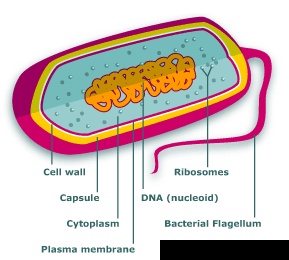
Which type of cell?
a)
Prokaryote
b)
Eukaryote
52.
Has membrane bound organelles
a)
Prokaryote
b)
Eukaryote
c)
both
53.
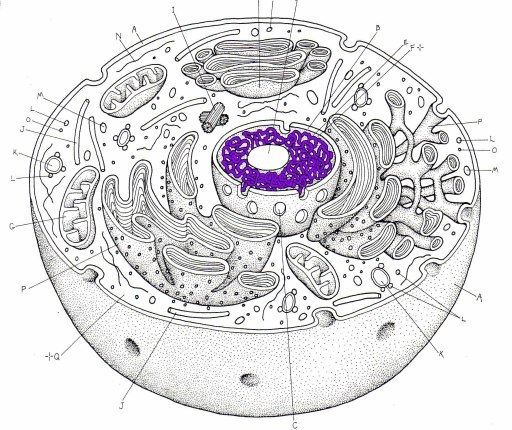
What kind of cell is this?
a)
Eukaryotic
b)
Prokaryotic
54.
Plants and animal cells are examples of ___ cells
a)
prokaryotic cells
b)
eukaryotic cells
55.
These cells have DNA surrounded by a nuclear membrane...
a)
Eukaryotic
b)
Prokaryotic
c)
Neither
d)
Both prokaryotic and eukaryotic
56.
Prokaryote are?
a)
simple, mostly single-celled organism that lacks a nucleus, or any other membrane-bound organelle.
b)
have a peptidoglycan cell wall and many have polysaccharide capsules.
c)
have a true nucleus, which means the cell's DNA is surrounded by a membrane.
d)
contain membrane-bound organelles, such as the nucleus
57.
Which organelle belongs in plant cells only?
a)
Cell Membrane
b)
Mitochondrion
c)
Chloroplast
d)
Nucleus
58.
Which organelle belongs in plant cells only?
a)
Cytoplasm
b)
Mitochondrion
c)
Cell Wall
d)
Nucleus
59.
Which organelle belongs in both plant and animal cells?
a)
Chloroplast
b)
Mitochondrion
c)
Large Central Vacuole
d)
Cell Wall
60.
Which organelle belongs in both plant and animal cells?
a)
Chloroplast
b)
Cell Wall
c)
Large Central Vacuole
d)
Nucleus
61.
Which of the following is a correct list of structures found in both plant AND animal cells?
a)
mitochondria, vacuole, nucleus, cell membrane, cytoplasm
b)
mitochondria, vacuole, nucleus, cell membrane, cytoplasm, cell wall, chloroplasts
c)
mitochondria, vacuole, nucleus, cell membrane, cell wall, chloroplasts
d)
mitochondria, vacuole, nucleus, cell membrane, cell wall
62.

Which would be found in the cell of a sunflower plant but not in the cell of a chicken?
a)
cell wall
b)
vacuole
c)
mitochondria
d)
cell membrane
63.
What is the smallest unit of life that can carry out all life functions?
a)
the nucleus
b)
the vacuole
c)
the mitochondria
d)
the cell
64.
Cell structures that perform specific functions are called
a)
tissues
b)
organs
c)
organelles
d)
organ systems
100 %

