wayground logo

Free Printable Worksheets

NEW

Font size

S
M
L
XL
Worksheets

Case 21 Review: 1st Benchmark

Total questions: 51

Worksheet time: 40mins

Name
Class
Date
1.
Green plants produce their own food through the process of photosynthesis.
a)
All living things use energy
b)
All living things contain cells
c)
All living things maintain homeostasis
d)
All living things grow
2.
A camel has eyelashes that work to keep the dust and sand out of its eyes.
a)
All living things adapt to their environment
b)
All living things grow
c)
All living things have cells
d)
All living things use energy
3.
Over three years, Tim's height has increased from 5'4" to 5'11".
a)
All living things contain cells
b)
All living things maintain homeostasis
c)
All living things use energy
d)
All living things grow
4.
Which scientist was the first to observe cells under a microscope? Hint: He looked at cork.
a)
Hooke
b)
Virchow
c)
Schwann
d)
Leeuwenhoek
5.
Who was the scientist who said that all cells come from cells?
a)
Hooke
b)
Schwann
c)
Virchow
d)
Leeuwenhoek
6.
Who was the scientist that concluded all plants are made of cells?
a)
Scheiden
b)
Schwann
c)
Leeuwenhoek
d)
Virchow
7.
Who was the scientist that concluded all animals are made of cells?
a)
Scheiden
b)
Schwann
c)
Leeuwenhoek
d)
Virchow
8.

This scientist was the first to use the term "cell" to describe the microscopic structures he observed in cork tissue. He also made many observations of insects with the microscope.

a)

Antonie Van Leeuwenhoek

b)

Robert Brown

c)

Robert Hooke

d)

Theodor Schwann

9.
The ___________ is the basic unit of life
a)
organ
b)
cell
c)
atom
d)
tissue
10.
A group of tissues that perform a similar function is called_____. (Examples include the heart, lungs or stomach)
a)
cells
b)
tissues
c)
organs
d)
organ system
11.
What is the correct order of organization
a)
tissues-cells-organs-organ systems-organism
b)
cell-tissue-organs-organ systems-organism
c)
organism-cells-tissues-organ systems-organism
d)
tissues-cells-organs-organ sytems-organism
12.
A group of similar cells that come together to perform a specific function is a/an
a)
organ
b)
organism
c)
organ system
d)
tissue
13.
What do viruses need to reproduce?
a)
they need genetic material
b)
They need a host cell
c)
They need  bacteria
d)
They need insulin
14.

Which characteristic does bacteria and viruses have in common?

a)

no membrane bound organelles

b)

nonliving

c)

reproduce on their own

d)

use energy

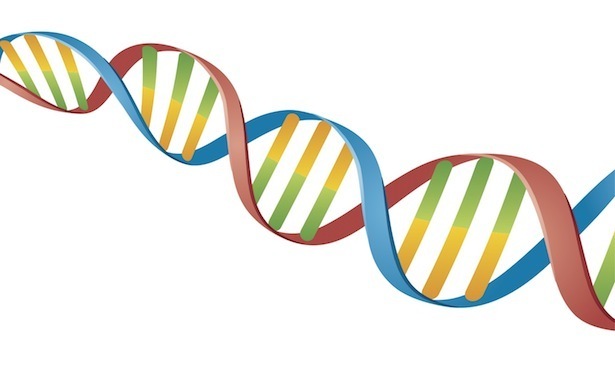
15.
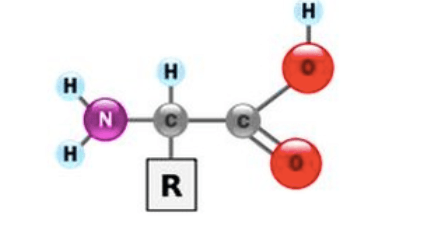
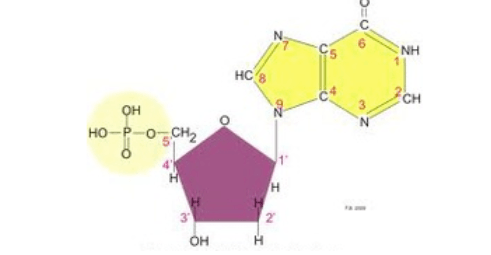
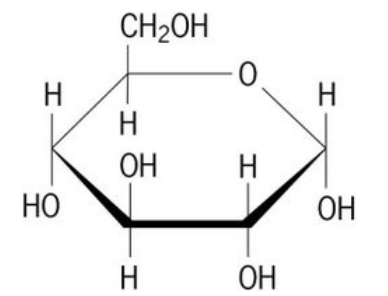
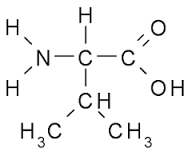
Which biomolecule is this a picture of?
a)
Protein
b)
Nucleic Acid
c)
Lipid
d)
Carbohydrate
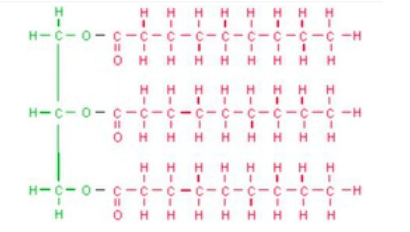
16.
Which biomolecule is this a picture of?
a)
Protein
b)
Nucleic Acid
c)
Lipid
d)
Carbohydrate
17.
Which biomolecule is this a picture of?
a)
Protein
b)
Nucleic Acid
c)
Lipid
d)
Carbohydrate
18.
Which biomolecule is also known as enzymes?
a)
Carbohydrate
b)
Lipid
c)
Nucleic Acid
d)
Protein
19.
Which biomolecule contain your genetics?
a)
Carbohydrate
b)
Lipid
c)
Nucleic Acid
d)
Protein
20.
The process that builds molecules by removing water to bind them together is
a)
Hydrolysis
b)
Protein Synthesis
c)
Dehydration Synthesis
d)
Lysis
21.
The chemical reaction that breaks down a molecule by adding water is
a)
Dehydration Synthesis
b)
Hydrophobia
c)
Hydrolysis
d)
Dehydration
22.
Carbon, Hydrogen, Oxygen and Nitrogen are elements in what biomolecule?
a)
Carbohydrate
b)
Lipid
c)
Protein
d)
Nucleic acid
23.
What is the function of a nucleic acid?
a)
Stores genetic information
b)
Stores energy
c)
Quick source of energy
d)
Builds structures
24.
Which biomolecule is this a picture of?
a)
Protein
b)
Nucleic Acid
c)
Lipid
d)
Carbohydrate
25.

How do enzymes speed up chemical reaction?

a)

Increasing activation energy

b)

Decreasing activation energy

c)

Increasing deactivation energy

d)

Decreasing deactivation energy

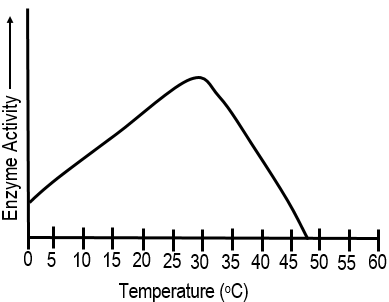
26.
Based on the graph, what is the optimal temperature for this enzyme? 
a)
15oC
b)
40oC
c)
30oC
d)
35oC
27.
What happens when enzymes are heated to a high temperature?
a)
The enzymes die.
b)
The shapes of the enzyme are altered or denatured
c)
The enzymes' amino acid sequence changes.
d)
The enzymes remain the same
28.
What is the function of the vacuole?
a)
Sac that stores water, nutrients, and waste products
b)
Sac filled with digestive chemicals
c)
Jelly-like substance within the plasma membrane
d)
stack of membranes that packages chemicals
29.
In plant cells, this structure captures energy from the sun to produce food.
a)
Ribosomes
b)
Cell Wall
c)
Vacuoles
d)
Chloroplasts
30.
This structure packages and distributes proteins throughout the cell. 
a)
Golgi Body
b)
Lysosome
c)
Ribosome
d)
Mitochondria
31.
This structure produces protein in the cell.
a)
Ribosomes
b)
Cytoplasm
c)
Nucleus
d)
Lysosomes
32.
This small structures break down materials in the cell.
a)
Cholorplasts
b)
Ribosomes
c)
Lysosomes
d)
Golgi Body
33.
This is the "powerhouse" of the cell that converts food to energy.
a)
Mitocondria
b)
Endoplasmic Reticulum
c)
Nucleus
d)
Lysosome
34.

Which type of cell is this?

a)

Prokaryote

b)

Eukaryote

35.
Larger
a)
Prokaryote
b)
Eukaryote
c)
Both
36.
Which is true of prokaryotic and eukaryotic cells?
a)
Prokaryotic cells are larger than eukaryotic cells.
b)
Eukaryotic cells do not have nuclei, and prokaryotic cells do have nuclei.
c)
Prokaryotic cells lack membrane-bound organelles, and eukaryotic cells contain membrane-bound organelles.
d)
Eukaryotic cells are simpler than prokaryotic cells.
37.
Why are viruses considered to be NON-LIVING?
a)
They are not cellular
b)
They cannot reproduce on their own
c)
They cannot make proteins
d)
all of the above
38.
Which of the following occurs after a virus attaches to a host cell in the viral reproduction process?
a)
The host cell DIES
b)
The virus DIES
c)
The virus INSERTS its genetic information into the host cell
d)
COPIES of the virus are immediately released from the host
39.

What is the difference between active and passive transport?

a)

Active transport requires energy, passive transport doesn't.

b)

Active transport molecules move across a cell membrane and passive transport doesn't.

c)

Active transport involves oxygen and water molecules, passive transport does not.

40.

What does it mean when substances move "down a concentration gradient?" Choose the best answer.

a)

They move from areas where there are few particles to areas where there are lots of particles.

b)

They move from areas with lots of water to areas with little water.

c)

They move from one side of the cell membrane to the other.

d)

They move from areas where there are a lot of particles to areas where there are few particles.
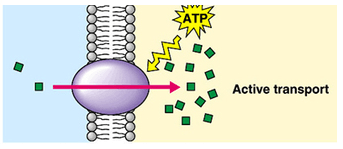
41.

Which type of transport is pictured?

a)

Passive Transport

b)

Active Transport

42.
Solutes move against the concentration gradient, therefore energy is needed
a)
Passive Transport
b)
Active Transport
43.
A cell in a hypotonic solution will
a)
swell
b)
shrink 
c)
stay the same size
d)
impossible to tell
44.
A cell in a hypertonic solution will
a)
Swell
b)
Shrink
c)
Stay the same size
d)
Impossible to tell
45.
The cell below is in a _________ solution.
a)
Hypotonic
b)
Hypertonic
c)
Isotonic
46.
The cell below is in a _____________ solution.
a)
Hypertonic
b)
Hypotonic
c)
Isotonic
47.
Osmosis is the ______
a)
When the smell of the neighbors trash moves through the neighborhood
b)
smell of cookies moving through the kitchen
c)
movement of water across a semi-permeable membrane
d)
movement of gases across a room
48.
When particles move out of a cell through facilitated diffusion, the cell ____________.
a)
gains energy
b)
uses energy
c)
releases energy
d)
does not use energy
49.
Which type of Passive Transport is being represented in this picture?
a)
Passive Diffusion
b)
Simple Diffusion
c)
Active Diffusion
d)
Facilitated Diffusion
50.
Which way will the water molecules move during osmosis?
a)
Out of the cell, so the cell shrinks.
b)
Out of the cell, so the cell swells.
c)
Into the cell, so the cell shrinks.
d)
Into the cell, so the cell swells.
51.
An animal cell placed in a hypertonic (salty) solution will
a)
Shrink
b)
Swell
c)
Stay the same