

Wayground logo

Free Printable Worksheets

Font size

S
M
L
XL
Worksheets

Photosynthesis and Cellular Respiration Review

Total questions: 48

Worksheet time: 42mins
Name
Class
Date
1.

Chlorophyll a absorbs a higher percentage of _____ light wavelengths.

a)

purple

b)

red

c)

blue

d)

yellow

2.
The reactants of photosynthesis are
a)
sugar and water.
b)
sugar and oxygen.
c)
carbon dioxide and water.
d)
carbon dioxide and oxygen.
3.
Which of the following is the correct equation for PHOTOSYNTHESIS?
a)
6CO2 + 6H2O --> 6O2 + C6H12O6
b)
6CO2 + C6H12O6 + 6H2O --> O2 
c)
6O2 + 6H2O --> 6CO2 + C6H12O6
d)
C6H12O6 + 6O2 ---> 6H2O + 6CO2 
4.

Where do the light-dependent reactions occur? 

a)
thylakoid membrane
b)
stroma
c)
mesophyll
d)
mitochondria
5.
Which of the following is NOT a product of the light-dependent reactions?
a)
ATP
b)
Oxygen
c)
Glucose
6.
What is the primary function of the light-dependent reactions of photosynthesis?
a)
To produce glucose
b)
To produce NADPH and ATP
c)
To use ATP
d)
To produce RuBP
7.
How many sugar molecules are produced from every six molecules of carbon dioxide that enter the Calvin cycle?
a)
1
b)
3
c)
6
d)
12
8.

Which pigments absorb green and blue light but reflect orange and red light?

a)
Carotenoids
b)
Chlorophylls
c)

Xanthophylls

d)

Anthocyanins

9.
Which of the following is considered a waste product of photosynthesis?
a)
glucose
b)
oxygen
c)
carbon dioxide
d)
sunlight
10.
What is the purpose of photosynthesis?
a)
make glucose
b)
make ATP
c)
make light
d)
release carbon dioxide
11.

What type of organisms use photosynthesis?

a)
plants
b)
bacteria
c)

algae

d)
both plants and bacteria
e)

all of the above

12.
Why is photosynthesis an essential process for life?
a)
It creates oxygen for animals to breathe
b)
Most food chains and food web depend on it
c)
It creates glucose for plants to use as energy
d)
All of these are correct
13.

The Calvin Cycle takes place in the:

a)

Stroma

b)

Thylakoid

c)

Grana

d)

Stomata

14.

In CAM plants, light independent reactions occurs during the:

a)

Day

b)

Night

15.

Where does the electron transport chain of photosynthesis occur?

a)

Plasma Membrane

b)

Mitochondrial Membrane

c)

Chloroplast Membrane

d)

Thylakoid Membrane

16.

Which color in the electromagnetic spectrum is absorbed the least by chlorophyll?

a)

Red

b)

yellow

c)

Green

d)

Blue

17.

Which type of plant is most efficient in hot weather?

a)

C4

b)

C3

c)

CAM

d)

C2

18.
The mitochondria is responsible for ...
a)
photosynthesis
b)
anaerobic respiration
c)
aerobic respiration
d)
fermentation
19.
Aerobic respiration is different from anaerobic respiration in that aerobic respiration needs...
a)
chlorophyll
b)
carbon dioxide
c)
glucose
d)
oxygen
20.

______________ produces the most ATP.

a)

photosynthesis

b)

aerobic respiration

c)

anaerobic respiration

d)

glycolysis

21.
How many ATP are produced in aerobic respiration?
a)
2
b)
33
c)
4
d)
36
22.
How many ATP are produced in Alcoholic respiration?
a)
2
b)
33
c)
4
d)
36
e)

0

23.
What is the correct equation for cellular respiration?
a)
6O2 + C6H12O6 -> 6CO2 + 6H2O + Energy
b)
6O2 + C6H12O6 + Energy -> 6CO2 + 6H2O
c)
6CO2 + 6H2O -> 6O2 + C6H12O6 + Energy
d)
6CO2 + 6H2O + Energy -> 6O2 + C6H12O6
24.
What is cellular respiration?
a)
the breakdown of glucose  to release ATP
b)
the breakdown of glucose to release NADH
c)
the breakdown of glucose to release FADH
d)
the breakdown of glucose to release carbon
25.
Where does anaerobic respiration occur?
a)
glucose molecule
b)
mitochondria
c)
cytoplasm
26.

In addition to ATP, what is produced during glycolysis?

a)

Pyruvate

b)

CO2 and H2O

c)

CO2 and ethyl alcohol

d)

CO2 and NADH

27.

Glucose is converted into pyruvate during which process?

a)

Calvin Cycle

b)

Krebs Cycle

c)

Glycolysis

d)

Photolysis

28.
What is the Krebs Cycle also called?
a)
Dark reaction
b)
ETC
c)
Oxidative reaction
d)
Citric acid cycle
29.

What is pyruvate converted into before entering the Krebs cycle?

a)

Glucose

b)

Electrons

c)

Acetyl CoA

d)

Citric acid

30.
Where does the energy created in the Krebs cycle go?
a)
cytoplasm
b)
mitochondrial matrix
c)
ETC
d)
stroma
31.
What are the products of the ETC?
a)
ATP and NADPH
b)
Glucose and oxygen
c)
Co2 and water
d)
water and ATP
32.
Which type of fermentation occurs in muscles?
a)
Alcoholic 
b)
Lactic acid
33.

What is the name of the process that helps make cider and soy sauce?

a)
Fermentation
b)
Alcoholic fermentation
c)
Lactic acid fermentation
d)
Glycolysis
34.
This process does not make ATP alone, but it allows glycolysis to continue making ATP when oxygen is unavailable for cellular respiration.
a)
Fermentation
b)
Electron Transport Chain
c)
Glycolysis
d)
Kreb's cycle
35.
Because fermentation takes place in the absence of oxygen, it is said to be
a)
aerobic
b)
anaerobic
c)
cyclic
d)
oxygen-rich
36.
The process carried out by yeast that causes bread to rise is
a)
alcoholic fermentation
b)
lactic acid fermentation
c)
cellular respiration
d)
yeast mitosis
37.
Bread is a product of fermentation that contains bubbles. These bubbles come from:
a)
Carbon Dioxide
b)
Lactic Acid 
c)
Oxygen
d)
Water
38.
What is a disadvantage of fermentation as a process? 
a)
It produces too much ATP
b)
It only produces 2 ATP
c)
It occurs in the absence of oxygen
d)
It is only for quick bursts of energy
39.
How are lactic acid and alcoholic fermentation similar?
a)
They have the same products
b)
They have the same reactants
c)
They both require oxygen
d)
They occur in the same organisms
40.

Which chemical is the end result of the Krebs Cycle, in addition to NADH and 2 ATP?

a)
citric acid
b)
oxaloacetic acid
c)

pyruvate

d)
Acetyl CoA
41.
Which pathway is common to both fermentation and cellular respiration? 
a)
Krebs cycle
b)
ETC
c)
glycolysis
d)
formation of Acetyl CoA
42.
Which of the following is NOT made by fermentation
a)
Sauerkraut
b)
Bread
c)
Olive oil
d)
Yogurt
43.

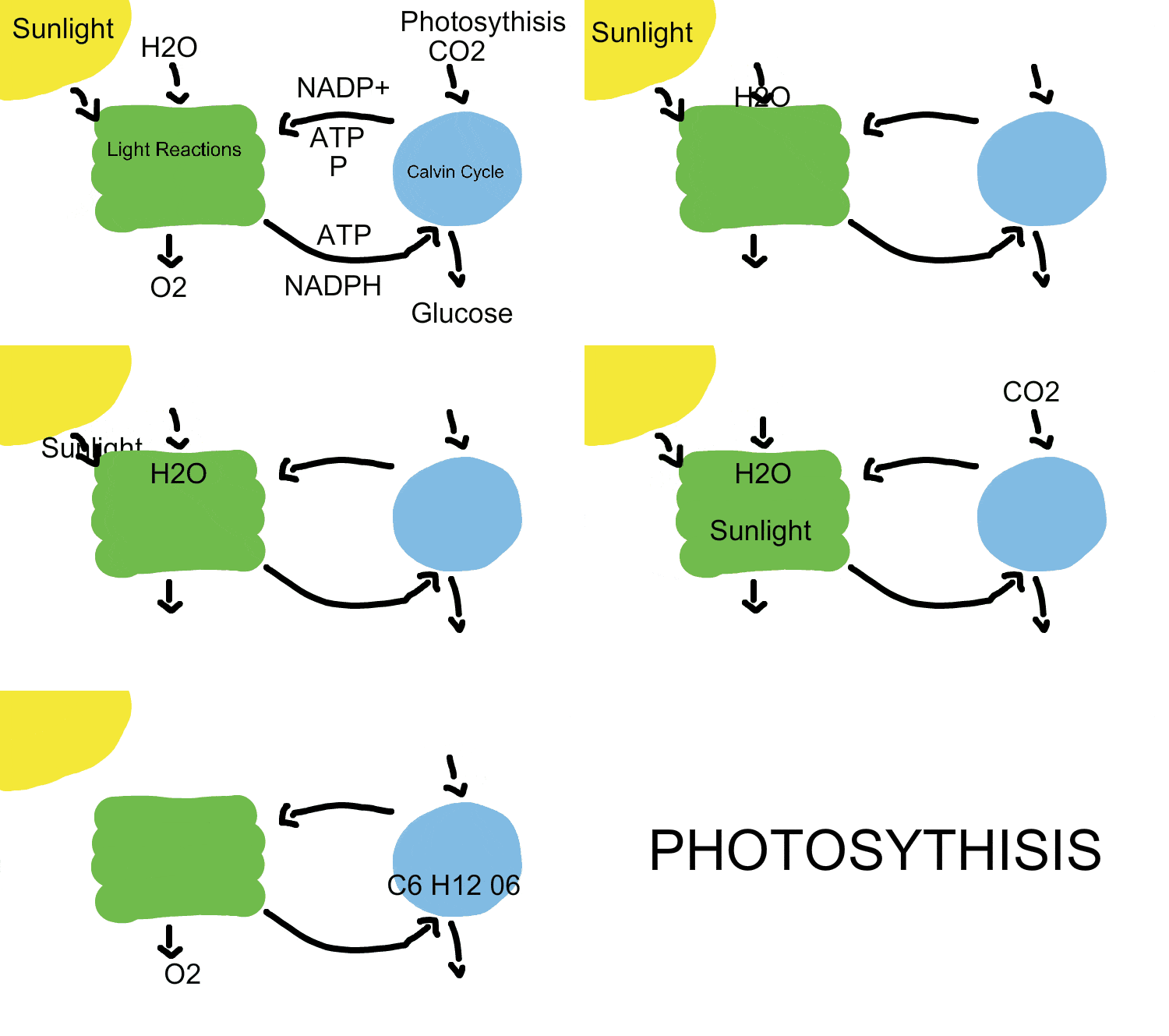
Label the diagram

44.

Label the following chart of AEROBIC and ANAEROBIC cell respiration

45.

Glycolysis takes place in the ​ (a)   .

Choose from the below words
cytoplasm
mitochondria
46.

Identify the colors that each pigment absorbs

a)

1.

Xanthophyll

b)

2.

Chlorophyll b

c)

3.

Chlorophyll a

d)

4.

Carotenoids

e)

5.

Anthocyanin

47.

Identify the parts of the chloroplast

48.

Plants in humid environment...

a)

use C3 pathways

b)

use C4 pathways

c)

use CAM pathways

d)

open stomata at night

e)

partially open stomata during the day
