wayground logo

Free Printable Worksheets

Font size

S
M
L
XL
Worksheets

Unit 2 Review: Heat, Temperature, & Energy

Total questions: 93

Worksheet time: 2hrs 23mins

Name
Class
Date
1.
Under which conditions of temperature and pressure does a real gas behave most like an ideal gas? 
a)
137 K and 1 atm
b)
347 K and 1 atm
c)
37 K and 8 atm
d)
347 K and 8 atm
2.
The temperature of a sample of matter is a measure of the
a)
average potential energy of the particles of the sample
b)
average kinetic energy of the particles of the sample
c)
total nuclear energy of the sample
d)
total thermal energy of the sample
3.
Which group on the Periodic Table has at least one element in each of the three phases of matter at STP? 
a)
1
b)
2
c)
17
d)
18
4.
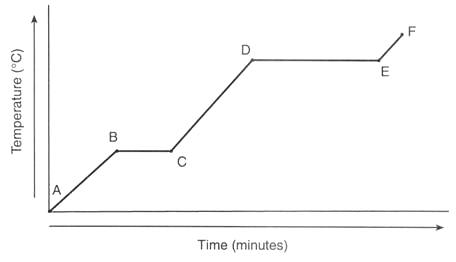
A sample of a substance is a liquid at 65°C. The sample is heated uniformly to 125°C. The heating curve for the sample at standard pressure is shown below.
Determine the boiling point of the sample at standard pressure
a)
95°C
b)
125°C
c)
100°C
d)
65°C
5.
State what happens to the potential energy of the particles of the sample during time interval BC.
a)
Increases
b)
Decreases
c)
Stays the same
6.
Which physical change is endothermic? 
a)
 CO2(s) → CO2(g)
b)
CO2(g) → CO2(ℓ)
c)
CO2(ℓ) → CO2(s)
d)
CO2(g) → CO2(s)
7.
What is the state of matter that has a definite volume but no definite shape
a)
solid
b)
liquid
c)
plasma
d)
gas
8.
 _?_  is the amount of energy required to raise the temperature of 1 gram of any substance 1oC.
a)
Specific heat
b)
A calorie
c)
Thermal energy
d)
Conduction
9.
What is boiling water in Celsius?
a)
212
b)
112
c)
100
d)
50
10.
The symbol for specific heat is .......
a)
c
b)
Q
c)
m
d)
t
11.
20 g of water. specific heat of water is 4.18 J/x°C.  temperature changes from 25° C to 20° Chow much heat energy (Q) moves from the water to the surroundings?
a)
418 Joules
b)
209 J
c)
83 J
d)
4.18 J
12.
Using the heat equation, what would the formula look like if we were solving for change in temperature?
a)
Q m=∆T c
b)
Q/mc= ∆T
c)
Qm/c=∆T
d)
mcQ=∆T
13.
A reaction is performed in a beaker with a temperature probe recording the temperature changes of the reaction.  If the temperature began at 15.0 degrees Celsius and ended at 27.5 degrees Celsius.  If the reaction is our system, is the system endothermic or exothermic?
a)
Exothermic
b)
Endothermic
14.
What would be the effect on the particles if more heat is supplied to the system?
a)
They would slow down
b)
They would stop moving
c)
They would speed up
d)
There would be no effect
15.
Calculate the heat needed to raise the temperature of 0.25 kg of aluminum 7°C (c=900 J/kg°C)
a)
1575 J
b)
-1575 J
c)
514 J
d)
-514 J
16.
For an exothermic reaction, the heat is on the ____ side
a)
reactant
b)
product
c)
either side
17.
If 300 g of Iron absorbs 15 kJ of heat, calculate the change in temperature of the iron sample. Specific heat of Iron is 0.5 J/g⋅⁰C.
a)
10⁰C
b)
-10⁰C
c)
20⁰C
d)
-20⁰C
18.
Object X has a specific heat of 2.45 J/g⁰C and object Z has a specific heat of 5.82 J/g⁰C. Which object will heat up slower?
a)
Object X, it has a lower spefici heat
b)
Object Z, it has a lower specific heat
c)
Object X, it has a higher specific heat
d)
Object Z, it has a higher specific heat
19.
What is temperature a measure of?
a)
total kinetic energy in a substance
b)
total energy in a substance
c)
average molecular kinetic energy in a substance.
d)
average energy in a substance.
20.
Which has a higher specific heat capacity, water or sand?
a)
Sand
b)
Water
c)
They both have the same specific heat capacity.
21.
The faster molecules move, 
a)
the higher the temperature
b)
the less temperature
c)
the same temperature
d)
I don't know
22.
Calculate the heat absorbed by 105.0 grams of water when it is heated to cook spaghetti. The initial temperature of the water is 20.0°C, and the final temperature of the water is 99.0°C. The specific heat of water is 4.18 J/g•°C.
a)
8778 J/g°C
b)
0.0005 J/g°C
c)
34673 J/g°C
d)
43451.1 J/g°C
23.
The temperature of an unknown piece of metal with a mass of 30.00 g changes from 25.0 °C to 35.0 °C when the metal absorbs 350.0 J of energy. What is the specific heat of the metal?
a)
1.17 J/g°C
b)
-1.17 J/g°C
c)
0.857 J/g°C
d)
-0.857 J/g°C
24.
Which of the following terms identifies the change from a liquid to gas?
a)
Vaporization
b)
Condensation
c)
Deposition
d)
Sublimation
25.
No Definite Shape and No Definite Volume
a)
Gas
b)
Liquid
c)
Solid
26.
As the temperature of a gas rises its volume ____________.
a)
stays the same
b)
increases
c)
decreases
27.
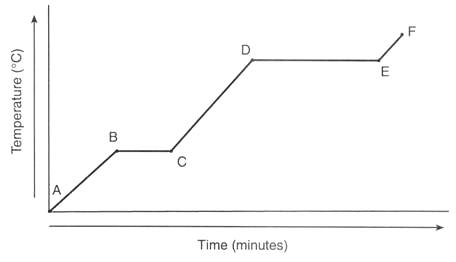
Describe the substance between letters D and E. 
a)
Gas
b)
Liquid
c)
Melting
d)
Evaporating
28.
Between which points is the temperature of the substance remaining constant?
a)
A-B only. 
b)
A-B, C-D, E-F
c)
B-C only. 
d)
B-C, D-E
29.
How many states of matter are present during line segment AB?
a)
One
b)
Two
c)
Three
d)
Depends on the temperature
30.
This type of graph is called a:
a)
Phase diagram
b)
Heating curve
c)
State of matter
d)
Temperature chart
31.
Which phase of matter is represented by the atoms in this diagram? 
a)
solid
b)
liquid
c)
gas
32.
What phase change is represented by the dry ice in this picture?
a)
evaporation
b)
condensation
c)
sublimation
d)
melting
33.
What two phase changes require heat energy to be absorbed?  
a)
melting and freezing
b)
melting and boiling
c)
freezing and boiling
d)
freezing and condensation
34.
What section of the phase change graph would you find a liquid being heated?
a)
A-B
b)
B-C
c)
C-D
d)
D-E
35.
What section of the phase change graph would you find a gas being heated?
a)
A-B
b)
C-D
c)
D-E
d)
E-F
36.
What happens to the temperature while a substance is changing phase? 
a)
increases
b)
decreases
c)
stays the same
37.

25 degrees Celsius is ___________ K

a)

-248

b)

298

c)

125

d)

-125

38.

In order to convert degrees Celsius to Kelvin you should _______

a)

add 273

b)

subtract 273

c)

multiply by 1.8 and add 23

d)

add 100

39.

100 Kelvin is ________ degrees Celsius

a)

373

b)

0

c)

-173

d)

200

40.

In Celsius, the freezing point of water is ___ and the boiling point is ___.

a)

32, 100

b)

32, 212

c)

273, 373

d)

0, 100

41.

In Kelvin, the freezing point of water is ___ and the boiling point is ___.

a)

32, 100

b)

32, 212

c)

273, 373

d)

0, 100

42.

Which curve would show atoms at the highest temperature?

a)

Purple

b)

Teal

c)

Yellow

d)

Blue

43.
At what temperature do nitrogen molecules move fastest?
a)
350 K
b)
300 K
c)
250 K
d)
200 K
44.
Gas molecules can easily be compressed  because ___________. 
a)
gas molecules are soft
b)
gas molecules are far apart
c)
gas molecules follow the shape of the container
45.
The molecules of a gas are in constant and random motion.
a)
TRUE
b)
FALSE
c)
DEPENDS UPON THE KIND OF MOLECULE
46.
If two objects have different temperatures, heat will flow from the warmer object to the cooler one UNTIL ____________
a)
one reaches a temperature of zero
b)
they both have an equal temperature
c)
one runs out of energy
47.

For a skillet, used for cooking, do you want a high or low specific heat

a)

High, so that it will need more energy to heat up

b)

Low, so that it will change temperature quickly

48.
The SI unit of heat and energy is the __________.
a)
calorie
b)
heat
c)
joule
d)
watt
49.
If I have 2 blocks of Aluminium (one of 1kg and one of 10 kg) and heat them up.
Which one heats up the fastest.
a)
1 kg
b)
10 kg
c)
They both heat up at the same speed
d)
They don't heat up.
50.
What does "ΔH" mean? 
a)
A change in health
b)
A change in heat
c)
A change in height
d)
A change in temperature
51.

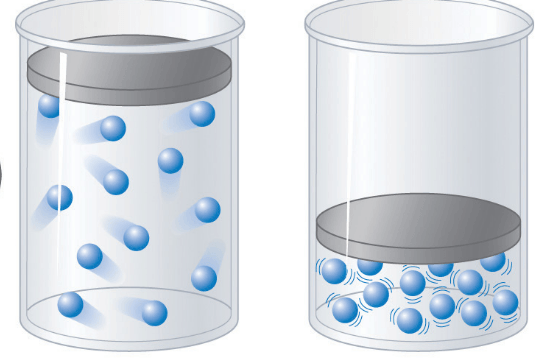
Observe the diagram. Which statement is true about the kinetic energy of the molecules in the containers?

a)

The molecules are moving faster in Diagram A

b)

The molecules are moving slower in Diagram A

c)

The molecules are moving at the same rate in both diagrams

52.
_________________________ is a measure of the average kinetic energy of the particles in a material.
a)
thermal
b)
friction
c)
temperature
d)
expansion
53.
According to Boyle's Law, pressure and volume are inversely related which means that
a)
When pressure increases, volume increases
b)
When pressure decreases, volume decreases
c)
When pressure increases, volume decreases
d)
When pressure doubles, volume triples
54.
According to Charles Law, volume and temperature are directly related. This means that
a)
When volume increases, temperature increases
b)
When volume increases, temperature decreases
c)
When volume double, pressure triples
d)
When volume doubles, volume is reduced by 1/2
55.
If 22.5L of nitrogen at 0.98 atm is compressed to 0.95 atm, what is the new volume?
a)
23.2L
b)
21.8L
c)
24.2L
d)
20.6L
56.
If 6L of gas at 293K is compressed to 4L, what is the new temperature? 
a)
195K
b)
439.5K
c)
0.082K
d)
12.2K
57.
If 15L of neon at 300K and 3 atm is allowed to heat to 350K, what is the new pressure, assuming volume stays constant?
a)
3.5 atm
b)
2.6 atm
c)
16.7 atm
d)
0.86 atm
58.
When heat is added to a sample of gas sealed in a container, which of the following will most likely happen?
a)
The temperature of gas will increase because the gas molecules will move much more slowly.
b)
The temperature of gas will decrease because the gas molecules will move faster
c)
The temperature of gas will increase because the gas molecules will move faster. 
d)
Temperature of gas will decrease because the gas molecules will stop moving
59.
What is the variable for this number 22.4 L
a)
P
b)
T
c)
n
d)
V
60.
What is the variable for this number 32oC
a)
P
b)
T
c)
n
d)
V
61.
Gas laws involve what three variables?
a)
Solid Liquid Gas 
b)
Speed Velocity Acceleration 
c)
Elements Compounds Mixtures 
d)
Pressure Temperature Volume 
62.
What will happen to the volume of a gas if the pressure increases, with constant temperature ?
a)
Increase
b)
Decrease
c)
Nothing
d)
Explosion!
63.
What do you call a pig that knows Karate
a)
Piggly
b)
Porkchop
c)
Babe
d)
Porky
64.
Using Combined Gas Law, if the pressure of a gas starts out at 200kPa and increases to 600kPa, what would the initial temperature be if it ended up at 300K?
a)
50K
b)
200K
c)
400K
d)
100K
65.
If the specific heat of water is 4,186 J/kg∙°C, how much heat is required to increase the temperature of 1.2 kg of water from 23 °C to 39 °C? 
a)
-80,371.2 J
b)
44,938.6 J
c)
80,371.2 J
d)
112,575.9 K
66.
What would be the effect on the particles if more heat is supplied to the system?
a)
They would slow down
b)
They would stop moving
c)
They would speed up
d)
There would be no effect
67.
The specific heat(c) of copper is 0.39 J/g °C. What is the temperature change(∆t) when 100 Joules of heat(Q) is added to 20 grams?
a)
12.82 °C
b)
24.12°C
c)
351 °C
68.
You have 20 g of water with specific heat of 4.18 J/gŸ°C.  The temperature changes from 25° C to 20° C.  How much heat energy (Q) moves from the water to the surroundings?
a)
418 Joules
b)
209 J
c)
83 J
d)
4.18 J
69.
The temperature of an unknown piece of metal with a mass of 30.00 g changes from 25.0 °C to 35.0 °C when the metal absorbs 350.0 J of energy. What is the specific heat of the metal?
a)
1.17 J/g°C
b)
-1.17 J/g°C
c)
0.857 J/g°C
d)
-0.857 J/g°C
70.

What units should change in energy be in?

a)

Jules

b)

Juoles

c)

Jewels

d)

Joules

71.

Which example would be considered exothermic?

a)

Melting Ice

b)

Photosynthesis

c)

Making ice cubes

d)

Cooking an egg

72.

Which example would be considered endothermic?

a)

Baking bread

b)

Burning a candle

c)

Formation of snow in clouds

d)

Rusting iron

73.

Can a chemical reaction be both endothermic and exothermic?

a)

Yes

b)

No

74.

Which type of reaction has a positive heat flow?

a)

Endothermic

b)

Exothermic

c)

Neither

d)

Both Endo and Exo

75.

In an exothermic chemical reaction, where the reaction is considered to be ‘the system’

a)

Energy is transferred from the system to the surroundings and ΔHsystem is positive

b)

Energy is transferred from the system to the surroundings and ΔHsystem is negative

c)

Energy is transferred to the system from the surroundings and ΔHsystem is positive

d)

Energy is transferred to the system from the surroundings and ΔHsystem is negative

76.

Tin is a metal with a much smaller specific heat capacity than aluminum. If identical samples of tin and aluminum are exposed to identical amounts of energy, which of the following represents the most likely set of observations?

a)

The temperature change in each metal will be identical

b)

The temperature change of the tin will be greater than the temperature change of aluminum

c)

The temperature change of the aluminum will be greater than the temperature change of tin

d)

More information is required to predict the temperature change that will be observed in each metal sample

77.

Which of the following is associated with an increase in the energy of the surroundings?

a)

An exothermic system

b)

∆H = 0

c)

An increase in entrpy

d)

An endothermic system

78.
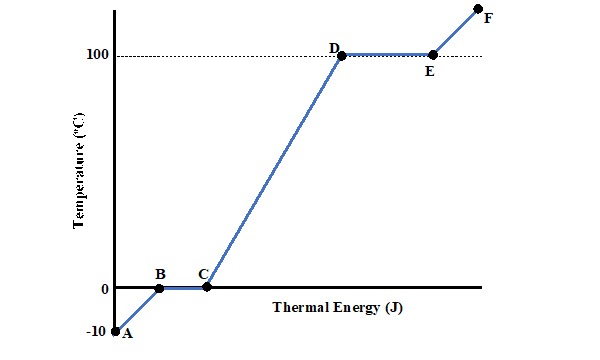
What line segment represents only the solid state?
a)
A-B
b)
B-C
c)
C-D
d)
D-E
79.
Between which points is the temperature of the substance remaining constant?
a)
A-B only. 
b)
A-B, C-D, E-F
c)
B-C only. 
d)
B-C, D-E
80.

Between which two points is Heat of Fusion?

a)

A <----> B

b)

B <----> C

c)

C <----> D

d)

D <----> E

e)

E <----> F

81.

Between which two points is Heat of Vaporization?

a)

A <----> B

b)

B <----> C

c)

C <----> D

d)

D <----> E

e)

E <----> F

82.
In which segment is the kinetic energy remaining constant?
a)
A-B
b)
B-C
c)
C-D
d)
E-F
83.
A substance's heating curve is shown in the graph.  What is its boiling point?
a)
100 C
b)
60 C
c)
80 C
d)
20 C
84.
The graph shows a cooling curve for an unknown substance.  What is happening during segment DE?
a)
boiling
b)
condensation
c)
freezing
d)
melting
85.

Which equation do you use to solve for the energy of segment D-E?

a)

q= mCΔT

b)

q= Hv*m

c)

PV=nRT

d)

q= Hf*m

86.

Which equation do you use to solve for segment B-C?

a)

q=mCΔT

b)

q= Hv*m

c)

q= Hf*m

d)

PV=nRT

87.

The energy of which segments can be found using the equation q=mCΔT?

a)

A-B, D-E, E-F

b)

B-C, D-E ,E-F

c)

B-C, C-D, E-F

d)

A-B, C-D, E-F

88.

Which equation do you use to solve for the energy of segment C-D?

a)

q=mCΔT

b)

q= Hv*m

c)

q= Hf*m

d)

PV=nRT

89.

Which equation would you use to solve the following: Calculate the heat necessary to change 10 g of ice(s) at 0°C to 10 g of water(l) at 0°C.

a)

q=mCΔT

b)

q= Hv*m

c)

q= Hf*m

d)

PV=nRT

90.

Which equation would you use to solve the following: Calculate the heat necessary to change 10 g of H2O(l) at 0 °C to 10 g of H2O(l) at 100°C.

a)

q=mCΔT

b)

q=Hv*m

c)

q= Hf*m

d)

PV=nRT

91.
In an endothermic reaction the system is releasing energy.
a)
True
b)
False
92.
Each of these flasks contains the same number of molecules. In which container is the pressure highest?
a)
Flask 1
b)
Flask 2
c)
Flask 3
d)
Flask 4
93.

Which container will have a lower pressure?

a)

left

b)

right

c)

they both have the same pressure