wayground logo

Free Printable Worksheets

Font size

S
M
L
XL
Worksheets

UNIT 4: Chemical Bonding & Nomenclature

Total questions: 55

Worksheet time: 56mins

Name
Class
Date
1.

Which of the following is NOT a property of ionic compounds?

a)

They conduct electricity when molten

b)

They conduct electricity when in solution

c)

They have high boiling points

d)

They are insoluble in water

2.
A(n) _________ is an ion with a positive (+) charge.
a)
anion
b)
cation
c)
ion
d)
solute
3.
Magnesium bromide is an ionic compound with the chemical formula MgBr₂.  What does the "2" tell you?
a)
There are 2 bromide ions for every magnesium ion
b)
Bromide has a 2- charge
c)
Bromide has a 2+ charge
d)
There are 2 magnesium ions to every bromide ion
4.
In the chemical formula for an ionic compound, which item is written first?
a)
positive ion
b)
negative ion
c)
subscript
d)
the female
5.
Elements in Group 1 lose one electron to form ions with a _________________ charge.
a)
1+
b)
2+
c)
0
d)
1-
6.
A charged particle that has gained at least one electron is called a(n) _____.
a)
Anion
b)
Cation
c)
Anonion
d)
chemistry cat
7.
What is the formula of Sodium oxide?
a)
Na2O
b)
NaO2
c)
Na2O2
d)
Na2O
8.
A Nitrogen molecule (N2) has one triple bond. How many electrons do the nitrogen atoms share?
a)
1
1
b)
3
c)
4
d)
6
9.
How do covalent bonds form?
a)
Donating & receiving valence e- between atoms.
b)
Opposite slight charges attract each other between compounds.
c)
Scientists are still not sure how they form.
d)
Sharing valence e- between atoms.
10.
Which of the following is NOT formed by a covalent bond?
a)
K2S
b)
H2O
c)
I2
d)
CO2
11.
What do we call a covalent bond where electrons are shared UNEVENLY or UNEQUALLY?
a)
Ionic
b)
Polar Covalent
c)
Nonpolar Covalent
d)
Van der Waals Force
12.

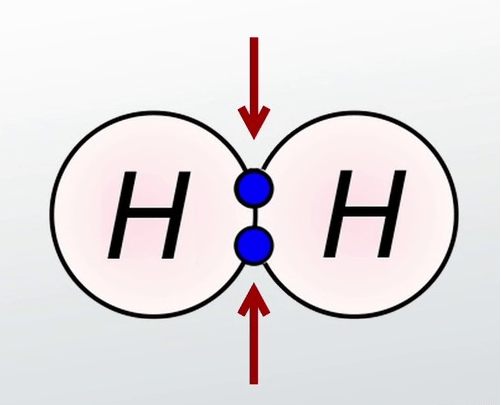
What type of bond is shown in this image?

a)

Ionic

b)

Polar Covalent

c)

Nonpolar Covalent

d)

London dispersion

13.
A mixture of two or more metals is called:
a)
mixture
b)
solution
c)
compound
d)
alloy
14.
What is the basis of a metallic bond?
a)
the attraction of neutral metal atoms.
b)
the attraction between protons and neutrons.
c)
the attraction between positive metal ions and interlocking electrons.
d)
the attraction between positive metal ions and free floating electrons.
15.
The name of Mg₃N₂ is
a)
manganese nitride
b)
magnesium nitride
c)
magnesium (III) nitride
d)
trimagnesium dinitride
16.
When adding a subscript to a polyatomic ion, you should...
a)
multiply any subscripts on the polyatomic ion by the subscript you are adding
b)
put parentheses around the polyatomic ion before adding a subscript
c)
write the new subscript next to any subscripts on the polyatomic ion
d)
put the polyatomic ion in square brackets before adding the subscript
17.

What is the correct formula for plumbic oxide?

a)

PbO

b)

Pb4O2

c)

PbO2

d)

Pb2O4

18.

What is the formula for calcium carbonate?

a)

Ca3CO2

b)

CaCO2

c)

CaCO3

d)

Ca2(CO3)2

19.

What is the FORMULA for ammonium sulfide?

a)

(NH4)2S

b)

NH4 S

c)

(NH4)2S4

d)

NH2S

20.

What is the formula for plumbous phosphate?

a)

Pb2(PO3)4

b)

Pb3(PO4)2

c)

Pb2PO4

d)

Pb3P

21.
The name of P₄S₁₀ is
a)
phosphorous sulfide
b)
phosphorus sulfide
c)
tetraphosphorus decasulfide
d)
phosphorus (X) sulfide
22.
The chemical formula of sulfur hexabromide is
a)
SBr₆
b)
S₆Br
c)
S(VI)Br
d)
S6Br
23.
What is the formula for dichlorine heptaoxide?
a)
Cl2O5
b)
Cl7O2
c)
Cl2O6
d)
Cl2O7
24.
The name of SO₃ compound is
a)
sulfate
b)
sulfur oxide
c)
sulfur trioxide
d)
monosulfur trioxide
25.
If you have an oxyacid and it contains an -ate polyatomic ion, then acid's ending will change to _____. 
a)
-ic 
b)
-ous
c)
-ite 
26.
If you have an oxyacid and it contains an -ite polyatomic ion, then acid's ending will change to _____. 
a)
-ic 
b)
-ous 
c)
hydro-root-ic acid 
d)
-ate 
27.
Is the formula for hydrosufuric acid, H2SO4? If not, what would the formula be?
a)
It is correct
b)
Is not. It should be HSO
c)
Is not. It should be HS
d)
Is not. It should be H2S
28.
bromic acid
a)
HBr
b)
H2Br
c)
HBrO3
d)
HBrO4
29.
carbonic acid
a)
H2CO3
b)
H2CrO4
c)
H2C2O4
d)
HCO3
30.
Name the acid: H2SO3
a)
Sulfurous Acid
b)
Sulfuric Acid
c)
Hydrosulfuric Acid
d)
Hydrosulfurous Acid
31.
Choose the correct shape for this molecule:
a)
Trigonal planar
b)
Trigonal pyramidal
c)
Bent
d)
Linear
32.
Choose the correct shape for this molecule:
a)
Bent
b)
Trigonal pyramidal
c)
Trigonal planar
d)
Linear
33.
Choose the correct shape for this molecule:
a)
linear
b)
Trigonal pyramidal
c)
Bent
d)
Tetrahedral
34.
Choose the correct shape for this molecule:
a)
Bent
b)
Linear
c)
Tetrahedral
d)
Trigonal pyramidal
35.
According to VSEPR, molecules adjust their shapes to keep which of the following as far away as possible?
a)
Pairs of valence electrons
b)
Inner shell electrons
c)
Mobile Electrons
d)
Electrons closest to the nucleus
36.
VSEPR stands for ________ theory.
a)
Valence Structure of Electron Pyramids and Regression
b)
Varied Structures of Electrons Paired and Replaced
c)
Varied Shell Energy of Protons and Radiation
d)
Valence Shell Electron Pair Repulsion
37.

Will this molecule be polar or nonpolar? soluble or insoluble?

a)

polar

b)

nonpolar

c)

soluble

d)

insoluble

38.

Will this molecule be polar or nonpolar? Soluble or insoluble?

a)

polar

b)

nonpolar

c)

insoluble

d)

soluble

39.

Which force is the strongest?

a)

Ionic

b)

Hydrogen Bonding

c)

Dipole-dipole

d)

London Dispersion force

40.
What type of intermolecular force is the result of temporary uneven distribution of electrons around molecules that result in momentary dipoles?
a)
dipole-dipole
b)
molecule-ion
c)
London dispersion
d)
hydrogen bonds
41.
Type of intermolecular force present in HF.
a)
permanent dipole dipole
b)
London dispersion forces
c)
H-bond
d)
ionic
42.

What is the mass of 5.76 moles of sodium phosphate?

a)

164 g

b)

944 g

c)

984 g

d)

820 g

43.

Which list of number for the atoms in magnesium nitrate is right?

a)

Mg = 1, N = 6, O = 6

b)

Mg = 1, N = 6, O = 2

c)

Mg = 2, N = 2, O = 6

d)

Mg = 1, N = 2, O = 6

44.

What is the mass of 1.20 moles of iridium III iodide?

a)

570 g

b)

690 g

c)

688 g

d)

957 g

45.
Find the percent composition of each element in N2S2 
a)
69.6% N, 30.4%S
b)
15.2% N, 84.8% S
c)
30.4% N, 69.6% S
d)
65.2% N, 34.8% S
46.
What is the empirical formula of a molecule containing 18.7% of Lithium, 16.3% of Carbon and 65.0% of oxygen?
a)
CO2Li3
b)
Li2CO3
c)
Li3CO2
d)
LiCO5
47.
What is the molecular formula if the empirical formula is C2H5 and the molecular molar mass is 58.14 g/mol?
a)
C2H5
b)
C4H10
c)
C1H2.5
d)
C4H8
48.

How many moles are in 987g of radium hydroxide?

a)

38.0 moles

b)

3.00 moles

c)

3.80 moles

d)

2.60 moles

49.

Name the following ionic compound: MgSO4*7H2O

a)

magnesium sulfate * hexahydarte

b)

magnesium sulfate *hexahydarte

c)

magnesium sulfate heptahydrate

d)

magnesium sulfate heptahydronium

50.

Calculate the percent of water in ferrous acetate tetrahydrate.

a)

38.5%

b)

29.2%

c)

41.4%

d)

20.7%

51.

A compound contains 15 g of C and 177 g of Cl. What is the empirical formula for this compound.

a)

CCl3

b)

C4Cl

c)

CCl4

d)

CCl

52.
What is the molecular formula if the empirical formula is CH2O and the molecular molar mass is 180.18?
a)
CH2O
b)
C2H4O2
c)
C4H8O4
d)
C6H12O6
53.
A 15.67 g sample of a hydrate of magnesium carbonate was heated to drive off the water. The mass was reduced to 7.58 g. What is the formula of the hydrate?
a)
MgCO3 · 5H2O
b)
MgCO3 · 4H2O
c)
MgCO3 · 6H2O
d)
MgCO3 · 1H2O
54.

Name the following ionic compound: MgSO4·7H2O

a)

magnesium sulfate * hexahydarte

b)

magnesium sulfate hexahydarte

c)

magnesium sulfate heptahydrate

d)

magnesium sulfate* heptahydrate

55.

Calculate the percent water in strontium chloride hexahydrate

a)

6.76%

b)

59.45%

c)

68.21%

d)

40.55%