
 Worksheets
Pre Assessment Matter, and Energy: 5.P.2 and 5.P.3
Total questions: 78
Worksheet time: 58mins
Name
Class
Date
1.
What are the states of matter?
a)
solid, liquid, and juice
b)
solid and liquid
c)
solid and gas
d)
solid, liquid, and gas
2.
Something that takes up space and has mass.
a)
volume
b)
matter
c)
mass
d)
density
3.
A state of matter that has a definite volume and shape.
a)
solid
b)
liquid
c)
gas
d)
matter
4.
A measure of how much mass is contained in a given unit of volume.
a)
mass
b)
density
c)
volume
d)
matter
5.
The amount of space something takes up
a)
density
b)
volume
c)
mass
d)
matter
6.
You can measure ______ with grams.
a)
mass
b)
volume
c)
conductivity
d)
melting point
7.
A description of objects that can be measured and observed.
a)
gas
b)
mustangs
c)
physical properties
d)
melting point
8.
Which of the following is a part of the water cycle?
a)
evaporation
b)
condensation
c)
precipitation
d)
all of the above
9.
a type of matter that can be found on earth as a solid, liquid, and gas
a)
gold
b)
water
c)
oxygen
d)
rock
10.
Cutting an orange is a physical change.
a)
True
b)
False
11.
What causes a change in the state of matter?
a)
physical properties
b)
chemical energy
c)
temperature
12.
Changing the way matter looks without changing it into NEW matter is a:
a)
Chemical change
b)
Physical change
c)
Energy change
d)
BOTH a chemical and a physical change
13.
Which term means "the ability to cause change?"
a)
Matter
b)
Heat
c)
Energy
d)
physical change
14.
Burning wood to ash is an example of a:
a)
Physical change
b)
Chemical change
15.

What part of the water cycle does this picture show?
a)
condensation
b)
precipitation
c)
evaporation
16.
Which of these is an example of precipitation?
a)
snow
b)
air
c)
clouds
d)
vapor
17.
Snow, sleet, hail, and rain are all examples of ________________.
a)
evaporation
b)
condensation
c)
accumulation
d)
precipitation
18.

What is it called when WATER is FORMED from an LIQUID to a WATER VAPOR Oor an [GAS]?
a)
EVAPORATION
b)
PRECIPITATION
c)
TRANSPIRATION
19.

What does groundwater do?
a)
It sends water to our buildings, houses, and water transplant places
b)
to the sky
c)
to the sun
d)
To the Earth's surfaces
20.

What is it called when plants give off water vapor as a waste product?
a)
condensation
b)
evaporation
c)
sublimation
d)
transpiration
21.
What is the water cycle?
a)
the 3 forms of water
b)
the movement of water on, above, or below the surface of the Earth
c)
when water melts
d)
when clouds form
22.
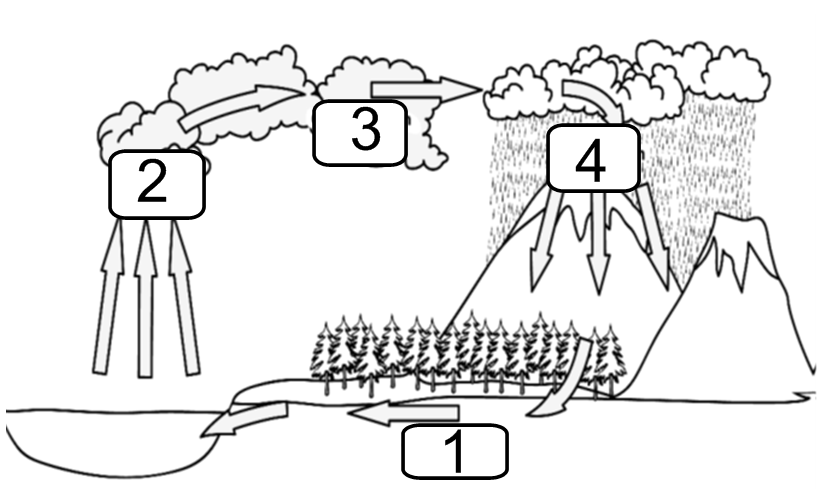
Which stage does the #2 show in the diagram?
a)
condensation
b)
evaporation
c)
precipitation
d)
run off
23.

Which stage does the #3 show in the diagram?
a)
condensation
b)
evaporation
c)
precipitation
d)
run off
24.

what does the #4 show in the diagram?
a)
condensation
b)
evaporation
c)
precipitation
d)
run off
25.
The first step in the water cycle
a)
evaporation
b)
condensation
c)
precipitation
d)
there is no first step
26.
The ________ is the driving force of the earth's surface.
a)
sun
b)
moon
c)
stars
27.
The water cycle has no start or end
a)
true
b)
false
28.
Precipitation occurs because
a)
the droplets evaporate in the air
b)
the droplets are too light for the air to hold
c)
the droplets are too heavy for the air to hold
29.
What is a layer of rock or sediment that holds water?
a)
glacier
b)
well
c)
aquifer
d)
natural spring
30.
Which best explains why runoff is important?
a)
It returns water to other locations on Earth
b)
It increases the chance of flooding
c)
It makes evaporation occur faster
d)
It increases condensation
31.
On which kind of day would you expect the most evaporation from the surface of a pond?
a)
sunny and hot
b)
sunny and cold
c)
rainy and hot
d)
rainy and cold
32.
What is water vapor?
a)
Water on the land (geosphere)
b)
Water in the air (atmosphere)
c)
Water in plants
d)
Water in the water (hydrosphere)
33.
A possible explanation to a problem that has not yet been tested.
a)
data
b)
theory
c)
hypothesis
d)
fact
34.
Should experiments be repeated over and over to see if the results are the same each time?
a)
yes
b)
no
35.
There are two types of data. Which type of data involves numbers that are obtained by counting or measuring?
a)
quantitative
b)
qualitative
36.
There are two types of data. Which type of data involves descriptions/photographs/illustrations that cannot be counted or measured?
a)
qualitative
b)
quantitative
37.
A series of steps used by scientists to solve a problem or answer a question.
a)
scientific method
b)
recipe
c)
data collection
d)
metric system
38.
The summary at the end of an experiment that explains the results.
a)
conclusion
b)
procedures
c)
materials
d)
responding variable
39.
A list of the steps anyone could follow to conduct an experiment.
a)
obervations
b)
question/problem
c)
materials
d)
procedures
40.
Two types of data scientists collect are...
a)
hypothesis and theory
b)
qualitative and quantitative
c)
myths and fables
d)
metric and standard measurements
41.
Science is a continually ongoing process.
a)
True
b)
False
42.
Which is NOT a step in the scientific method?
a)
Make observation
b)
Form a theory
c)
Collect data
d)
Form a hypothesis
43.
What is a hypothesis?
a)
A hypothesis is the right answer to an experiment.
b)
A hypothesis is the wrong answer to an experiment.
c)
A hypothesis is an educated guess.
d)
I don't know.
44.
What step does every scientific experiment begin with?
a)
hypothesis
b)
question/problem
c)
procedures
d)
conclusion
45.
Which of these contains steps in the right order?
a)
Ask a question, state your hypothesis, research, experiment, analyze, make a conclusion
b)
State your hypothesis, ask a question, research, experiment, analyze, make a conclusion
c)
Ask a question, research, state your hypothesis, experiment, analyze, make a conclusion
d)
State your hypothesis, ask a question, research, make a conclusion, experiment, analyze
46.
Is a deer an abiotic or biotic factor?
a)
abiotic
b)
biotic
47.
Is a weather an abiotic or biotic factor?
a)
abiotic
b)
biotic
48.
A living or once-living organisms in an ecosystem is a
a)
population
b)
biotic factor
c)
abiotic factor
d)
community
49.
A nonliving element in an ecosystem is an
a)
animal
b)
abiotic factor
c)
biotic factor
d)
organism
50.
If a piece of matter changes shape, what happens to its mass?
a)
It increases
b)
It decreases
c)
it changes randomly
d)
it stays the same
51.
Which of the following is a unit of mass?
a)
kilogram
b)
liter
c)
meter
d)
pound
52.
Anything made of matter must _____________________.
a)
take up space and have mass
b)
have mass and be a solid
c)
be a solid and not move
d)
take up space and be a liquid
53.
The mass of an object ___________________________.
a)
changes, depending on where it is located
b)
changes randomly
c)
changes, depending on temperature
d)
does not change
54.
One piece of matter is cut into two pieces. What would be the mass of the two new pieces if we combined them?
a)
the two pieces would have the same mass as the original piece
b)
the two pieces would have more mass than the original piece
c)
the two pieces would have less mass than the original piece
d)
there is no way to tell which would have more mass
55.
Which organelle performs PHOTOSYNTHESIS?
a)
Chloroplast
b)
Mitochondria
56.
What process occurs when light energy is captured in autotrophs and converted into sugar?
a)
Photosynthesis
b)
Cellular Respiration
57.
What are the products of photosynthesis?
a)
water and carbon dioxide
b)
oxygen and glucose
c)
oxygen and carbon dioxide
d)
oxygen and water
58.
Which gas is removed from the atmosphere during photosynthesis?
a)
hydrogen
b)
oxygen
c)
nitrogen
d)
carbon dioxide
59.
The downward movement of water through the soil.
a)
percolation
b)
throughflow
c)
infilitration
d)
soil water
60.
The process of water moving through the soil
a)
infiltration
b)
percolation
c)
sublimation
d)
condensation
61.

Which unit of measurement would you use to measure the weight of an elephant?
a)
Ounces
b)
Pounds
c)
Tons
d)
Cups
62.

Which unit of measurement would you use to measure the weight of a feather?
a)
Ounces
b)
Pounds
c)
Gallons
d)
Kilograms
63.
What is the definition of "weight"?
a)
measure of the force of gravity on your body
b)
the time it takes to get on a ride
c)
the amount of matter in an object
d)
the size of an object
64.
What is the definition of CONDUCTION?
a)
When heat is transferred from objects like rays of light or electromagnetically.
b)
a hot liquid or air that expands, becomes less dense, and rises or becomes more dense, and sinks.
c)
When heat transfers from objects that are touching.
d)
When heat transfers through the heater or AC in your house.
65.
What is the definition of CONVECTION
a)
When heat transfers through waves.
b)
When heat transfers from objects that are touching.
c)
a hot liquid or air that expands, becomes less dense, and rises or becomes more dense, and sinks.
d)
Heat traveling from the sun
66.
What kind of heat transfer happens when the sun is heating your body?
a)
Conduction
b)
Radiation
c)
Convection
d)
Density
67.
Which of the following is an example of convection?
a)
A hair dryer is drying up your hair.
b)
When the AC or heater changes the temperature.
c)
When a car engine turns hot after being turned on.
d)
When you are making soup and the water is rising and lowering.
68.
What heat transfer happens when you burn your hand by touching a fire?
a)
Radiation
b)
Conduction
c)
Convectio
d)
I don't know!!!!!!!!!!!
69.
Which of the following is needed for convection to happen?
a)
Fluid/s
b)
Light in the form or rays
c)
Electromagnetic waves
d)
Fire
70.
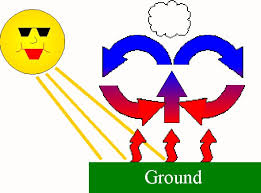
Warm air rises and the cool air sinks demonstrates this type of heat transfer.
a)
conduction
b)
convection
c)
radiation
d)
Insolation
71.
Warm air is __________ dense than cold air and rises creating convection currents.
a)
more
b)
less
72.
Transfer of thermal energy through "space"
a)
conduction
b)
convection
c)
radiation
73.
Transfer of thermal energy through "touch"
a)
conduction
b)
convection
c)
radiation
74.
Transfer of thermal energy through "flow"
a)
conduction
b)
convection
c)
radiation
75.
Heat transfer always goes from-
a)
Cold to Hot
b)
Hot to Cold
c)
Heat doesn't transfer
d)
Freezing to Cold
76.
What is a convection cell?
a)
is a system in which a fluid is warmed, loses density and is forced into a region of greater density.
b)
A jail for lava lamps
c)
A cell that makes up convection
d)
Cells in Radiation
77.
Transfer Means to :
a)
Move
b)
Dance
c)
Swing
d)
Hop
78.
To Evaluate Means:
a)
To ask
b)
To solve
c)
To repeat
d)
To listen
100 %

