Wayground logo

Free Printable Worksheets

Font size

S
M
L
XL
Worksheets

Chem 2nd 6-Week Exam

Total questions: 99

Worksheet time: 3hrs 13mins
Name
Class
Date
1.
What elements generally make an ionic bond?
a)
metal and nonmetal
b)
2 or more nonmetals
c)
metal
d)
none of the above
2.
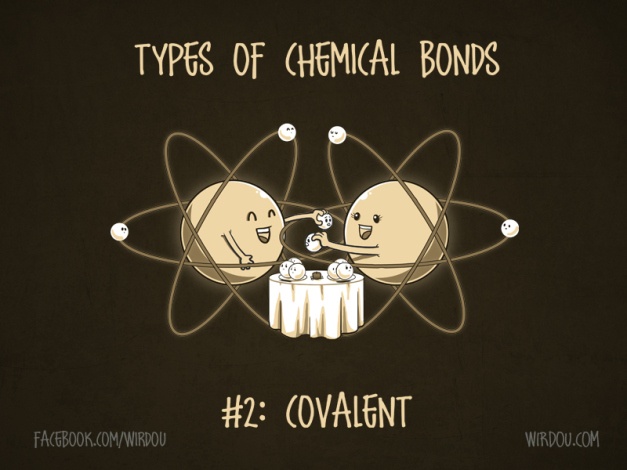
What elements generally make a covalent bond?
a)
metal and nonmetal
b)
2 or more nonmetals
c)
metal
d)
none of the above
3.
In chemical compounds, covalent bonds form when
a)
the electronegativity difference between two atoms is very large.
b)
electrons are completely transferred between two metals.
c)
pairs of electrons are shared between two nonmetal atoms.
d)
two nonmetal atoms are attracted to each other by opposite charges.
4.
An ionic bond forms when 
a)
Valence electrons are shared
b)
a sea of mobile electrons surround the cations
c)
valence electrons are transferred between atoms
d)
none of the above
5.
Predict the bond that will form between Be and F.
a)
Ionic
b)
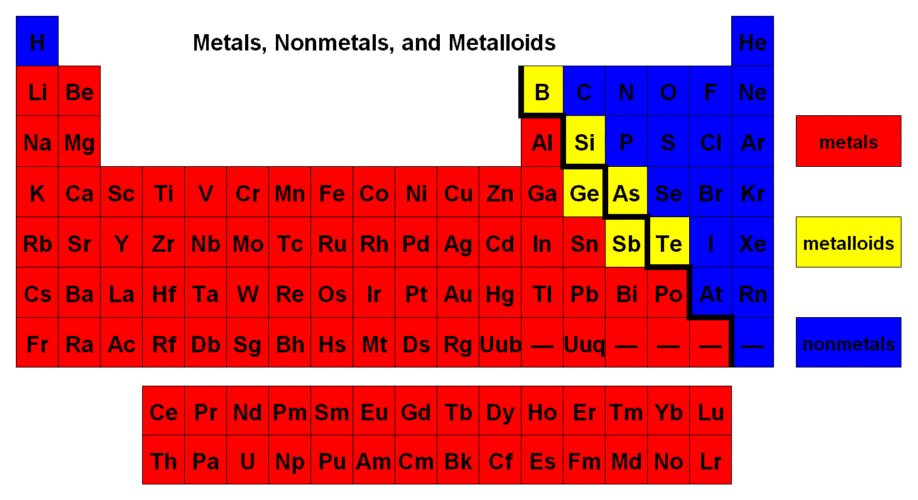
Covalent
6.
Predict the bond that will form between Se and Cl.
a)
Ionic
b)
Covalent
7.
Predict the bond that will form between Sr and S.
a)
Ionic
b)
Covalent
8.
What is a valence electron?
a)
an electron that is found in the outermost shell of an atom. 
b)
an electron found in the innermost shell of an atom.
c)
an electron found in the middle shell.
9.
What type of diagram is this?
a)
Electron Dot Diagram
b)
Bohr Model
c)
Alkali Diagram
d)
Chemical Diagram
10.
How many valence electrons in this structure?
a)
6
b)
5
c)
4
d)
7
11.
Force that holds together atoms in a substance.
a)
compound
b)
ion
c)
chemical bond
d)
ionic bond
12.
How many electrons should Lithium have around its Lewis dot model?
a)
1
b)
2
c)
3
d)
4
13.
How many electrons should Beryllium have around its Lewis dot model?
a)
1
b)
2
c)
3
d)
4
14.
?
a)
Boron
b)
Carbon
c)
Nitrogen
d)
Lithium
15.

This is a correct dot diagram for nitrogen (N)

a)

true

b)

false

16.

This is a correct dot diagram for carbon (C)

a)

true

b)

false

17.

This is a correct dot diagram for neon (Ne)

a)

true

b)

false

18.

How many electrons are shared in one of these N-Cl bonds?

a)

1

b)

2

c)

3

d)

4

19.

Which of the following is the correct Lewis dot structure for the molecule fluorine (F2)?

a)

A

b)

B

c)

C

d)

D

20.

What is the correct formula for this molecule?

a)

NH

b)

N3H

c)

NH3

d)

NH4

21.
The electron configuration of an atom is 1s22s22p6.  The number of electrons in the atom is 
a)
3
b)
6
c)
8
d)
10
22.
What atom matches this electron configuration?
1s22s22p63s23p64s23d10
a)
Zinc
b)
Copper
c)
Nickel
d)
Germanium
23.
What is the noble gas shorthand electron for Sulfur atom?
a)
[Ar] 3p4
b)
[He] 3s23p4
c)
[Ne] 3s23p4
d)
[Na] 3s23p4
24.
What atom matches this electron configuration?
[Xe] 6s25d9
a)
Mercury
b)
Gold
c)
Platinum
d)
Thallium
25.
What electron configuration matches an oxygen ion?
a)
1s22s22p63s2, 3p64s23d104p5
b)
1s22s22p4
c)
1s22s22p6
d)
1s22s22p63s23p64s23d1
26.
Which of the following is the smallest in size?
a)
K
b)
Na
c)
Li
d)
Cs
27.
How many electrons does Si contain? (click to see image)
a)
14
b)
28
c)
2
d)
4
28.
How many valence electrons does Si contain? (click to see image)
a)
14
b)
28
c)
2
d)
4
29.
Valence electrons are: 
a)
Electrons farthest away from the nucleus
b)
Electrons closest to the nucleus
c)
Electrons that just come and go - they don't stay with the atom
30.
Magnesium's ion
a)
Mg+
b)
Mg2+
c)
Mg-
d)
Mg2-
31.
Which element is depicted from this orbital diagram
a)
Fluorine
b)
Neon
c)
Chlorine
d)
Argon
32.
What is the charge of an atom that has gained one electron?
a)
-1
b)
-2
c)
+1
d)
+2
33.
What is the charge of an atom that has lost one electron?
a)
-1
b)
-2
c)
+1
d)
+2
34.
Cations are _______ that form ____________ ions and __________ electrons.
a)
nonmetals, positive, lose
b)
nonmetals, negative, gain
c)
metals, positive, gain
d)
metals, positive, lose
35.
Anions are _______ that form ____________ ions and __________ electrons.
a)
nonmetals, positive, lose
b)
nonmetals, negative, gain
c)
metals, positive, gain
d)
metals, positive, lose
36.
What atom matches this electron configuration?
1s22s22p63s2
a)
Neon
b)
Magnesium
c)
Aluminum
d)
Potassium
37.
True or false: as you move along the spectrum, left to right, the wavelengths decrease in size (get smaller)
a)
true
b)
false
38.
A wave with a large wavelength will have a ______ frequency and _____ energy
a)
high, low
b)
high, high
c)
low, high
d)
low, low
39.
Which has the LONGEST wavelength and, therefore, the lowest frequency/energy
a)
Gamma Rays
b)
Radio Waves
c)
Visible Light
d)
Infrared rays
40.
Select the correct order of waves on the EMS 
a)
Radio, Micro, Infra, Visible, Ultra, X-ray, Gamma
b)
Gamma, X-ray, Ultra, Vis, Infra, Micro, Radio
c)
Vis, Micro, Infra, Ultra, X-ray, Gamma, Radio
d)
Micro, Radio, Vis, Infra, Ultra, X-ray, Gamma
41.
Which has the SHORTEST wavelength and, therefore, the highest frequency/most energy
a)
Radio waves
b)
Ultraviolet Rays
c)
Gamma Rays
d)
X-rays
42.
Which section of the spectrum is the ONLY one we can see?
a)
X-rays
b)
Visible Light
c)
Gamma Rays
d)
Ultraviolet Rays
43.
Put the visible light colors in order from longest wavelength to shortest wavelength
a)
Violet, Indigo, Blue, Green, Orange, Yellow, Red
b)
Red, Yellow, Green, Orange, Violet, Blue, Indigo
c)
Red, Orange, Yellow, Green, Blue, Indigo, Violet
44.
Which of the following electromagnetic waves is given off as heat? 
a)
Radio Waves
b)
Infrared Rays
c)
Visible Light
d)
Gamma Rays
45.
The _______________ determines the color of visible light. 
a)
wavelength
b)
speed
c)
amplitude
d)
light
46.
Which of the following electromagnetic waves has the lowest energy?
a)
gamma ray
b)
infrared wave
c)
visible light wave
d)
microwave
47.
Which color has the highest frequency?
a)
red
b)
orange
c)
green
d)
blue
48.
Which of the following has the longest wavelength?
a)
microwaves
b)
visible light
c)
x-rays
d)
infrared waves
49.
High frequency waves have _________ wavelengths.
a)
varying
b)
long
c)
the same
d)
short
50.
The distance between two crests or two troughs of a wave is called:
a)
frequency
b)
amplitud
c)
wavelength
d)
hertz
51.
All electromagnetic waves have the same...
a)
frequency
b)
speed
c)
wavelength
d)
energy
52.
How much of the electromagnetic spectrum is visible?
a)
All of it
b)
None of it
c)
Most of it
d)
Only a small part
53.
The height of the wave is known as the _____________.
a)
amplitude
b)
crest
c)
trough
d)
wavelength
54.
Which travels faster: sound or light?
a)
light
b)
sound
55.
Frequency and energy have a direct relationship.  This means as the frequency increases the energy
a)
increases
b)
decreases
56.
Frequency and wavelength have an indirect relationship.  As the wavelength increases, the frequency
a)
increases
b)
decreases
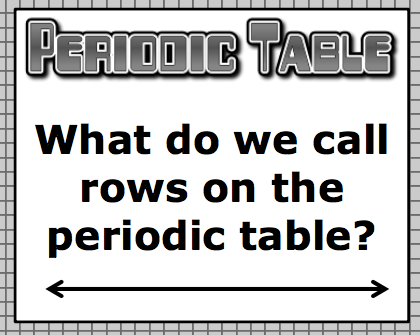
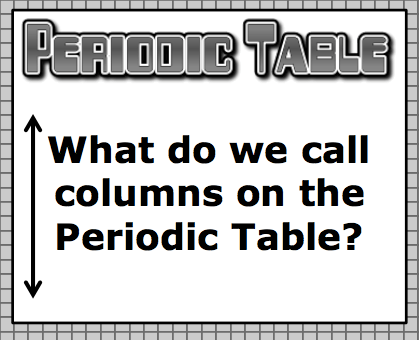
57.
a)
Periods
b)
Groups
58.
a)
Periods
b)
Groups
59.
Elements which are shiny, conduct electricity and heat are called
a)
metal
b)
nonmetal
c)
metalloid
d)
nonexistent
60.
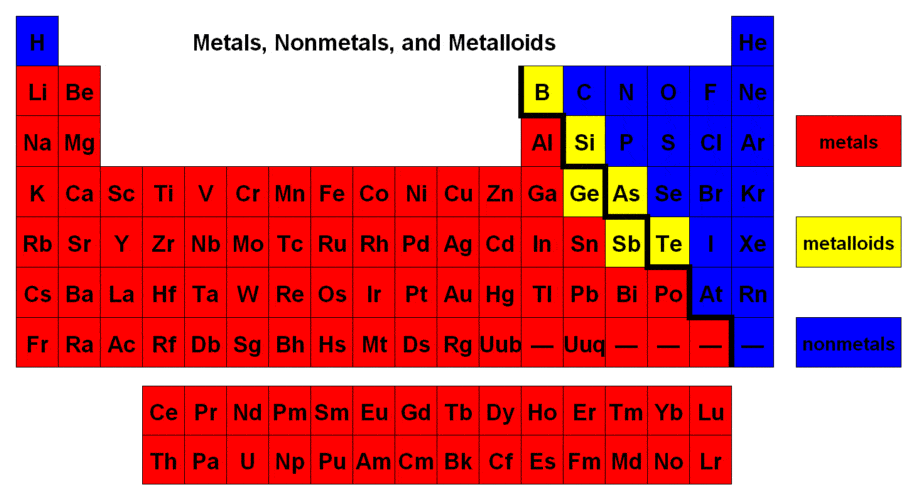
The atoms along the staircase are called 
a)
metals
b)
nonmetals
c)
metalloids
d)
noble gases
61.
Which is a halogen?
a)
Helium
b)
Chlorine
c)
Oxygen
d)
Neptune
62.
Which is an alkali metal?
a)
Magnesium
b)
Iron
c)
Sodium
d)
Europium
63.
Group 18 elements are known as the _____ _____ and have full valence shells.
a)
royal gases.
b)
supreme solids.
c)
noble gases.
d)
legit liquids.
64.

Which of these elements is the most electronegative?

a)

oxygen O

b)

tellurium Te

c)

Ne neon

d)

strontium Sr

65.
Which element is a halogen?
a)
K potassium
b)
Ca calcium
c)
Zn zinc
d)
Br bromine
66.
Which of these elements is a Alkali metal?
a)
W tungsten
b)
Sc scandium
c)
Be beryllium
d)
Li lithium
67.
Which of these elements has the SMALLEST atomic radius?
a)
H hydrogen
b)
Rb rubidium
c)
Li lithium
d)
Fr francium
68.
Which of the following will have a lower ionization energy than Scandium (Sc)?
a)
Helium (He)
b)
Titanium (Ti)
c)
Calcium (Ca)
d)
Magnesium (Mg)
69.
As you move across the periodic table atoms tend to get smaller because, ______________.
a)
the atoms have more mass.
b)
the atoms have less mass
c)
the atoms have more protons.
d)
the atoms have less electrons.
70.
As you move down the periodic table atoms get bigger.  This is because ____________.
a)
The atoms have more mass.
b)
The atoms have more protons.
c)
The atoms have more energy levels
d)
The atoms have more neutrons
71.
The atom with the largest atomic radius in Group 18 is - 
a)
Ar
b)
He
c)
Kr
d)
Rn
72.
Atomic radius generally increases as we move __________.  
a)
down a group and from right to left across a period 
b)
up a group and from left to right across a period 
c)
down a group and from left to right across a period 
d)
up a group and from right to left across a period 
73.
Electronegativity __________ from left to right within a period and __________ from top to bottom within a group.
a)
decreases, increases 
b)
increases, increases
c)
increases, decreases 
d)
stays the same, increases
74.
The chart scientists use to organize and classify all the known elements
a)
elements chart
b)
the chart
c)
Periodic Table of the Elements
d)
Period table
75.
What is the VSEPR theory used to predict?
a)
Bond Strength
b)
Polarity
c)
Molecular Shape
d)
Electronegativity
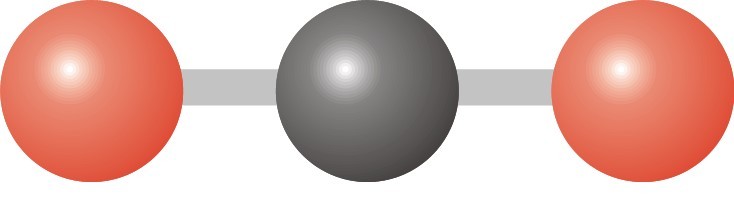
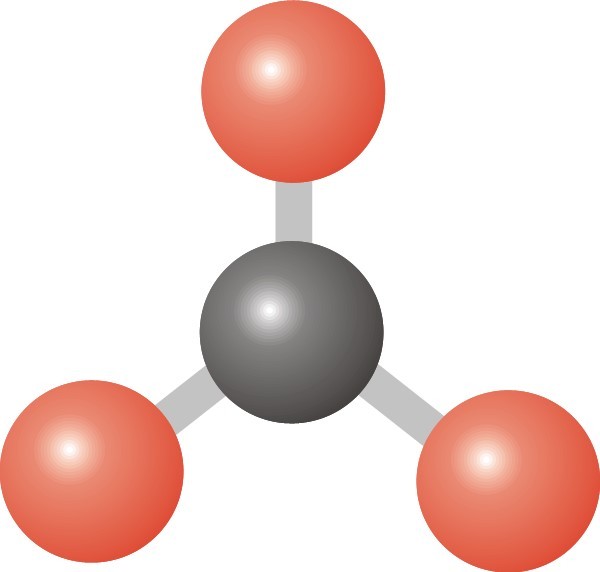
76.
Which molecule would have this shape?
a)
BF3
b)
CH4
c)
PCl5
d)
CO2
77.
According to VSEPR, molecules adjust their shapes to keep which of the following as far away as possible?
a)
Pairs of valence electrons
b)
Inner shell electrons
c)
Mobile Electrons
d)
Electrons closest to the nucleus
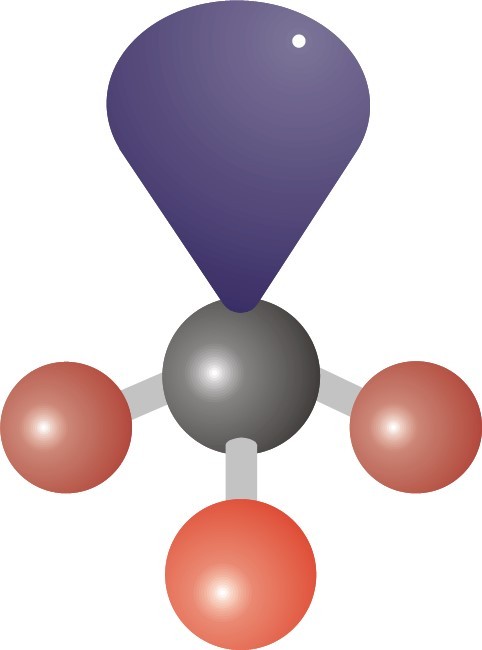
78.
Which of the following shapes has unshared pairs of electrons on the central atom? 
a)
Bipyramidal
b)
Bent
c)
Trigonal Planar
d)
Tetrahedral
79.
Which of the following molecular shapes would have a bond angle of 180 Degrees?
a)
Bent
b)
Trigonal Planar
c)
Tetrahedral
d)
Linear
80.
What molecule could this be? 
a)
BF3
b)
CH4
c)
H2O
d)
CO2
81.
What shape would PH3 have?
a)
Trigonal Planar
b)
Trigonal Bipyramidal
c)
Bent
d)
Linear
82.
Hint: Draw the Lewis dot structure for NH3.
a)
tetrahedral
b)
trigonal pyramid
c)
trigonal planar
d)
bent or angular
83.
Which of the following describes water?
a)
Linear structure, nonpolar
b)
Linear structure, polar
c)
Bent structure, nonpolar
d)
Bent structure, polar
84.

3 shared pairs and 0 unshared pairs

a)

true linear

b)

trigonal planar

c)

bent

d)

tetrahedral

e)

trigonal pyramidal

85.

4 shared pairs and 0 unshared pairs

a)

true linear

b)

trigonal planar

c)

bent

d)

tetrahedral

e)

trigonal pyramidal

86.
Who could this be?
a)
H2O
b)
NH3
c)
CO2
d)
CH4
87.
Who could this molecule be?
a)
CH4
b)
CO2
c)
PCl5
d)
BF3
88.
Who could this be? 
a)
CO2
b)
NH3
c)
H2S
d)
CH4
89.
 A lone pair is defined as
a)
A pair of bonding electrons
b)
One non-bonding electron
c)
A pair of non-bonding electrons
d)
A pair of electrons on the central atom
90.
How many electrons should Lithium have around its Lewis dot model?
a)
1
b)
2
c)
3
d)
4
91.
Which of the following is the correct Lewis structure for the compound PBr3?
a)
structure A
b)
structure B
c)
structure C
d)
structure D
92.
What is the correct structure for BF3?
a)
Option A.
b)
Option B. 
c)
Option C.
d)
Option D.
93.

Which Lewis Dot Model drawing correctly shows an O2 molecule?

a)
b)
c)
d)
94.

What (if anything) is wrong with the Lewis Dot Model of H2O?

a)

The Hydrogens don't have enough Valence Electrons

b)

The Oxygen doesn't have enough Valence Electrons

c)

There should be triple bonds between atoms, not single bonds

d)

Nothing, this is correct

95.
This is an example of a __________ bond.
a)
non-polar covalent
b)
polar covalent
c)
ionic
d)
metallic
96.
In this Lewis structure, the symbol above F means...
a)
electrons are being transferred to Fluorine
b)
electrons are less attracted to F than H
c)
electrons are more attracted to F than H
d)
Fluorine has formed a cation
97.
Will this molecule be polar or nonpolar? H2S
a)
polar
b)
nonpolar
98.
Will this molecule be polar or nonpolar? CCl4
a)
polar
b)
nonpolar
99.
In the diagram shown, what is the total number of electrons shared in the bond between the two carbon atoms?
a)
2
b)
3
c)
4
d)
6