
 Worksheets
Neuromuscular junction and muscles
Total questions: 101
Worksheet time: 51mins
The point at which the nerve cell reaches the sarcolemma of the muscle fiber is the _____.
Neurotransmitter
Acetylcholine
Synaptic cleft
Neuromuscular Junction
One neuron and all the skeletal muscle cells it stimulates is the ____ ___.
Neurotransmitter
Neuromuscular junction
Motor unit
Synaptic cleft
The gap between the nerve cell and sarcolemma is the ____ ___.
Synaptic cleft
Neurotransmitter
Motor unit
Neuromuscular junction
What is the specific neurotransmitter that stimulates the movement of skeletal muscles?
GABA
Acetylcholine
Serotonin
Dopamine
Once the action potential reaches the end of the axon terminal what takes place?
ACh is released into the synaptic cleft.
Calcium is pumped into the sarcolemma.
Calcium is pumped into the AT.
The muscle contracts.
Once calcium is pumped into the axon terminal what happens?
The muscle contracts
ACh is released into the synaptic cleft.
Sodium pumps into the sarcolemma.
The muscle contracts.
What is the name of the component that houses the neurotransmitters?
Synaptic cleft
Acetylcholine
Receptors
Synaptic vesicles
Once ACh binds to receptor cells on the sarcolemma, what takes place?
Sarcolemma becomes temporarily permeable to sodium.
The muscle contracts.
Calcium is pumped into the axon terminal.
Synaptic vesicles move to the end of the terminal.
The neuromuscular junction is created when the nerve cell reaches the ___.
Sarcomere
Sarcoplasmic reticulum
Sarcolemma
Myofibril
Once sodium is pumped into the sarcolemma, what happens?
Action potential is transferred to the sarcolemma to cause contraction.
The process ends and ACh breaks down.
Calcium is pumped into the axon terminal.
ACh is released into the synaptic cleft.
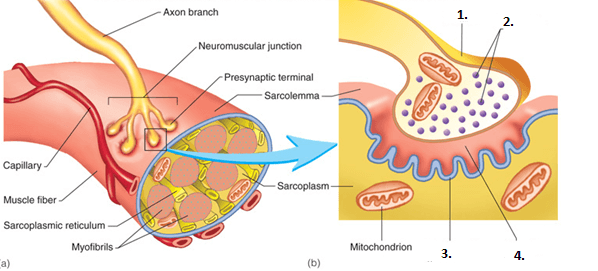
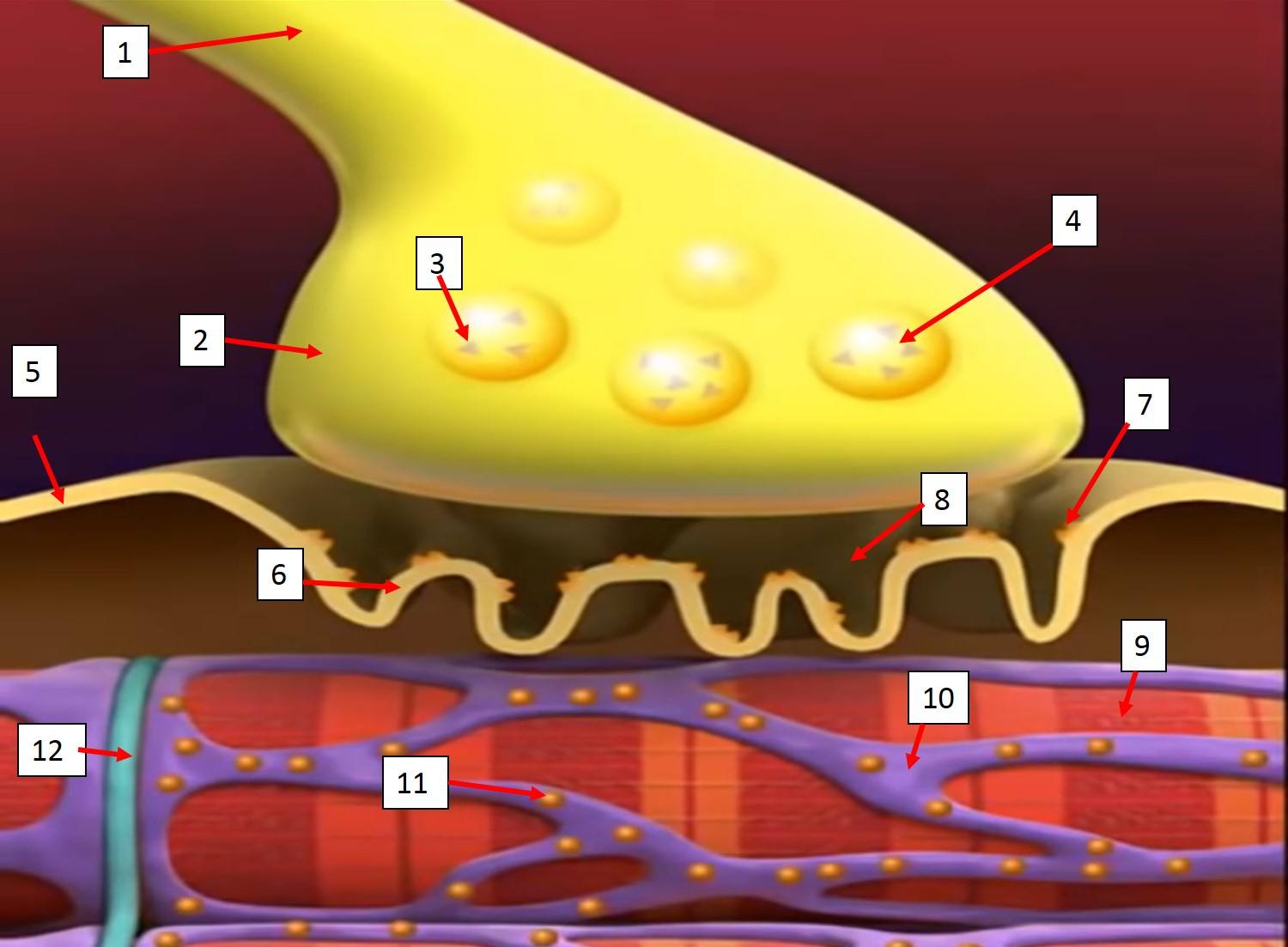
The specialized part of the cell membrane of the muscle fiber identified as #5
Sodium ion (Na+)
Axon Terminal of Motor Neuron
motor end plate
Vesicle

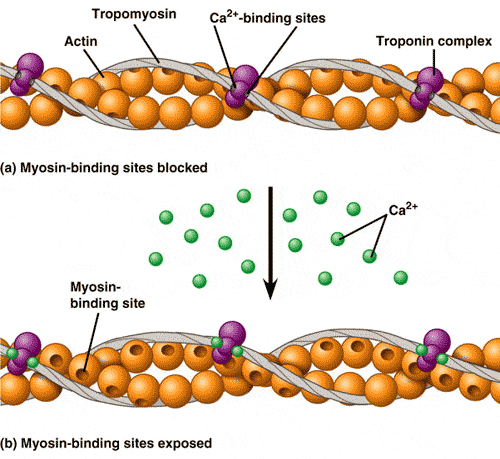
One neuron and all the skeletal muscles it stimulates is known as a ________.
sarcoplasmic reticulum
motor unit
synaptic cleft
neuromuscular junction
What is the unstoppable electrical current that travels down the length of the entire surface of a sarcolemma?
neurotransmitter
graded response
acetylcholine
action potential
What is released by axon terminals into the synaptic cleft to stimulate a muscle to contract?
potassium ions
sodium ions
acetylcholine
actin
Why are calcium ions necessary for skeletal muscle contraction?
Calcium ions increase the speed of the action potential transmitted along the sarcolemma.
Calcium ions release the inhibition on Z discs.
Calcium ions trigger the binding of myosin heads to actin filaments.
Calcium ions cause ATP binding to actin.
What is acetylcholine?
an ion pump on the postsynaptic membrane
a source of energy for muscle contraction
a component of thick myofilaments
a neurotransmitter that stimulates skeletal muscle to contract
The gap between the axon terminal of a motor neuron and the sarcolemma of a skeletal muscle cell is called the ________.
motor unit
synaptic cleft
cross bridge
sarcomere
What must rush into a muscle cell to promote its depolarization?
potassium ions
calcium ions
acetylcholine
sodium ions
Neurotransmitters are released upon stimulation from a nerve impulse from the ________.
axon terminals of the motor neuron
myofibrils
sarcolemma of the muscle cell
sarcoplasmic reticulum
Which of these events must occur first to trigger the skeletal muscle to generate an action potential and contract?
Potassium ions diffuse out of the muscle cell.
Acetylcholine (ACh) binds to receptors on the sarcolemma and allows passage of sodium ions into the cell.
The sodium-potassium pump restores sodium and potassium back to their initial positions.
Acetylcholinesterase (AchE) breaks down acetylcholine (ACh).


The point at which the motor neuron reaches the sarcolemma of the muscle fiber is the _____.
Neurotransmitter
Acetylcholine
Synaptic cleft
Neuromuscular Junction
One neuron and all the skeletal muscle cells it stimulates is the ____ ___.
Neurotransmitter
Neuromuscular junction
Motor unit
Synaptic cleft
The gap between the nerve cell and sarcolemma is the ____ ___.
Synaptic cleft
Neurotransmitter
Motor unit
Neuromuscular junction
What is the specific neurotransmitter that stimulates the movement of skeletal muscles?
GABA
Acetylcholine
Serotonin
Dopamine
Once the action potential reaches the end of the axon terminal what happens next?
ACh is released into the synaptic cleft.
Calcium is pumped into the sarcolemma.
Calcium is pumped into the motor neurons axon terminal.
The muscle contracts.
Once calcium is pumped into the axon terminal what happens?
The muscle contracts
ACh is released into the synaptic cleft.
Sodium pumps into the sarcolemma.
The muscle contracts.
What is the name of the component that holds the neurotransmitters?
Synaptic cleft
Acetylcholine
Receptors
Synaptic vesicles
Once sodium is pumped into the sarcolemma, what happens?
A muscle action potential is formed which will cause the muscle to contract.
The process ends and ACh breaks down.
Calcium is pumped into the axon terminal.
ACh is released into the synaptic cleft.
The specialized part of the cell membrane of the muscle fiber identified as #5
Sodium ion (Na+)
Axon Terminal of Motor Neuron
motor end plate
Vesicle
The point at which the nerve cell reaches the sarcolemma of the muscle fiber is the _____.
Neurotransmitter
Acetylcholine
Synaptic cleft
Neuromuscular Junction
One neuron and all the skeletal muscle cells it stimulates is the ____ ___.
Neurotransmitter
Neuromuscular junction
Motor unit
Synaptic cleft
The gap between the nerve cell and sarcolemma is the ____ ___.
Synaptic cleft
Neurotransmitter
Motor unit
Neuromuscular junction
What is the specific neurotransmitter that stimulates the movement of skeletal muscles?
GABA
Acetylcholine
Serotonin
Dopamine
Once the action potential reaches the end of the axon terminal what takes place?
ACh is released into the synaptic cleft.
Calcium is pumped into the sarcolemma.
Calcium is pumped into the AT.
The muscle contracts.
What is a prime mover?
A: The muscles that are responsible for generating a movement
B: The muscles that move the most in an action
C: The muscles that cause you to flex
D: The muscles that cause you to extend
_______ movement is at your free will.
A: Voluntary
B: Involuntary
What is synergist?
A: A muscle that assists in prime movement muscles
B: Muscles that are the prime movement muscles
C: A muscle that relaxes during a movement
D: Muscles that are voluntary
What is an antagonist?
A: A muscle that is responsible for carrying out an action
B: A muscle that is involuntary
C: A muscle that relaxes during a movement
D: A muscle that assists in prime movement muscles
Where does Ach (acetylcholine) release?
A: In the neuromuscular junction
B: In the bones
C: In the synaptic cleft
D: In the baroreceptors
A _________ connects two bones/cartilages together or holds together a joint.
A: Ligament
B: Tendon
C: Synergist
D: Antagonist
What is a neuromuscular junction?
A: synapse
B: chemoreceptor
C: neurotransmitter
D: vesicles
Where is the cardiac muscle located?
A: The bones
B: The organs
C: The heart
D: In the muscles
Where is the neuromuscular junction located?
A: Between the skeletal muscle and schwann cells
B: Between the motor neuron and skeletal muscle
Is skeletal muscle voluntary or involuntary?
A: Voluntary
B: Involuntary
Is cardiac muscle voluntary or involuntary?
A: Involuntary
B: Voluntary
What does Ach (acetylcholine) do in the body?
A: Sends signals to other cells.
B: Binds cells together
C: Provides energy
D: Is a catalyst to chemical reactions
What main muscle contracts the lungs?
A: Sarcoplasmic Reticulum
B: Medulla Oblongata
C: Muscle Fibers
D: Diaphragm
Where is the skeletal muscle in the body?
A: In the muscles
B: In the heart
C: In the bones
D: In the organs
Where is smooth muscle located in the body?
A: In the heart
B: In the bones
C: In the organs
D: In the bones
_______ movement that is unconsciously made.
A: Voluntary
B: Involuntary
Is smooth muscle voluntary or involuntary?
A: Voluntary
B: Involuntary
Tetanus is caused by the bacteria....
Clostridium tetani
Varcella zoster
C.diptheria
None of the above
The toxin of late tetanus creates...
Rampant coughing
Muscle relaxation to the point of flaccid paralysis
Muscle spasms to the point of paralysis
None of the above
Generally, the last muscle(s) the tetanus bacteria effects, which is lethal, is....
The arms
The diaphragm
The heart
The legs
What toxin produced by another bacteria is the cure for late stage tetanus?
Clorox
Botox
Ammonia
None of the above
Is tetanus caused by rust or the bacteria on rust/dirt?
Rust!
Bacteria on rust/dirt!
The endospores in tetanus...
Create a fake bacteria that the sanitizer attacks
Allow the bacteria to breath
Protect the bacteria in hostile environments
None of the above
The nickname for tetanus is...
Lockjaw
Lockup
Locking disease
Lockback
If not cured, Tetanus has a ________ fatality rate.
10%
40%
100%
2%
Clostridium tetani is a bacteria or a virus?
Bacteria
Virus
All of the following are symptoms EXCEPT
Jaw cramping
Trouble swallowing
Exhaustion
Fever
Tetanus can be transmitted through
deep cuts
breathing
person to person
burns
5.The ______________________ is a sheet of smooth muscles located below the lungs and separates them from the abdominal cavity.
A. Lungs
B. Diaphragm
C. Alveoli
D. Bronchioles

