wayground logo

Free Printable Worksheets

Font size

S
M
L
XL
Worksheets

Ecology Test Review

Total questions: 100

Worksheet time: 1hrs 15mins

Name
Class
Date
1.

The highest concentration of life exists in the top 200 meters of ocean water. What is the most important factor that influences the concentration of life?

a)

amount of gases at the surface

b)

amount of nutrients in the water

c)

large number of predators at lower depths

d)

amount of sunlight

2.

Ecologists study different levels of organization within the biosphere. Identify which level corresponds to a group of individuals that belong to the same species and live in the same area.

a)

A: Community

b)

B. Biome

c)

C. Ecosystem

d)

D. Population

3.

In addition to energy, organisms need matter to survive. Which of the following is true about matter in the biosphere?

a)

The total amount of matter decreases overtime

b)

The total amount of matter increases overtime

c)

Biogeochemical cycles transform and reuse molecules

d)

Matter flows through ecosystems in one direction

4.

Each step in a food chain is called a trophic level. What percentage of energy available at one trophic level is transferred to organisms at the next level?

a)

about 2 percent

b)

about 10 percent

c)

about 25 percent

d)

about 50 percent

5.
Consumer that eats plants
a)
heterotroph
b)
herbivore
c)
producer
d)
community
6.
Organisms that relies on other organisms for food; consumer
a)
herbivore
b)
decomposer
c)
heterotroph
d)
species
7.
All the organisms in a particular location, including their nonliving environment
a)
ecosystem
b)
carnivore
c)
niche
d)
population
8.
What does fungi do to dead plants and animals?
a)
Leave them there
b)
Decompose them
c)
Wait for other animals to eat them
d)
Move away
9.
What may happen if the snowshoe hare was removed from the food web pictured?
a)
The insects in the habitat would increase.
b)
The shrew population would decrease due to being only hawk food source.
c)
The willow tree population would decrease.
d)
Foxes would dies due to no food source. 
10.
What is it called when water is changed from a liquid to a gas?
a)
EVAPORATION
b)
PRECIPITATION
c)
TRANSPIRATION
11.
Nitrogen makes up _____ percent of the atmosphere.
a)
66%
b)
78%
c)
90%
12.
In the food web shown, the snail would be considered...
a)
primary consumer
b)
secondary consumer
c)
tertiary consumer
d)
producer
13.
Which biome, because of its climate and amount of rainfall, has the largest number of species of plants and animals?
a)
Tundra
b)
Rainforest
c)
Desert
d)
Pineforest
14.
All these organisms share the same
a)
Biome
b)
Population
c)
Community
d)
Habitat
15.
Bacteria which convert nitrogen gas into bio-available forms of nitrogen, such as ammonia and nitrate, are known as _____
a)
De-nitrification bacteria 
b)
Nitrogen fixing bacteria
c)
Oxidizers
d)
Buffers
16.
Phosphorus is an essential nutrient for plants and animals because it is use to make _______
a)
Carbohydrates
b)
Glucose
c)
RNA / DNA
d)
Starches
17.
Fungi are a  ________
a)
Autotrophs
b)
Heterotroopers
c)
Decomposers
d)
Primary Consumers
18.
All living things get their energy from which of the following sources?
a)
food
b)
water
c)
sun
19.
Which of the following is another word for a plant?
a)
autotroph
b)
heterotroph
c)
consumer
20.
Which of the following is an organism that eats only meat?
a)
herbivore
b)
carnivore
c)
omnivore
21.
Which of the following terms describes an area where an organism lives?
a)
community
b)
habitat
c)
area
22.
Which is represented by all of the bullfrogs living around a pond?
a)
community
b)
habitat
c)
population
23.
What would most likely happen if the rabbit population was removed from the food chain grass —› rabbit —› fox?
a)
their would be more grass
b)
there would be less rabbits
c)
there would be more fox
24.
Which is an example of a parasitic relationship?
a)
a bee pollinates a flower
b)
a tapeworm takes nutrients from a dog
c)
an orchid lives in a tree but does not harm the tree
25.
In which type of relationship do both species benefit?
a)
parasitism
b)
mutualism
c)
commensalism
26.
Barnacles grow on whales.  Whales give the barnacles a place to live but the barnacles do not help or harm the whale.  Which type of relationship is this?
a)
commensalism
b)
mutualism
c)
parasitiesm
27.
An oxpecker bird eats ticks off of a zebra.  The bird gets food from eating the ticks and the zebra has harmful parasites removed.  Which type of symbiosis is this?
a)
mutualism
b)
parasitism
c)
commensalism
28.
Study of interactions between organisms and their environment 
a)
niche
b)
community 
c)
ecology
d)
ecosystem
29.
Non-living factor that affects an ecosystem
a)
biotic factor
b)
abiotic factor
c)
food chain 
d)
biome
30.
A collection of organisms that belong to different populations but all live in the same area and interact with one another.
a)
Population
b)
Ecosystem
c)
Community
d)
Ecosphere
31.
Evaporation of water from the leaves of a plant gives of purified water to be evaporated.
a)
precipitation
b)
concentration
c)
transpiration
d)
evaporation
32.
Individuals that can breed with one another make up a
a)
species
b)
population
c)
community
d)
ecosystem
33.
Organisms that obtains its energy from abiotic sources, such as sunlight or inorganic chemicals
a)
Autotroph
b)
Heterotroph
c)
Omnivore
d)
Carnivore
34.

A bee receives nectar from a flower and carries the pollen to other flowers:

a)

predation

b)

parasitism

c)

mutualism

d)

commensalism

35.

Mistletoe grows and spreads on trees, taking their nutrients:

a)

predation

b)

parasitism

c)

mutualism

d)

commensalism

36.

What would happen within a few months after the formation of a volcanic island?

a)

pioneer species would grow

b)

no pioneer species would grow

c)

trees and large plants would grow

d)

rich, organic soil would be present

37.

What would be a good example of a primary consumer?

a)

carnivore

b)

detrivore

c)

decomposer

d)

herbivore

38.

The monkey would be a

a)

decomposer

b)

producer

c)

primary consumer

d)

secondary consumer

39.

Which is an example of where primary succession could occur?

a)

a glacier melts and exposes new rocks

b)

natural fire burns a prairie

c)

a corn field is abandoned and left to overgrow

d)

flood covers a piece of land

40.

Mice might grow in population and destroy the community by eating all of the berry bushes if

a)

wolves and snakes were removed from the food web

b)

another predator migrated in to the community

c)

the snake population grew

d)

none of these

41.

These organisms are often not shown in a food chain, but are important for recycling nutrients

a)

producers

b)

decomposers

c)

primary consumers

d)

carnivores

42.

Which event would not cause secondary succession?

a)

forest fire

b)

flooding of a valley

c)

volcanic lava flow

d)

tornado

43.

The difference between weather and climate is that climate is:

a)

The average, year-to-year conditions

b)

The day-to-day conditions

c)

Described in terms of months at a time

d)

B and C are both correct

44.

What is the greenhouse effect?

a)

It is a phenomenon where the sun’s rays are absorbed by clouds.

b)

It is a phenomenon that occurs when heat escapes into space.

c)

It is when heat is trapped by gases, then sent back to earth’s surface.

d)

It describes the atmosphere’s composition.

45.

In the woods, there are ducks and mice. They both compete for grasshoppers as the only source of food in that area at that time. The ducks outcompete the mice, and the mice die out in that area. This is an example of:

a)

Neutralism

b)

Commensalism

c)

The competitive exclusion principle

d)

Mutualism

46.

In the wild, some alligators gets their teeth cleaned by birds. The birds gets their food from the alligators' teeth.

What type of symbiosis is this?

a)

Mutualism

b)

Commensalism

c)

Parasitism

d)

Neutralism

47.

In an ecosystem, there are populations of moose, rabbits, grass, and pine trees. Suddenly, a fire blazes through the area, which kills all of the populations. As the months go on, new species of grass begin to take root. This attracts animals, and eventually the ecosystem is restored.


What type of ecological succession happened?

a)

Primary succession

b)

Secondary succession

c)

Tertiary succession

d)

None of the above

48.
Which of the following best describes an ecosystem?
a)
all the living organisms in an area and their physical surroundings
b)
a region with a distinct climate
c)
all the living organisms of the same species throughout the world
d)
all the living organisms in an area
49.
A pod of dolphins hunting and feeding on a school of fish is an example of
a)
an ecosystem interaction.
b)
a population interaction.
c)
a community interaction.
d)
a biome interaction.
50.
Which of the following interactions is an example of symbiosis?
a)
an insect acts as a pollinator for a plant species
b)
a population of hummingbirds migrates during the summer
c)
a tropical bird performs a courtship dance for a mate
d)
a mother bear feeds and protects her cubs
51.
A farmer plants two species of grass with similar nutrient needs on the same small plot of land.  What kind of interaction will most likely occur between the two species?
a)
parasitism
b)
competition
c)
commensalism
d)
mutualism
52.
The diagram below depicts the water cycle.  Which process is represented by the number 2?
a)
precipitation
b)
evaporation
c)
surface runoff
d)
condensation
53.
The bodies of all living things are based on carbon.  Which of the following is the primary source of carbon in living things?
a)
carbon compounds stored in fossil fuels
b)
carbon compounds in the soil
c)
dissolved carbon dioxide in the biosphere
d)
carbon dioxide in the atmosphere
54.
An increase in the atmospheric levels of carbon dioxide (CO2) is the biggest contributor to which of the following?
a)
El Nino
b)
global warming
c)
wind storms
d)
ozone depletion
55.
Which human activity has had the greatest impact on climate change?
a)
building skyscrapers
b)
deforestation
c)
burning fossil fuels
d)
production of nuclear waste
56.
78% of Earth's atmosphere is nitrogen gas. All living things need nitrogen as a part of DNA and RNA. Yet you and I, and other living things, cannot use the nitrogen in our atmosphere directly. One type of organism is responsible for "fixing" nitrogen or helping to put it in a form so other living things can use it. That organism is
a)
bacteria.
b)
fungi.
c)
plants.
d)
viruses.
57.
What is a producer?
a)
an organism that gets energy from eating other organisms
b)
an organisms that uses sunlight to make its own food
c)
an organism that gets energy from eating dead organisms, non-living material or waste
d)
an organism that uses chemical energy to make its own food
58.
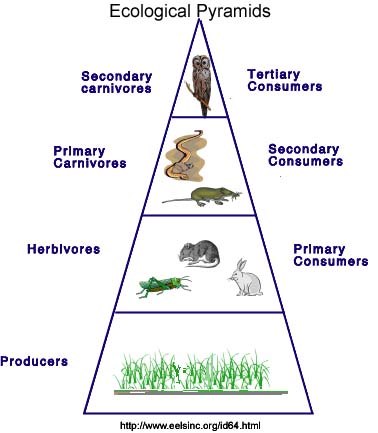
In the energy pyramid here, which organisms have the most energy available?
a)
Producers
b)
Carnivores
c)
Herbivores
d)
Top Predator
59.
If these organisms were arranged in a food pyramid, which organism would have the least amount of total energy available?
a)
coyote
b)
insect
c)
lizard
d)
shrub
60.
The largest group of organisms found in a food web would be:
a)
Primary Consumers
b)
Producers
c)
Decomposers
d)
Tertiary Consumers
61.
Which is the smallest level of an ecosystem?
a)
organsism
b)
population
c)
community
d)
ecosystem
62.
An area where an organism finds food, shelter and water in a specific arrangement
a)
niche
b)
biosphere
c)
biome
d)
habitat
63.
The living part of an ecosystem
a)
Biotic
b)
Abiotic
c)
Mother Earth
d)
Flowers
64.
A living relationship between two species in which one organism is harmed is called...
a)
mutualism
b)
commensalism
c)
parasitism
d)
niche
65.
An illustration that uses arrows to show the many possible directions in which matter and energy can pass through the organisms in an ecosystem.
a)
Food chain
b)
Food web
c)
Energy Pyramid
d)
Succession Map
66.
Water temperature would be an example of ...
a)
A biotic factor
b)
An abiotic factor
67.
If there is 1000 Kcal available in the producers in trophic level 1, how much energy is available in the herbivores in trophic level 2?
a)
10 Kcal
b)
1 Kcal
c)
100 Kcal
d)
1000 Kcal
68.

All of the fish and aquatic plants living in Mirror Lake are considered a

a)

species

b)

population

c)

community

d)

biome

69.

The portion of the planet in which living things are found

a)

ecosystem

b)

biosphere

c)

biome

d)

atmosphere

70.

Organisms that break down decaying material are

a)

consumers

b)

producers

c)

decomposers

71.

Desert, tropical rain forest, deciduous forest, and tundra are types of

a)

ecosystems

b)

biomes

c)

communities

d)

biospheres

72.

The role an organism plays in its environment is known as its

a)

ecosystem

b)

habitat

c)

niche

d)

biosphere

73.

The physical place where an organism lives is known as its

a)

niche

b)

habitat

c)

community

d)

biome

74.

These organisms must eat to obtain their energy

a)

autotrophs

b)

heterotrophs

c)

producers

d)

niche

75.
What is the name of an animal that is hunted and eaten by other animals?
a)
producer
b)
prey
c)
predator
d)
decomposer
76.
The concept that predators can affect the size and distribution of other animals is known as 
a)
predation
b)
herbivory
c)
tolerance
d)
limitation
77.
What is formed during primary succession that doesn't need to be formed during secondary succession?
a)
pioneer species
b)
soil
c)
climax community
d)
lichens
78.
After a forest fire, an ecosystem would start regrowth through -
a)
primary succession
b)
secondary succession
c)
climax community
d)
limiting factors
79.
Which catastrophic event will most likely have the effect of returning an ecosystem to primary succession?
a)
A tornado
b)
A volcanic eruption
c)
A flood
d)
A drought
80.
succession that occurs in an area with no soil
a)
ecological succession 
b)
primary succession 
c)
secondary succession
d)
pioneer speciles
81.
succession that occurs in an area where soil is already present
a)
ecological succession 
b)
primary succession 
c)
secondary succession
d)
pioneer speciles
82.
starts with bare rock followed by lichen
a)
primary succession 
b)
secondary succession
c)
both types of succession
83.

Which experiences the least change over time?

a)

Pioneer Species

b)

Primary Succession

c)

Aquatic Succession

d)

Climax Community

84.

Which would result in primary succession?

a)

volcano destroying habitat leaving only soil and ash

b)

Tornado destroying a crop leaving very little soil

c)

Glacier retreating exposing bare rock

d)

limiting factors

85.

What best describes the term succession?

a)

rapid changes that create an ecosystem overnight

b)

gradual changes over time to fully create or restore and ecosystem

c)

forest with the tallest trees

d)

the rate species produce offspring

86.
What are areas where freshwater meets saltwater called?
a)
wetlands
b)
estuaries
c)
coastal byways
d)
intertidal zones
87.
What factors affect aquatic ecosystems? 
a)
Light, salinity, temperature
b)
Sun, moon and stars
c)
Nothing
d)
Coral reefs, whales
88.

Which ecosystem provides most of the world's oxygen?

a)

kelp forest

b)

estuary

c)

coral reef

d)

open ocean

89.

permanently dark layer of the oceans below the photic zone

a)

aphotic zone

b)

photic zone

c)

surface zone

d)

intertidal zone

90.

Portion of the marine biome that is shallow enough for sunlight to penetrate.

a)

open ocean

b)

aphotic zone

c)

photic zone

d)

deep zone

91.

A mix of freshwater and saltwater is called:

a)

wetland

b)

mangal

c)

brackish

d)

osmoconformer

92.

Which effect does deforestation have on the carbon cycle?

a)

decreased CO2 in the atmosphere

b)

increased CO2 in the ocean

c)

increased CO2 in the atmosphere

d)

decreased decomposition of carbon

93.

What is the source of phosphorus in ecosystems?

a)

respiration by plants and animals

b)

erosion of nutrients

c)

radiant energy from sunlight

d)

fixation by microbes

94.

Which of the following statements is true about the nitrogen cycle?

a)

Nitrogen has a critical role in ecosystems because it is the primary building block of fats and lipids.

b)

Most of the nitrogen in the nitrogen cycle is held in living plants.

c)

Nitrogen reenters the atmosphere through animal and plant respiration.

d)

Plants take in nitrogen through their roots.

95.

Every food chain begins with a(n) ____________ and ends with a(n) _____________.

a)

primary consumer ; tertiary consumer

b)

producer ; decomposer

c)

producer ; scavenger

d)

herbivore ; carnivore

96.

Which of the following is NOT a freshwater ecosystem?

a)

an estuary

b)

a stream

c)

a river

d)

a lake

97.

Animals that get energy by eating the carcasses of other animals that have been killed by predators or have died of natural causes are called

a)

detritivores.

b)

omnivores.

c)

decomposers.

d)

scavengers.

98.

In which biome do you live?

a)

temperate forest

b)

grassland

c)

tropical rainforest

d)

savanna

99.

Earth has three main climate zones because of the differences in latitude and, thus,

a)

winds

b)

amount of precipitation received.

c)

distribution of sunlight.

d)

ocean currents.

100.

A seed is eaten by a chipmunk. The chipmunk is eaten by a snake. The snake is eaten by an eagle. In this food web, all the following are true EXCEPT

a)

the eagle is the highest trophic level

b)

the seed is part of a producer

c)

the chipmunk is the primary consumer

d)

energy is gained at each tropic level