
 Worksheets
DNA Unit review Pre-AP
Total questions: 65
Worksheet time: 43mins

Which of the following units are repeatedly joined together to form a strand of DNA?
amino acids
nucleotides
fatty acids
polysaccharides

In DNA, Adenine bonds with ______________.
Guanine
Thymine
Cytosine
Adenine
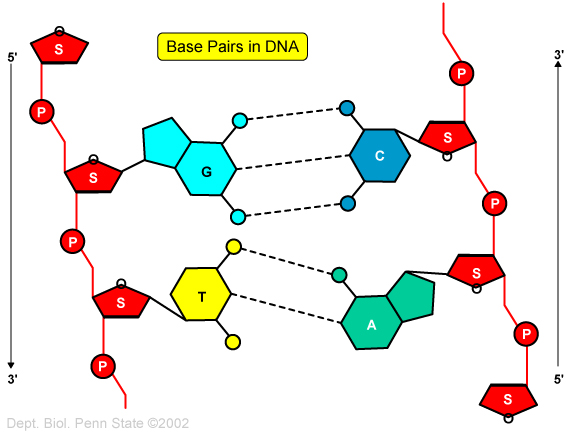
Nitrogenous bases (A to T and C to G) are joined by which type of bond?
hydrogen, sugar, nitrogen base
oxygen, sugar, nitrogen base
phosphate, sugar, nitrogen base
phosphate, sugar, protein
ATG GGA ACT CCA
DNA replication is "semi-conservative". What does this mean?
Each new piece of DNA is half old/half new
The DNA code sometimes remains intact
One entire new DNA molecule is created, the old molecule is completely conserved

T-G-A-C-C-A
T-G-A-G-C-A
Are all mutations harmful?
Yes
No
In RNA, adenine binds with ?
thymine
uracil
cytosine
guanine
The process of making mRNA from DNA is called?
replication
translation
transcription
duplication
Which of the following DNA mutations would be considered a silent mutation?
GAG mutated to GAC
GGC mutated to GCC
TAA mutated to AAA
CCC mutated to CTC
What organelle binds to mRNA in order to make the protein?
ribosome
mitochondria
chloroplast
lysosome
TGGCAAGTACGT
Things such as radiation that are KNOWN to cause mutations are known as
mutagens
mutation agents
DNA splicers
nogoodnics


diameter of the DNA molecule
A binds with T and C binds with G in DNA. These are called...
sugar-phosphate backbone
nucleotides
base pairs
hydrogen bonds
Which of the following could be a nucleotide found in DNA?
phosphate + ribose sugar + thymine
phosphate + ribose sugar + guanine
phosphate + deoxyribose sugar + adenine
phosphate + deoxyribose sugar + uracil
Which of the following could be a nucleotide found in RNA?
phosphate + ribose sugar + thymine
phosphate + ribose sugar + guanine
phosphate + deoxyribose sugar + adenine
phosphate + deoxyribose sugar + uracil
If a particular DNA gene contains 1233 Adenine bases, it will also contain 1233
Thymine bases
Phosphate groups
Cytosine bases
Guanine bases
The number of Guanine bases in a piece of DNA will always be equal to the number of ________________ bases
Thymine
Adenine
Cytosine
Uracil

What process is shown here?
Transcription
Translation
Replication
Gene Splicing
How many nucleotide bases make up one codon?
1
3
5
10
If mRNA contains a codon that reads CGU, what anticodon on a tRNA would bind to this codon?
CGU
GCT
GCA
UCG
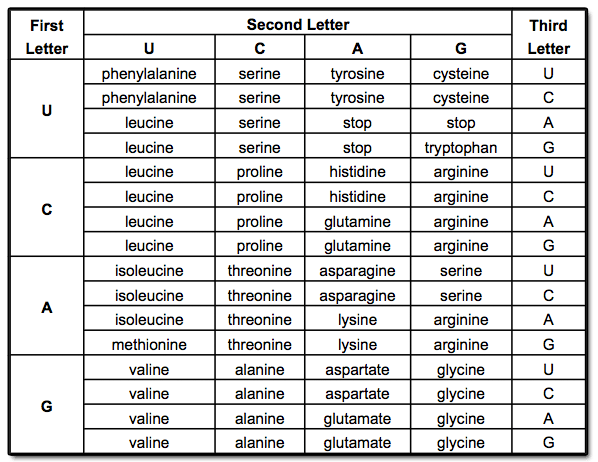
If a section of DNA reads T G A, what amino acid will be added to the protein chain?
Arginine
Glutamic Acid
Lysine
Threonine
Which sequence of bases would make up the complementary strand of the DNA below?
ATGTG
ATGTG
TACAC
GTAAG
CATTC

This molecule is a ________
tRNA
rRNA
mRNA
xRNA
This molecule's job is ....
to create mRNA from DNA in the nucleus
to fix errors in RNA whenever they occur
to bring amino acids to the ribosome where a protein chain is forming
To bind to RNA and remain bound until an entire chromosome has been coded
A particular protein is supposed to be 1200 base pairs in length. A mutation in the DNA causes a STOP codon which stops the production of the protein after 325 amino acids. What type of mutation is this?
missense
nonsense
silent
premature
Which type of mutation would likely cause the MOST change in a protein?
A substitution
An insertion of 3 base pairs
A deletion of 1 base
Which of these can cause DNA mutations?
Some chemicals such as cigarette smoke
UV radiation
They occur naturally through aging
All of these can cause mutations
Which of the following would be considered a "frame-shift" mutation in DNA that should be TTA CCG ATA GAG
TAA CCG ATA GAG (one base substitution)
AAA DGC ATA GAG (two base substitution)
TTA GCC GAT AGA G.. (one base insertion)
The sides or "backbone" of DNA is made of
base pairs
sugars and phosphates
hydrogen bonds
hydrogen and oxygen
A "missense" substitution causes a change in..
one amino acid
all amino acids
no amino acids

What process is shown here?
Transcription
Translation
Replication
DNA creation
WHY would DNA need to replicate?
When growth is occurring and new cells are needed
When old cells are damaged and need to be replaced
When reproduction occurs and the baby is growing
All of the above
When DNA "unzips" and makes a copy of itself using DNA polymerase, this process is called
Transcription
Translation
Replication
Protein Synthesis

Each piece of DNA created is 1/2 "old" and half "new" DNA. What is this called?
Halfsies
Semiconservative
Split molecules
Supercoiled

Where is the arrow pointing?
5' end
3' end

Purine or Pyrimidine?
Purine
Pyrimidine

Purine or Pyrimidine?
Purine
Pyrimidine
What enzyme UNZIPS the helix during DNA replication?
Helicase
Zipase
DNA Polymerase
Ligase
The DNA side that is created during replication using SHORT PIECES called Okazaki fragments is the
leading strand
lagging strand
old strand
A-T strand
What enzyme unzips AND adds nucleotides during transcription?
DNA helicase
RNA polymerase
Ribosomase
tRNA
A mutation that causes NO change in the resulting protein is a ______________ mutation.
Missense
Nonsense
Silent
Frame-shift
Transcription happens in the _______________, Translation happens in the ________________
Animal cell, Plant cell
Cytoplasm, Nucleus
Nucleus, Cytoplasm
Mitochondria, Nucleus
A small piece of DNA that will code for a protein is a ____________
Centriole
Gene
Amino acid
Nucleic Acid
DNA is directional - one side 5' to 3', the other side 3' to 5'. This is called
Ribosomal
Parallel
Mutated
Antiparallel

