
 Worksheets
Chapter 14/15 Work, Power, and Energy
Total questions: 72
Worksheet time: 3615secs
To calculate work done on an object,
divide distance by force
divide distance by time
multiply force by distance
divide force by distance
Frank does 2400 J of work in climbing a set of stairs. If he does the work in 6 seconds, what is his power output?
14400 Watts
400 Watts
40 Watts
0.0025 Watts
A student who weighs 500 Newton's climbed the stairs from the first floor to the third floor, 15 meters above, in 20 seconds. What was her power output?
375 Watts
25 Watts
300 Watts
33 Watts
If 55 Watts of power are used to do 275 J of work, how many seconds will it take for the work to be completed?
1 second
5 seconds
0.2 seconds
30 seconds


Which of the following statements is true?
To increase power, you can decrease the amount of work you do in a given amount of time, or you can do a given amount of work in less time.
To increase power, you can decrease the amount of work you do in a given amount of time, or you can do a given amount of work in more time.
To increase power, you can increase the amount of work you do in a given amount of time, or you can do a given amount of work in less time.
To increase power, you can increase the amount of work you do in a given amount of time, or you can do a given amount of work in more time.
How many Horsepower is 12,500 watts?
9,325,000 hp
1776 hp
28.03 hp
17.76 hp


What is the kinetic energy of a zorb and human with a total mass of 90Kg rolling at 10m/s?
3,700J
900J
4,500J
6,500J

A crane carries an 8-m long steel girder weighing 2600 N out 12 m to the end of the crane. The crane did ___ of work.
0 J
2600 J
20800 J
31200 J
Kinetic energy is associated with ---.
speed
position
direction
temperature

A block starts at rest at point P at the top of a ramp which is height h above the ground. The block slides down one side and up the other, stopping at a point less than h above the ground.
The block did not go as high on the other side because gravity pulls down.
The block did not go as high on the other side because potential energy always has to decrease.
The block did not go as high on the other side because work from friction made the mechanical energy less.
The situation as described is impossible to happen.

If there is no friction on this track, at which point would the coaster have the most kinetic energy?
A
B
C
D

Where is the roller coaster gaining potential energy?
A to B
B to C
C to D
The roller coaster is always losing potential energy
What effect do external forces like an applied force, friction force, or drag force have?
They have no effect on a system's mechanical energy.
They convert kinetic energy into potential energy.
They convert potential energy into kinetic energy.
They convert between mechanical energy and other forms of energy to change the total mechanical energy of the system.
What is needed to calculate work?
force
distance
time
mass
Which of these items is not part of the law of conservation of energy?
energy cannot be created
energy cannot be destroyed
energy can be transferred between forms
energy is destroyed by friction


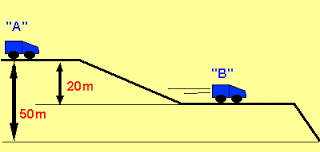
In diagram 2, if the mass of the car is 600 kg, what is the change in potential energy from point A to point B?
411,600 J
294,000
176,400 J
117,600 J
A weightlifter holds a 100 kg barbell above her head. Is work done?
Yes because there is a force applied to the barbell and the force causes a displacement of the barbell.
Yes because there is an upward force applied to the barbell and the barbell moves vertically.
No because no displacement occurred.
No because there is no force applied.

How will you describe the energy at Point A?
mostly potential energy
mostly kinetic energy
losing PE, gaining KE
losing KE, gaining PE
The "power" of a machine measures...
The work it does
The force it produces
The rate of doing work
Its strength
It takes 60 J of work to push a large box 6 m across a floor. Assuming the push is in the same direction as the displacement, what is the magnitude of the force on the box?
6 N
10 N
60 N
360 N
None of these
When a car breaks to a stop, all its kinetic energy is converted to...
Stopping Energy
Potential Energy
Chemical Energy
Heat through friction
Nuclear Energy

What type of energy transformation occurs, when a hawk eats a mouse and then uses the energy from the mouse to fly?
mechanical energy to chemical energy
thermal energy to mechanical energy
chemical energy to mechanical energy
mechanical energy to thermal energy

