wayground logo

Free Printable Worksheets

NEW

Font size

S
M
L
XL
Worksheets

Chemical Reactions Practice Test

Total questions: 48

Worksheet time: 1hrs 3mins
Name
Class
Date
1.
hydrochloric acid
a)
HClO3
b)
HClO2
c)
HClO
d)
HCl
2.
nitrous acid
a)
H2NO3
b)
HNO3
c)
HNO2
d)
H2NO2
3.
H2SO3
a)
sulfuric acid
b)
hydrosulfuric acid
c)
sulfurous acid
d)
persulfuric acid
4.
chlorous acid
a)
HClO3
b)
HClO2
c)
HClO
d)
HCl
5.
Select the name for the following acid: H2SO4
a)
Sulfuric acid
b)
Sulfurous acid
c)
Hydrosulfuric acid
6.
bromic acid
a)
HBr
b)
H2Br
c)
HBrO3
d)
HBrO4
7.
What is the formula for Hydrochloric Acid?
a)
HClO3
b)
HClO2
c)
HClO
d)
HCl
8.
Name the Acid: H2S
a)
Sulfuric Acid
b)
Sulfurous Acid
c)
Hydrosulfuric Acid
d)
Hydrosulfurous Acid
9.
The substances listed on the right side of a chemical equation are the
a)
Yields
b)
Reactants
c)
Products
d)
Precipitates
10.
The substances listed on the left side of a chemical equation are the
a)
Products
b)
Coefficients
c)
Precipitates
d)
Reactants
11.
In chemical reactions, what does the principle of conservation of mass mean?
a)
Matter is not created or destroyed.
b)
The total mass of the reactants is greater than the total mass of the products.
c)
The total mass of the reactants is less than the total mass of the products.
d)
Matter is not changed.
12.
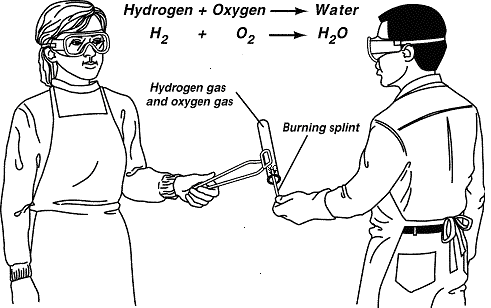
Identify the reactant(s) and product(s) of the reaction.
a)
All three are reactants and none are products.
b)
Hydrogen and water are the reactants, and oxygen is the product.
c)
Water and oxygen are the reactants, and hydrogen is the product.
d)
Hydrogen and oxygen are the reactants, and water is the product.
13.
How many Oxygen (O) atoms are in 2C2HO8Cl2
a)
2
b)
16
c)
8
d)
5
14.
How many Hydrogen (H) atoms are in NH3O5
a)
3
b)
4
c)
5
d)
1
15.
Which is the Law of Conservation of Matter?
a)
matter cannot be created or destroyed, it only changes form
b)
matter can be created but it cannot be destroyed, it never changes form
c)
matter can be destroyed but it cannot be created, it usually just changes form
d)
matter is an unproven theory created by Hans Geiger
16.
How many molecules of Carbon are in the following formula? 3C2H6
a)
3
b)
6
c)
12
d)
18
17.
How many elements are in C6H12O6?
a)
1
b)
2
c)
3
d)
4
18.
Which of the following shows the correct way to balance the chemical equation?
Fe + O2 -> Fe2O3
a)
4Fe + 3O2 -> 2Fe2O3
b)
2 Fe + 3O2 -> Fe2O6
c)
4 Fe + O6 -> 2Fe2O3
d)
None of the options are correctly balanced.
19.
Which of the following reactions is balanced?
a)
2CH4 + O2 -> CO2 + H2O
b)
CH4 + 2O2 -> CO2 + H2O
c)
CH4 + 2O2 -> CO2 + 2H2O
d)
None of the chemical equations are balanced.
20.
How many HCl molecules do you need to balance this equation? 
Mg +  __HCl --->  MgCl2 + H2
a)
1
b)
2
c)
3
d)
4
21.
Which coefficients balance this equation:
NH3  +  O2 ---->   NO  + H2O
a)
2,3,5,6
b)
5,5,4,6
c)
4,6,4,5
d)
4,5,4,6
22.
Balance this equation
_Al +_HCl --> _H+_AlCl3
a)
2, 6, 3, 2
b)
it is already balanced
c)
4, 12, 3, 4
d)
2, 1, 4, 5
23.
Balance this equation.
_CH4 + _O--> _CO+ _H2O
a)
1,2,1,1
b)
2,1,2,1
c)
1,2,1,2
d)
0,2,0,2
24.
What type of reaction occurs between an element and a compound?
Zn + 2HCl --> ZnCl2 + H2
a)
Synthesis
b)
Decomposition
c)
Single Replacement
d)
Double Replacement
25.
What kind of reaction is this:
2H2 + O2 --> 2H2O
a)
Synthesis
b)
Decomposition
c)
Single Replacement
d)
Double Replacement
26.
What kind of reaction is this:
4Fe  +  3O2 →   2Fe2O3 
a)
Synthesis
b)
Decomposition
c)
Single Replacement 
d)
Double Replacement
27.
What kind of reaction is this:
2H2O2 →2 H2+ O2
a)
Synthesis
b)
Decomposition
c)
Single Replacement 
d)
Combustion
28.
What kind of reaction is this:
2C3H7OH +9O2 -> 6CO2 + 8H2O
a)
Double Replacement
b)
Combustion
c)
Single Replacement
d)
Decomposition
29.
What kind of reaction is this:
Fe + CuSO4 -> Cu + FeSO4
a)
Double Replacement
b)
Decompostion
c)
Single Replacement
d)
Combustion
30.
The reaction below is an example of?
AgNO3 + NaCl 
→ AgCl + NaNO3
a)
Single Replacement
b)
Double Replacement
c)
Decomposition
d)
Combustion
31.
What kind of reaction is this:
 CaCO3 + Ag2SO4 → CaSO4 + Ag2CO3 
a)
Decomposition
b)
Single Replacement
c)
Double Replacement
d)
Combustion
32.
An element plus additional element reacts to form one product is an example of which type of chemical reaction? 
a)
combustion
b)
decomposition 
c)
synthesis 
d)
single replacement
33.
Which type of reaction takes place in the presence of oxygen and produces carbon dioxide and water?
a)
double replacement 
b)
decomposition 
c)
combustion 
d)
single replacement
34.
What type of reaction is illustrated below?
2HI --> H2  +  I2
a)
synthesis
b)
decomposition
c)
single replacement
d)
double replacement
35.
Which type of reaction involves one element and one compound reacting?
a)
Single Replacement
b)
Double Replacement
c)
Combustion
d)
Synthesis
36.
Select the pair of words that correctly displays the general FORMAT for writing CHEMICAL EQUATIONS.
a)
products  -->  reactants
b)
products  -->  products
c)
reactants  -->  products
d)
reactants  -->  reactants
37.
What does the ARROW in a Chemical Equation mean?
a)
"yields"
b)
"equals"
c)
"moves over"
38.
Which is the correct formula for the compound formed between beryllium and nitrogen?
a)
BeN
b)
Be3N
c)
Be3N2
d)
Be2N3
39.
Which is the correct formula for the compound Chromium (II) Nitrate?
a)
Cr2NO3
b)
(Cr)2NO3
c)
CrNO2
d)
Cr(NO3)2
40.
Which is the correct name for the compound Na3P?
a)
Sodium Phosphide
b)
Sodium Phosphite
c)
Sodium Phosphate
d)
Sodium (III) Phosphide
41.
Which is NOT a diatomic molecule?
a)
Fluorine
b)
Nitrogen
c)
Boron
d)
Bromine
42.
Which is the correct name for the compound N2O3?
a)
dinitro trioxide
b)
nitrogen (II) oxide (III)
c)
trinitrogen dioxide
d)
dinitrogen trioxide
43.

Which is the correct chemical equation for the following: Solid Zn reacts with silver (I) chloride to produce Zinc (II) chloride and silver metal

a)

Zn + AgCl → ZnCl2 + Ag

b)

ZnCl2 + Ag → Zn + AgCl

c)

ZnCl2 + Ag2 → Zn + AgCl

d)

Zn2Cl + Ag → Zn + AgCl

44.

Which is the correct chemical equation for the following: Barium Chloride combined with sodium sulfide yields barium sulfide and sodium chloride

a)

BaCl + NaS → BaS+ NaCl

b)

BaCl2 + Na2S → BaS+ NaCl

c)

BaS+ NaCl → BaCl + NaS

d)

BaCl2 + Na2S → BaS+ NaCl2

45.
Which of the following is a reactant in this equation? 
Methane gas (CH4) reacts with Oxygen gas (O2) to produce  water and carbon dioxide gas (CO2).
a)
CO2
b)
CH4
c)
H2
d)
CH2
46.

Aluminum metals is immersed in a solution of silver nitrate, forming aluminum nitrate and silver metal.

a)

Al + AgNO3 → AlNO3 + Ag

b)

Al + 3 AgNO3 → Al(NO3)3 + 3 Ag

c)

Al + Ag2NO3 → AlNO3 + 2 Ag

d)

2 Al + 3 Ag(NO3)2 → 2 Al(NO3)3 + 3 Ag

47.

Bromine is added to a container of sodium iodide, forming sodium bromide and iodine.

a)

2 Br + 2 NaI → 2 NaBr + I2

b)

2 Br2 + 2 NaI → 2 NaBr2 + I2

c)

Br2 + 2 NaI → 2 NaBr + I2

d)

Br + NaI → NaBr + I

48.

Solutions of silver nitrate and magnesium chloride are mixed, forming silver chloride and magnesium nitrate.

a)

AgNO3 + MgCl2 → AgCl2 + MgNO3

b)

2 AgNO3 + MgCl2 → 2 AgCl + Mg(NO3)2

c)

AgNO3 + MgCl → AgCl + MgNO3

d)

2 AgNO3 + MgCl2 → 2 AgCl + 2 MgNO3