
 Worksheets
Year 9 Oil Quiz
Total questions: 45
Worksheet time: 45mins
Which of these is not a fossil fuel?
Coal
Oil
Electricity
Natural Gas
Why are fossils fuels so widely used?
They are renewable so they won't run out.
They pollution they produce is less compared to renewable energy sources.
They are easy to obtain and process.
They don't disrupt the environment when mined from the earth.

Compounds made only of carbon and hydrogen atoms are called ______________.
hydrocarbons
hydrogencarbonates
carbohydrates

A substance with a high boiling point . . .
changes rapidly from a liquid to a gas at a low temperature.
changes rapidly from a liquid to a gas at a high temperature.
flows easily.
doesn't flow easily.
is easy to ignite and burn.

The boiling point of hydrocarbons . . .
increases with increasing molecular size.
decreases with increasing molecular size.
is not affected by molecular size.

The viscosity of hydrocarbons depends on the size of their molecules. What is viscosity?
a measure of how difficult it is for a substance to flow
a measure of how easy it is to ignite and burn
a substance the temperature at which a substance rapidly changes state from a liquid to a gas

The flammability of hydrocarbons depends on the size of their molecules. What is flammability?
a measure of how difficult it is for a substance to flow
a measure of how easy it is to ignite and burn
a substance the temperature at which a substance rapidly changes state from a liquid to a gas
A highly flammable substance . . .
evaporates at a high temperature.
flows easily.
doesn't flow easily.
is easy to ignite and burn.
is difficult to ignite and burn
What term describes alkene molecules that contain a C=C double bond?
saturated
unsaturated
What term describes alkane molecules that contain C-C single bonds?
saturated
unsaturated
Where in the fractionating column are shorter chain hydrocarbon molecules obtained?
At the top
At the bottom
Fractional distillation separates crude oil based on the different __________ of the molecules in the mixture
melting point
boiling point
freezing point
chemical reactivity
Molecules collected at the bottom of the fractionating column tend to be...
more viscous, less flammable and less volatile
less viscous, more flammable and more volatile
more viscous, more flammable and less volatile
less viscous, less flammable and more volatile
What is the term given to the process by which longer chain hydrocarbons are broken down into shorter length alkanes and alkenes?
fractional distillation
evaporation
cracking
polymerisation

Name the following hydrocarbon
alkane
pentene
pentane
alkene
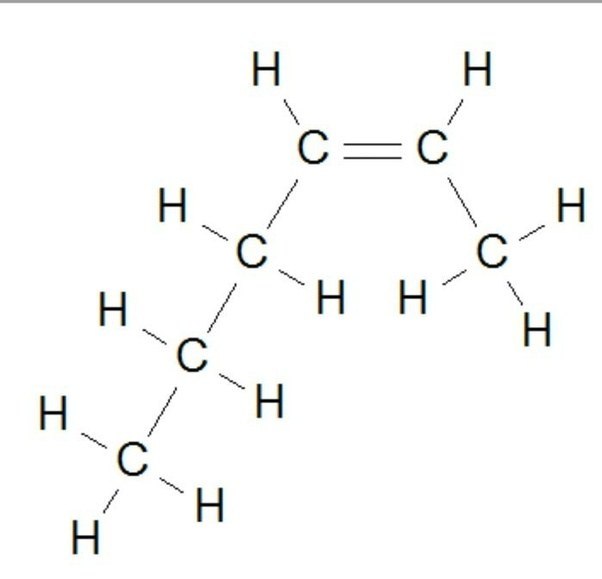
Name the following hydrocarbon
butane
hexane
heptane
hexene
Fuel for lorries
fuel oil
petroleum
diesel
bitumen
For surfacing roads
bitumen
refinery gas
petroleum
diesel
Fraction with the highest boiling point
bitumen
refinery gas
petroleum
diesel
is the alkene with 3 carbons in its chain.
Ethene
Propene
Methene
Decene
Is the simplest alkane
Ethane
Methane
Propane
Decane

C3H8
Match the following

Methane

Propene

Pentane

Ethane

Ethene
How many hydrogen atoms are in ethene (C2H4)?
2
3
4
6
What is the molecular formula for methane?
CH4
C2H6
C3H8
C4H10
Match the following

Butane
CnH2n
General formula for an alkene
CnH2n+2
General formula for an alkane

Hexane

Nonane
What chemicals are found in crude oil?
Methane only
A mixture of compounds, which are mostly hydrocarbons
A mixture of elements
Carbon only
What is the first stage in the fractional distillation of crude oil?
Heating, to vaporise the hydrocarbons
Heating, to make it a hot liquid
Cooling it
Separating the fractions
Hydrocarbons with shorter carbon chains are more flammable.
What does this make them useful for?
Lubricants
Fuels
Plastics
Feedstock
What happens to carbon and hydrogen during combustion reactions?
They are reduced
They are oxidised
They are cracked
They are distilled
Crude oil is which type of resource?
Finite
Non-Finite
Oil is used widely for the production of plastics as it is composed of which two elements?
Carbon and Helium
Oxygen and Hydrogen
Carbon and Hydrogen
Lead and Hydrogen
Which of the following is true about plastic?
It's cheap
It's versatile (many uses)
It's disposable
All of the above
True or False: Large pieces of plastic break down into smaller pieces in the ocean
True
False
The hydrocarbons that leave the top of the fractioning column are
solids
liquids
gases
What is the first state change that happens in the fractioning column?
evaporation
condensation
melting
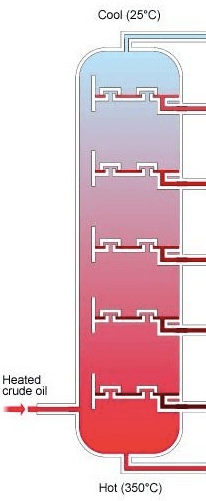
What process happens at each level in the fractionating column?
Evaporation
Condensation
Combustion
What process is used to separate crude oil in hydrocarbons with different chain lengths?
distillation
fractional distillation
cracking
polymerisation
What do scientists call plastics when they break down into tiny pieces?
Microtrash
Microplastics
Microparticles
Macroplastics
How does plastic trash cause marine life and sea birds to starve?
They mistake plastic for food, which clogs their stomachs and doesn't leave any room for real food.
Plastic takes up space in the water so marine animals have no place to live.
The plastic in the ocean is so dense that the marine life cannot find food easily.
Plastic doesn't cause marine life or sea bird to starve: they're smart enough to know the difference between plastic and food.

This is an image of what?
Oil Rig
Distillation Tower
Distillation Factory
Oil Refinery

