wayground logo

Free Printable Worksheets

Font size

S
M
L
XL
Worksheets

Invisible World Test

Total questions: 74

Worksheet time: 51mins

Name
Class
Date
1.
The clear, jelly-like material in a cell that supports and protects the cell’s organelles.
a)
Cytoplasm
b)
Cell Membrane
c)
Nucleus
d)
Mitochondria
2.
Controls the movement of materials in and out of the nucleus.
a)
Nuclear Membrane
b)
Cellular Membrane
c)
Cytoplasm
d)
Endoplasmic Reticulum
3.
Protects the cell from the outside environment. (Only Plants)
a)
Cell Membrane
b)
Chloroplasts
c)
Cell Wall
d)
Vacuoles
4.
Acts like a subway system, carrying protein through the cell.
a)
Golgi Apparatus
b)
Nuclear Membrane
c)
Ribosomes
d)
Endoplasmic Reticulum
5.
Provides support and protection for the cell while also controlling the movement of materials in and out of the cell.
a)
Cellular Membrane
b)
Nucleus
c)
Ribosomes
d)
Vacuole
6.
Breaks down food  to release energy. Known as the power plant of the cell.
a)
Endoplasmic Reticulum
b)
Mitochondria
c)
Ribosomes
d)
Cell Wall
7.
The part of the cell that is used for storage.
a)
Nucleus
b)
Cell Membrane
c)
Mitochondria
d)
Vacuole
8.
The control center of the cell.
a)
Nucleus
b)
Nuclear Membrane
c)
Chloroplasts
d)
Golgi Aparatus
9.
Uses energy from the sun to make food for the plant.
a)
Cell Wall
b)
Cell Membrane
c)
Chloroplasts
d)
Vacuole
10.
Structures in cytoplasm that help with cell life processes
a)
organ system
b)
cell wall
c)
organelles
11.
The smallest unit of an organism that carries on the functions of life
a)
cell
b)
tissue
c)
organ
12.
Temporary storage structure; stores water, waste and food
a)
nucleus
b)
endoplasmic reticulum
c)
vacuole
13.
Protects and gives shape to plant cells
a)
chloroplast
b)
cell wall
c)
ribosome
14.
Any living thing
a)
tissue
b)
organism
c)
organ system
15.
Contains instructions for everything the cell does
a)
lysosome
b)
cell membrane
c)
nucleus
16.
Which is an accurate difference between plant cells and animals cells?
a)
Plant cells have a cell wall, but animal cells do not. 
b)
Animal cells have a cell wall, but plant cells do not. 
17.
Which is an accurate statement?
a)
Animal cells contain chloroplast.
b)
Plant cells contain chloroplast.
18.
Which is an accurate statement?
a)
Plant cells have a large central vacuole.
b)
Animal cells have a large central vacuole.
c)
Prokaryotes have a large central vacuole. 
19.
Animal cells DO NOT have ...
a)
mitochondria
b)
lysosomes
c)
vacuoles
d)
chloroplasts
20.

Large balloon-shaped organelle?

a)

nucleus

b)

vacuole

c)

chloroplast

d)

lysosome

21.
Plants' vacuoles are larger because...
a)
plants require water
b)
plants have chloroplasts
c)
plants cannot move to find water and nutrients
d)
plants have cell walls
22.
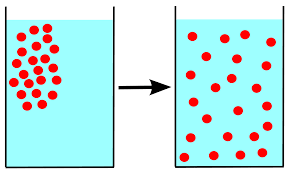
What is diffusion?
a)
when molecules move 
b)
when molecules move from a high concentration to a low.
c)
no movement 
d)
molecules move everywhere
23.
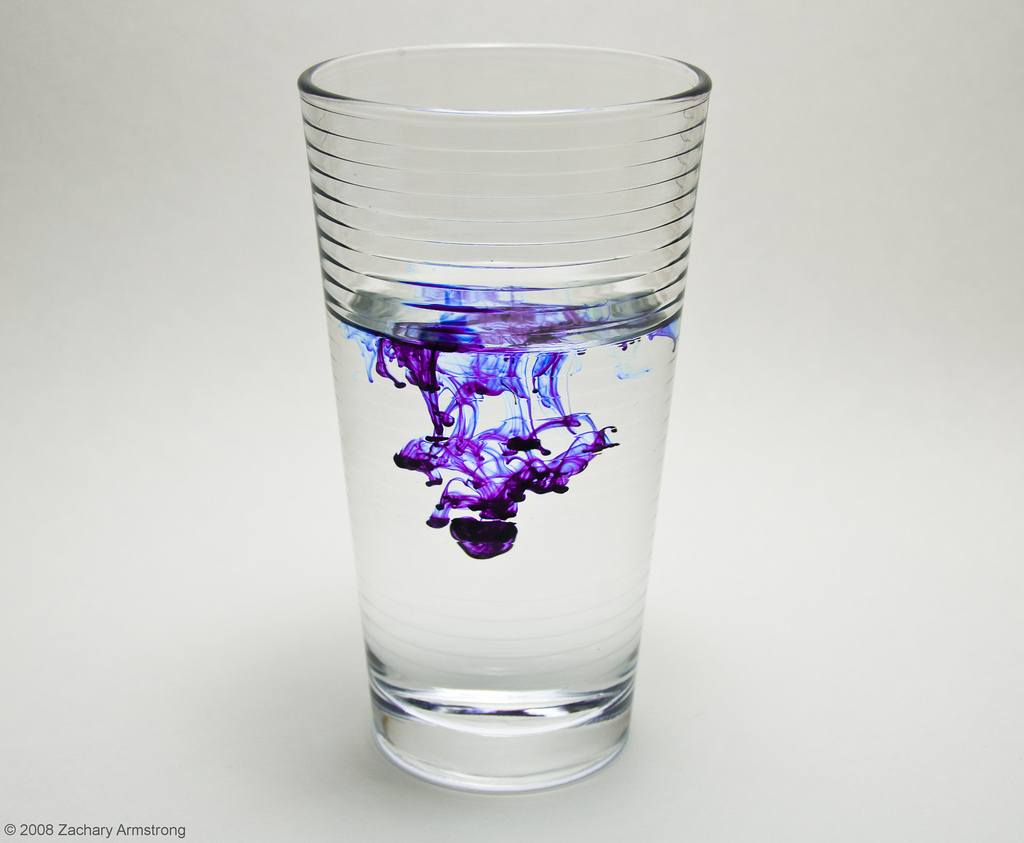
Where is there a low concentration of dye?
a)
at the bottom of cup
b)
in the color
c)
at the top of cup 
d)
no concenteraion gradient
24.
The picture below is an example of _________________.
a)
osmosis
b)
isotonic
c)
diffusion
d)
active transport
25.
Osmosis is the movement of _____ across a membrane.
a)
food
b)
energy
c)
oxygen
d)
water
26.
During osmosis
a)
water moves from high to low concentration
b)
large or oddly shaped molecules move across a cell membrane
c)
water moves when energy is used
d)
proteins are built
27.
The diffusion of water through a semi-permeable membrane is called?
a)
Osmosis
b)
Cell wall
c)
Diffusion
d)
Respiration
28.
Where is there a high concentration of water?
a)
in the flower
b)
cannot be determined by picture.
c)
in the vase
d)
in the leaves
29.
What is the definition of  Selective Permeability?
a)
The movement of materials across the cell membrane that requires NO ENERGY from the cell.
b)
The movement of materials through (or across) the cell membrane
c)
The ability of the cell membrane to allow some things to pass through while preventing other things from passing through.
d)
The movement of molecules from an area of high concentration to a area of low concentration 
30.
When both inside and outside of a cell have the same amount of water it is said that the cell has reached a state of
a)
Osmosis
b)
Diffusion
c)
Equilibrium
31.
Permeable means
a)
things can pass through
b)
the concentration levels are different
c)
it is permanent
d)
things are stuck
32.
If there is 5 percent water inside a cell and 5 percent water outside a cell
a)
more water will move inside the cell
b)
more water will move outside the cell
c)
There will be no movement of water cells
33.
Why do scientists use the scientific method?
a)
To make sure they get credit for their discoveries.
b)
To make sure their results are valid and can be performed by other scientists.
c)
So that other scientist don't get mad at them
34.
If plants are exposed to sunlight, then they will grow taller.
What part of the scientific method is this an example of?
a)
Procedure
b)
Hypothesis
c)
Question
d)
Results
35.
The summary at the end of an experiment that explains the results. 
a)
conclusion
b)
procedures
c)
materials
d)
hypothesis
36.
The independent variable is the ONE thing you _____.
a)
change on purpose
b)
control or keep constant
c)
measure
37.
An experiment is performed on plants to see how different liquids affect plant growth. Each plant in the experiment is given a different liquid: water, apple juice, or milk. What variables should be kept constant/controlled? 
a)
type of plant, flower pot,  soil, and amount of sunlight
b)
water, apple juice, milk
c)
only the amount of sunlight
d)
type of plant only
38.
Why do we want to test one variable at a time?
a)
Because it is hard to setup a data table with more
b)
To know what is causing the changes. This helps us understand cause and effect.
c)
It is what has always been done
39.
What is a constant/control in an experiment?
a)
Things that do not change inana experiment.  It's the variable that stays the same.  You can have many variables stay the same.
b)
It's the variables that the scientist changes in the experiment
c)
It's the variables that are being measured in an experiment
40.
What is being changed in this experiment?
a)
temperature of the stove
b)
how fast the water boils
c)
amount of water
41.
What is being measured or the result/effect of this experiment?
a)
how fast the water boils
b)
amount of water
c)
temperature of stove
42.
What is being kept constant?
a)
how fast the water boils
b)
amount of water
c)
temperature of stove
43.
The boy is in the water.
a)
inference
b)
observation
44.
The weather is cold.
a)
inference
b)
observation
45.
The tree branch is broken.
a)
inference
b)
observation
46.
If the boy crawled out of the water, the goat would push him in.
a)
inference
b)
observation
47.
The boy fell off the branch.
a)
inference
b)
observation
48.
There are three rocks in the pond.
a)
inference
b)
observation
49.
I am the outer most layer of an animal cell. What am I?
a)
cell wall
b)
nucleus
c)
cell membrane 
d)
cell skin
50.
The letter A is pointing to  the...
a)
Nuclues
b)
Cell Membrane
c)
Nucleolus
d)
Cytoplasm
51.
The letter E is pointing to  the...
a)
Nuclues
b)
Cell Membrane
c)
Cell Wall
d)
Cytoplasm
52.
The letter H is pointing to  the...
a)
Vacuole
b)
Cell Membrane
c)
Ribosome
d)
Cytoplasm
53.
What type of cell?
a)
prokaryotic
b)
plant cell
c)
animal cell
54.
What is F pointing to?
a)
mitochondria
b)
chloroplast
c)
ribosome 
d)
vacuole
55.
What is A pointing to?
a)
mitochondria
b)
chloroplast
c)
ribosome 
d)
vacuole
56.
What is D pointing to?
a)
nucleus
b)
chloroplast
c)
ribosome 
d)
nucluoles
57.
What is B pointing to?
a)
Smooth ER 
b)
Cell Membrane
c)
Golgi Apparatus
d)
Cell Wall
58.
What type of cell?
a)
prokaryotic
b)
plant cell
c)
animal cell
59.
life process are....
a)
human anatomy and physiology
b)
characteristics necessary for life of living organisms
c)
found in all things
d)
metabolism
60.
movement is 
a)
sum of all the chemical processes that occur in the body
b)
 an increase in the body size due to increasing the size of existing cells, the number of cell or  the amount of material surrounding the cell
c)
Includes motion of the whole body, individuals organs, single cells
d)
Is the body’s ability to detect and respond to changes 
61.
The removal of all the wastes produced by the cells of the body. 
a)
excretion 
b)
metabolism 
c)
digestion
d)
respiration 
62.
The ability of an organism to maintain a stable internal environment even when the external environment changes. 
a)
homeostasis 
b)
circulation (transport)
c)
reproduction 
d)
synthesis 
63.
Which statement reflects one of the major components of the cell theory?
a)
All living things are multi-cellular.
b)
Organs are the basic unit of structure and function for all living things.
c)
All cells come from previously existing cells.
d)
Every organism has a reproductive system to ensure survival of the species.
64.
A worm turns away from light is an example of a worm
a)
reproducing
b)
doing cellular respiration
c)
having cells
d)
responding to its environment
65.
Which of the following is the correct order of organization in living things from most basic (simple) to most complex?
a)
a.  Organism, cell, tissue, organ, organ system
b)
a.  Organ system, organ, tissue, cell, organism
c)
a.  Cell, tissue, organ, organ system, organism
d)
a.  Cell, organ, tissue, organ, organism, organ system
66.
The digestive system includes the stomach. What level is the stomach?
a)
organ
b)
tissue
c)
cell
d)
organism
67.

Using oxygen to release energy from food, occurs in the mitochondria

a)

RESPIRATION

b)

REPRODUCTION

c)

REGULATION

d)

EXCRETION

68.

The production of offspring-- can be sexual (2 parents) or asexual (1 parent)

a)

RESPIRATION

b)

REPRODUCTION

c)

REGULATION

d)

EXCRETION

69.

Response to stimulus: A process when an organism reacts (response) to change (stimulus) in its environment. Also known as homeostasis.

a)

RESPIRATION

b)

REPRODUCTION

c)

REGULATION

d)

EXCRETION

70.

The removal of waste products produced by cell activities from the organism. This can involved the skin, the kidneys and the lungs.

a)

RESPIRATION

b)

REPRODUCTION

c)

REGULATION

d)

EXCRETION

71.

Process by which an organism increases in size or cell growth.

a)

GROWTH

b)

NUTRITION

c)

TRANSPORT

d)

SECRETION

72.

This is the process by which living things take in materials from its environment for growth and repair.

a)

GROWTH

b)

NUTRITION

c)

TRANSPORT

d)

SECRETION

73.

Movement; this is the process by which usable materials are taken into the living thing

a)

GROWTH

b)

NUTRITION

c)

TRANSPORT

d)

SECRETION

74.

All organisms produce useful fluids needed for body activities. These fluids are called secretions.

a)

GROWTH

b)

NUTRITION

c)

TRANSPORT

d)

SECRETION