wayground logo

Free Printable Worksheets

Font size

S
M
L
XL
Worksheets

Unit 2 Test Pre-AP Biology 2018

Total questions: 91

Worksheet time: 1hrs 14mins

Name
Class
Date
1.
High Surface area to volume ratio allows cells to do what quickly?
a)
Move materials around inside the cell
b)
Move materials in and out of the cell 
c)
Communicate to other cells
d)
Divide
2.
Microvilli are tiny projections that extend off the cell to increase the Surface Area.  What purpose might that serve? 
a)
Increased absorption
b)
Better communication among cells
c)
Maintain homeostasis 
d)
Decreased oxygen use
3.
This image shows how materials move into various sized cells in a given amount of time.... why does one square cell have more pink coloring than the others? 
a)
The surface area was too larger to get through
b)
The volume of the other cells was too large for the dye to get through
c)
There was not enough surface area for the dye to get through
d)
The volume was too low for the dye to stay in the square
4.
Cells of organism must replicate for ?
a)
growth
b)
repair of damaged cells
c)
replacement of dying cells.
d)
All of the above
5.
Before cells can divide, what must be copied?
a)
mitochondria
b)
cytoplasm
c)
DNA
d)
Cell Wall
6.
The division of the nucleus is known as:
a)
Synthesis
b)
Mitosis
c)
G1
d)
G2
7.
The individual strands on duplicated chromosomes are called_____________
a)
Centromeres
b)
daughters
c)
Chromatids
d)
Karyotypes
8.
In the S stage of interphase_______________
a)
the cell grows
b)
the nucleus divides
c)
the cell membrane divides
d)
the DNA is replicated
9.
When an animal cell goes through cytokinesis,__________
a)
a cell plate forms dividing the 2 new nuclei.
b)
the cell membrane pinches off the 2 new cells.
c)
4 new cells are formed.
d)
None of the above
10.
What is a series of events a cell goes through as they grow and divide?
a)
Cell Division
b)
Cell Cycle
c)
Cytokinesis
d)
Mitosis
11.
What is the longest stage of the cell cycle called?
a)
Cytokinesis
b)
M phase
c)
Interphase
d)
G1 Phase
12.
During what stage does the G1, S and G2 phases happen?
a)
Interphase
b)
M phase
c)
Mitosis
d)
Cytokinesis
13.
During what phase of the cell cycle does cell division occur?
a)
Interphase
b)
M phase
c)
S phase
d)
G2 phase
14.
During what phase of the cell cycle is DNA replicated?
a)
G1 phase
b)
S phase
c)
G2 phase
d)
M phase
15.
How many stages are in mitosis?
a)
1
b)
2
c)
3
d)
4
16.
Put the following stages of mitosis in order: anaphase, prophase, metaphase, and telophase. 
a)
prophase, metaphase, telophase, anaphase
b)
prophase, anaphase, metaphase, telophase
c)
prophase, metaphase, anaphase, telophase
d)
prophase, telophase, metaphase, anaphase
17.
Put the following stages of the cell cycle in order: G2, S, G1, M. 
a)
G1, S, G2, M
b)
S, G1, G2, M
c)
G1, M, G2, S
d)
M, G1, S, G2
18.
Put the following in order: G2, G1, S, mitosis, cytokinesis. 
a)
G1, G2, S, Mitosis, cytokinesis
b)
G1, S, G2, Mitosis, cytokinesis
c)
G1, G2, S, cytokinesis, mitosis
d)
G1, S, G2, cytokinesis, mitosis
19.
Put the following actions in order: DNA replicates, cell grows, cell divides, cell prepares for mitosis. 
a)
DNA replicates, cell grows, cell prepares for mitosis, cell divides
b)
cell grows, cell prepares for mitosis, DNA replicates, cell divides
c)
cell grows, DNA replicates, cell prepares for mitosis, cell divides
d)
DNA replicates, cell prepares for mitosis, cell grows, cell divides
20.
Why would it be important to replicate DNA before a cell divides in mitosis or meiosis?
a)
In order for genetic information to be transferred into daughter cells.
b)
In order for the cell to be able to increase in size.
c)
In order for the DNA to be contained in the nucleus.
d)
In order for the cell to re-order the DNA sequencing in the new cells.
21.
a)
Prophase
b)
Interphase
c)
Anaphase
d)
Telophase
22.
a)
Anaphase
b)
Cytokinesis
c)
Telophase
d)
Metaphase
23.
a)
Cytokinesis
b)
Interphase
c)
Anaphase
d)
Metaphase
24.
a)
Cytokinesis
b)
Anaphase
c)
Telophase
d)
Prophase
25.
In mitosis, the two resulting cells are
a)
different from the starting cell and identical to each other.
b)
different from the starting cell and different from each other.
c)
identical to the starting cell and different from each other.
d)
identical to the starting cell and identical to each other.
26.
The cell spends most of its time in (in between) which phase?
a)
anaphase
b)
interphase
c)
prophase
d)
metaphase
27.
Fruit fly body cells have 8 chromosomes. After mitosis, you would expect a resulting fruit fly daughter cell to have -
a)
16 chromosomes.
b)
46 chromosomes.
c)
8 chromosomes.
d)
4 chromosomes.
28.
The dark "spider" looking things on opposite sides of the cell are called "Spindle Fibers".  What is their job?
a)
Eating the chromosomes
b)
Pulling the chromosomes apart
c)
Putting the chromosomes together
29.
The cell membrane pinches in, cutting the cytoplasm into 2 cells
a)
Metaphase
b)
Anaphase
c)
Telephase
d)
Cytokinesis
30.
Name the phase:
a)
Anaphase
b)
Telophase
c)
Metaphase
d)
Prophase
31.
What is the next phase of mitosis?
a)
Prophase
b)
Metaphase
c)
Anaphase
d)
Telophase
32.
How many chromosomes do humans have?
a)
46
b)
21
c)
10
33.
Which sequence of DNA bases would pair with this partial strand
ATG TGA CAG
a)
ATG TGA CAG
b)
TAC ACT GTC
c)
GTA AGT GAC
d)
CAT TCA CTG
34.
Which enzyme seals okazaki fragments together on the lagging strand?
a)
Topoisomerase
b)
Helicase
c)
Polymerase
d)
Ligase
35.
What is the purpose of DNA replication?
a)
Cut the DNA 
b)
Make more cells
c)
Apoptosis
d)
Duplicate the DNA
36.

Which enzyme assembles new nucleotides?

a)

Topoisomerase

b)

Helicase

c)

DNA Polymerase

d)

Ligase

37.
Which enzyme breaks the hydrogen bonds between the two DNA strands?
a)
Topoisomerase
b)
Helicase
c)
DNA polymerase
d)
Ligase
38.
What do we call DNA replication since new DNA has 1 parent strand and 1 new strand?
a)
Conservative 
b)
Semiconservative 
c)
Dispersive
39.
Why is it crucial that living things are able to replicate their DNA?
a)
Each cell must have its own DNA
b)
Less copies of DNA are needed when a new cell is created
c)
A cell needs multiple copies of DNA
d)
Only muscle cells need DNA 
40.
DNA replication results in two DNA molecules,
a)
each one with two original strands
b)
each one with two new strands
c)
each one with one new strand and one original strand
d)
one with two new strands and the other with two original strands
41.
DNA Replication is the process of turning 1 DNA molecule into...
a)
1 DNA molecule
b)
2 DNA molecules
c)
3 DNA molecules
d)
4 DNA molecule
42.
Before DNA can replicate it has to...
a)
Separate the two strands
b)
Find 4 new strands
c)
Ask its mom
43.
What is the end result of replication?
a)
Two new identical strands of DNA
b)
One parent strand and one daughter strand of DNA
c)
Two new and different strands of DNA
d)
One new strand of DNA
44.

What best describes the solution the cell is in?

a)

Hypotonic Solution

b)

Hypertonic Solution

c)

Isotonic Solution

45.

What will happen to the cell in the given solution?

a)

Swell up

b)

Shrink

c)

Stay the same

46.

What best describes the solution the cell is in?

a)

Hypotonic Solution

b)

Hypertonic Solution

c)

Isotonic Solution

47.

What best describes the solution the cell is in?

a)

Hypotonic Solution

b)

Hypertonic Solution

c)

Isotonic Solution

48.
Which process involves the movement of molecules from high concentration to low concentration?
a)
Endocytosis
b)
Active transport
c)
osmosis
d)
phagocytosis
49.
An animal cell placed in a hypertonic (salty) solution will
a)
Shrink (get smaller)
b)
Swell (get bigger)
c)
Stay the same 
50.
Water will move INTO a cell in a(n) _______ solution
a)
Hypertonic
b)
Hypotonic
c)
Isotonic
d)
Gravy
51.
A molecule that diffuses down a concentration gradient goes from an area of ______ concentration into an area of ______ concentration.
a)
high, low
b)
low, high
c)
passive, active
d)
active, passive
52.
A cell started out with 60 g of mass. Then, when put in a solution, it decreased in mass to 40 g. What type of solution was it in?
a)
Hypertonic
b)
Hypotonic
c)
Isotonic
d)
Gin and Tonic
53.
A cell started out with 60 g of mass. Then, when put in a solution, it decreased in mass to 40 g. What happened in this experiment?
a)
Water moved out of the cell
b)
Water moved into the cell
c)
Water moved in and out of the cell at the same rate
d)
The water did not move
54.
In this picture, which way will the water move?
a)
Water will move into the cell
b)
Water will move out of the cell
c)
Water will move in and out of the cell
d)
Water will not move
55.
In this picture, how do you classify the solution?
a)
The solution is hypotonic
b)
The solution is hypertonic
c)
The solution is isotonic
d)
The solution is my tonic
56.
What is diffusion?
a)
when molecules move 
b)
when molecules move from a high concentration to a low.
c)
no movement 
d)
molecules move everywhere
57.
During osmosis
a)
water moves from high to low concentration
b)
large or oddly shaped molecules move across a cell membrane
c)
water moves when energy is used
d)
proteins are built
58.
The diffusion of water through a semi-permeable membrane is called?
a)
Osmosis
b)
Cell wall
c)
Diffusion
d)
Respiration
59.
Endocytosis is defined as
a)
the movement of large molecules from the inside of the cell to the outisde of the cell using channel proteins. 
b)
the movement of large molecules from the inside of the cell to the outisde of the cell membrane vesciles. 
c)
 the movement of large molecules from the outside of the cell to the inside of the cell using membrane vesciles.
d)
the movement of large molecules from the outside of the cell to the inside of the cell using channel proteins. 
60.
Active transport _______ and is the movement of a substance from _____ to _____ concentration
a)
requires energy, high to low
b)
requires no energy, low to high
c)
 requires no energy, high to low
d)
 requires energy, low to high
61.
If something goes "along" its concentration gradient it goes from
a)
an area of low concentration to an area of high concentration
b)
an area of high concentration to an area of low concetration
62.
In this image, the cell is using which type of molecular transport?
a)
Osmosis
b)
Diffusion 
c)
Endocytosis
d)
Exocytosis 
63.
Passive transport
a)
 always occurs slowly
b)
 does not require energy
c)
requires energy
64.
If something goes "along" its concentration gradient it goes from
a)
an area of low concentration to an area of high concentration
b)
an area of high concentration to an area of low concetration
65.
Large particles being encased in a vesicle and brought into the cell.
a)
endocytosis
b)
exocytosis
c)
passive transport
d)
active transport
66.
A type of active transport that releases particles that were enclosed from a cell when the membrane of the vesicle fuses with that of the cell membrane
a)
Exocytosis
b)
Osmosis
c)
Mitosis
d)
Endoyctosis
67.
Moving particles while using a cell's energy
a)
Osmosis
b)
Diffusion
c)
Photosynthesis
d)
Active Transport
68.
This picture represents what type of cell transport?
a)
endocytosis
b)
exocytosis
c)
osmosis
d)
passive transport
69.
This picture represents which type of cellular transport?
a)
passive transport
b)
endocytosis
c)
exocytosis
d)
osmosis
70.
This picture represents which type of cellular transport?
a)
passive transport
b)
endocytosis
c)
exocytosis
d)
osmosis
71.

Diffusion & Facilitated Diffusion are both __________ transport.

a)

Passive

b)

Active

c)

Easy

d)

Free

72.

What is the movement of particles with the concentration gradient using protein "helpers"?

a)

diffusion

b)

facilitated diffusion

c)

active transport

d)

enzymatic reactions

73.
A ______________ is composed of a phosphate and glycerol head and 2 fatty acid chain tails. 
a)
phospholipid 
b)
Carbohydrate
c)
Cholesterol 
d)
Protein 
74.
This is a balance that organisms maintain through self-regulating adjustments
a)
bilayer
b)
homeostasis
c)
secretions
75.
_______________  requires energy in the form of ATP
a)
Osmosis
b)
Active transport
c)
Facilitated diffusion
d)
Passive transport
76.
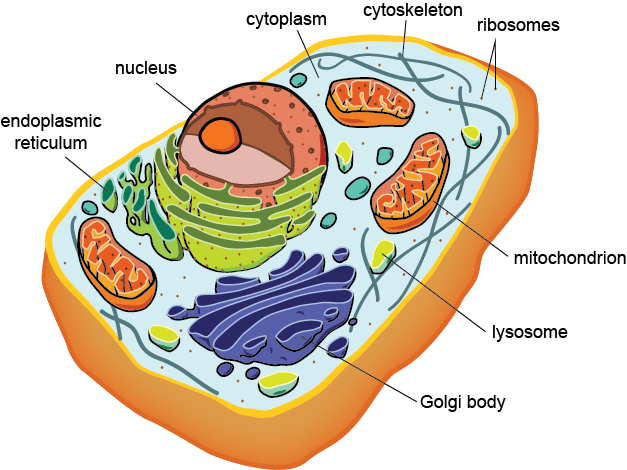
This is a ____.
a)
Golgi body
b)
plasma membrane
c)
lysosome
d)
cell wall
77.
The cell below is in a _____________ solution.
a)
Hypertonic
b)
Hypotonic
c)
Isotonic
78.
The cell membrane is made mostly of
a)
phospholipid monolayer and proteins
b)
phospholipid bilayer and proteins
c)
proteins and carbohydrates bilayer
d)
triglycerides and carbohydrates
79.
Which organelle belongs in plant cells only?
a)
Cytoplasm
b)
Mitochondrion
c)
Large Central Vacuole
d)
Cell Membrane
80.
Which organelle belongs in plant cells only?
a)
Cytoplasm
b)
Mitochondrion
c)
Cell Wall
d)
Nucleus
81.
Which organelle belongs in plant cells only?
a)
Cell Membrane
b)
Mitochondrion
c)
Chloroplast
d)
Nucleus
82.
Which organelle belongs in both plant and animal cells?
a)
Chloroplast
b)
Cell Wall
c)
Large Central Vacuole
d)
Cell Membrane
83.
Which organelle belongs in both plant and animal cells?
a)
Chloroplast
b)
Cell Wall
c)
Large Central Vacuole
d)

Nucleus

84.
Which of the following does a bacteria cell NOT have in common with a plant cell?
a)
cytoplasm
b)
cell membrane
c)
genetic material (DNA)
d)
nucleus
85.
what's the difference between prokaryotes vs. eukaryotes?
a)
Prokaryotes have nucleus
b)
Eukaryotes do not have a nucleus
c)
Prokaryotes have a cell wall
d)
Eukaryotes do have a nucleus
86.
What cell part is NOT found in all cells?
a)
Cell Wall
b)
Cell Membrane
c)
Cytoplasm
d)
Genetic Material
87.
Which of the following statements is not part of the cell theory?
a)
Cells are the basic unit of structure and function in all living things.
b)
All cells are produced from other cells.
c)
Only animal cells are composed of cells.
d)
All living things are composed of cells.
88.
What is one way in which all living things on Earth are alike?
a)
All living things have hair.
b)
All living things are made of cells and come from other cells.
c)
The cells of all living things have chloroplast.
d)
All living things can move. 
89.
Which statement is a part of the cell theory?
a)
all cells come from preexisting cells
b)
bacteria are prokaryotic cells
c)
eukaryotic cells are complex
d)
humans are multicellular
90.
The Cell Theory states...
a)
atoms create all matter
b)
living things evolve
c)
the cell is the backbone of all matter
d)
cells are the basic unit of structure and organization of organisms
91.

You have used the compound microscope to view a slide of cork with the 40x objective and the 10x eyepiece. What is the total magnification of the cork section?

a)

30x

b)

50x

c)

400x

d)

4x