wayground logo

Free Printable Worksheets

Font size

S
M
L
XL
Worksheets

Biology Interim Review

Total questions: 90

Worksheet time: 1hrs 25mins

Name
Class
Date
1.
Why do scientists use the scientific method?
a)
To make sure they get credit for their discoveries.
b)
To make sure their results are valid and can be performed by other scientists.
c)
So that other scientist don't get mad at them
2.
True or False: Your hypothesis can never be wrong.
a)
True
b)
False
3.
What step does every scientific experiment begin with?
a)
hypothesis
b)
question/problem
c)
procedures
d)
conclusion
4.
What is a hypothesis?
a)
an educated guess stating what you believe will be the result of your experiement
b)
a random guess
c)
a statement of the outcome of your experiment
d)
step by step directions for your experiment
5.
If plants are exposed to sunlight, then they will grow taller.
What part of the scientific method is this an example of?
a)
Procedure
b)
Hypothesis
c)
Question
d)
Results
6.
The independent variable is the ONE thing you _____.
a)
change on purpose
b)
control or keep constant
c)
measure
7.
The variable that is being measured or observed is called the _______________. Hint: this is the variable that is the result or effect 
a)
independent variable
b)
dependent variable
c)
control variable
8.
What are the materials in your scientific method? 
a)
your favorite markers and lucky eraser
b)
everything you will need to complete your experiment
c)
a hypothesis
d)
step by step directions to complete an experiment
9.
An experiment is performed on plants to see how different liquids affect plant growth. Each plant in the experiment is given a different liquid: water, apple juice, or milk. What variables should be kept constant/controlled? 
a)
type of plant, flower pot,  soil, and amount of sunlight
b)
water, apple juice, milk
c)
only the amount of sunlight
d)
type of plant only
10.
What is being changed in this experiment?
a)
ramp height
b)
the speed that the ball rolls
c)
type of ball
11.
What is being measured or the result/effect of this experiment?
a)
ramp height
b)
the speed that the ball rolls
c)
type of ball
12.
What is being kept constant?
a)
ramp height
b)
speed of the ball rolling
c)
type of ball
13.
This variable in an experiment is the one being deliberately changed by the scientist. 
a)
dependent variable
b)
independent variable
c)
data
d)
control group
14.
Should experiments be repeated over and over to see if the results are the same each time?
a)
yes
b)
no
15.

The part of the experiment that remains unaffected by the independent variable. Used to compare dependent variable to.

a)

constants

b)

control group

c)

independent

d)

dependent

16.
Susan said, “If I fertilize my geranium plants, they will blossom.”
a)
recognize a problem
b)
test the hypothesis with an experiment
c)
form a hypothesis   
d)
draw conclusions
17.
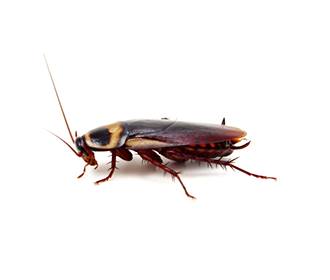
Johathan’s data showed that household cockroaches moved away from raw cucumber slices.
a)
recognize a problem
b)
test the hypothesis with an experiment
c)
form a hypothesis
d)
draw conclusions
18.
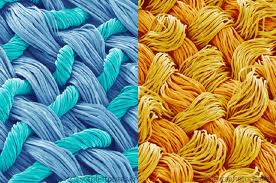
Dana want to know how different are synthetic fibers from natural fibers.
a)
recognize a problem
b)
test the hypothesis with an experiment
c)
form a hypothesis
d)
draw conclusions
19.
What is the most basic unit of life?
a)
cell
b)
tissue
c)
organ
d)
organ system
20.

The combination of chemical reactions through

which an organism builds up or breaks down

materials as it carries out its life processes is called ...

a)

absorption

b)

metabolism

c)

digestion

d)

consumption

21.

Maintaining a stable internal

environment is called

a)

homeostasis

b)

equilibrium

c)

balance

d)

evenness

22.

When you step out into the cold, your body shivers in order to keep its temperature at 98.6F. Which characteristic of life does this represent?

a)

All living things use energy

b)

All living things contain cells

c)

All living things maintain homeostasis

d)

All living things grow

23.

Green plants produce their own food through the process of photosynthesis. Which characteristic of life does this represent?

a)

All living things use energy

b)

All living things contain cells

c)

All living things maintain homeostasis

d)

All living things grow

24.

A baby song bird hatches from its egg with both parent songbirds watching. Which characteristic of life does this represent?

a)

All living things reproduce

b)

All living things maintain homeostasis

c)

All living things use energy

d)

All living things grow

25.

A camel has eyelashes that work to keep the dust and sand out of its eyes. Which characteristic of life does this represent?

a)

All living things adapt to their environment

b)

All living things grow

c)

All living things have cells

d)

All living things use energy

26.
Rocks are not living because
a)
they never move
b)
they aren't needed for humans
c)
they are not made of cells
d)
they don't break down
27.
A worm turns away from light is an example of a worm
a)
reproducing
b)
doing cellular respiration
c)
having cells
d)
responding to its environment
28.

Over three years, Tim's height has increased from 5'4" to 5'11". Which characteristic of life does this represent?

a)

All living things contain cells

b)

All living things maintain homeostasis

c)

All living things use energy

d)

All living things grow

29.

Over many hundreds of years, a population of rabbits living in the woods adapts to its surrounding with brown fur. Which characteristic of life does this represent?

a)

All living things adapt to their environment

b)

All living things grow

c)

All living things use energy

d)

All living things have cells

30.

An adult hydra is producing its offspring through budding. Which characteristic of life does this represent?

a)

All living things use energy

b)

All living things reproduce

c)

All living things contain cells

d)

All living things grow

31.
Has membrane bound organelles
a)
Prokaryote
b)
Eukaryote
c)
both
32.
One example of a prokaryote is a...
a)
fungus
b)
bacteria
c)
animal
d)
plant
33.
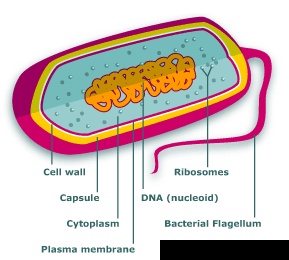
Which type of cell?
a)
Prokaryote
b)
Eukaryote
34.
Which type of cell?
a)
Prokaryote
b)
Eukaryote
35.
Which type of cell?
a)
Prokaryote
b)
Eukaryote
36.
Where is the DNA found in a prokaryotic cell? 
a)
floating around in the cytoplasm 
b)
in the nucleus 
c)
in the ribosomes
d)
attached to the cell membrane
37.
Where is the DNA found in a eukaryotic cell? 
a)
floating around in the cytoplasm 
b)
in the nucleus 
38.
Oldest type of cell
a)
Prokaryote
b)
Eukaryote
c)
both
39.
Smaller
a)
Prokaryote
b)
Eukaryote
c)
both
40.
more complex
a)
Prokaryote
b)
Eukaryote
c)
both
d)
both
41.
All eukaryotes and prokaryotes are surrounded by a _____.
a)
cell wall
b)
cell membrane
c)
cell envelope
d)
loving, supportive family
42.

An animal cell has the following except a/an...

a)

Nucleus

b)

Lysosome

c)

Cell Wall

d)

Endoplasmic reticulum

43.
The vacuoles in ________ cells are smaller.
a)
Animal
b)
Plant
44.
This cell can produce it's own food through photosynthesis. 
a)
Animal
b)
Plant
45.
Which organelle belongs in plant cells only?
a)
Cell Membrane
b)
Mitochondrion
c)
Chloroplast
d)
Nucleus
46.
This organelle is in both plants and animals. It is a barrier between the cell and the environment.  It controls what goes in and out of a cell.
a)
cell wall
b)
cell membrane
c)
cell organelles
d)
mitochondria
47.
What shape are most plant cells?
a)
round / irregular
b)
rectangular
48.

Which is the best description of a cell wall's function?

a)

keeps the organelles inside of the cell

b)

holds the cell up and keeps a square shape so the cell can stack on top of each other

c)

responsible for directing the activities of a cell

d)

is responsible for turning carbon dioxide and water into sugars and oxygen
49.
With what 3 letters do enzymes typically end?
a)
-ose
b)
-ase
c)
-ese
d)
-tic
50.
Enzymes are...
a)
nucleic acids
b)
proteins
c)
lipids
d)
carbohydrates
51.
What happens when enzymes are heated to a high temperature?
a)
The enzymes die.
b)
The shapes of the enzyme are altered denature
c)
The enzymes' amino acid sequence changes.
d)
The enzymes remain the same
52.
Which of these is most likely an enzyme?  
a)
Sucrose
b)
Galactose
c)
Fructose
d)
Amylase
53.
Where do substrates bind on an enzyme?
a)
voltage-gated channels
b)
surface receptor
c)
calcium channels
d)
active site
54.
What is the purpose  of an enzyme?
a)
give permission for the reaction
b)
raise activation energy
c)
speed up reactions
d)
control how many reactions occur
55.
What is the name for the mechanism of enzyme activity?
a)
Lock and key
b)
jigsaw puzzle
c)
hammer and nail
d)
two hands pattern
56.
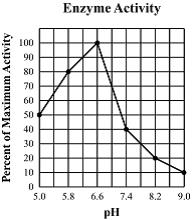
Which of the following conclusions can be drawn from this graph?
a)
The optimum pH of the enzyme is 6.6.
b)
The optimum pH of the enzyme is 5.8
c)
The enzyme’s activity increases as pH increases 5.0 to 9.0
d)
The enzyme’s activity is greater around pH of 8.0 .
57.

What is the energy source needed for photosynthesis to occur.

a)

sugar

b)

water

c)

sunlight

d)

A Drake soundtrack

58.

What is the plant organelle called that performs photosynthesis

a)

Chloroplast

b)

Mitochondria

c)

Nucleus

d)

DNA

59.

What is made by plants during photosynthesis that can be used for energy by both plants and animals

a)

Salt

b)

Tacos

c)

Sugar (glucose)

d)

Carbon Dioxide

60.
Cellular Respiration's goal is to
a)
make water
b)
make ATP
c)
make glucose
d)
make  oxygen
61.
In photosynthesis ...
a)
water is chloronated
b)
light energy is changed to glucose
c)
osmosis happens
d)
ATP is made
62.
What is cellular respiration?
a)
the breakdown of glucose  to release ATP
b)
the breakdown of glucose to release NADH
c)
the breakdown of glucose to release FADH
d)
the breakdown of glucose to release carbon
63.
A plant is releasing a gas. What is the mosl tlikely the gas?
a)
co2
b)
methane
c)
water vapor
d)
oxygen
64.
All living things do which of the following?
a)
Chemosynthesis
b)
Respiration
c)
photosynthesis
d)
all of the answers
65.
Which statement about photosynthesis is correct?
a)
Plants get the energy they need for photosynthesis from water.
b)
Plants get the energy they need for photosynthesis from soil.
c)
Plants get the energy they need for photosynthesis from sunlight.
d)
Plants do not require energy to perform photosynthesis.
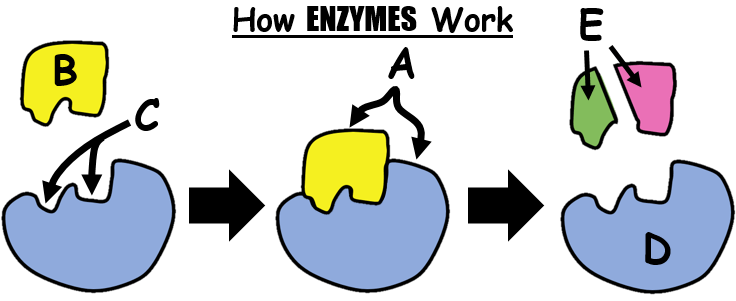
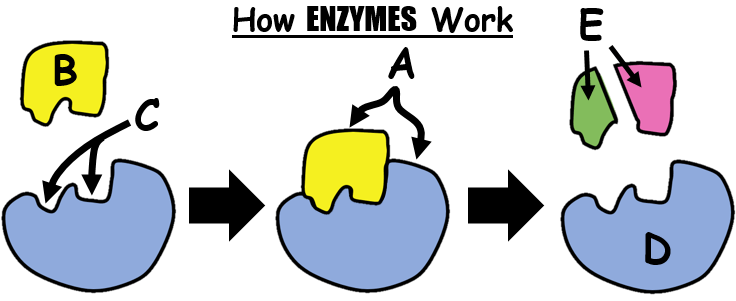
66.
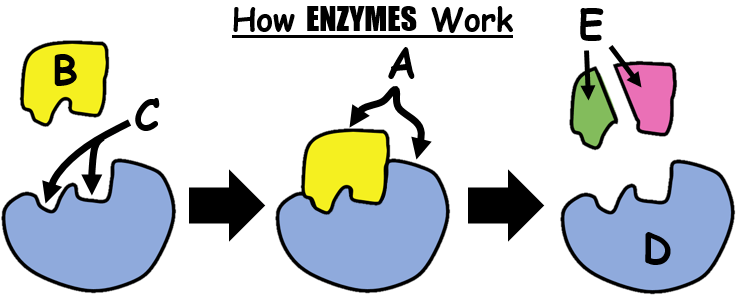
Letter D...
a)
active site
b)
enzyme
c)
substrate
d)
products
67.
Letter B...
a)
active site
b)
enzyme
c)
substrate
d)
products
68.
Letter C...
a)
active site
b)
enzymes
c)
substrate
d)
products
69.

A function of protein is to:

a)

Build and repair body tissues

b)

Carry iron and oxygen in the blood

70.
Which biomolecule is made of nucleotides and include your DNA? (Hint: they carry genetic information)
a)
Carbohydrate
b)
Lipids
c)
Protein
d)
Nucleic Acid
71.
Which biomolecule is responsible for insulation and LONG term energy storage?
a)
Proteins
b)
Nucleic Acids
c)
Lipids
d)
Carbohydrates
72.

Which biomolecule includes sugars and starches and is used for quick energy use?

a)
Lipids
b)
Proteins
c)
Carbohydrates
d)
Nucleic Acids
73.

How many minutes are in 5 hours? (Use Google Calculator)

Equation = # of hours x 60 minutes

a)

150

b)

200

c)

250

d)

300

74.

What is the change of mass of a ball that was filled with air? (Use Google Calculator)

Initial= 3.7 g Final= 5.8 g

a)

2.1 g

b)

30 g

c)

1.6 g

d)

.75 g

75.

The one factor that a scientist controls during an experiment. This goes on the x-axis.

a)

Independent Variable

b)

Dependent Variable

76.

The variable that is measured. It goes on the y-axis.

a)

Independent Variable

b)

Dependent Variable

77.

Changes in the _________ variable cause changes in the _________ variable.

a)

independent; dependent

b)

dependent; independent

78.
The x-axis shows
a)
time
b)
carbon dioxide concentration
c)
Mauna Loa volcano
d)
science
79.
The y-axis shows
a)
time
b)
carbon dioxide concentration
c)
Mauna Loa volcano
d)
science
80.
This data set shows that
a)
there is more CO2 in the atmosphere now than ever before
b)
Hawaii will be most affected by global warming
c)
global temperatures are rising
d)
there is more CO2 in Hawaii than anywhere else
81.
Based on the graph, what is the dependent variable being recorded?
a)
Day
b)
Degees in Fahrenheit
82.
True or False: Your hypothesis can never be wrong.
a)
True
b)
False
83.
a summary of the results of the experiment
a)
Hypothesis
b)
Control Group
c)
Conclusion
d)
Experiment
84.
a planned procedure to test a hypothesis
a)
Hypothesis
b)
Control Group
c)
Conclusion
d)
Experiment
85.
In this graph, what is the independent variable? 
a)
Population
b)
Day
c)
Species 5
86.

A single unit that can bond to other single units to form a polymer is a:

a)

Lego

b)

Monounits

c)

Monopoly

d)

Monomer

87.
Proteins are composed of what smaller subunits?
a)
amino acids
b)
nucleic acids
c)
fatty acids
d)
nucleotides
88.
What are the monomers of DNA?
a)
glycerols
b)
amino acids
c)
fatty acids
d)
nucleotides
89.
Lipids can be digested into what smaller subunits?
a)
nucleic acids
b)
amino acids
c)
fatty acids
d)
glucose
90.

The monomer Glucose/Monosaccharides make up the polymer....

a)

Proteins

b)

Lipids

c)

Nucleic Acids

d)

Carbohydrates