Wayground logo

Free Printable Worksheets

Font size

S
M
L
XL
Worksheets

Unit 2 Evolution/Taxonomy Review

Total questions: 50

Worksheet time: 1hrs 2mins

Name
Class
Date
1.
Structures with the same parts have different functions; suggests that organisms share a common ancestry
a)
vestigial structures
b)
homologous structures
c)
adaptive radiation
d)
fossil
2.
The process by which populations slowly change over time is called__________
a)
selective breeding
b)
adaptation
c)
sepeciation
d)
evolution
3.

If species A and B have very similar genes (DNA sequences) and proteins, what is probably TRUE?

a)

species A and B share a relatively recent common ancestor

b)

species A evolved independently of species B for a long period

c)

species A is younger than species B

d)

species A is older than species B

4.
According to this cladogram, birds are LEAST related to -
a)
Amphibians
b)
Sharks
c)
Ray Finned Fish
d)
Crocodiles
5.

Individuals that are well adapted to their environment will survive and produce:

a)

Fewer mutations

b)

Stronger genes

c)

More offspring

d)

More traits

6.

Which trait do only humans have, according to the cladogram?

a)

jaws

b)

mammary glands & hair

c)

terrestrial during all life stages

d)

opposable thumbs

7.
The study of the past and present geological distribution of species and the patterns that emerge from such analysis.
a)
Common Ancestry
b)
Biogeography
c)
Stasis
d)
Sequential
8.
The closest evolutionary relationship most likely exists between the....
a)
human and gorilla
b)
horse and zebra
c)
human and chimpanzee
d)
chimpanzee and gorilla
9.
Study of embryos of various organisms to show a common ancestor because of similarities in development
a)
natural selection
b)
embryology
c)
speciation
d)
evolution
10.
Peppered moths can have either a light wing color or a dark wing color. A scientist studied populations of both light and dark peppered moths over a 10-year period. A graph of the data he collected is shown. Based on the graph, which is the best conclusion to make about changes in the moth populations by the end of the study period? 
a)
A disease has affected only the dark winged peppered moth. 
b)
At present, wing color is not a factor in the success of peppered moths. 
c)
A new food source has become available only to the light winged peppered moth. 
d)
At present, dark-winged peppered moths are being naturally selected for survival. 
11.

The intentional reproduction of individuals in a population that have desirable traits.

a)

artificial selection

b)

genetic engineering

c)

selective breeding

12.
A virus killed most of the seals in the North Sea (e.g. dropped the population from    8000 to 800).  In an effort to help preserve the species, scientists caught 20 of the   remaining seals and used them to start a new population in the northwest Pacific   Ocean.  Which of the following statements would accurately describe the new   population?  
a)
The new seal population is genetically less diverse than the original population 
b)
The new seal population is genetically more diverse than the original population
c)
There is equal genetic variety compared  to the original population 
d)
None of the answers
13.
Genetic drift is change in the allele frequency of a population due to...
a)
random chance
b)
natural selection
c)
non-random mating (sexual selection)
d)
artificial selection
14.
The model below shows a how populations of organisms can change. Which of the   following concepts is best illustrated by this demonstration?                                          
a)
 Evolution of a predatory species
b)
Genetic drift 
c)
 Environmentally induced genetic mutations 
d)
Gene flow 
15.
What is the name of the process in which the most favorable traits are passed onto the next generation?
a)
Genetic drift
b)
Gene pool
c)
Gene flow
d)
Natural selection
16.
If an individual has favorable traits, then they are said to have a high level of:
a)
Diversity
b)
Genes
c)
Fitness
d)
Fertility
17.
Which of the following must occur for speciation to happen?
a)
geographic isolation
b)
reproductive isolation
c)
temporal isolation
d)
behavioral isolation
18.

According to their scientific names, which organisms are most closely related?

a)

Equus caballas (Horse) & Equus burchellii (Zebra)

b)

Cyanea artica (Jellyfish) &

Ctenodiscus crispatus (Mud Starfish)

c)

Naja naja (cobra) & Glycine max (soya bean)

d)

Ophiocomina nigra (black brittle star) & Brassica nigra (black mustard)
19.
The scientific name for an organism is made from the:
a)
class and family name
b)
genus and species name
c)
domain and kingdom name
d)
kingdom and phylum name
20.
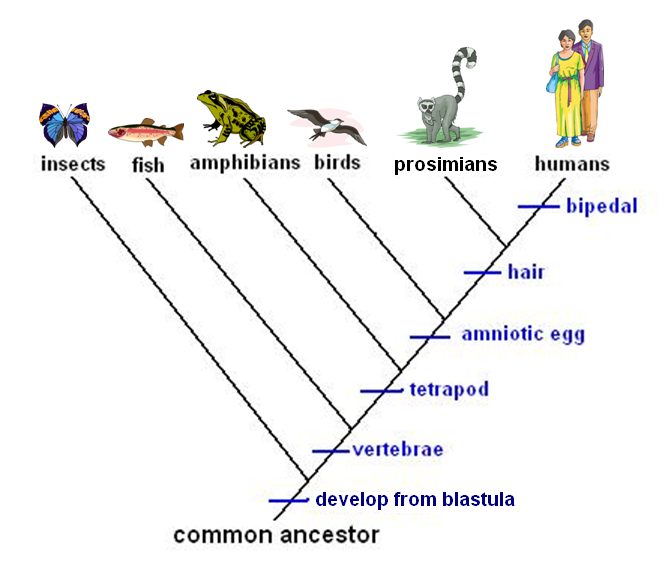
Which organisms pictured on the cladogram have hair?
a)
prosimians only
b)
prosimians and humans
c)
humans only
d)
prosimians and birds
21.
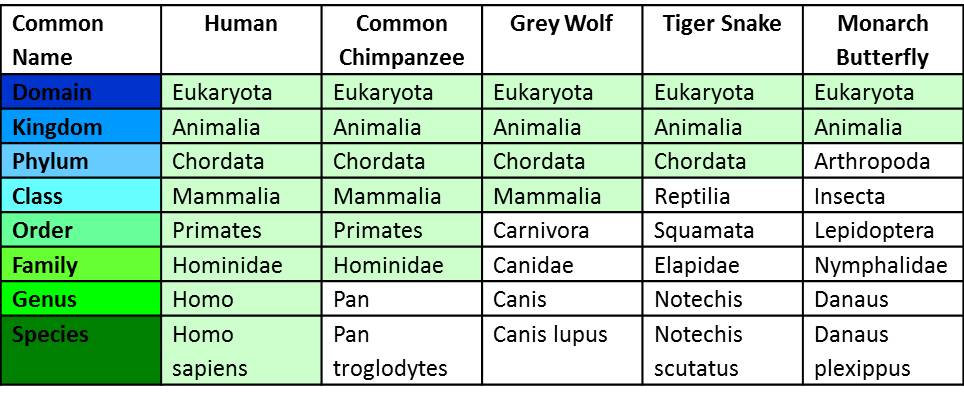
Which organism in the table is least closely related to the chimpanzee?
a)
human
b)
grey wolf
c)
tiger snake
d)
monarch butterfly
22.
What kingdom do unicellular, prokaryotic organisms that live in extreme environments?
a)
Animal
b)
Archaebacteria
c)
Eubacteria
d)
Plant
23.

I have a nucleus, can do photosynthesis and am multicellular. What kingdom do I belong to?

a)

Animalia

b)

Archaebacteria

c)

Plantae

d)

Protista

24.

This organism is multicellular, heterotroph, that has a cell wall made of chitin.

a)

animalia

b)

plantae

c)

fungi

d)

eubacteria

25.

Which of these is demonstrated by the information above?

a)

The need for controlling variables by experiments.

b)

The need for classifying and naming organisms scientifically.

c)

The importance of predicting trends from scientific data.

d)

The importance of questioning experimental evidence.

26.

What is the importance of a standardized taxonomic system to the scientific community?

a)

To have many different common names for one species.

b)

To organize species' cells, tissues, organs, and organ systems

c)

To have a universal scientific naming system and to avoid confusion

d)

To analyze species genetic information

27.

Which organism in the chart above is most distantly related from the other organisms?

a)

A

b)

B

c)

C

d)

D

28.

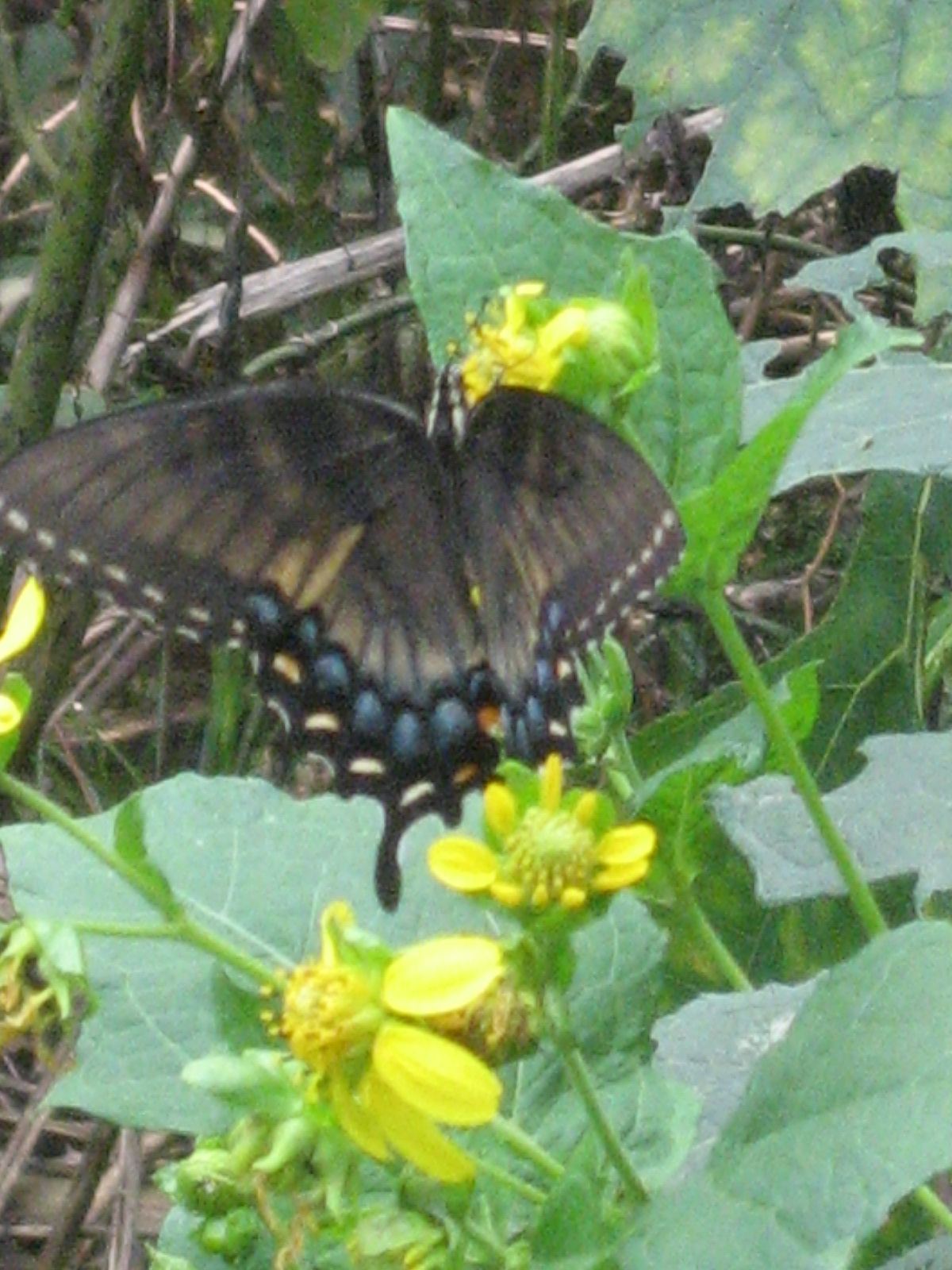
What is the specimen number for the following insect?

a)

Number 145

b)

Number 256

c)

Number 232

d)

Number 123

29.
Correctly identify the kingdom whose members exhibit these traits: most are multicellular, eukaryotic, possess cell walls, do not perform photosynthesis, non- mobile representative organisms include mushrooms and mold.
a)
Kingdom Protista
b)
Kingdom Fungi
c)
Kingdom Plantae
d)
Kingdom Eubacteria
30.
How many of the answer choices should you read on each question?
a)
All of them
b)
Skim until you see a correct one
c)
the first and last one
d)
Just guess
31.

What answers should you eliminate?

a)

Obviously wrong answers

b)

Choices that are partly wrong

c)

Answers that are correct but don't answer the question

d)

All of the above

32.
What is the method of eliminating answers?
a)
Cross out or ignore ones that you KNOW are wrong
b)
Don't read the first two answers
c)
Chose an answer you think is wrong
d)
Eat pizza
33.
The picture shows the members of the Camelidae family. The physical features and the geographical origin of these animals provide evidence that - 
a)
they live in the same type of environment.
b)
have slowly evolved to become herbivores.
c)
have a common ancestor.
d)
exchanged DNA in the past.
34.
The opossum and kangaroo both incubate their young in a pouch. This provides evidence that they---
a)
are descended from a common ancestor
b)
Have very similar skeletal structures
c)
belong to the same species
d)
must range great distances to eat
35.
Scientists compare the limbs of organisms to look for evidence of common ancestry. These limbs provide evidence of common ancestry because they -
a)
perform the same function
b)
are the same size
c)
have the same basic structure
d)
are parts of the same animal
36.

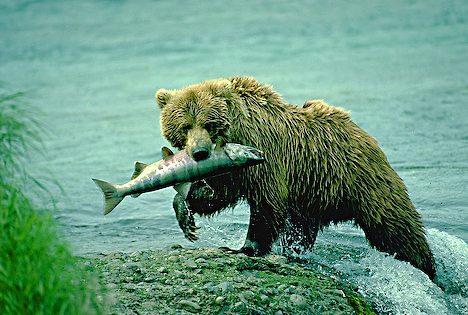
A grizzly bear survives because he is well-adapted to his environment. When he reproduces he passes on those traits to his offspring. this process is called

a)

Natural Selection

b)

Selective Breeding

c)

Random mutations

d)

Variations in a species

37.

If a sick person takes an antibiotic but it doesn't kill all of the bacteria causing the sickness, what might explain this?

a)

Variations in the bacteria allowed some organisms to be less affected by the antibiotic

b)

Bacteria cannot be killed by antibiotics

c)

You cannot cure a bacterial infection

d)

Bacteria do not cause sicknesses

38.
Genetic differences between organisms of the same species
a)
Variation
b)
Adaptation
c)
Behavior
d)
Environment
39.
Only populations can evolve.
Individuals can not evolve.
a)
True
b)
False
40.

Which of the following is an example of the bottleneck effect?

a)

Cheetah populations reach their lowest levels with reduced diversity and as they rebound are so genetically similar they appear to be inbred.

b)

Affected individuals with blue skin can trace their ancestry back to one of the first settlers in the region.

c)

The environment of a fox population changes and over time foxes who are white survive and pass on their genes to their offspring.

d)

Humans choose two dogs they like the characteristics of and breed them together.

41.

This mechanism of evolution occurs when individuals of one population migrate and mate with individuals of another population.

a)

Extinction

b)

Gene flow

c)

Genetic drift

d)

Natural Selection

42.

A harmless scarlet king snake and a venomous eastern coral snake have similar band patterns, as shown below. For the scarlet king snake, the adaptation of having a banding pattern like the eastern coral snake’s is known as mimicry


The outcome of this adaptation in the scarlet king snake is to —

a)

make it easier for the scarlet king snake to attract prey

b)

make it easier for the scarlet king snake to interbreed with the other snake

c)

allow the scarlet king snake to blend in with its environment

d)

protect the scarlet king snake from predators

43.

Adaptations that result from natural selection are expected to increase the fitness of an organism. In terms of natural selection, which of the following best describes fitness?

a)

Being able to escape from predators

b)

Being among the strongest organisms in a population

c)

Being able to survive, find a mate, and produce offspring

d)

Being able to survive long enough to reach the adult stage

44.

Does gene flow increase or decrease the genetic variety/diversity of a population?

a)

Increase

b)

Decrease

45.
The 8 levels of classification, most broad to most specific.
a)
Domain, Genus, Family, Order, Class, Phylum, Kingdom, Species
b)
Domain, Species, Kingdom, Genus, Phylum, Family, Class, Order
c)
Domain, Kingdom, Phylum, Class, Order, Family, Genus, Species
d)
Order, Kingdom, Species, Domain, Phylum, Family, Class, Genus
46.
Cells that do not have a true nucleus are called....
a)
eukaryote
b)
prokaryote
c)
unicellular
d)
multicellular
47.
Cells that have a true nucleus are called....
a)
eukaryotes
b)
prokaryotes
c)
unicellular
d)
multicellular
48.
The science of describing, classifying, and naming living things is called:
a)
Geology
b)
Biology
c)
Taxonomy
d)
Chemistry
49.

Who first proposed binomial nomenclature as a way of classifying organisms?

a)

Carolus Linnaeus

b)

Aristotle

c)

Charles Darwin

d)

Louis Pasteur

50.

Who is going to ACE the Evolution exam?

a)

ME! because I am studying and I payed attention in class

b)

Everyone but me because I am not going to study

c)

Shiner

d)

No one