wayground logo

Free Printable Worksheets

NEW

Font size

S
M
L
XL
Worksheets

Natural Selection

Total questions: 50

Worksheet time: 30mins

Name
Class
Date
1.
What was the name of the scientist who had the theory of evolution?
a)
Lamarck
b)
Einstein
c)
Washington
d)
Darwin
2.
All rabbits living in a particular area would be an example of a(n)
a)
population
b)
species
c)
fossil
d)
individual organism
3.
"Survival of the Fittest" describes which theory
a)
a) natural selection
b)
b) gravity
c)
c) heredity
d)
d) string theory
4.
Modern whales developed their traits through natural selection.  What occurs during the process of natural selection?
a)
Organisms choose mates from other species to create new species
b)
Breeders selectively cross organisms with desired traits
c)
Only the fittest organisms can survive and reproduce
d)
Organisms remain exactly the same over time.
5.
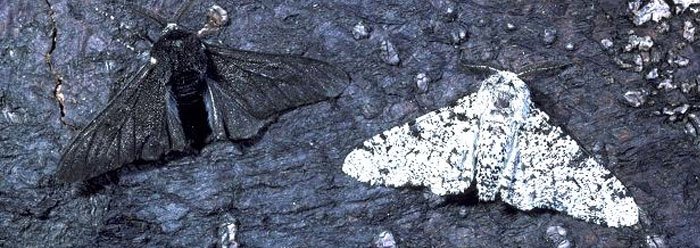
The example of the peppered (brown) moths living near English industrial cities demonstrates that
a)
A change in an environment can result in the evolution of species living there
b)
Evolution occurs so slowly that is it not possible to determine that it has happened in less than a million years
c)
The environment near these cities has always favored dark colored moths
6.
Why are advantageous traits more likely to be passed onto offspring?
a)
Because they are more likely to survive and reproduce.
b)
Because they come from dominant alleles.
c)
Because they come from recessive alleles.
d)
Because the trait is an acquired phenotype.
7.
The difference in the physical traits of an individual from those of other individuals in a group is called a(n)
a)
change
b)
adaption
c)
species
d)
variation
8.
The ability of an organism to survive and reproduce is known as...
a)
Adaptation
b)
Trait
c)
Fitness
d)
Variation
9.
Any variation that can help a species survive in a given environment is called...
a)
an adapatation
b)
a characteristic
c)
a homologous structure
d)
a vestigial structure
10.
When every organism of a species has died.
a)
Evolution
b)
Natural Selection
c)
Extinction
d)
Artificial Selection
11.
Which organisms are most likely to survive?
a)
the best adapted
b)
the fastest
c)
the strongest
d)
the most domesticated (tamed)
12.
Which of the following means "genetic change over time"
a)
natural selection
b)
speciation
c)
evolution
d)
fitness
13.
The trees these moths used to live on were white, but have been covered in soot from coal factories. Which moth will be more successful in this environment?
a)
Dark moth
b)
Light moth
c)
Both will be equally successful
d)
Neither will be successful
14.
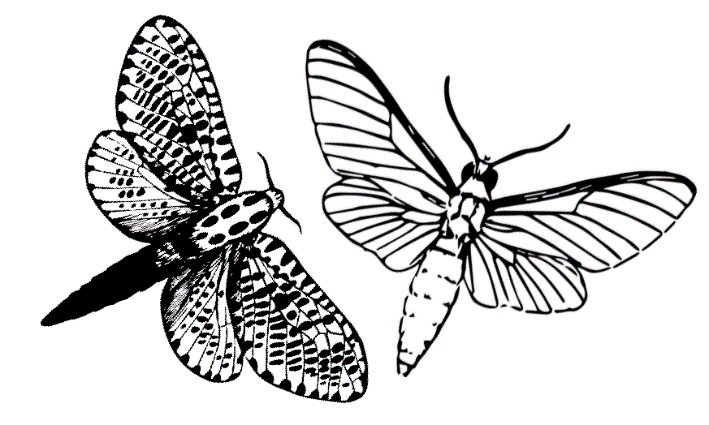
These moths are all the same species. The differences between their wings is an example of ________________
a)
Natural Selection
b)
Variation
c)
Homeostasis
d)
Extinction
15.
The long and sharp beak of a woodpecker is an example of:
a)
Natural Selection
b)
Selective Breeding
16.

Natural Selection is driven by a change in the environment and survival of the

a)

Smartest

b)

Fastest

c)

Most well adapted

d)

Biggest

17.
Where the better adapted organisms survive to pass traits along to offspring.
a)
Evolution
b)
Natural Selection
c)
Extinction
d)
Artifical Selection
18.
Why are advantageous traits more likely to be passed onto offspring?
a)
Because they are more likely to survive and reproduce.
b)
Because they come from dominant alleles.
c)
Because they come from recessive alleles.
d)
Because the trait is an acquired phenotype.
19.

Mutations are a change in what?

a)

DNA

b)

phenotype

c)

genotype

20.
When every organism of a species has died.
a)
Evolution
b)
Natural Selection
c)
Extinction
d)
Artificial Selection
21.

What word describes a trait that helps an organism survive in its environment?

a)

natural selection

b)

mutation

c)

camouflage

d)

adaptation

22.
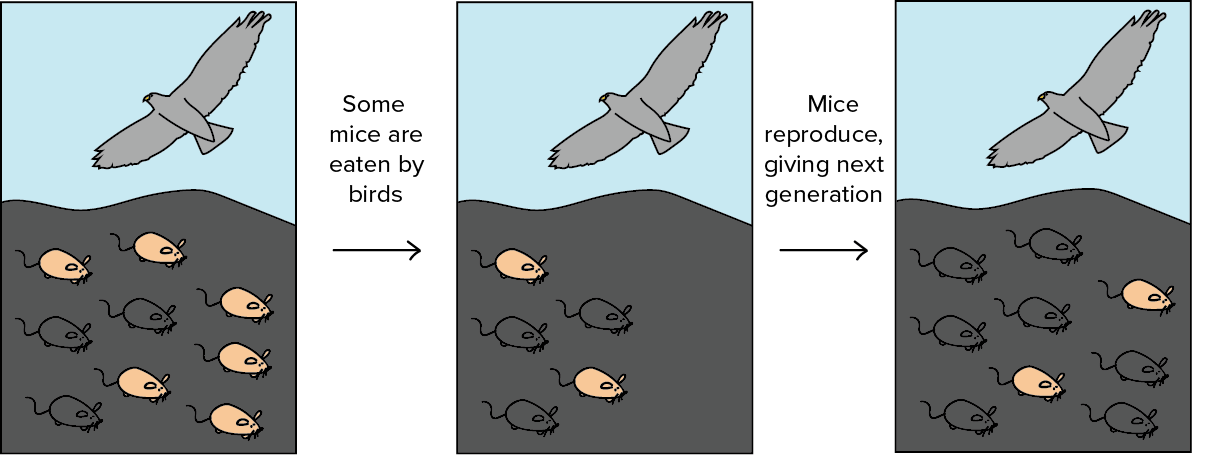
Why is the mouse population changing over time?
a)
The light mice can reproduce more successfully than the dark mice
b)
The hawks eat more dark mice than light mice because the dark mice taste better
c)
The hawks eat more light mice than dark mice because they can see the light mice more easily
d)
The hawks eat more dark mice than light mice because they can see the dark mice more easily
23.
If an organism can't adapt fast enough, this might happen.
a)
hibernate
b)
stay the same
c)
live longer
d)
become extinct
24.

What is most likely to happen to moth populations in the picture shown?

a)

Light moths--hunted easily, dark moths--population increase

b)

Dark moths--hunted easily, dark moths--population increase

c)

Light moths--hunted easily, light moths--population increase

d)

Lights moths will change their color to match dark moths.

25.

TRUE or FALSE: Natural selection will still occur if individuals are exactly the same.

a)

TRUE

b)

FALSE

26.

How do you "win" at natural selection?

a)

survive

b)

go extinct

c)

survive & reproduce

27.

Due to pollution, a pond becomes darker over time. Which trait variation became more common?

a)

light fish

b)

dark fish

28.
Why are advantageous traits more likely to be passed onto offspring?
a)
Because they are more likely to survive and reproduce.
b)
Because they come from dominant alleles.
c)
Because they come from recessive alleles.
d)
Because the trait is an acquired phenotype.
29.

According to natural selection, light colored tree trunks would favor

a)

light colored moths

b)

dark colored moths

c)

red colored moths

d)

red and light colored moths

30.

Natural Selection is driven by a change in the environment and survival of the

a)

Earth

b)

Fastest

c)

Fittest

d)

Biggest

31.
Which organisms are most likely to survive?
a)
the best adapted
b)
the fastest
c)
the strongest
d)
the most domesticated (tamed)
32.
The trees these moths used to live on were white, but have been covered in soot from coal factories. Which moth will be more successful in this environment?
a)
Dark moth
b)
Light moth
c)
Both will be equally successful
d)
Neither will be successful
33.
Definition: fitness
a)
ability to survive and reproduce in a specific environment
b)
organisms with traits well suited to their environment survive and reproduce at a greater rate
c)
a growing population causes a scarcity of resources
d)
differences in the DNA sequence
34.
Definition: natural selection
a)
inherited characteristic that increases chances of survival
b)
organisms with traits well suited to their environment survive and reproduce at a greater rate
c)
a growing population causes a scarcity of resources
d)
differences in the DNA sequence
35.
The differences among a species, like different bird beaks, are called
a)
genes.
b)
variations.
c)
traits.
d)
theories.
36.

The more genetic variation a population has,

the more likely it is for some individuals to

a)

evolve

b)

migrate

c)

survive

d)

mutate

37.
Do organisms "decide" to evolve and change?
a)
Yes, they know they need to change to survive 
b)
No, they change because of natural selection
38.

What is a way of hiding by looking the same as the background?

a)

feature

b)

distribution

c)

chromosome

d)

camouflage

39.

An adaptive trait depends on the (fill in the blank)

a)

environment

b)

species

c)

natural selection

d)

predation

40.

The presence of snakes creating an environment where high poison levels in newts becomes the adaptive trait is an example of a

a)

prediction

b)

effect

c)

cause

d)

distribution

41.

What is a feature?

a)

everything (living and nonliving) that surrounds an organism

b)

an instruction for making a protein molecule

c)

a change that happens because of an event

d)

a characteristic that all members of a species have

42.

Is being yellow always an adaptive trait in ostrilopes in a yellow environment?

a)

Yes, it always is an adaptive trait because of camouflage

b)

No, it never is because ostrilopes don't have adaptive traits

c)

No, it only is when the ostrilopes have predators

d)

Yes, it always is because carnithons can't see them

43.

What does a histogram show?

a)

Adaptive and non-adaptive traits

b)

The distribution of traits within a population

c)

The variation of features for a species

d)

The variation of adaptive traits within a population

44.

What is an instruction for making a protein molecule?

a)

a mutation

b)

a chromosome

c)

a feature

d)

a gene

45.

What is a trait that makes it less likely that an individual will survive in a specific environment

a)

A non-adaptive trait

b)

A feature

c)

A trait

d)

An adaptive trait

46.

What information can you gain from this histogram?

a)

The population has high distribution

b)

The population has low variation

c)

The population has high variation

d)

The population has no variation

47.

What can you tell about this population of Thornpalms from the histogram?

a)

High water storage is an adaptive trait

b)

It has a non-adaptive trait

c)

It has medium to high variation

d)

It has low variation

48.

What can you tell about this population of newts from the histogram

a)

Most of the newts have high poison levels

b)

Most of the newts have medium poison levels

c)

Low poison level is the adaptive trait

d)

You cannot tell anything about the poison levels

49.

Where do the genes that determine an individual's traits come from?

a)

An individual can be born with any genes, since genes are random.

b)

Individuals grow genes specific to their environment.

c)

Parents pass their genes down to their offspring.

d)

Parents choose which genes their offspring have when each individual is born.

50.

How can an individual be born with an adaptive trait?

a)

The individual can choose to change to the adaptive trait when they want to.

b)

The parents had genes for the adaptive trait, which they passed down to the individual.

c)

The individual can choose to have the adaptive trait at birth.

d)

The parents can choose for the offspring to have genes for the adaptive trait.