
 Worksheets
IGCSE 0654 B9 Coordination and response
Total questions: 45
Worksheet time: 23mins
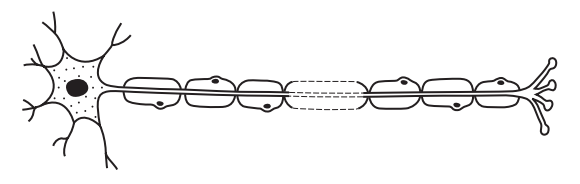
The diagram shows a cell.
What type of cell is shown?
ciliated cell
motor neurone
relay neurone
sensory neurone

The diagram shows a neurone carrying an impulse.
Which row describes the type of neurone and the direction of impulse?
Which choice describes the type of neurone and the direction of impulse?
type of neurone = motor; direction of impulse = towards the spinal cord
type of neurone = motor; direction of impulse = away from the spinal cord
type of neurone = sensory; direction of impulse = towards the spinal cord
type of neurone = sensory; direction of impulse = away from the spinal cord

The diagram shows a section through part of the human eye.
When a person looks at an object which is close to their eye, which of the following takes place?
suspensory ligaments slacken; lens becomes fatter
suspensory ligaments slacken; lens becomes thinner
suspensory ligaments tighten; lens becomes fatter
suspensory ligaments tighten; lens becomes thinner
A bright light suddenly shines into a person’s eyes.
What happens?
The lenses become more concave.
The lenses become more convex.
The pupils become larger.
The pupils become smaller.
When a person is frightened, adrenalin is released by the adrenal glands.
What are the effects of the adrenalin?
breathing rate decreased; heart beat rate decreased
breathing rate decreased; heart beat rate increased
breathing rate increased; heart beat rate decreased
breathing rate increased; heart beat rate increased
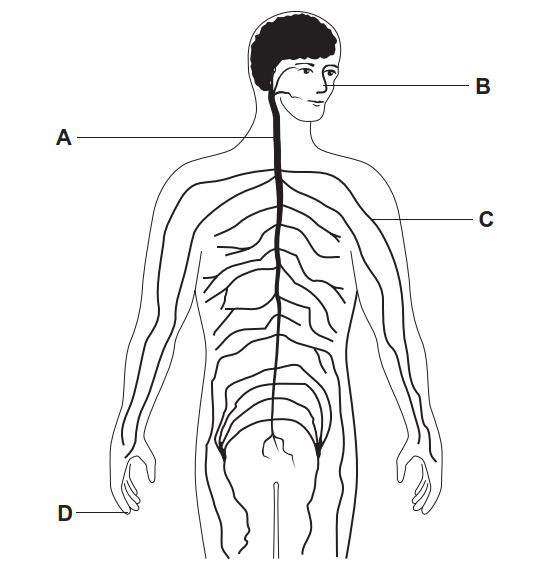
The diagram shows the human nervous system.
Which letter indicates a part of the central nervous system?
A
B
C
D

The diagram shows the muscles which control the size of the pupil in an eye.
How do the muscles make the pupil larger?
circular muscles contract; radial muscles contract.
circular muscles contract; radial muscles relax.
circular muscles relax; radial muscles contract.
circular muscles relax; radial muscles relax.
Which list describes the correct sequence of a simple reflex arc?
A receptor, relay neurone, motor neurone, sensory neurone, effector
B receptor, relay neurone, sensory neurone, motor neurone, effector
C receptor, sensory neurone, motor neurone, relay neurone, effector
D receptor, sensory neurone, relay neurone, motor neurone, effector
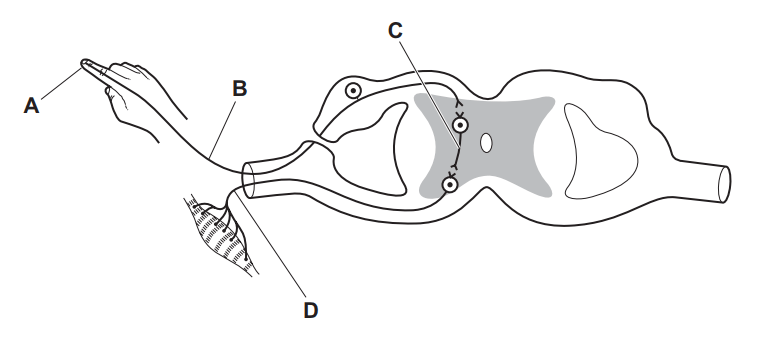
The diagram shows a simple reflex arc.
Which labelled part is the sensory neurone?
A
B
C
D
Some structures in the eye are listed.
1 cornea
2 iris
3 lens
4 retina
Which structures contain light receptors?
1, 2 and 3
2, 3 and 4
2 and 4 only
4 only
Which statement about light receptors in the retina of a normal human eye is correct?
The cones only work in dim light
The rods are found in the fovea.
The cones can detect colours of light
There are three types of rod.
How can we best describe a nerve impulse?
An electrical signal that passes along nerve cells called neurones
A chemical signal that is transferred to an electrical signal
An electrical charge that travels in nerve endings
Brain's response to an unfavourable change
What is CNS?
Central Neurone System
Brain and spinal cord
Peripheral neurones
Synapses that connect neurones
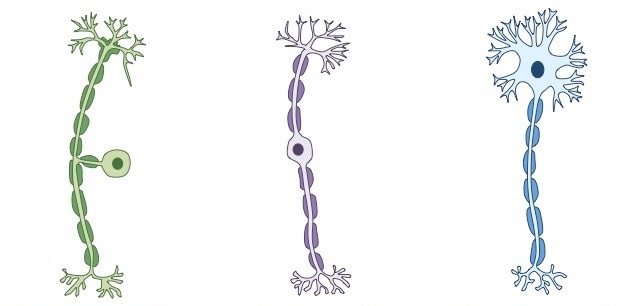
What type of neurone is shown on this picture as green?
Sensory
Relay
Motor
Synapse
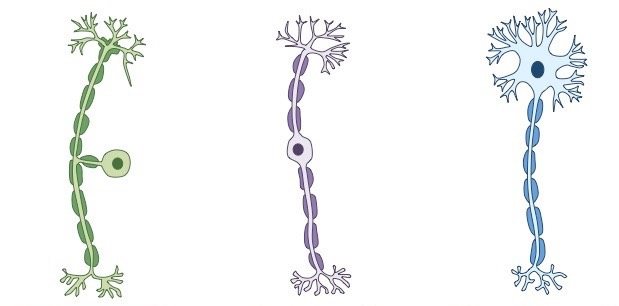
What type of neurone is shown on this image as purple?
Sensory
Motor
Relay
Synapse
Which structure of the eye contains light receptor cells?
Retina
Lens
Cornea
Iris
How does lens help us see objects that are far?
It stays the same
It becomes fatter
It becomes flatter
It becomes more spherical
What is the job of optic nerve?
To carry nerve impulses to the brain
To convert light to electrical signal
To react to too much light
To help bending light
What do we refer to when we say "accommodation"?
How eye is adapted for converting light
How eye is protected from too much light
How eye reacts to too little light
How eye is adapted to see near or far
What is the main advantage of nervous response over chemical response?
Nervous response is safer
Nervous response lasts longer
Nervous response is unconscious
Nervous response is quicker
Which response is not due to homeostasis?
enlargement of iris
increase in glucose production when blood glucose level is low
increase in permeability of collecting duct of kidney tubules
shivering in cold weather
A finger that touches a hot object is quickly taken away from the source of heat. What is the role of relay neurons in this response?
to carry nerve impulses within the spinal cord
to generate nerve impulses in the receptors of the finger
to link the sense organs to the sensory neurones
to pass nerve impulses to the effectors

Which changes take place in the iris of the eye when a person moves quickly from darkness into bright light?
A
B
C
D
What substance is the urine of a person suffering from diabetes mellitus likely to contain?
amino acids
fatty acids
glucose
proteins
Which parts of the skin are involved in temperature regulation?
sweat glands, temperature receptors and blood vessels
sweat glands and temperature receptors only
sweat glands and blood vessels only
temperature receptors and blood vessels only

The diagram shows some of the structures seen in a section through human skin.
What is the function of structure X?
to cause capillaries to constrict
to detect changes in temperature
to receive impulses from the central nervous system
to stimulate sweat glands to release sweat

The diagram shows a section of a human eye. Which parts receives impulses from motor neurones?
A
B
C
D
Which structures does light pass through when it is focused on the retina?
cornea, lens and sclera
cornea and lens only
cornea and sclera only
lens and sclera only

The diagram shows blood vessel P which carries digested food from the small intestine to the liver.
Which row describes the level of glucose in blood vessel P and the level of glycogen in the liver, shortly after a meal containing carbohydrates?
glucose in blood vessel P = high; glycogen in liver = decreasing.
glucose in blood vessel P = high; glycogen in liver = increasing.
glucose in blood vessel P = low; glycogen in liver = decreasing.
glucose in blood vessel P = low; glycogen in liver = increasing.
What happens when a person's body temperature rises above normal?
blood vessels in the surface of the skin constrict; sweat production decreases.
blood vessels in the surface of the skin constrict; sweat production increases.
blood vessels in the surface of the skin dilate; sweat production decreases.
blood vessels in the surface of the skin dilate; sweat production increases.
After a meal, the concentration of blood glucose increases.
What then causes the concentration of blood glucose to return to normal?
adrenalin
blood cells
insulin
platelets
What is true for a runner, at the end of a marathon race, in a hot climate?
sweating and vasoconstriction
sweating and vasodilation
vasoconstriction only
vasodilation only
Capillaries near the surface of the skin become wider after drinking large amounts of alcohol.
Why does this cause the body temperature to drop?
It allows heat to be lost rapidly from the skin.
It causes vasoconstriction.
It prevents vasodilation.
It stops the person from sweating.
What is an example of homeostasis?
breathing in oxygen
regulating blood glucose
removing undigested food through the anus
urinating to empty the bladder
A patient is injected with adrenaline.
Which graph shows the expected changes to pulse rate and blood glucose concentration?


Which area/s of the retina has NO rods
Fovea
General retina surface
Blind spot
Which area/s of the retina has NO cones?
Fovea
General retina surface
Blind spot
What of these is correct for a hormone?
Made in a gland
A chemical substance
Alters the activity of a single organ
Carried in the blood
Where is adrenaline secreted from?
Adrenal glands
Pancreas
Testes
Ovaries
Pituitary gland
Where is insulin secreted from?
Adrenal glands
Pancreas
Testes
Ovaries
Pituitary gland
Where is glucagon secreted from?
Adrenal glands
Pancreas
Testes
Ovaries
Pituitary gland
What is homeostasis?
Maintenance of a website environment
Maintenance of a constant internal environment
Maintenance of cosy internal environment
Maintenance of a constant external environment

