wayground logo

Free Printable Worksheets

Font size

S
M
L
XL
Worksheets

TEST 4 std 6

Total questions: 153

Worksheet time: 2hrs 15mins

Name
Class
Date
1.
Which body system absorbs oxygen from the surrounding air?
a)
Circulatory system
b)
Digestive system
c)
Muscular system
d)
Respiratory system
2.
In which organ is oxygen absorbed into the blood? 
a)
Gills
b)
Mouth
c)
Nose 
d)
Stomata 
3.
In our lungs, _________ is removed and ________ is absorbed. 
a)
oxygen ... carbon dioxide 
b)
carbon dioxide ... oxygen
c)
oxygen ... nitrogen 
d)
carbon dioxide ... nitrogen
4.
What transports oxygen from our lungs to other parts of the body? 
a)
air tubes
b)
gills
c)
blood 
d)
stomata
5.
Lungs are part of the __________ system of a human. 
a)
circulatory 
b)
respiratory
c)
digestive
d)
muscular
6.
Gills take in oxygen from the water while lungs take in oxygen from the air.
a)
True
b)
False
7.
The air we breath in contains only oxygen.
a)
True
b)
False
8.
The body systems that work together to take in oxygen to all parts of the body are ______ systems .
a)
digestive and circulatory 
b)
digestive and muscular 
c)
circulatory and respiratory
d)
circulatory and muscular
9.
During inhalation, air flows into the lungs because ___
a)
air pressure is greater outside the body than in the lungs and naturally flows inside once the chest has expanded.
b)
the strong chest muscles are sucking in air.
c)
air moves passively in and out of the lungs through time
d)
the surfactant in the lungs "draws" in air because of its adhesive properties.
10.
What percentage of oxygen in the blood is carried by hemoglobin, as opposed to dissolved in the plasma?
a)
97.5%
b)
75%
c)
15%
d)
32.6%
11.
When the diaphragm contracts, the volume of the thoracic cavity ___
a)
increases
b)
decreases
c)
remains the same
12.
How many molecules of oxygen can each hemoglobin theoretically carry?
a)
4
b)
12
c)
1
d)
2
13.
As the volume of the thoracic cavity increases, the pressure ___
a)
decreases
b)
remains unchanged
c)
increases
14.
Carbon dioxide in the blood is converted to ___
a)
bicarbonate
b)
oxygen
c)
glucose
d)
lactic acid
15.
Approximately how many breaths per minute is normal for a resting human?
a)
12
b)
120
c)
75
d)
35
16.
If carbon dioxide levels in your blood increase, this will result in a medical condition known as ___
a)
acidosis
b)
alkalosis
c)
acidophilus
d)
diabetes
17.
An infection of the lungs with bacteria or virus leading to inflammation and fluid build up is known as ___
a)
pneumonia
b)
COPD
c)
asthma
d)
apena
18.
The back of the nasal cavity or throat is also known as the ___.
a)
pharynx
b)
nare
c)
larynx
d)
glottis
19.
The ___ is also referred to as the voice box
a)
larynx
b)
epiglottis
c)
pharynx
d)
trachea
20.
The membrane surrounding the lungs is referred to as the ___ membrane.
a)
pleural
b)
pulmonary
c)
thoracic
d)
capillary
21.
For the proper diffusion of gases into and out of animals it is necessary that the body walls, gills or lungs ___.
a)
be moist
b)
have a blood circulatory system
c)
be very small
d)
have many partitions
22.
Terrestrial arthropods, like insects, have ___ which are openings to the external environment that allow air into the body.
a)
spiracles
b)
bronchioles
c)
trachea
d)
tracheoles
23.
The function of the epiglottis is to ___
a)
cover the trachea when food is being swallowed
b)
line the interior of the thoracic cavity
c)
separate the thoracic cavity from the abdominal cavity.
d)
bind to carbon dioxide in red blood cells
24.
Which mineral is an essential part of hemoglobin and responsible for reversibly binding to oxygen?
a)
iron
b)
nitrogen
c)
oxygen
d)
calcium
25.
In mammals, gas exchange between the air and blood takes place across the walls of the ___.
a)
alveoli.
b)
pleural membrane
c)
gills
d)
diaphragm
26.
What is the main function of the respiratory system?
a)
to provide oxygen and remove carbon dioxide from the body
b)
to bring oxygen to the body
c)
to break down food and absorb nutrients
d)
to remove oxygen from the body and deliver carbon dioxide
27.
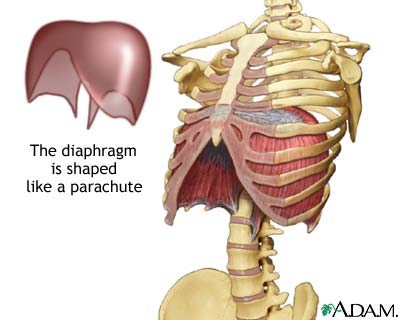
What is function of the dome-shaped diaphragm?
a)
This is where gas exchange happens.
b)
Air passes through the diaphragm on the way to the lungs.
c)
It attaches to the lungs to help in breathing.
d)
It is under the lungs and keeps them from falling down to your stomach.
28.
What is the function of the bronchi?
a)
Transport air from nose to lungs
b)
Transport air from trachea to lungs
c)
Transport air from lungs to alveoli
d)
Transport air from alveoli to blood
29.
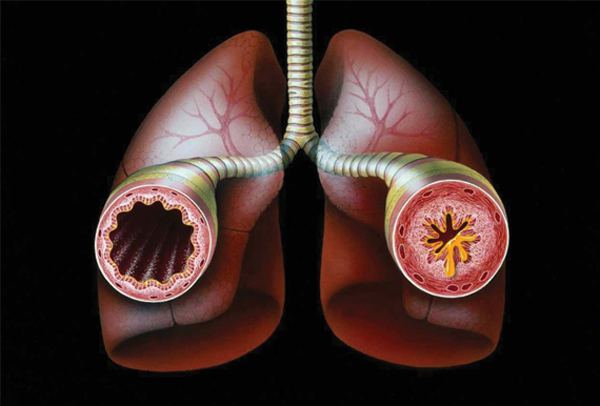
A disorder of the lungs called ____ causes the bronchi to become restricted (get smaller) so air can't get to the lungs.
a)
asthma 
b)
cold
c)
influenza 
d)
bronchitis 
30.
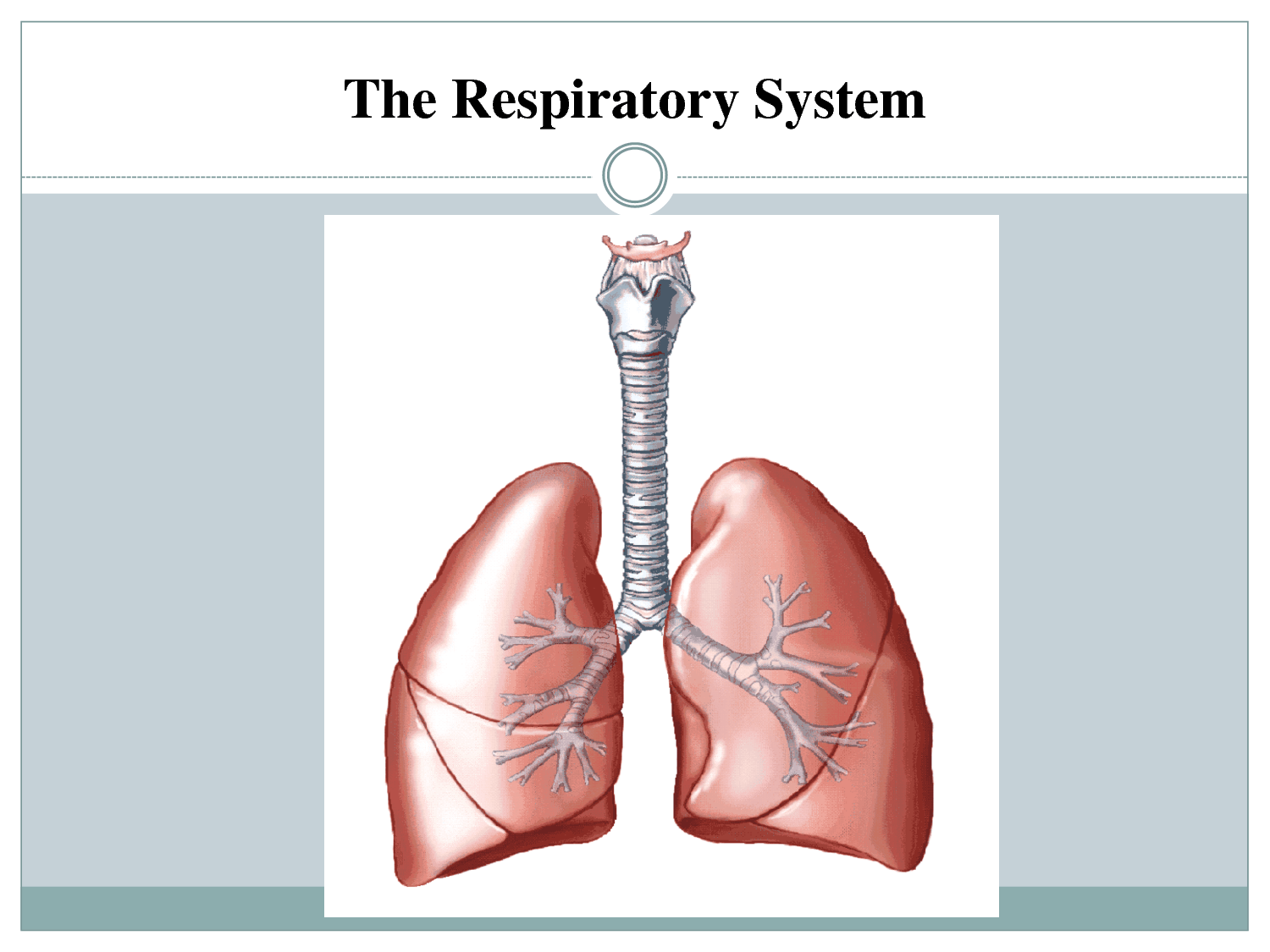
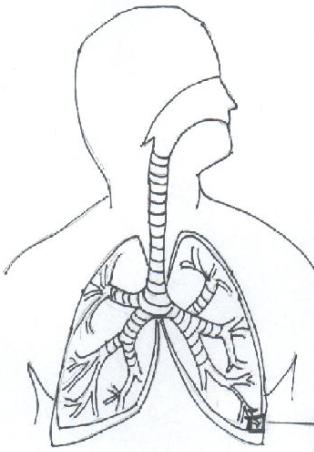
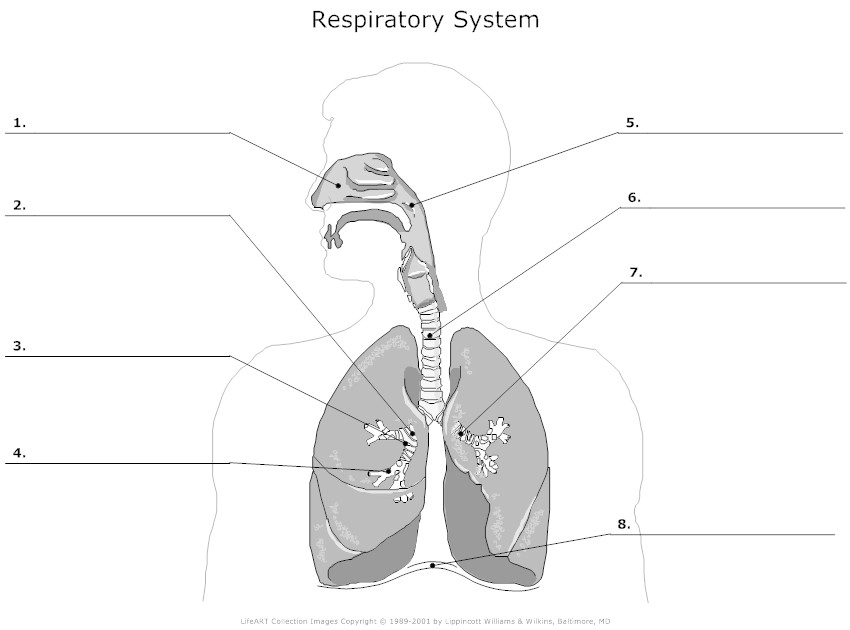
Name the organ label # 6. 
a)
alveoli 
b)
bronchi 
c)
trachea 
d)
lungs 
31.
What is the function of the kidneys in the excretory/urinary system?
a)
store urine before it is eliminated from the body.
b)
break down food into smaller pieces through chemical digestion
c)
filter blood of cellular waste material as a result of cellular respiration
d)
control thoughts, voluntary actions, and other sensations of the five senses.
32.
Which organ system removes cellular wastes as the result of cellular respiration?
a)
nervous
b)
digestive
c)
excretory
d)
circulatory
33.
One major function of the excretory system is to clean the what?
a)
urine
b)
blood
c)
kidneys
d)
bladder
34.
These organs are responsible for what?
a)
storing urine
b)
storing water
c)
filtering blood
d)
they don't have a particular job 
35.
Which are the tubes that carry urine from the kidney to the bladder?
a)
Adrenal tubes
b)
Kidneys
c)
Ureters
d)
Urethras
36.
Urine flows out of the kidneys through narrow tubes called
a)
Gallbladder
b)
Ureter
c)
Nephrons
d)
Urethra
37.
What word describes the function of the nephrons?
a)
Tube
b)
Passageway
c)
Filter
d)
Reservoir
38.
What is organ 1.
a)
Kidney
b)
Ureter
c)
Bladder
d)
Urethra
39.
fingerlike folds in the intestine to increase the surface area
a)
villi
b)
vector
c)
vanilla
d)
vortex
40.
tube from the mouth that uses muscle contractions called peristalsis to push the food to the stomach
a)
pharynx
b)
nasal cavity
c)
lung
d)
esophagus
41.
long tube that absorbs nutrients into the body using villi
a)
small intestine
b)
large intestine
c)
trachea
d)
alveoli
42.
secrete wastes including water, salts, and small amounts of urea
a)
appendix
b)
gall bladder
c)
salivary glands
d)
sweat glands
43.
remove urea from (filters) the blood and regulate concentrations of most of the substances in the body fluids
a)
liver
b)
kidney
c)
urinary bladder
d)
ureter
44.
tube from the bladder to the outside of the body
a)
urethra
b)
ureter
c)
large intestine
d)
I.V
45.
fully digested wastes are stored temporarily before being egested from the anus
a)
rectum
b)
anus
c)
urinary bladder
d)
large intestine
46.
Identify organ C. 
a)
liver
b)
stomach
c)
small intestine 
d)
large intestine
47.
Digested food is absorbed here into the bloodstream. What organ am I?
a)
mouth
b)
stomach
c)
small intestine 
d)
large intestine
48.
What is the opening where urine is released from the body?
a)
urethra
b)
ureters
c)
bladder
d)
kidneys
49.
Kidneys create a liquid called:
a)
Urine
b)
Blood
c)
Feces
d)
Carbon Dioxide
50.
Place the following events in sequence:
A)  Urine passes through the ureters
B)  Urea enters the kidneys
C)  Urine enters the urethra
a)
B, A, C
b)
C, B, A
c)
B, C, A
d)
A, C, B
51.
The part of the nephron where fluid is absorbed from the circulatory system is the:
a)
Ascending Loop of Henle
b)
Descending Loop of Henle
c)
Bowman's Capsule
d)
Malphigian Tubule
52.
Blood flows into the kidney along the:
a)
Renal Venule
b)
Renal Artery
c)
Glomerulus
d)
Hepatic Artery
53.
The part of the nephron that primarily reabsorbs water is:
a)
Ascending Loop of Henle 
b)
Descending Loop of Henle
c)
Bowman's Capsule
d)
Vasa Recta
54.
The part of the nephron that primarily reabsorbs Na+ ions is:
a)
Ascending Loop of Henle 
b)
Descending Loop of Henle
c)
Bowman's Capsule
d)
Vasa Recta
55.
The part of the nephron that would have cells loaded with aquaporins would be:
a)
Ascending Loop of Henle 
b)
Descending Loop of Henle
c)
Bowman's Capsule
d)
Vasa Recta
56.
The primary enzyme released when blood pressure drops is:
a)
Renin
b)
Angiotensin
c)
Aldosterone
d)
ADH
57.
Birds & Insects get rid of Nitrogenous waste by producing:
a)
Urea
b)
Ammonia
c)
Uric Acid
d)
NO2 gas
58.
Mammals get rid of Nitrogenous waste by producing:
a)
Urea
b)
Ammonia
c)
Uric Acid
d)
NO2 gas
59.
Fish release their nitrogen waste as:
a)
Ammonia
b)
Urea
c)
Uric Acid
d)
Uranium
60.
Water and Salt re-absorption into the circulatory system is mostly done by:
a)
Proximal Tubule
b)
Distal Tubule
c)
Loop of Henle
d)
Glomerulus
61.
The high pressure capillary network that pushes fluid out of the bloodstream is the:
a)
Proximal Tubule
b)
Distal Tubule
c)
Loop of Henle
d)
Glomerulus
62.
Glucose reabsorption occurs in the
a)
Proximal Tubule
b)
Distal Tubule
c)
Loop of Henle
d)
Glomerulus
63.
ADH is produced by the:
a)
Pituitary Gland
b)
Adrenal Gland
c)
Kidney
d)
Nephrone
64.

The two functions of testosterone are...

a)

Stimulates the production of ICSH

b)

Stimulates the production of sperm cells

c)

Activates the prostate gland and seminal vesicles

d)

Activates the interstitial cells

65.

The ovarian hormones are

a)

LH and FSH

b)

LH and oestrogen

c)

Oestrogen and progesterone

d)

Progesterone and FSH

66.

The nervous system is...

a)

an electrical communication system

b)

a chemical communication system

c)

a hormonal communication system

d)

an electrochemical communication system

67.

The chemical messengers in the neural system are

a)

neurotransmitters

b)

hormones

c)

agonists

d)

anatagonists

68.

In the nervous system, ______ _____ pick up information {about images, smells, tastes and so on} from the world around us and transform that information into neural impulses that your brain can understand.

a)

the dendrites

b)

axon terminals

c)

receptor cells

d)

the interneurons

69.

The ______ gland is called the "master gland" because it has a close connection with the brain and helps to monitor and control other glands.

a)

adrenal

b)

hypothalamus

c)

thyroid

d)

pituitary

70.

This system controls everything that you do

a)

Nervous

b)

Excretory

c)

Hormonal

d)

Cardiovascular

71.

The central nervous and peripheral system are apart of the nervous system

a)

True

b)

False

72.

These 2 systems share the same function with one another

a)

Cardio and Muscular

b)

Hormonal and Nervous

c)

Skeletal and Hormonal

73.

This system includes thyroid,pituitary glands, pancreas, adrenal glands

a)

Respiratory

b)

Skeletal

c)

Hormonal

74.

Kidneys, Ureters, Bladder, and Urethra in order are called

a)

Skeletal system

b)

Muscular system

c)

Pathway of urine throughout your body

75.

The windpipe is known as what....

a)

Pharnyx

b)

Trachea

c)

Larynx

76.

This system breaks down food and eliminates as waste

a)

Respiratory system

b)

Digestive system

c)

Hormonal system

77.

This systems kills, traps, and fights off diseases

a)

Cardiovascular system

b)

Digestive system

c)

Immune system

78.

How many bones are in your body?

a)

260

b)

206

c)

602

79.

Provides movement and protection

a)

Muscular system

b)

Cardiovascular system

c)

Hormonal system

80.

Lungs, trachea, nasal cavity, pharynx, larynx, bronchi are all apart of what system?

a)

Respiratory system

b)

Excretory system

c)

Muscular system

81.

What system pumps blood throughout your body and provide nutrients?

a)

Skeletal system

b)

Nervous system

c)

Cardiovascular system

82.

This bone is the longest and strongest in your body

a)

Tibia

b)

Fibula

c)

Femur

83.

An increased response (to threats) by this leads to aggression.

a)

Amygdala

b)

Limbic system

c)

Serotonin

d)

Testosterone

84.
The speed and sensitivity of this predicts aggression in humans.
a)
Amygdala
b)
Limbic system
c)
Serotonin
d)
Testosterone
85.
Which type of study has shown that castration leads to lower aggression?
a)
Animal studies
b)
Case studies
c)
Longitudinal studies
d)
Meta-analysis
86.
A positive correlation was found between testosterone and aggression in __________.
a)
Child prisoners
b)
Female prisoners
c)
Male prisoners
d)
Psychiatric patients
87.
This hormone is linked to aggression and is typically higher in males.
a)
Amygdala
b)
Limbic system
c)
Serotonin
d)
Testosterone
88.
Berman et al supports the neural explanation of aggression finding that _____________ causes aggression.
a)
Increased dopamine
b)
reduced dopamine
c)
increased serotonin
d)
reduced serotonin
89.
The __________ serves as the president in the hierarchy of endocrine organs.
a)
Adrenal cortex
b)
Hypothalamus
c)
Pituitary
d)
Thyroid
90.
Which is NOT a gland that serves as a secretary in the hierarchy of endocrine organs?
a)
Adrenal Cortex
b)
Pituitary gland
c)
Testes
d)
Thyroid
91.
_________ control works by monitoring substances in the blood.
a)
Cellular
b)
Hormonal
c)
Humoral
d)
Neural
92.
___________ is a hormone that helps with regulating body temperature.
a)
Epinephrine
b)
Insulin
c)
Melatonin
d)
Thyroxin
93.
The release of hormones is stopped by a __________________.
a)
Adrenal Cortex
b)
Hormonal Control
c)
The Hypothalamus
d)
Negative feedback-loop
94.
In vascular plants, _________ transports water and minerals from the roots to the rest of the plant.
a)
Phloem
b)
Xylem
c)
Roots
d)
Cotyledons
95.
What are the openings on the underside of leaves that let carbon dioxide into the leaf and let oxygen out?
a)
Chloroplasts
b)
Stomata
c)
Stomach
d)
Cuticle
96.
In which type of growth response does the plant grow toward a light source?
a)
Phototropism
b)
Heliotropism
c)
Geotropism
d)
Hydrotropism
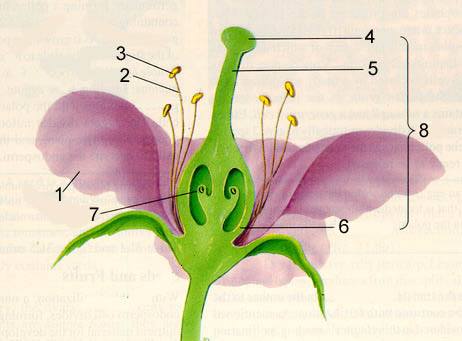
97.
What is #4 pointing to?
a)
anther
b)
style
c)
stigma
d)
ovary
98.
What tissues in the plant are similar to the circulatory system? 
a)
Xylem and Phloem
b)
Dermal Tissue
c)
Ground Tissue
d)
Nothing
99.
When you get cut, your skin cells release hormones that signal platelets to come and stop the bleeding. Platelets then release more hormones that signal even more platelets to help stop bleeding (moving away from homeostasis). The hormone signals continue until the cut is closed.
a)
Positive Feedback Response
b)
Negative Feedback Loop 
100.
According to the cladogram, which two orgainsms have hair? 
a)
Sharks & Ray Finned Fish
b)
Primates & Rodents
c)
Birds & Crocodiles
d)
Rabbits & Birds
101.
___________ is the hormone that primes the body for the fight-or-flight response.
a)
Epinephrine
b)
Insulin
c)
Melatonin
d)
Thyroxin
102.
The moon is a natural  ______ of Earth.
a)
comet
b)
axis
c)
satellite
d)
space probe
103.
Earth's ________ on its axis causes day and night.
a)
rotation
b)
revolution
c)
phase
d)
comet
104.
One full orbit of an object around another object is called a ________.
a)
axis
b)
rotation
c)
revolution
d)
satellite
105.
One of the main differences between the outer and inner planets is __________.
a)
The inner planets all have water
b)
the inner planets are much bigger than the outer planets
c)
the outer planets are gas planets
d)
the outer planets have rings, and the inner planets don't
106.
The __________ has planets, moons, comets, and asteroids.
a)
solar system
b)
earth
c)
rotation
d)
United States
107.
Which is the largest object in our solar system?
a)
Sun
b)
Jupiter
c)
Earth
d)
Pluto
108.
A small object that appears as a streak of light as it enters earth's atmosphere.
a)
Asteroid
b)
Comet
c)
Moon
d)
Meteor
109.
regulates blood-sugar levels.
a)
Endocrine System
b)
Pancreas
c)
Flight or Fight Response
d)
Glands
110.
is a network of tissues and organs that release chemicals that control certain body functions.
a)
Hormones
b)
Pituitary Gland
c)
Endocrine System
d)
Type 2 Diabetes 
111.
The gland that stimulates body metabolism
a)
Thyroid
b)
testes
c)
ovary
d)
adrenal
112.
The gland that stimulates secondary sex characteristics in females. 
a)
Thyroid
b)
testes
c)
ovary
d)
adrenal
113.
Gigantism is a disorder in which an individual has a very large body; caused by excess human growth hormons
a)
True 
b)
False
114.
stimulates secondary sex characteristics in males and stimulates sperm production.
a)
Hypothyroidism
b)
Hyperthyroidism
c)
Testosterone
d)
Estrogen 
115.
Are chemicals that travel in the blood and cause changes in different parts of the body
a)
Hormones
b)
Glands
c)
Parathyroid 
d)
Adrenal Gland 
116.
If the environment gets cold, we will often shiver in order to:
a)
keep body temperature the same as the external temperature
b)
decrease body temperature
c)
increase body temperature
d)
regulate blood pressure
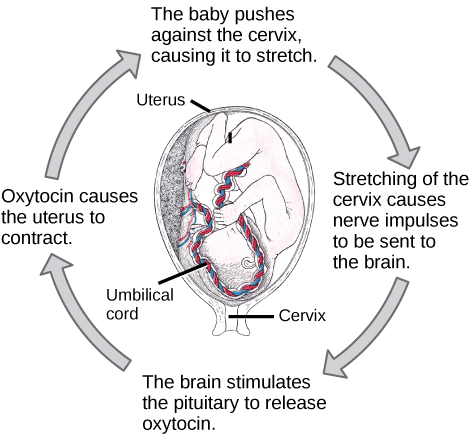
117.
What type of feedback loop is shown?
a)
negative
b)
neutral 
c)
positive
118.
The pituitary gland is divided into 2 lobes:  anterior and posterior lobes.
a)
true
b)
false
119.
Where are the adrenal glands located?
a)
at the base of the brain
b)
in the pelvic area
c)
on top of each kidney
120.
An organ that produces secretions called hormones is known as a :
a)
chemical
b)
gland
c)
hormone
d)
duct
121.
The _____ _____ is the master gland of the body because it releases hormones that stimulate other glands.  It is located at the base of the brain. 
a)
gonads
b)
thymus gland
c)
thyroid gland
d)
pituitary gland
122.
The Islets of Langerhans are located in the ______.  They produce glucagon and insulin. 
a)
thymus
b)
gonads
c)
thyroid
d)
pancreas
123.
This gland is located between the lungs behind the sternum and secretes thymosin that helps mature WBC's in our bodies when we are children. 
a)
thyroid
b)
parathyroid
c)
thymus
d)
brain stem
124.
___________is a hormonal disorder that develops when your pituitary gland produces too much growth hormone during adulthood. When this happens, your bones increase in size, including those of your hands, feet and face.
a)
Addison's Disease
b)
Cushing's Disease
c)
Acromegaly
d)
Grave's Disease
125.
In females, breast milk production is the result of:
a)
growth hormone
b)
vasopressin
c)
prolactin
d)
adrenaline
126.
_______ is a hormone that acts on organs in the body (including the breast and uterus) and as a chemical messenger in the brain, controlling key aspects of the reproductive system, including childbirth and lactation, and aspects of human behavior
a)
Estrogen
b)
Testerone
c)
Oxytocin
127.
_____ disease is a disorder that occurs when your body produces insufficient amounts of cortisol and aldosterone  produced by your adrenal glands. Symptoms include fatigue, tan colored skin, low BP and hypoglycemia. 
a)
Cushing's 
b)
Addison's
c)
hypothyroidism
d)
hyperthyroidism
128.
Plants use ______ to convert sunlight into food.
a)
Phloem
b)
Photosynthesis
c)
Stomata
d)
Xylem
129.
The plant tissue that carries food materials DOWNWARD from the leaves to the rest of the pant is the ______.
a)
Phloem
b)
Stomata
c)
Chlorophyll
d)
Xylem
130.
Vascular tissue that transports water and minerals UPWARDS from a plant's roots is know as ______.
a)
Chlorophyll
b)
Phloem
c)
Stomata
d)
Xylem
131.
What does a plant transport system transport?
a)
water and food 
b)
oxygen, water and food 
c)
oxygen and water 
d)
oxygen, carbon dioxide, food and water
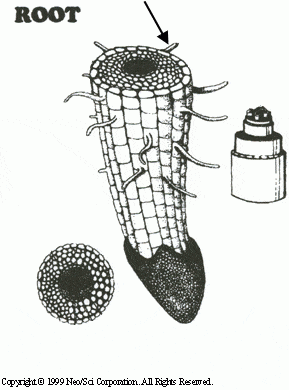
132.
What is the name of the part of the root that allows water and minerals enter?
a)
root hairs
b)
epidermis
c)
phloem
d)
phyla
133.
Look at the diagram above!
the function of the structure A is ....
a)
transfer glucose
b)
transfer soil
c)
transfer carbon dioxide
d)
transfer water
134.
How does glucose travel in the phloem
a)
clockwise
b)
in both direction
c)
up only
d)
down only
135.
How do water enter the roots from the soil?
a)
diffusion
b)
osmosis
c)
transpiration
d)
active transport
136.
What are other raw materials needed by plants to build plant body
a)
N
b)
P
c)
Fe,Cu,K,Mg
d)
All of the above
137.
How do root hair cells absorb water?
a)
By osmosis
b)
By diffusion
c)
By active transport
d)
first take up ions by active transport then water moves to root hair by osmosis
138.
What is the movement of sugars through a plant called?
a)
Translation
b)
Translocation
c)
Transcription
d)
Transpiration
139.
Why does water loss slow down if a plant is put into a plastic bag?
a)
The humidity increases
b)
The temperature increases
c)
The light intensity increases
d)
None of the above
140.
The lamina is broad to increase surface area for maximum absorption of light energy.
a)
True
b)
False
141.
There are more chloroplasts in the palisade mesophyll cells than in spongy mesophyll cells.
a)
True
b)
False
142.
Stomata open to allow gas exchange to take place during photosynthesis. 
a)
True
b)
False
143.
The equation for photosynthesis is
a)
oxygen + water --> glucose + carbon dioxide
b)
oxygen + glucose --> carbon dioxide + water
c)
carbon dioxide + water --> glucose + oxygen
d)
carbon dioxide + glucose --> oxygen + water
144.
Which plant structure is extremely necessary for photosynthesis to take place?
a)
leaves
b)
flower petals
c)
anthers
d)
pistils
145.
What is the process of making food in plants called?
a)
interdependence
b)
symbiosis
c)
photosynthesis
d)
homeostasis
146.
What is the source of energy for photosynthesis?
a)
carbohydrates (chemical energy)
b)
sunlight (radiant energy)
c)
heat (thermal energy)
d)
wind (kinetic energy)
147.
Stairs
a)
wedge
b)
pulley
c)
inclined plane
d)
wheel and axle
148.
A device that has two or more simple machines working together 
a)
fulcrum 
b)
pulley
c)
compound (complex) machine 
d)
motor 
149.
Lightbulb
a)
wedge
b)
pulley
c)
incline plane
d)
screw
150.
Which of the following is true for the picture?
a)
elephant is the fulcrum, mouse is the effort, triangle is the load
b)
mouse is the fulcrum, triangle is the effort, elephant is the load
c)
triangle is the fulcrum, mouse is the effort, elephant is the load
151.
To increase the mechanical advantage of a lever
a)
make sure the fulcrum is in the middle of the lever
b)
move the fulcrum closer to the load
c)
move the fulcrum closer to the effort
d)
use a bigger fulcrum
152.
A simple machine usually used to raise a flag is a
a)
inclined plane
b)
pulley
c)
lever
d)
wheel and axle
153.
An object being lifted or moved is a
a)
load
b)
fulcrum
c)
force
d)
work