wayground logo

Free Printable Worksheets

Font size

S
M
L
XL
Worksheets

Cell Membranes and Transport

Total questions: 37

Worksheet time: 33mins

Name
Class
Date
1.

"Water Loving"

a)

Hydrophobic

b)

Hydrophilic

c)

Hydroelectric

d)

Hydroloric

2.
"Water Fearing" 
a)
Hydrophobic
b)
Hydrophilic 
c)
Hydroelectric 
d)
Hydroloric
3.
Describes the arrangement of the cell membrane as bendable and made of many parts. 
a)
The Fluid Mosaic Model 
b)
The Major Mobility Model 
c)
The Crazy Cell Model
d)
The Maze Model
4.
___________ strengthens and stabilizes the cell membrane.
a)
Carbohydrates 
b)
Proteins 
c)
Phospholipids 
d)
Cholesterol
5.
___________ form the two layers of the cell membrane. 
a)
Carbohydrates 
b)
Proteins 
c)
Phospholipids 
d)
Cholesterol
6.
Controls the passage of materials inside and outside of the cell. 
a)
Cell Membrane
b)
Lipid Cleric Layer
c)
Membrane Gate
d)
Protein Receptors 
7.
Something is ___________ ____________
when some molecules can cross the membrane while others cannot. 
a)
Selectively (or Semi) Permeable 
b)
Totally Transparent
c)
Liquid Licorice 
d)
Heavily Patrolled 
8.
What is NOT TRUE about the cell membrane
a)
It controls what enters and leaves the cell
b)
Semipermeable
c)
Phospholipid bilayer
d)
Contains digestive enzymes
9.
What does "bilayer" mean?
a)
one layer
b)
two layers
c)
laminated
d)
bilateral
10.
This is a balance that organisms maintain through self-regulating adjustments
a)
bilayer
b)
homeostasis
c)
secretions
11.
_______________  requires energy in the form of ATP
a)
Osmosis
b)
Active transport
c)
Facilitated diffusion
d)
Passive transport
12.
Active transport requires ______, moves materials from __________________, and goes _______ the concentration gradient.
a)
No energy, low to high, against
b)
ATP, high to low, with
c)
ATP, low to high, with
d)
ATP, low to high, against
13.
Moving "Big stuff" out
a)
Endocytosis 
b)
Exocytosis
c)
Diffusion
d)
Osmosis
14.
This picture represents which type of cellular transport?
a)
passive transport
b)
endocytosis
c)
exocytosis
d)
osmosis
15.
This picture represents what type of cell transport?
a)
endocytosis
b)
exocytosis
c)
osmosis
d)
passive transport
16.

what are types of passive transport?

a)

endo and exocytosis

b)

facilitated diffusion

c)

Sodium-Potassium Pumps

d)

Osmosis

e)

simple diffusion

17.
What forms the channels and pumps in the phospholipid bilayer?
a)
carbohydrates
b)
proteins
c)
hydrophilic heads 
d)
lipids
18.
Hydrophilic portion of cell membrane?
a)
A
b)
C
c)
D
d)
19.
Hydrophobic region of the cell membrane?
a)
E
b)
B
c)
C
d)
20.
Which part is made of Protein...
a)
A
b)
B
c)
C
d)
D
21.
Movement of particles from high to low concentration. 
a)
Passive Transport
b)
Active Transport
22.
a)

Passive Transport - with the concentration gradient

b)

Active Transport - against the concentration gradient

c)

Passive Transport - against the concentration gradient

d)

Active Transport - with the concentration gradient
23.
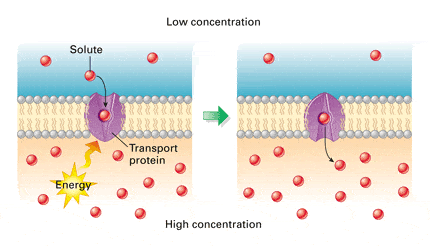
Solutes move with the concentration gradient, therefore no energy is used. 
a)
Passive Transport
b)
Active Transport
24.
a)
Passive Transport
b)
Active Transport
25.
a)

Passive Transport - with the concentration gradient
b)

Active Transport - against the concentration gradient

c)

Passive Transport - against the concentration gradient

d)

Active Transport - with the concentration gradient

26.

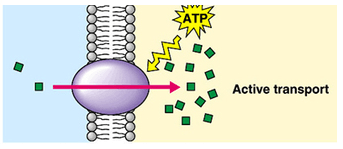
Which type of transport is pictured?

a)

Passive Transport

b)

Active Transport

27.
Exocytosis
a)
Passive Transport
b)
Active Transport
28.
Endocytosis
a)
Passive Transport
b)
Active Transport
29.
Low to High
a)
Passive Transport
b)
Active Transport
30.
This takes substances into a cell
a)
endocytosis
b)
exocytosis
c)
both
31.
What is it called when molecules move across the cell membrane from an area of high concentration to an area of low concentration through a carrier protein?
a)
Diffusion
b)
Osmosis
c)
Active Transport
d)
Facilitated Diffusion
32.
Molecules diffusing with the concentration gradient through a protein channel is...
a)
Facilitated Diffusion
b)
Simple Diffusion
c)
Active Transport
d)
Osmosis
33.
In a nerve cell, ATP energy is used to pump sodium (Na) out of the cell and potassium (K) into the cell. This is an example of...
a)
Facilitated Diffusion
b)
Simple Diffusion
c)
Active Transport
d)
Osmosis
34.

Carrier proteins are used for

a)

simple diffusion

b)

active transport

c)

exocytosis

d)

facilitated diffusion

35.

Carrier proteins

a)

change shape to move a molecules through the membrane without using energy

b)

are simply a hole or pore through the membrane

c)

use energy and change shape to move a molecule through the membrane

d)

are not used in cell tranport

36.

Protein pumps

a)

change shape to move a molecules through the membrane

b)

are simply a hole or pore through the membrane

c)

use energy and change shape to move a molecule through the membrane

d)

are not used in cell tranport

37.

Ion channels

a)

change shape to move a molecules through the membrane

b)

are simply a hole or pore through the membrane

c)

use energy and change shape to move a molecule through the membrane

d)

are not used in cell tranport