
 Worksheets
5.E.1.1
Total questions: 81
Worksheet time: 2hrs 28mins
Name
Class
Date
1.
What instrument measures the amount of liquid that falls to the ground in a given period of time.
a)
hydrometer
b)
rain gauge
c)
thermometer
d)
barometer
2.

What weather instrument is pictured?
a)
Barometer
b)
Anemometer
c)
Thermometer
d)
Hygrometer
3.

This weather instrument is an...
a)
wind vane
b)
anemometer
c)
barometer
d)
thermometer
4.
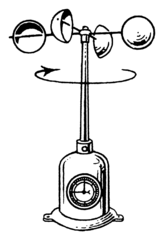
This weather instrument is an...
a)
wind vane
b)
anemometer
c)
barometer
d)
thermometer
5.

Which form of weather will this instrument measure?
a)
wind direction
b)
wind speed
c)
air temperature
d)
humidity
6.

This weather instrument is a...
a)
thermometer
b)
wind vane
c)
anemometer
d)
rain gauge
7.

What part of the illustration shows Evaporation?
a)
1
b)
2
c)
3
d)
4
8.

Which number illustrates Condensation?
a)
1
b)
2
c)
3
d)
4
9.

What does this symbol on a weather map indicate?
a)
High pressure system
b)
Low pressure system
c)
Cold front
d)
Warm front
10.

What does this symbol indicate on a weather map?
a)
High pressure system
b)
Low pressure system
c)
Cold front
d)
Warm front
11.
What kind of weather is usually associated with a high pressure system?
a)
Sunny weather
b)
Precipitation (rain, snow, etc.)
12.
Which weather tool measures air pressure?
a)
thermometer
b)
barometer
c)
anemometer
d)
psychrometer
13.
This weather tool measures wind speed and direction
a)
thermometer
b)
barometer
c)
anemometer
d)
psychrometer
14.
Which weather tool measures temperature?
a)
thermometer
b)
barometer
c)
psychrometer
d)
anememeter
15.
The boundary between two air masses is known as:
a)
front
b)
storm
c)
climate
d)
flood
16.
Mark looks at the clouds in the sky and decides that he does not need to
take his umbrella with him today. Which clouds did Mark most likely see
in the sky?
take his umbrella with him today. Which clouds did Mark most likely see
in the sky?
a)
cirrus
b)
nimbostratus
c)
cumulonimbus
17.
Which type of cloud is most often observed during a thunderstorm?
a)
cirrus
b)
stratus
c)
cumulus
d)
cumulonimbus
18.
Hot air (RISES / FALLS) __________.
a)
RISES
b)
FALLS
19.
Cold air (RISES/ FALLS) _________.
a)
RISES
b)
FALLS
20.
Which condition usually means cloudy, stormy weather?
a)
high pressure
b)
low pressure
21.

a)
nimbostratus cloud
b)
cumulonimbus cloud
c)
cirrocumulus cloud
d)
altostratus cloud
22.

name this front
a)
warm front
b)
cold front
c)
stationary front
d)
occluded front
23.
name this front
a)
warm front
b)
cold front
c)
stationary front
d)
occluded front
24.
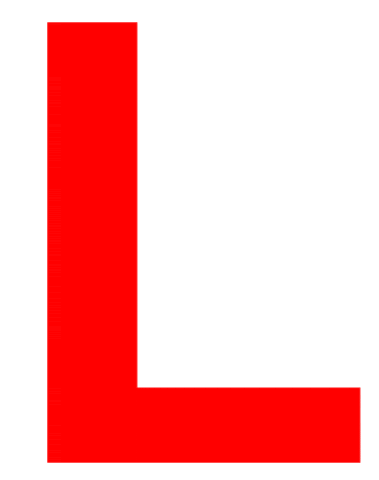
What does this symbol on a weather map indicate?
a)
High pressure system
b)
Low pressure system
c)
Cold front
d)
Warm front
25.

A _____ is a large, swirling, low-pressure system that forms over the Atlantic Ocean.
a)
blizzard
b)
cold front
c)
tornado
d)
hurricane
26.

A violently rotating column of air called a _____ when it comes in contact with the ground.
a)
hurrican
b)
tornado
c)
trade wind
d)
local wind
27.
A violently rotating column of air called a _____ when it comes in contact with the ground.
a)
hurrican
b)
tornado
c)
trade wind
d)
local wind
28.
Rain, snow, sleet, and hail are all forms of _____.
a)
precipitation
b)
condensation
c)
evaporation
d)
climate
29.
Rain, snow, sleet, and hail are all forms of _____.
a)
precipitation
b)
condensation
c)
evaporation
d)
climate
30.

The amount of water vapor present in the air is called ________________.
a)
weather
b)
humidity
c)
air mass
d)
dew point
31.
When a warm air mass gently slides on top of a cold air mass, and you have drizzly rain and then warmer weather, what type of front is it?
a)
warm front
b)
cold front
c)
occluded front
d)
stationary front
32.

What type of storm front is this?
a)
warm front
b)
cold front
c)
stationary front
d)
occluded front
33.
Rain, snow, sleet, and hail are all forms of _____.
a)
precipitation
b)
condensation
c)
evaporation
d)
climate
34.

A violently rotating column of air called a _____ when it comes in contact with the ground.
a)
hurrican
b)
tornado
c)
trade wind
d)
local wind
35.

A(n) _____ is a large body of air that has properties similar to the part of Earth's surface over which it depends.
a)
tornado
b)
pressure system
c)
front
d)
air mass
36.

When two air masses meet, there is a _____, or boundary.
a)
thunderstorm
b)
watch
c)
front
d)
cloud
37.

A _____ is a large, swirling, low-pressure system that forms over the Atlantic Ocean.
a)
blizzard
b)
cold front
c)
tornado
d)
hurricane
38.
There are three forms of precipitation: rain, snow and sleet.
a)
True
b)
False
39.
what kind of pressure predicts good weather?
a)
high
b)
low
c)
cold
d)
stationary
40.
what kind of pressure predicts good weather?
a)
high
b)
low
c)
cold
d)
stationary
41.

name this front
a)
warm front
b)
cold front
c)
stationary front
d)
occluded front
42.
name this front
a)
warm front
b)
cold front
c)
stationary front
d)
occluded front
43.

name this front
a)
warm front
b)
cold front
c)
stationary front
d)
occluded front
44.
Which condition usually means cloudy, stormy weather?
a)
high pressure
b)
low pressure
45.

What part of the illustration shows Evaporation?
a)
1
b)
2
c)
3
d)
4
46.

Which number illustrates Condensation?
a)
1
b)
2
c)
3
d)
4
47.
What kind of weather is usually associated with a high pressure system?
a)
Sunny weather
b)
Precipitation (rain, snow, etc.)
48.
What role do oceans play in hurricane formation?
a)
they provide cool, dense water
b)
warm water supplies energy to hurricanes
c)
warm ocean water slows hurricane formation
d)
cold ocean water supplies energy to hurricanes
49.
What role do oceans play in hurricane formation?
a)
they provide cool, dense water
b)
warm water supplies energy to hurricanes
c)
warm ocean water slows hurricane formation
d)
cold ocean water supplies energy to hurricanes
50.

What does this symbol on a weather map indicate?
a)
High pressure system
b)
Low pressure system
c)
Cold front
d)
Warm front
51.

This weather tool is used to measure...
a)
Rainfall
b)
Wind Direction
c)
Wind Speed
d)
Temperature
52.

What part of the water cycle is illustrated by 2?
a)
Evaporation
b)
Condensation
c)
Precipitation
d)
Runoff
53.

This weather tool is used to measure...
a)
Temperature
b)
Rainfall
c)
Wind Speed
d)
Humidity
54.

Number 4 in the diagram illustrates what part of the water cycle?
a)
Condensation
b)
Evaporation
c)
Runnoff
d)
Precipitation
55.

What part of the illustration shows Evaporation?
a)
1
b)
2
c)
3
d)
4
56.

Which number illustrates Condensation?
a)
1
b)
2
c)
3
d)
4
57.

This weather tool is used to determine...
a)
Temperature
b)
Wind Vain
c)
Wind Direction
d)
Rainfall
58.

Which type of pressure system is pictured?
a)
High
b)
Low
c)
Medium
d)
None
59.

What type of weather is associated with this type of pressure system?
a)
Cold
b)
Hot
c)
Cloudy
d)
Clear
60.

What type of weather can be expected with the pressure system pictured?
a)
Cold
b)
Warm
c)
Cloudy
d)
Clear
61.

What type of clouds are pictured?
a)
Cumulous
b)
Stratus
c)
Cirrus
62.
What are the daily conditions of temperature, humidity and precipitation?
a)
weather
b)
climate
63.
What are the yearly conditions of temperature, precipitation and humidity?
a)
weather
b)
climate
64.
What imaginary line divides our world into the northern and southern hemispheres?
a)
equator
b)
international date line
65.
As your distance from the equator increases, what happens to temperature?
a)
temperature increases
b)
temperature decreases
66.
Which climate zone gets the least amount of direct sunlight and is the coldest?
a)
tropical
b)
temperate
c)
polar
67.
Which climate zone gets the most amount of direct sunlight and rainfall and is the warmest?
a)
tropical
b)
temperate
c)
polar
68.
Which climate zone has moderate temperatures and rainfall year round?
a)
tropical
b)
temperate
c)
polar
69.
As altitude increases, what happens to temperature?
a)
temperature increases
b)
temperature decreases
70.
What are the imaginary lines that determine weather patterns and run parallel to the equator?
a)
latitude
b)
longitude
71.
True or False? Warm and cold ocean currents affect the land nearby.
a)
false
b)
true
72.
Which factor does not affect climate?
a)
longitude
b)
distance from large bodies of water
c)
latitude
d)
altitude
73.
What instrument measure air pressure?
a)
barometer
b)
thermometer
74.
What instrument measure air pressure?
a)
barometer
b)
thermometer
75.

Describe the weather in this picture.
a)
Snowy and Freezing Cold
b)
Snowy and Very Hot
c)
Sunny and Freezing Cold
d)
Cloudy and Freezing Cold
76.

Describe the weather in this picture.
a)
Sunny and Very Hot
b)
Snowy and Very Hot
c)
Cloudy and Very Hot
d)
Sunny and Very Cold
77.

Describe the weather in this picture.
a)
Dry and Hot
b)
Wet and Hot
c)
Cold and Hot
d)
Rainy and Hot
78.

Describe the weather in this picture.
a)
Rainy and Wet
b)
Rainy and Dry
c)
Snowy and cold
d)
Sunny and Cold
79.

Describe the weather in this picture.
a)
Foggy and Humid
b)
Foggy and Sunny
c)
Sunny and Cold
d)
Snowy and Cold
80.
This weather tool is used to measure...
a)
Rainfall
b)
Wind Direction
c)
Wind Speed
d)
Temperature
81.
What part of the water cycle is illustrated by 2?
a)
Evaporation
b)
Condensation
c)
Precipitation
d)
Runoff
100 %

