

Wayground logo

Free Printable Worksheets

Font size

S
M
L
XL
Worksheets

Ecology Unit Test

Total questions: 50

Worksheet time: 40mins
Name
Class
Date
1.
The largest group of organisms found in a food web would be:
a)
Primary Consumers
b)
Producers
c)
Decomposers
d)
Tertiary Consumers
2.
Which of the following organisms is a herbivore.
a)
butterfly
b)
snake
c)
fox
d)
ladybird
3.
The efficiency of energy transfer from a lower trophic level to the next highest level is roughly
a)
1%
b)
10%
c)
100%
d)
1000%
4.
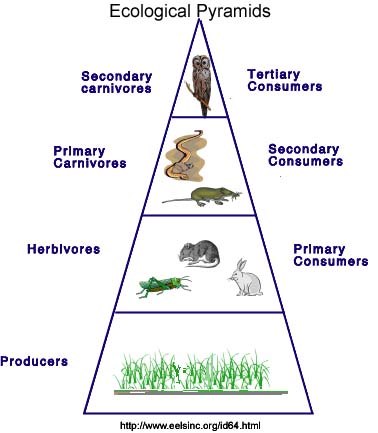
In the energy pyramid here, how much of the energy in each level gets lost as heat or used by the organism for survival?
a)
80%
b)
90%
c)
10%
d)
20%
5.
The arrows in a food chain or web represents what?
a)
They point to the organism that is being eaten.
b)
It shows how sunlight flows within an ecosystem.
c)
They show what direction the energy is flowing between organisms. 
d)
They represent how water is transferred within a habitat.
6.

Organisms that consume other organisms for energy are...

a)

Heterotrophs

b)

Autotrophs

7.
Organisms that create their own energy from sunlight or chemicals
a)
Herbivore
b)
Omnivore
c)
Autotroph
d)
Heterotroph 
8.
If the grasshopper were to be removed completely from the food web, what organism would be most effected?
a)
The squirrel
b)
The shrew
c)
The deer
d)
The rabbit
9.
A species that is NOT indigenous (native) to an area is called a/an: 
a)
native species
b)
natural species
c)
invasive species
d)
symbiotic species
10.
The particular role (job) of an organism in its environment including types of food it eats, how it obtains its food and how it interacts with other organisms is called a what?
a)
niche
b)
habitat
c)
home
d)
ecosystem
11.
Based on the graph shown, zebra mussels are a/an _____________.
a)
invasive species
b)
keystone species
c)
not enough information to tell
d)
native species
12.

What does the graph represent?

a)

Emigration

b)

Exponential growth

c)

Immigration

d)

Carrying Capacity

13.

What does "d" on the graph represent?

a)

Growth

b)

Carrying Capacity

c)

Immigration

d)

Emmigration

14.

Which limiting factor did we model in the yeast growth lab when we added sugar to one test tube and no sugar to the other test tube?

a)

food availability

b)

space

c)

Births

d)

Disease

15.
What is the carrying capacity of the following graph?
a)
1000
b)
8000
c)
800
d)
600
16.
Any abiotic or biotic factor in an ecosystem that causes a population’s size to slow or decrease is a ____________ factor.
a)
growth
b)
limiting
c)
carrying
d)
density dependent
17.
Which kind of dispersion is #1?
a)
clumped
b)
random
c)
uniform
18.
Does this food web have arrows pointing the right way?
a)
yes
b)
no
19.

The fox in this food web would be considered a:

a)

Consumer

b)

Producer

c)

Herbivore

d)

Insectivore

20.

Matter in a food web is...

a)

released

b)

recycled

21.

Energy in a food web is mostly...

a)

released

b)

recycled

22.

Which kind of dispersion is #2?

a)

clumped

b)

random

c)

uniform

23.

Which kind of dispersion is #3?

a)

clumped

b)

random

c)

uniform

24.

The trees in this food web would be considered a:

a)

Consumer

b)

Producer

c)

Herbivore

d)

Insectivore

25.

The hare in this food web would be considered a(n):

a)

Omnivore

b)

Producer

c)

Herbivore

d)

Insectivore

26.

The hawk in this food web would be considered a(n):

a)

Insectivore

b)

Omnivore

c)

Herbivore

d)

Carnivore

27.
Two organisms both benefit from the relationship
a)
Commensalism
b)
Mutualism
c)
Parasitism
28.
A bird makes a nest in a tree.  The bird gets a house, but the tree is unharmed.
a)
Commensalism
b)
Mutualism
c)
Parasitism
29.
A squirrel hides his acorns from the chipmunks for the winter.
a)
commensalism
b)
parasitism
c)
competition
d)
mutualism
30.
A bear eats fish out of the river
a)
mutualism
b)
parasitism
c)
predator / prey
31.
The black bear has a tick on it's back
a)
parasitism
b)
mutualism
c)
commensalism
32.
A fish will eat the left over food scraps from the shark's meal
a)
mutualism
b)
commensalism
c)
parasitism
d)
competition
33.

Is wind a biotic or abiotic factor?

a)

biotic

b)

abiotic

34.

Is soil a biotic or abiotic factor?

a)

biotic

b)

abiotic

35.

Is water a biotic or abiotic factor?

a)

biotic

b)

abiotic

36.

Is temperature a biotic or abiotic factor?

a)

biotic

b)

abiotic

37.

Is pH a biotic or abiotic factor?

a)

biotic

b)

abiotic

38.

Is precipitation a biotic or abiotic factor?

a)

biotic

b)

abiotic

39.

Is symbiosis a biotic or abiotic factor?

a)

biotic

b)

abiotic

40.

Is competition within a species a biotic or abiotic factor?

a)

biotic

b)

abiotic

41.

Is predation a biotic or abiotic factor?

a)

biotic

b)

abiotic

42.

Are producers biotic or abiotic factors?

a)

biotic

b)

abiotic

43.

Are consumers biotic or abiotic factors?

a)

biotic

b)

abiotic

44.

Are decomposers biotic or abiotic factors?

a)

biotic

b)

abiotic

45.

Is sunlight a biotic or abiotic factor?

a)

biotic

b)

abiotic

46.

Abiotic factors are ___________.

a)

non-living parts of an ecosystem

b)

living parts of an ecosystem

c)

things that once were alive, but now are dead

d)

not important parts of ecosystems.

47.

Biotic factors are ___________.

a)

non-living parts of an ecosystem

b)

living parts of an ecosystem

c)

things that once were alive, but now are dead

d)

not important parts of ecosystems.

48.

An ecosystem is made up of __________.

a)

living things only

b)

non-living things only

c)

both living and non-living things

49.

T/F: Abiotic factors are an unimportant part of ecosystems.

a)

true

b)

false

50.

What does the word root 'bio-' mean?

a)

living

b)

dead

c)

science

d)

study
