wayground logo

Free Printable Worksheets

NEW

Font size

S
M
L
XL
Worksheets

Vector Problems #1 (make up assignment)

Total questions: 55

Worksheet time: 2hrs 46mins

Name
Class
Date
1.
A car travels 90 meters due north in 15 seconds. Then the car turns around and travels 40 meters due south.  What is the magnitude and direction  of the car's resultant displacement?  
a)
40 metres, South
b)
50 metres, South
c)
50 metres, North
d)
40 metres, North 
2.
Which statement describes a vector?
a)
It has magnitude but no direction
b)
It has direction but no magnitude
c)
It has both direction and magnitude
d)
It has constant magnitude but no
 direction
3.
In practice A of the figure, What is  the magnitude of the  resultant displacement?
a)
5 km 
b)
8 km
c)
11 km
d)
15 km
4.
If a boomerang is thrown 20 m in a straight line and returns exactly to the spot it was thrown what is its displacement?
a)
20m
b)
40m
c)
0m
d)
-20m
5.
What is the net force?
100 N        230 N
<------        --------->
a)
30 N to the right
b)
230 N to the right
c)
130 N to the right
d)
This is a balanced force
6.
When two vectors are added together, a _____________ can be drawn.
a)
vector
b)
resultant
c)
trajectory
d)
none of these 
7.
Which are equivalent vectors?
a)
u and -u
b)
u and a
c)
u and v
d)
u and b
8.
How should you add two vectors?
a)
Add them head to tail
b)
Add them tail to tail
c)
Add them with the addition key
d)
just add the length of each
9.

To find the magnitude of a vector you use which formula

a)

inverse sine

b)

graphical analysis

c)

pythagorean theorem

d)

slope

10.

The magnitude of the resultant is equal to......

a)

2500m

b)

800m

c)

50m

d)

70m

11.
Find the direction of vector <0, 4>.
a)
180⁰
b)
90⁰
c)
270⁰
d)
0⁰
12.
The magnitude of a vector is its :
a)
Length
b)
Direction
c)
sign (+ or -)
d)
Angle
13.
a)
17
b)
149
c)
3
d)
12.2
14.
Find the magnitude of the vector <0, -9>
a)
9
b)
3
c)
-9
d)
<0, 1>
15.
Find the magnitude of the vector <10, -8>
a)
2
b)
12.81
c)
6
d)
18
16.
Find the magnitude of the vector <5, 5>
a)
0
b)
10
c)
25
d)
7.07
17.
Find the component form of a vector whose initial point is (5, 7) and terminal point is (1, 10)
a)
<-4, 3>
b)
<4, -3>
c)
5
d)
<6, 17>
18.
Given u = <3, 7> and v =<-5, 4>, find 2u - 3v
a)
<21, 2>
b)
<-11, 26>
c)
<8, 3>
d)
23
19.
You and your dad are moving the couch from one side to another. Your dad pushes with a force of 35 N to the right and you push with a force of 25 N right. What is the net force on the couch?
a)
60 N right
b)
10 N left
c)
60 N right
d)
50 N left
20.
In a tug of war the left team pulls with a force of 200N. The right team pulls with a force of 150N.What is the resultant force?
a)
50N to the left.
b)
350N to the left.
c)
350N to the right.
d)
50N to the right.
21.
Find the direction angle for the vector <2, 7>
a)
74.05°
b)
15.95°
c)
195.94°
d)
97.28°
22.
Which side is adjacent to the 400 angle?
a)
AB
b)
AC
c)
BC
23.
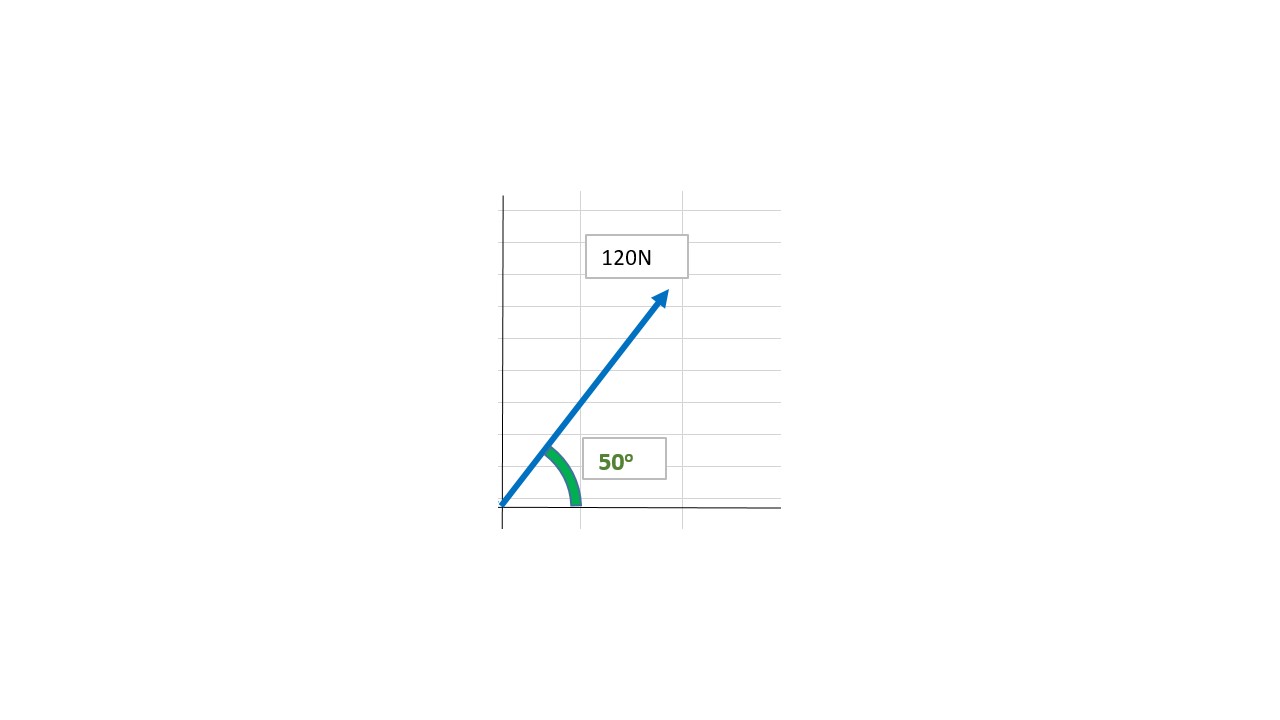
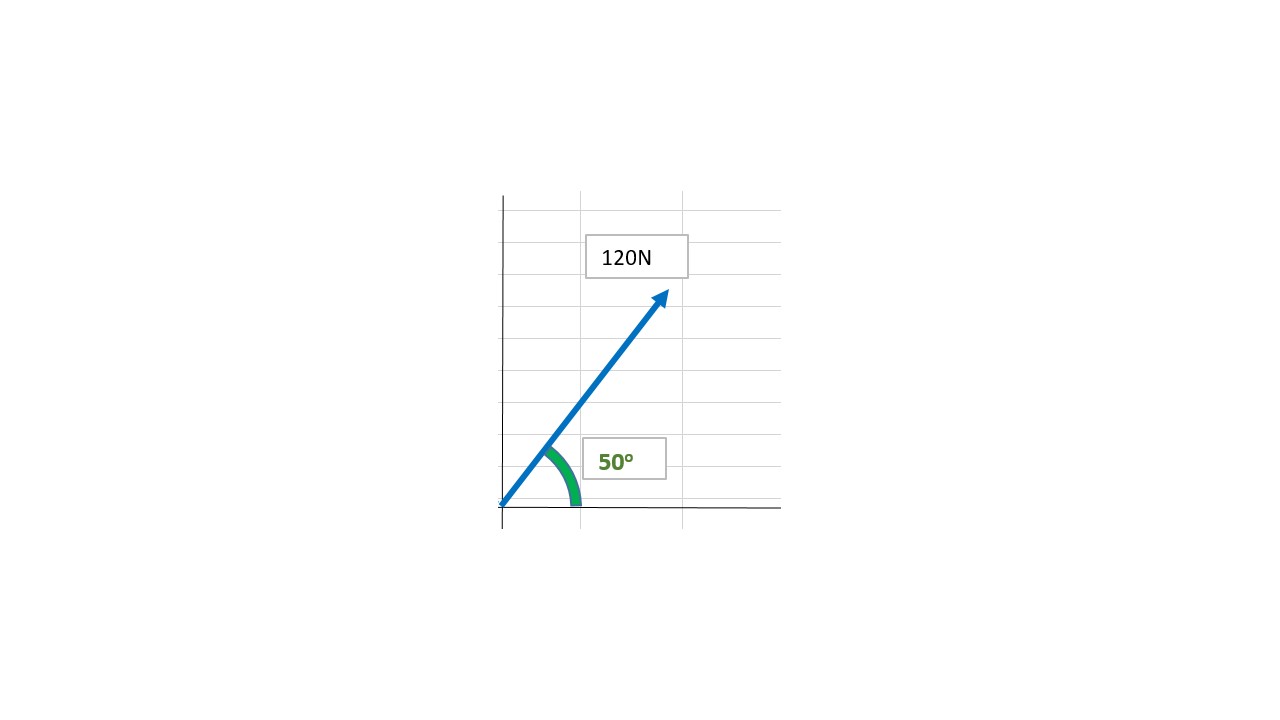
What is the y component of the vector given in the diagram?
a)
77N
b)
92N
c)
120N
d)
60N
24.
What is the x component of the vector given in the diagram?
a)
77N
b)
92N
c)
120N
d)
60N
25.
Which of the following quantities are vectors?
a)
speed, velocity, acceleration
b)
velocity, acceleration, force
c)
force, acceleration, mass
d)
length, mass, time
26.
A car travels 90 meters due north in 15 seconds. Then the car turns around and travels 40 meters due south.  What is the magnitude and direction  of the car's resultant displacement?  
a)
40 metres, South
b)
50 metres, South
c)
50 metres, North
d)
40 metres, North 
27.
Which statement describes a vector?
a)
It has magnitude but no direction
b)
It has direction but no magnitude
c)
It has both direction and magnitude
d)
It has constant magnitude but no
 direction
28.
When two vectors are added together, a _____________ can be drawn.
a)
vector
b)
resultant
c)
trajectory
d)
none of these 
29.
How should you add two vectors?
a)
Add them head to tail
b)
Add them tail to tail
c)
Add them with the addition key
d)
just add the length of each
30.
When adding vectors graphically, the direction of the resultant vector is obtained by measuring
a)
the angle with the protractor
b)
the length of the vector once a scale is determined
c)
both of the above
31.
To add vectors graphically one needs
a)
a value for the scale of the vectors being drawn.
b)
a ruler to measure the lengths of the vectors
c)
a protractor to measure the angles of the vectors
d)
all of the above
32.
When adding vectors graphically, the magnitude of the resultant vector is represented
a)
by the angle measured with the protractor
b)
the length of the vector after a scale is determined
c)
both of the above
33.
A vector is a mathematical structure that has both _______ and _______.
a)
direction, magnitude
b)
scope, sequence
c)
meat, potatoes
d)
scalar, vector
34.
Vectors can be moved as long as you preserve their length and points
a)
True
b)
False
35.
Which is a vector?
a)
A
b)
B
c)
C
d)
D
36.
Which diagram represents the projection of U onto V?
a)
A
b)
B
37.
What is the net force?
100 N        230 N
<------        --------->
a)
30 N to the right
b)
230 N to the right
c)
130 N to the right
d)
This is a balanced force
38.
The president’s airplane, Air Force One, flies at 250 m/s to the east with respect to the air. The air is moving at 35 m/s to the north with respect to the ground. Find the velocity of Air Force One with respect to the ground.
a)
252 m/s
b)
222 m/s
c)
435 m/s
d)
125 m/s
39.

The outcome when 2 or more vectors are combined

a)

Resultant vector

b)

Component vector

c)

Resultant scalar

d)

Component scalar

40.
Find the component form of a vector whose initial point is (5, 7) and terminal point is (1, 10)
a)
<-4, 3>
b)
<4, -3>
c)
5
d)
<6, 17>
41.
Find the component form of a vector whose terminal point is (15, 9) and initial point is (1, 5)
a)
<14, 4>
b)
<-14, -4>
c)
2√53
d)
<16, 14>
42.
Given u = <3, 7> and v =<-5, 4>, find 2u - 3v
a)
<21, 2>
b)
<-11, 26>
c)
<8, 3>
d)
23
43.

Has magnitude and direction

a)

Scalar

b)

Vector

c)

Initial Point

d)

Terminal Point

44.

Another name for the "tail" of a vector

a)

Terminal Point

b)

Standard Position

c)

Initial Point

d)

Magnitude

45.

Another name for the "tip" of the vector

a)

Terminal point

b)

Initial point

c)

Standard position

d)

Direction

46.

When the vector's initial point is at the origin, it is in ___.

a)

quadrant bearing

b)

true bearing

c)

resultant

d)

standard position.

47.

This is always between 0-90 degrees, measured from north or south and then goes toward the east or west

a)

True bearing

b)

Quadrant bearing

c)

Resultant

d)

Zero vector

48.

Two vectors who have the same or opposite direction.

a)

Parallel vectors

b)

Equivalent vectors

c)

Opposite vectors

49.

Two vectors that have the same magnitude and direction

a)

Parallel vectors

b)

Equivalent vectors

c)

Opposite vectors

50.

Two vectors that have the same magnitude but opposite direction

a)

Parallel vectors

b)

Equivalent vectors

c)

Opposite vectors

51.

The sum of two or more vectors (450 N in this picture)

a)

Zero vector

b)

Parallel vectors

c)

Equivalent vectors

d)

Resultant

52.

A way to find the resultant vector by lining them up tip-to-tail.

a)

Parallelogram method

b)

Triangle method

c)

Rectangular method

d)

Circle method

53.

A way of finding the resultant vector by lining up the vectors tail-to-tail.

a)

Triangle method

b)

Circle method

c)

Rectangular method

d)

Parallelogram method

54.

The result of adding two opposite vectors; the magnitude is zero and there is no direction.

a)

Zero vector

b)

Resultant

c)

Component

d)

Magnitude

55.

Two or more vectors with sum that is vector r.

a)

Zero vector

b)

Resultant

c)

Direction

d)

Components