
 Worksheets
Physics 01
Total questions: 69
Worksheet time: 2hrs 38mins
Name
Class
Date
1.

A wheeled cart is moving to the right at a constant speed. Two forces of equal magnitude are acting upon the cart. Which of the following best describes the forces and motion of the cart?
a)
Balanced Forces, Constant Speed
b)
Balanced Forces, Acceleration
c)
Unbalanced Forces, Constant Speed
d)
Unbalanced Forces, Acceleration
2.
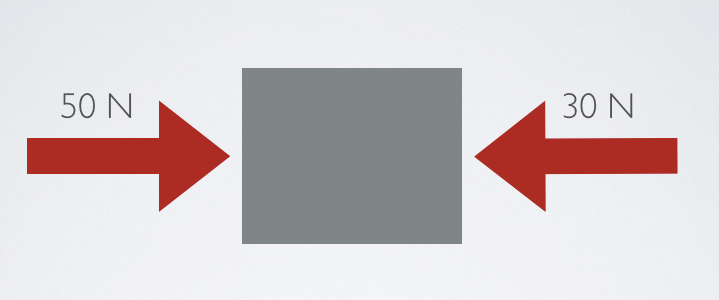
How will this object move?
a)
It won't move.
b)
It will move to the right.
c)
It will move to the left.
d)
It will move up.
3.

How will this object move?
a)
It won't move.
b)
It will move to the right.
c)
It will move to the left.
d)
It will move in both directions.
4.

What is the net force?
a)
30 N left
b)
25 N right
c)
5 N left
d)
55 N right
5.

What is the net force?
a)
40 N left
b)
0 N Balalnced
c)
400 N right
d)
40 N right
6.
Which could be an example of a balanced force?
a)
An asteroid moving at a constant speed through space
b)
A car accelerating from a stop sign
c)
A box of dishes falling from a counter
d)
A rocket taking off
7.
Which could be an example of an unbalanced force?
a)
A plate sitting on a dining table
b)
A ball at the top of a hill that is not moving
c)
Earth orbiting the Sun
d)
A baseball that has been thrown to home plate.
8.
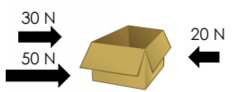
Calculate the Net Force.
a)
60N, Left
b)
40N, Right
c)
0N
d)
60N, Right
9.

Calculate the Net Force.
a)
40N, Left
b)
40N, Right
c)
0N, Balanced
d)
75N, Right
11.
You and your dad are moving the couch from one side to another. Your dad pushes with a force of 35 N to the right and you push with a force of 25 N right. What is the net force on the couch?
a)
60 N right
b)
10 N left
c)
60 n right
d)
50 N left
11.
You and your dad are moving the couch from one side to another. Your dad pushes with a force of 35 N to the right and you push with a force of 25 N right. What is the net force on the couch?
a)
60 N right
b)
10 N left
c)
60 n right
d)
50 N left
12.

What is the net force?
a)
10 N
b)
0 N
c)
25 N
d)
1 N
13.
If there are two forces going in the same direction how would you find the net force?
a)
Subtract
b)
Add
c)
Neither
d)
Multiply
14.
Find the net force: 15 N to the right, and another 15 newtons to the right.
a)
0 N Right
b)
0 N Left
c)
30 N Left
d)
30 N Right
15.
8 N to the left , and 4 N to the right. Find the net force. Is this balanced
a)
12 N Right No
b)
4 N Left No
c)
12 N Right Yes
d)
4 N Left Yes
16.
What is force?
a)
A push exerted on an object
b)
A push or pull exerted on an object
c)
A pull exerted on an object
d)
Nothing
17.
With unbalanced forces, the object will move in the direction of the _______ force.
a)
larger
b)
smaller
c)
equal
18.

Forces that have a net force of zero ( the object is still).
a)
Balanced force
b)
Unbalanced force
19.

The force that pulls things toward earth.
a)
Speed
b)
Gravity
20.

What is the net force?
a)
5000 N right
b)
4000 N right
c)
40 N left
d)
4000 N left
21.

__________ is the sum of all forces acting on an object. It is capable of accelerating a mass.
a)
velocity
b)
gravity
c)
net force
d)
distance
22.

What is happening at D?
a)
Stationary
b)
Accelerating
c)
Fast steady speed; moving away from the starting position
d)
Slower steady speed; moving away from the starting position
23.

What is happening at A?
a)
Stationary
b)
Accelerating
c)
Slower steady speed; moving away from the starting position
d)
Steady speed; returning to start position
24.

Which runner won the race?
a)
A
b)
B
c)
C
25.

How long did it take this object to travel 10 m?
a)
0 s
b)
10 s
c)
15 s
d)
20 s
26.

How long did it take this object to travel back to its reference/starting point?
a)
20 s
b)
30 s
c)
60 s
d)
100 s
27.

At 60 seconds, how far had this object traveled?
a)
0 m
b)
10 m
c)
20 m
d)
40 m
28.

What is this graph showing?
a)
Constant Speed
b)
Acceleration (speeding up)
c)
Deceleration (slowing down)
d)
No motion
29.

What does this graph represent?
a)
Constant speed
b)
Acceleration
c)
Not moving
30.

How many times does this object STOP moving?
a)
None
b)
Once
c)
Twice
d)
Three times
31.

How fast is the object traveling between points B and C?
a)
1 km/hr
b)
0 km/hr
c)
There is no way to tell from this graph
d)
0.9 km/hr
32.

During what segments is the object returning to the reference point?
a)
A to B
b)
B to C
c)
C to D
d)
D to E
33.

How long did it take Charlie to finish the race?
a)
A)14 meters
b)
B)12 seconds
c)
C)16.5 seconds
d)
D)14 seconds
34.
How far did they run?
a)
A)100 seconds
b)
B)100 meters
c)
C)18 meters
d)
D)18 seconds
35.
What does the flat line mean for Charlie?
a)
He stayed at the same speed
b)
He slowed down
c)
He stopped running
d)
He stayed at the same speed but at a slower rate
36.

What is the speed of the object shown in the graph?
a)
A)2 m/s
b)
B)4 m/s
c)
C)1 m/s
d)
D)10 m
37.
Energy due to motion is ____________ energy.
a)
Potential
b)
Energy
c)
Kinetic
d)
Friction
38.
The faster an object moves, the ________ kinetic energy it has.
a)
more
b)
less
c)
none of the above
d)
all of the above
39.
__________ is stored energy.
a)
Potential
b)
Kinetic
c)
None of the above
d)
All of the above
41.
Gravitational potential energy depends on the ________ and ________ of the object.
a)
Height and mass
b)
Friction and movement
c)
Mass and Movement
d)
Height and Friction
41.
Gravitational potential energy depends on the ________ and ________ of the object.
a)
Height and mass
b)
Friction and movement
c)
Mass and Movement
d)
Height and Friction
43.
When you stretch a rubber band, you are storing __________ energy.
a)
kinetic
b)
potential
c)
none of the above
d)
all of the above
43.
When you stretch a rubber band, you are storing __________ energy.
a)
kinetic
b)
potential
c)
none of the above
d)
all of the above
44.

what type of energy is stored in a battery?
a)
electrical
b)
chemical
c)
thermal
d)
mechanical
45.

Electrical Energy is transferred to _____ Energy.
a)
Thermal
b)
Solar
c)
Electrical
d)
None
46.
Which energy transformation occurs in a toaster?
a)
chemical to electric
b)
electric to thermal
c)
kinetic to chemical
d)
thermal to potential
47.

A battery converts what type of energy to another?
a)
sound to kinetic
b)
light to heat
c)
mechanical to electrical
d)
chemical to electrical
48.
Energy transformations occur when...
a)
energy is created through conduction
b)
energy changes from one form to another
c)
two forces slide together that are touching
d)
a chemical reaction takes place
49.
What is energy changing from one form to another?
a)
energy conservation
b)
energy transformation
c)
energy creation
d)
mechanical energy
50.

The roller coaster cart has the most gravitational potential energy at position-
a)
W
b)
X
c)
Y
d)
Z
51.
Which items would have this energy transformation: chemical energy -> mechanical energy?
a)
person running
b)
candle burning
c)
windmill turning
d)
playing a violin
52.
A hairdryer converts --
a)
electrical energy into chemical
b)
electrical energy into thermal
c)
chemical energy into mechanical
d)
thermal energy into mechanical
53.
What machine changes electrical energy into light and sound energy?
a)
battery
b)
lightbulb
c)
alarm clock
d)
apple
54.
Which of the following converts chemical energy to electrical energy?
a)
Battery
b)
Person eating food
c)
Automobile
d)
Camp Fire
55.
Which of the following converts chemical energy to thermal energy?
a)
Battery
b)
Person riding a bike
c)
Automobile
d)
Camp Fire
56.

Where is the potential energy the greatest?
a)
A
b)
B
c)
C
d)
D
57.
Energy from light waves.
a)
Radiant Energy
b)
Chemical Energy
c)
Nuclear Energy
d)
Radiation
58.
Name the energy transformations taking place when you plug in a lamp and turn it on.
a)
Mechanical to electrical
b)
Electric to radiant
c)
Chemical to mechanical to thermal
59.
Which of these is an example of light energy being transformed into chemical energy?
a)
A glow stick lights up when broken.
b)
Water heated by the sun evaporates.
c)
A plant makes sugar in the sunlight.
d)
A battery causes a buzzer to vibrate.
60.
The energy transformation that takes place when a flashlight is turned on is...
a)
Chemical - electrical - light
b)
Chemical - light - electrical
c)
Electrical - thermal - light
d)
Nuclear - light - electrical
61.
What is speed?
a)
how far you go
b)
how much distance is covered over a period of time
c)
how fast you accelerate
d)
the change in the location of a object
62.
What is the formula to calculate speed?
a)
Speed = time/distance
b)
Speed = distance/time
c)
Speed = distance x time
d)
Speed = time x distance
63.

According to the graph how far does the person travel in the first 5 seconds?
a)
2 m
b)
10 m
c)
0 m
d)
5 m
64.

What is the person doing from 5 seconds to 10 seconds?
a)
Walking
b)
Running
c)
Standing Still
d)
Walking Fast
65.
What is velocity?
a)
the quickness of an object
b)
the location of an object
c)
acceleration
d)
speed in a specific direction
66.
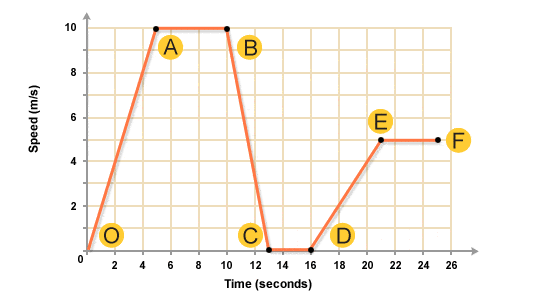
What is happening in this graph from point A to B?
a)
The object is accelerating.
b)
The object is not moving.
c)
The object is decelerating.
d)
The object is moving at a constant speed.
67.
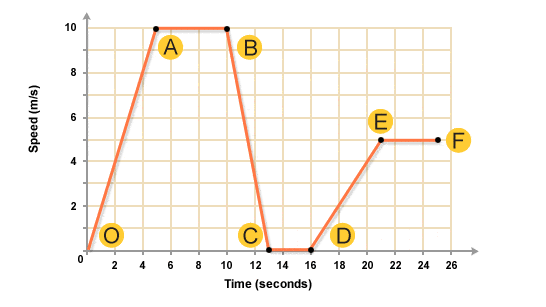
What is happening in this graph from point B to C?
a)
The object is going down a hill.
b)
The object is returning to its starting location.
c)
The object is slowing down.
d)
The object is staying still.
68.

What does this graph represent?
a)
Constant speed
b)
Acceleration
c)
Not moving
69.

What does this graph represent?
a)
Constant Speed
b)
Acceleration
c)
Not moving
100 %

