

wayground logo

Free Printable Worksheets

NEW

Font size

S
M
L
XL
Worksheets

Unit 2 Exam 2 Review: Chromatography, Hair, & Fibers

Total questions: 45

Worksheet time: 30mins
Name
Class
Date
1.
_________________ utilizes a stationary and a mobile phase to separate mixtures based on their affinity for each phase.
a)
filtration
b)
chromatography
c)
distillation
d)
osmosis
2.
When using water as a solvent which type of molecule is likely  to have the highest  Rvalue
a)
polar
b)
non-polar
3.
The protein that makes up hair is called _____
a)
ninhydrin
b)
pigments 
c)
medulla
d)
keratin
4.
The smallest unit of textile material that has a length many times greater than its diameter is..
a)
keratin 
b)
cuticles
c)
fibers
d)
chromatography
5.
Two or more substances that are mixed together but not chemically combined is a ___
a)
compound
b)
mixture
c)
keratin
d)
chromatography
6.
Two or more substances that are chemically combined is a ___
a)
compound
b)
mixture
c)
solvent
d)
solute
7.
In ocean water, the salt is the ___
a)
mixture
b)
medulla
c)
solvent
d)
solute
8.
In ocean water, water is the ___
a)
medulla
b)
solute
c)
solvent
d)
medulla
9.
The deepest layer of hair (compared to the lead of a pencil) is the ___
a)
medulla
b)
cortex
c)
cuticle
d)
keratin 
10.
The middle layer of a hair (compared to the wood of a pencil) is the __
a)
medulla
b)
cortex
c)
cuticle
d)
keratin
11.
The outside layer of a hair (compared to the ink on a pencil) is the ___
a)
medulla
b)
cortex
c)
cuticle
d)
keratin
12.
Which is NOT a characteristic of the medulla that varies and therefore should be observed?
a)
scales
b)
opacity 
c)
thickness
d)
continuity 
13.
Which of the following is NOT one of the characteristics of the cuticle that varies and should be observed?
a)
scales
b)
 continuity 
c)
pigment
d)
thickness
14.
Which layer of hair is the most important component when determining which individual human the hair came from?
a)
medulla
b)
cortex
c)
cuticle
15.
The name for man-made fibers is:
a)
processed fibers
b)
synthetic fibers
c)
natural fibers
d)
modified fibers
16.
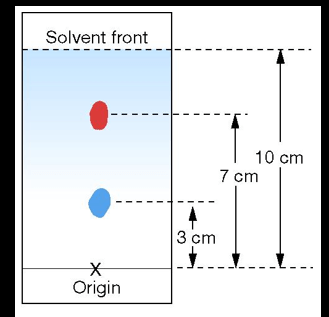
The Rvalue  for the blue component is 
a)
0.3
b)
0.7
c)
10
d)
3
17.
The Rvalue  for the red component is 
a)
0.3
b)
0.7
c)
10
d)
7
18.

Hair evidence would be categorized as what type of evidence?

a)

Individual and biological

b)

Individual and physical

c)

Class and biological

d)

Class and physical

19.

In the diagram above which letter would indicate the hair shaft?

a)

A

b)

B

c)

C

d)

D

e)

E

20.

In the diagram the layer in which I would observe the cuticle scale pattern would be indicated by the letter

a)

A

b)

B

c)

C

21.

In the diagram the cortex would be indicated by the letter

a)

A

b)

B

c)

C

22.

In the diagram the medulla would be indicated by the letter

a)

A

b)

B

c)

C

23.

In which layer would pigment granules be found?

a)

A

b)

B

c)

C

24.

What is the protein that hair is composed of?

a)

keratin

b)

glycerin

c)

catagen

25.

The medulla pattern shown would be

a)

absent

b)

fragmented

c)

continuous

d)

interrupted

26.

The medulla pattern shown would be

a)

absent

b)

continuous

c)

interrupted

d)

fragmented

27.

The medulla pattern shown would be

a)

absent

b)

continuous

c)

fragmented

d)

interrupted

28.

Which characteristics are common in hair from people of European descent?

a)

Round shape, thick diameter, and unbroken medulla

b)

Oval shape and even pigment granules

c)

Flat shape, uneven pigmentation, pronounced twists and curves

29.

Which characteristics are common in hair from people of Asian descent?

a)

Round shape, thick diameter, and unbroken medulla

b)

Oval shape and even pigment granules

c)

Flat shape, uneven pigmentation, pronounced twists and curves

30.
The following medulla pattern is called
a)
fragmented 
b)
continuous
c)
interrupted
31.
Fibers that have spun together are called
a)
a textile
b)
yarn
c)
a mineral fiber
d)
a fiber
32.
Small molecules that may bond together to become polymers are
a)
polymers
b)
fibers
c)
monomers
d)
none of these choices
33.
When fibers are transferred directly from victim to suspect or suspect to victim, this is called
a)
necessary transfer
b)
direct transfer
c)
absolute transfer
d)
secondary transfer
34.
Early collection of fibers in an investigation is critical.  Within 24 hours, an estimated:
a)
75% of all fibers fallen or lost
b)
85% of all fibers fallen or lost
c)
95% of all fibers fallen or lost
d)
None of the above
35.
Fiber evidence is gathered with 
a)
vacuums
b)
tape or lint roller
c)
forceps
d)
all choices correct
36.
A lengthwise yarn or thread in a weave
a)
polymer
b)
warp
c)
weft
d)
yarn
37.
What is the most common plant fiber?
a)
Wool
b)
Rayon
c)
Cotton
d)
Polyester
38.
What is the most common animal fiber?
a)
Cotton
b)
Wool
c)
Polyester
d)
Rayon
39.
Fibers are classified as either:
a)
natural fibers or synthetic fibers.
b)
polymers or synthetic fibers.
c)
acrylic fibers or plant fibers.
d)
olefins or synthetic fibers
40.
Natural fibers come from:
a)
animals.
b)
plants.
c)
minerals that are mined from the ground.
d)
All of these choices.
41.
Which one is an example of a synthetic fiber?
a)
Polyester
b)
Acrylic
c)
Nylon
d)
All of these
42.
Many fibers woven together create
a)
Megafibers
b)
Fabric
c)
Super Evidence
d)
Nothing
43.
Which of the following smells like burning hair when burned?
a)
wool
b)
silk
c)
cotton
d)
spandex
44.
Which of the following would melt when brought near a flame?
a)
rayon
b)
silk
c)
mohair
d)
cashmere
45.
The most common synthetic fiber is _____.
a)
nylon
b)
polyester
c)
spandex
d)
acrylic
