wayground logo

Free Printable Worksheets

NEW

Font size

S
M
L
XL
Worksheets

Matter Test Review

Total questions: 50

Worksheet time: 56mins

Name
Class
Date
1.
What are the three states of matter?
a)
solid, volume, mass
b)
density, volume, mass
c)
solid, liquid, gas
d)
density, gas, volume
2.
A state of matter that has a definite volume and shape.
a)
solid
b)
liquid
c)
gas
d)
matter
3.
Which of the following terms identifies the change from a liquid to gas?
a)
Vaporization
b)
Condensation
c)
Deposition
d)
Sublimation
4.
Which of the following terms identifies the change from a liquid to solid?
a)
Melting
b)
Condensation
c)
Vaporization
d)
Freezing
5.
When the temperature of matter increases the particles...
a)
speed up and move closer
b)
speed up and move farther apart
c)
slow down and move closer together
d)
slow down and move farther apart
6.
No Definite Shape and No Definite Volume
a)
Gas
b)
Liquid
c)
Solid
7.
No definite shape, but has a definite volume
a)
Gas
b)
Liquid
c)
Solid
8.
Phase change from a solid to a gas.
a)
sublimation
b)
deposition
c)
condensation
d)
evaporation
9.
Phase change from a solid to a liquid.
a)
melting
b)
sublimation
c)
boiling
d)
condensation
10.
Phase change from a liquid to a gas that only happens at the surface.
a)
evaporation
b)
boiling
c)
sublimation
d)
melting
11.
When the temperature of matter decreases the particles ...
a)
speed up and move farther apart
b)
speed up and move closer together
c)
slow down and move farther apart
d)
slow down and move closer together
12.
Phase change from a gas to a liquid.
a)
condensation
b)
evaporation
c)
melting
d)
deposition
13.
The opposite phase of melting is 
a)
freezing 
b)
sublimation
c)
condensation 
d)
deposition 
14.
Change from Gas to Solid is called........
a)
Sublimation
b)
Deposition
c)
Fusion
d)
condensation
15.
All changes in the state of matter of a substance requires
a)
vibration
b)
water
c)
permission
d)
energy
16.
What happens to particles when they are heated?
a)
They speed up and spread out
b)
They slow down and compress
c)
They stop moving
d)
They move closer together and speed up
17.
Boiling is ...
a)
liquid to gas
b)
gas to solid
c)
gas to liquid
d)
solid to liquid
18.

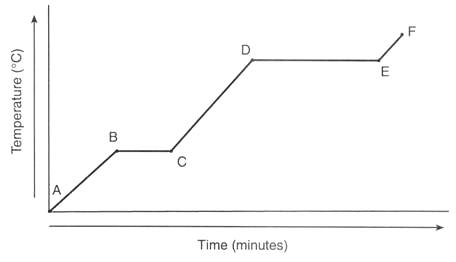
What section of the phase change graph is kinetic energy increasing the least?

a)

A-B

b)

B-C

c)

C-D

d)

D-E

19.

What section of the phase change graph is melting occurring?

a)

A-B

b)

B-C

c)

C-D

d)

D-E

20.

What section of the phase change graph is evaporation or boiling taking place?

a)

A-B

b)

C-D

c)

D-E

d)

E-F

21.
What line segment represents only the solid state?
a)
A-B
b)
B-C
c)
C-D
d)
D-E
22.
What state(s) of matter are present at D-E?
a)
Solid-liquid
b)
Liquid
c)
Liquid-gas
d)
Gas-Solid
23.
Between which points is the substance changing state?
a)
A-B only. 
b)
A-B, C-D, E-F
c)
B-C only. 
d)
B-C, D-E
24.
How are solids different from liquids?
a)
particles in solids are moving freely around each other.
b)
particles in solids have no motion.
c)
particles in solids are vibrating in place.
d)
particles in solids have more motion than in liquids
25.
In which segment is the kinetic energy remaining constant?
a)
A-B
b)
B-C
c)
C-D
d)
E-F
26.

What is happening to the kinetic during C-D?

a)

increasing

b)

decreasing

c)

staying the same

27.

The phase change identified in the image as #9 is called _____

a)

melting

b)

boiling

c)

condensation

d)

freezing, exothermic

28.

The phase change identified in the image as #11 is called _____

a)

boiling, evaporation

b)

melting

c)

condensing

d)

Freezing

29.
Which is an example of a solute?
a)
Egg whites
b)
Sugar
c)
Water
d)
Acetone
30.
Which is an example of a solvent?
a)
Salt
b)
Egg whites
c)
Water
d)
Sugar
31.

What is a solvent

a)

A liquid that will dissolve a solid solute

b)

Another word for solution

c)

A thing that make drinks change colour

d)

Usually the solid about to be dissolved

32.

The ___ is the thing being dissolved.

a)

solute

b)

solvent

c)

mixture

d)

solution

33.
If I dissolve sugar in water, what is the solute?
a)
Water
b)
Hydrogen
c)
Sugar
d)
Carbon
34.

If I dissolve carbon dioxide in water, what is the solvent?

a)

Carbon Dioxide

b)

There is no solvent

c)

Oxygen

d)

Water

35.

Define the term soluble.

a)

Can dissolve in water

b)

Cannot dissolve in water

c)

Partially dissolves in water

36.

Define the term insoluble.

a)

Can dissolve in water.

b)

Cannot dissolve in water.

c)

Partially dissolves in water.

37.
When a solvent contains as much of the solute as it can hold, the solution is said to be
a)
supersaturated
b)
diluted
c)
saturated
d)
unsaturated
38.
How does a solution become supersaturated?
a)
dissolve lots of solute in it.
b)
dissolve a little solute in it. 
c)
dissolve more solute than you should be able to. 
d)
dissolve a super amount of solvent in it. 
39.
__________ are made up of solutes and solvents.
a)
Solutions
b)
Suspensions
c)
Heterogeneous Mixtures
d)
Pure Substances
40.

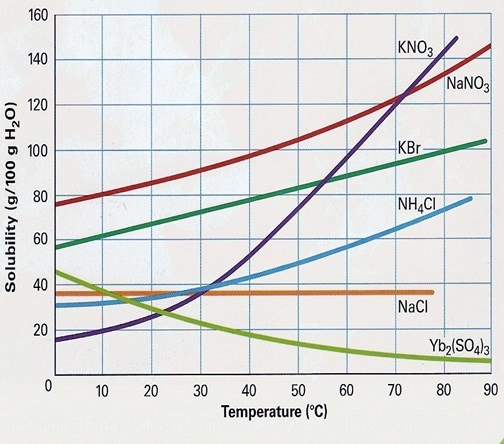
Which substance is least soluble at 0 ºC?

a)

KI

b)

KNO3

c)

KClO3

d)

Ce2(SO4)3

41.

How many grams are soluble in 100 g of water at 100 ºC?

a)

300 grams

b)

250 grams

c)

100 grams

d)

50 grams

42.

When 40 grams of NaCl is dissolved in 100 grams of water at 90 ºC, the solution can be correctly described as:

a)

supersaturated

b)

saturated

c)

unsaturated

43.
Which solute does not increase in solubility as temperature rises?
a)
NH3
b)
NaNO3
c)
KNO3
d)
NaCl
44.
Solution where more solute can still be dissolved at the given temperature. 
a)
Saturated
b)
Unsaturated
c)
Supersaturated
d)
Homogeneous solution
45.
A solution of potassium chlorate, KClO3, has 20 grams of the salt dissolved in 100 grams of water at 70 ºC. Approximately how many more grams of the salt can be added to the solution before reaching the saturation point?
a)
10 grams
b)
30 grams
c)
80 grams
d)
60 grams 
46.

Identify how many grams of KNO3 is required to make a saturated solution at 40'C.

a)

50 g

b)

45 g

c)

55 g

d)

33 g

47.
What will allow more solute to be dissolved in a solvent.
a)
adding more solute
b)
stiring
c)
cooling solution
d)
heat
48.

How many grams of K2Cr2O7, are soluble in 100 g of water at 95 ºC?

a)

83 grams

b)

75 grams

c)

40 grams

d)

12 grams

49.

Which substance is MOST soluble at 0 ºC?

a)

KI

b)

NaNO3

c)

NaCl

d)

Ce2(SO4)3

50.
Which solute is the least soluble at 90 ⁰C?
a)
SO2
b)
KClO3
c)
KI
d)
HCl