
 Worksheets
Unit 5 Practice - Metabolism, CR, Photo
Total questions: 114
Worksheet time: 2hrs 51mins
The two molecules needed for cellular respiration are...
water and fiber
oxygen and amino acids
protein and glucose
oxygen and glucose
sum of all chemical reactions
chemosynthesis
cellular respiration
metabolism
photosynthesis
Building of large molecules from smaller ones
metabolism
catabolism
anabolism
oxidation
The break down of large molecules into smaller ones
metabolism
catabolism
anabolism
oxidation
The energy held in bonds of atoms that is released when the bonds are broken
heat
kinetic energy
potential energy
chemical energy
The law of conservation of energy; total amount of energy in the universe is constant and be neither created or destroyed.
First Law of Thermodynamics
Second Law of Thermodynamics
Energy cannot be changed without a loss of useable energy (heat) .
First Law of Thermodynamics
Second Law of Thermodynamics
releases energy (occurs spontaneously)
metabolism
anabolic reaction
catabolic reaction
photosynthesis
absorbs energy (non-spontaneous)
metabolism
anabolic reaction
catabolic reaction
photosynthesis
Where does glycolysis take place in cells?
Cytoplasm
Mitochondrial matrix
Mitochondrial cristae
Cell membrane
Glycolysis results in the net gain of:
2 ATP
4 ATP
1 CO2
2 Acetyl CoA
A weightlifter is using heavy weights in short bursts for a competition. Because his muscle cells are not able to take in enough oxygen to make very much ATP, the weightlifter begins to get fatigue in his muscles. Which of the following processes is most likely going on in the muscles of the weightlifter as he competes in his event?
As the cells run out of oxygen they switch to anaerobic respiration, which allows the cell to make small amounts of ATP in the absence of oxygen.
As the cells run out of oxygen, they die off gradually and the weightlifter's muscles have fewer contracting muscle cells.
The cells will never run out of oxygen if the weightlifter is breathing.
As the cells run out of oxygen, they will continue to make the same amount of ATP, since oxygen is not required to make ATP.
Which process takes place in the presence of oxygen and produces a large amount of ATP?
photosynthesis
lactic acid fermentation
aerobic respiration
alcoholic fermentation
What are the reactants for cellular respiration?
oxygen and lactic acid
carbon dioxide and water
glucose and oxygen
water and glucose
After strenuous exercise, a muscle cell would contain decreased amounts of ______ and increased amounts of ______
glucose; ATP
ATP; glucose
oxygen; lactic acid
lactic acid; ATP


During cellular respiration, acetyl CoA accumulates in which location?
mitochondrial matrix
mitochondrial outer membrane
mitochondrial inner membrane
mitochondrial intermembrane space
How is a molecule oxidized?
Electrons are added to the molecule
Electrons are removed from the molecule
Electrons are shared with the molecule
Protons are added to the molecule
What are the stages of cellular respiration in order?
I. ETC
II. Pyruvate Oxidation
III. TCA/Citric Acid/Krebs Cycle
IV. Glycolysis
IV, III, II, I
II, IV, III, I
IV, II, III, I
IV, I, II, III
What is the main purpose of the Krebs cycle?
to produce ATP
to produce electron carriers
to produce water
to produce carbon dioxide

The main purpose of anaerobic respiration is to
produce oxygen
replenish NAD+ for glycolysis
replenish Acetyl-CoA for the Krebs cycle
produce ATP


It is important to create a concentration of H+ in the thylakoid space so that the H+ can diffuse through_________ to create ______.
ATP synthase; ATP
NADH; NADPH
proton pump; protons
The splitting/breaking of water
occurs during Cellular Respiration
is called hydrolysis
produces oxygen, electrons and hydrogens
occurs during fermentation
NADP+, NAD+, and FAD are
involved in photosynthesis
acceptors of electrons and hydrogens for transport
are involved in cellular respiration
are unrelated compounds
Carbon fixation
is part of the Krebs Cycle
is part of the Calvin Cycle
is part of the ETC
is part of the Light Reactions
Electrons become energized during photosynthesis when
they are absorbed by water
they undergo carbon fixation
they are struck with light energy
they are incorporated into oxygen
Each NADH molecule carrying hydrogen to the ETC can produce a maximum of _ molecules of ATP?
1.5
2.5
5
32


Green plants ________ green light.
absorb
reflect
use
consume
The light dependent reactions occur in the ________ and the light independent reactions occur in the ________.
chloroplast / thylakoid membrane
stroma / thylakoid
mesophyl / stomata
thylakoid membrane / stroma




Which of the following best explains why expired milk typically tastes sour and develops curds (becomes clumpy)?
Yeast make ethanol and CO2, which causes lactose to polymerize
Yeast are at an intermediate stage of making yogurt
Bacteria produce lactic acid, which lowers the pH and denatures the proteins
Bacteria produce ethanol, which denatures the sugars and the proteins
The molecules in the milk spontaneously clump and separate, with the acids rising to the top
ATP serves as the cellular energy source for all organisms because
it is a negatively charged molecule
its synthesis is exergonic
it is stable enough to store for long periods of time
its hydrolysis provides the energy that can do cellular work
A reduced rate of photosynthesis or photosynthetic yield can be attributed to any of the following except
reduced atmospheric carbon dioxide concentration
reduced water availability
fewer number of cytochrome proteins and Calvin cycle enzymes
increased stomatal openings
A botanist grows a plant in a sealed container under green light. What would you expect to happen?
An increase in oxygen
An increase in carbon dioxide
A decrease in carbon dioxide
An increase in nitrogen
No change is expected because plants do not use green light
A botanist places a plant in a sealed container in light for a few days and finds that the oxygen concentration increases. For the next several days, she places the plant in the dark and notices the oxygen concentration decreases. What is the best explanation for decreased oxygen production in the dark?
The plant used the oxygen for photosynthesis
The plant used the oxygen for cellular respiration
The plant produced more carbon dioxide, displacing the oxygen
The plant consumed more carbon dioxide, resulting in more oxygen use
The container was probably not sealed properly
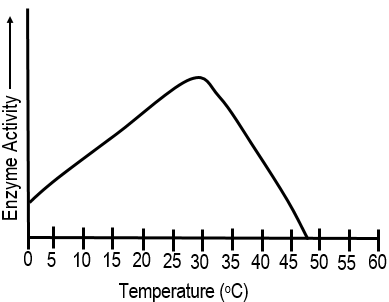
Which of the following best describes the relationship between enzyme activity and temperature?
Enzyme activity always increases with increasing temperature
Higher temperatures typically increase enzyme activity by lowering the activation energy of the reaction
Higher temperatures increase enzyme activity by increasing the number of activated complexes formed each minute
Low temperatures can denature enzymes by freezing them
Enzymes are activated allosterically at certain temperatures, but excessively high heat may destroy them by denaturation
Which of the following statements best describes enzymes?
They are present in the nucleus during eukaryotic DNA replication
They are made of amino acids
Their collective action regulates the metabolism of the cell
Many enzymes can be activated or inactivated by the presence or absence of specific hormones
All of the above are correct statements about enzymes
Which of the following best explains why different enzymes work best at different pHs?
Different enzymes are made from different amino acids
The three-dimensional folding of an enzyme is affected by the concentration of hydrogen ions in its environment
Enzymes that are present at low pHs work best at low pHs
Cells change their pH to regulate enzyme activity
Enzymes can increase or decrease the pH of a cell to become active or inactive
In the mitochondrial electron transport chain, protons are pumped into the intermembrane space. This would cause the pH of the intermembrane space to
increase due to an increase in hydrogen ion concentration
decrease due to an increase in hydrogen ion concentration
increase due to a decrease in hydrogen ion concentration
decrease due to a decrease in hydrogen ion concentration
not change because pH is related to hydrogen ion concentration, not proton concentration
In an experiment, plants are exposed to radioactively labeled O2. In which of the following molecules would the radioactivity be expected?
C6H12O6
NADPH
H2O
ATP
Rubisco
If plants are grown for several days in an atmosphere containing 14CO2, the largest amount of 14C would most likely be found in
the air spaces in the spongy mesophyll
the chlorophyll
the starch stored in the roots
the central vacuole
All the cells of the plant would be expected to contain equal concentrations
In an experiment, mice are fed glucose with radio-labeled (14C). In which of the following molecules would the radioactivity be expected?
NADH
H2O
CO2
ATP
The Calvin cycle requires energy and reducing power from which of the following?
ATP from oxidative phosphorylation, NADPH from the Krebs cycle
ATP from the light-dependent reactions, NADH from the Krebs cycle
ATP from photolysis, NADH from the thylakoid electron transport chain
ATP from the light dependent reactions, NADPH from the light-independent reactions
ATP and NADPH from the tylakoid electron transport chain and chemiosmosis
All of the following are true regarding both mitochondria and chloroplasts except
they cannot replicate independently of the cell
they contain a molecule of circular DNA
they are surrounded by two membranes
they synthesize ATP by chemiosmosis
they contain a compartment where hydrogen ions are pumped
Which of the following types of molecules produces the most energy when oxidized?
Proteins
Carbohydrates
Lipids
Nucleic Acids
ATP is produced in all of the following processes except
Cyclic light reactions
Non-cyclic light reactions
Glycolysis
Chemiosmosis
The Calvin Cycle
Which of the following is common to both fermentation and aerobic cellular respiration?
Oxygen is consumed
FADH2 is produced
ATP is synthesized
Carbon dioxide is consumed
All of the energy available in glucose is released as CO2
All of the following are true of chemiosmosis except
It occurs in both chloroplasts and mitochondria
It requires high-energy electrons to prodive the energy to pump protons across a membrane
Protons are pumped by ATP synthase
In the chloroplast, low-energy electrons are obtained from water, then energized (excited) by sunlight
In the mitochondria, high energy electrons are obtained from glucose
All of the following are true of chemiosmosis except
In the chloroplast, protons are pumped into the thlakoid space and flow into the stroma
In the mitochondria, protons are pumped into the intermembrane space and flow into the matrix
The energy for ATP synthesis comes from the release of the proton gradient
Cytochromes are membrane-bound proteins that make up the electron transport chain
Cytochrome proteins capture the energy from the release of the proton gradient and store it in the bonds of ATP
All of the following are true regarding fermentation except
Yeast produce two molecules of ethanol and two molecules of CO2 for each glucose molecule consumed
A net gain of two ATP per glucose is obtained
The purpose of fermentation is to produce two NADH per glucose
Bacteria and muscle cells under certain conditions perform lactic acid fermentation
In humans, red blood cells lack mitochondria and rely exclusively on lactic acid fermentation to produce ATP

What causes the graph to plateau?
The enzymes start to denature
The enzymes have achieved activation energy
The substrates have all been converted into products
The active sites of the enzymes have become saturated

Which enzyme is unaffected by pH?
chymotripsin
cholinesterase
pepsin
papain

