wayground logo

Free Printable Worksheets

Font size

S
M
L
XL
Worksheets

AKU TEST 1 BIOLOGY

Total questions: 112

Worksheet time: 19mins

Name
Class
Date
1.

Branch of biology that studies animals

a)

Zoology

b)

Botany

c)

Anatomy

d)

Physiology

2.

Branch of biology that studies plants

a)

Zoology

b)

Botany

c)

Taxonomy

d)

Genetics

3.

The study of all living things is known as...

a)

Biology

b)

Cytology

c)

Physiology

d)

Ecology

4.

The study of how organisms interact with each other and their environment

a)

cell biology

b)

ecology

c)

zoology

d)

microbiology

5.

The study of how organisms pass traits to their offspring

a)

cell biology

b)

ecology

c)

microbiology

d)

genetics

6.

The study of bacteria and viruses is known as

a)

botany

b)

zoology

c)

microbiology

d)

cell biology

7.

The study of changes in types of organisms over time

a)

ecology

b)

evolutionary theory

c)

cell biology

d)

zoology

8.

The study of the human body

a)

physiology

b)

psychology

c)

zoology

d)

microbiology

9.

The study of life on the cellular level

a)

biology

b)

biochemistry

c)

cell biology

d)

physiology

10.

The study of the chemistry of life

a)

biology

b)

botany

c)

cell biology

d)

biochemistry

11.

Ecology is the study of:

a)

Growth

b)

Environment and eco-system

c)

Body

d)

Bacteria

12.

Horticulture is the study of :

a)

Growth

b)

Growth and development of animals

c)

Growth and development of Plants

d)

Growth and development of insects

13.
The part of Earth where organisms can live.
a)
biotic factors
b)
biosphere
c)
ecology
d)
biology
14.
A __________ includes all living and non-living things in an environment. 
a)
population
b)
niche
c)
abitotic
d)
ecosystem
15.
Identify the examples as: a organism, population, community, or ecosystem.
A beautiful butterfly.
a)
Organism
b)
Population
c)
Community
d)
Ecosystem
16.
Identify the examples as: a organism, population, community, or ecosystem.
Water, Fish, Turtles, Oxygen, Rocks and Moss interacting in a river system.
a)
Organism
b)
Population
c)
Community
d)
Ecosystem
17.
Identify the examples as: a organism, population, community, or ecosystem.
Chicken, Cow, Grass, Buffalo, and Mouse living on farmland.
a)
Organism
b)
Community
c)
Population
d)
Ecosystem
18.
All organisms of the same species living in the same area.
a)
Population
b)
Community
c)
Ecosystem
d)
Organism
19.
A large geographical area that is characterized by its climate, flora (plants), and fauna (animals).
a)
Biome
b)
Ecosystem
c)
Habitat
d)
Community
20.
All of the different biotic organisms found in the same area.
a)
Organism
b)
Population
c)
Community
d)
Ecosystem
21.
Identify the examples as: a organism, population, community, or ecosystem.
All speckled sting-ray that live in the Pacific Ocean
a)
Organism
b)
Population
c)
Community
d)
Ecosystem
22.
The study of organisms and how they interact with one another and their environment is best described as
a)
Biology
b)
Ecology
c)
Zoology
d)
Botany
23.

Living things are made up of cells. Cells are organized at different levels to form very complex living organisms like your body. Each level has a specific role or job to perform. Which of the following lists these levels in the correct order of organization from the simplest to the most complex?

a)

cells, tissues, organs, organ systems, organism

b)

organism, organ systems, organs, tissues, cells

c)

tissues, cells, organs, organism, organ systems

d)

organs, organ systems, organism, cells, tissues

24.

Which of the following displays the levels of organization INCORRECTLY from smallest to largest?

a)

Atom, Molecule, Organelle, Cell

b)

Organ System, Organ, Organism, Population

c)

Community, Ecosystem, Biome, Biosphere

d)

Organelle, Cell, Tissue, Organ

25.

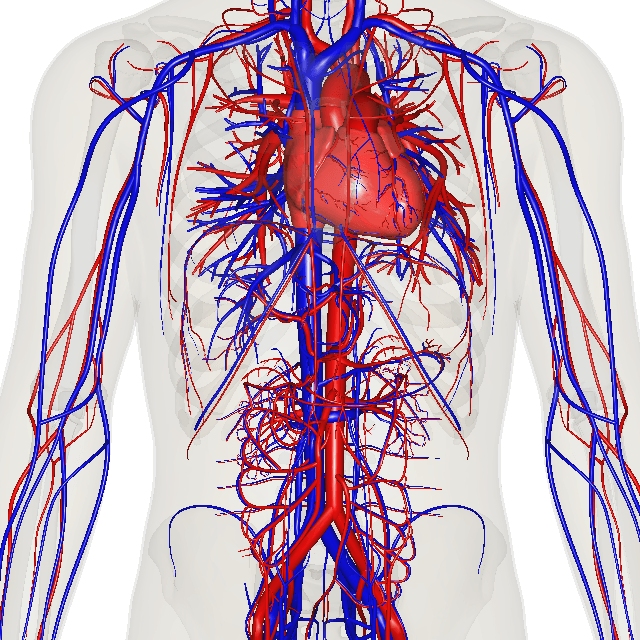
This is an example of ........

a)

organ

b)

organ system

c)

tissue

d)

cell

26.

The liver is a dark red structure in the human body that releases bile and hormones. At what level of organization is the liver?

a)

Cell

b)

Tissue

c)

Organ

d)

Organ System

27.

Which of the following is the correct sequence in biological method of study?

a)

Observation \rightarrow  Hypothesis \rightarrow  Deduction \rightarrow  Experimentation \rightarrow  Theory \rightarrow  Law

b)

Observation undefined Deduction undefinedHypothesis  undefined Experimentation undefined Theory undefined Law

c)

Observation undefined Hypothesis undefined Experimentation undefined Deduction undefined Law undefined Theory

d)

Observation undefined Hypothesis undefined Deduction undefined Experimentation undefined Law undefinedTheory

28.

Unicellular organism that causes malaria in mammals and birds etc

a)

Plasmodium

b)

Anopheles

c)

Culex

d)

Aedes

29.

Which of the following scientist examined plasmodium in blood from malarial patient?

a)

A.F.A. King

b)

Laveran

c)

Ronald Ross

d)

Grassi

30.

Experimentation is only a step of the scientific process, but it is very important step because it always __________.

a)

Gives a biologist a correct result

b)

Allows rejection of some alternative hypotheses

c)

Ensures that hypothesis can be confirmed with certainty

d)

Gives scientists a chance to work in the laboratory

31.

Which of the following is the most possible sequence of making a biological discovery?

(1) proposing a hypothesis

(2) formation of theories

(3) making observations

(4) doing experiments

a)

(1), (2), (3), (4)

b)

(1), (4), (3), (2)

c)

(3), (1), (4), (2)

d)

(4), (2), (3), (1)

32.

This is an interdisciplinary field combining mechanical, electrical, and chemical engineering to study the human body.

a)

Manufacturing

b)

Chemical

c)

Bio medical

33.

A veterinarian that works with fish and mollusks would be:

a)

Aquatic animal practice

b)

Large animal clinic.

c)

Small and companion animals clinic

34.

Lisa want to become a zoologist. Does Lisa have to study geology?

a)

Yes

b)

No

35.

Changes in biodiversity can influence ecosystem services.

a)

true

b)

false

36.
Enzymes are considered to be 
a)
Lipids
b)
Carbohydrate
c)
Protein
d)
Nucleic Acid
37.

What is the purpose of an enzyme?

a)

give permission for the biochemical reaction

b)

raise activation energy

c)

speed up biochemical reactions

d)

control how many reactions occur

38.
Where do substrates bind on an enzyme?
a)
voltage-gated channels
b)
surface receptor
c)
calcium channels
d)
active site
39.
Which of the following tasks listed below is most associated with enzymes?
a)
catalyze chemical reactions                  
b)
store genetic information       
c)
store chemical energy in the cell   
d)
dissolve nutrients and minerals 
40.

Enzymes are examples of

a)

biological catalysts

b)

proteins

c)

macromolecules

d)

all of these are true

41.
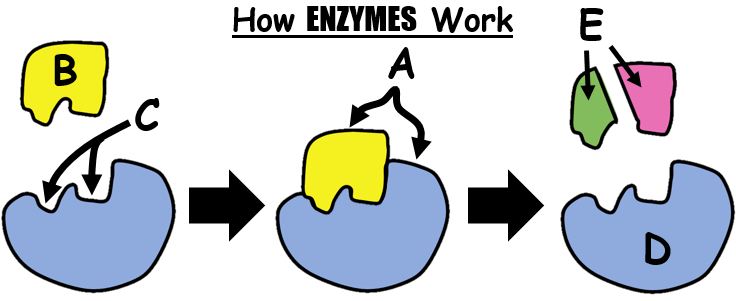
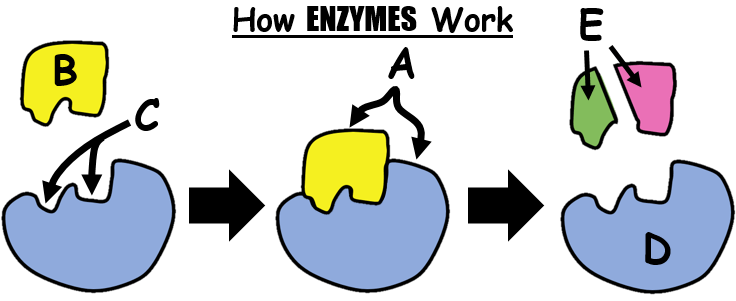
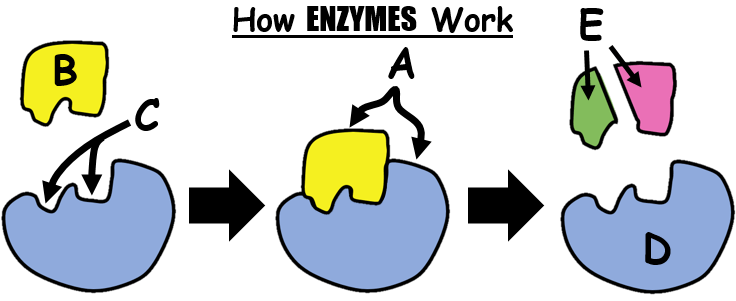
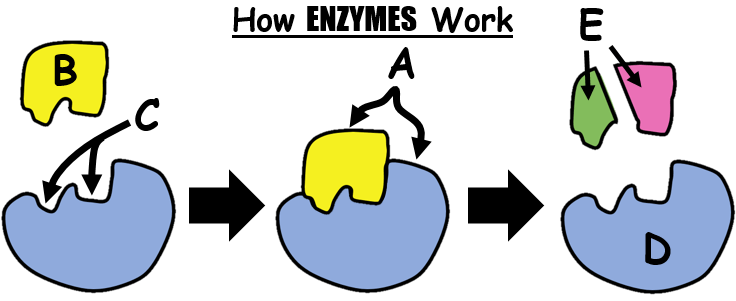
What is structure A?
a)
Substrate
b)
Active site
c)
Enzyme
d)
Products
42.

What is the name for the mechanism of normal enzyme activity?

a)

lock and key

b)

jigsaw puzzle

c)

hammer and nail

d)

competitive inhibition

43.
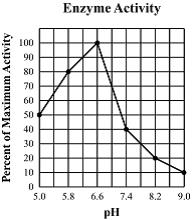
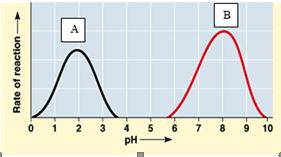
Which of the following conclusions can be drawn from this graph?
a)
The optimum pH of the enzyme is 6.6.
b)
The optimum pH of the enzyme is 5.8
c)
The enzyme’s activity increases as pH increases 5.0 to 9.0
d)
The enzyme’s activity is greater around pH of 8.0 .
44.

Normal body temperature is 37 degrees Celsius. At 40 degrees Celsius, your biological enzymes will...

a)

Function optimally

b)

Denature (change shape and break down)

c)

Wait until the temp. increases

d)

Wait until the temp. decreases

45.

What gives an enzyme substrate specificity?

a)

Size

b)

Shape

c)

Name

d)

Location it is found in

46.
The part of the enzyme that the substrate bonds to is called the _____.
a)
active site
b)
activation energy
c)
bond site
d)
peptide bond
47.
Any substance that is acted upon by an enzyme is called a(n)?
a)
Coenzyme
b)
Substrate
c)
Vitamin
d)
Polypeptide
48.
After the enzyme and substrate bind together and perform the reaction, what does the substrate become?
a)
a substrate
b)
an enzyme
c)
a product
d)
an active site
49.
In the diagram, what is letter A? 
a)
product
b)
substrate
c)
enzyme-substrate complex
d)
active site
50.
An enzyme speeds up a reaction by
a)
lowering the activation energy.
b)
raising the activation energy.
c)
releasing energy.
d)
absorbing energy.
51.
Each enzyme only has 1 substrate that will fit its active site.  What is this called?
a)
reusablility
b)
denaturation
c)
specificity
d)
fragility
52.
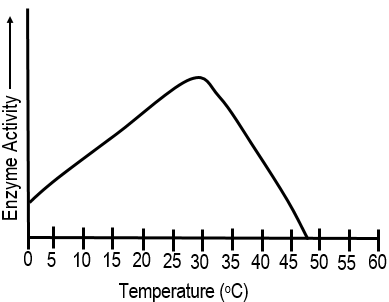
Based on the graph, what is the optimal temperature for this enzyme? 
a)
15oC
b)
40oC
c)
30oC
d)
35oC
53.
An enzyme speeds up a chemical reaction in the cell but can only be used once.  True or False? 
a)
true
b)
false
54.
What is the name of structure A?
a)
Active Site
b)
Substrate
c)
Enzyme-Substrate Complex
d)
Product
55.

The substrate is

a)

another word for enzyme

b)

the chemical(s) that are reactants in a catalyzed reaction

c)

amino acids

d)

water

56.
What type of organic compound are enzymes? 
a)
Carbohydrates
b)
Lipids
c)
Proteins
d)
Nucleic Acids
57.
What is a substance called if it speeds up a chemical reaction?
a)
reusable
b)
catalyst
c)
specific
d)
fragile
58.
With what 3 letters do enzymes typically end?
a)
-ose
b)
-ase
c)
-ese
d)
-tic
59.
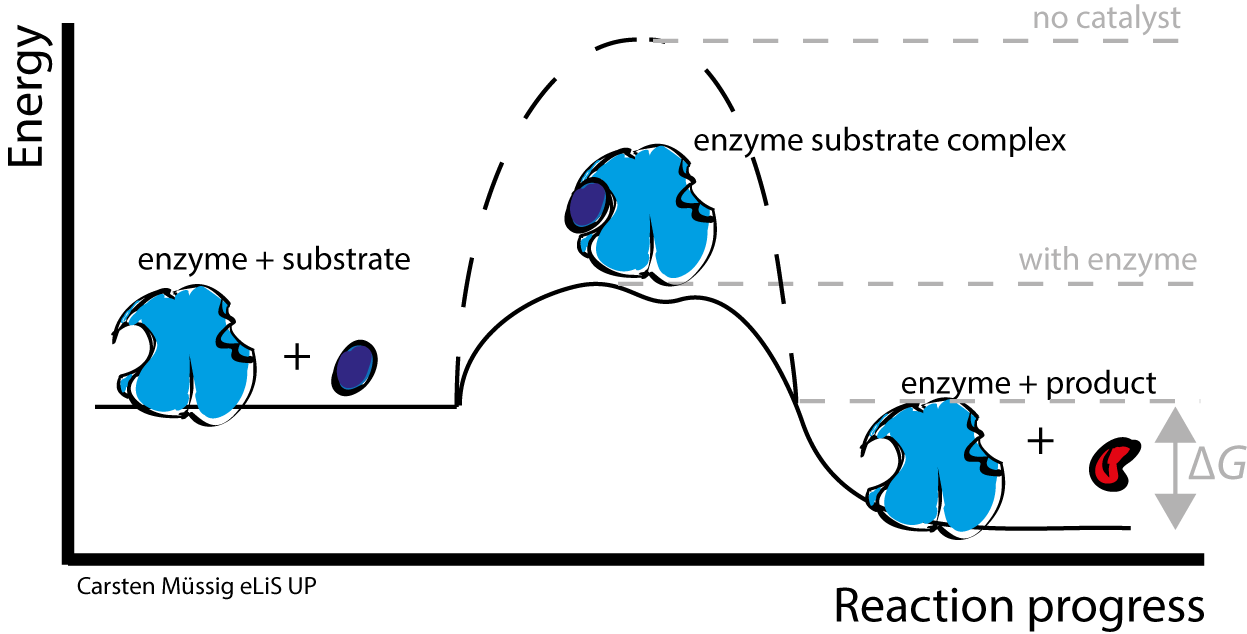
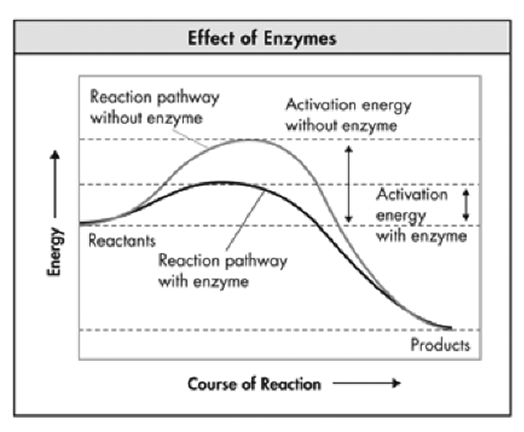
The graph shows how enzymes affect reactions in cells. Which statement best summarizes the information shown in the graph?
a)
Enzymes increase the energy of the reactants.
b)
Enzymes decrease the energy level of the products.
c)
Enzyme decrease the activation energy of the reaction.
d)
Enzymes reverse the direction of the reaction.
60.
Any substance that is acted upon by an enzyme is called a(n)?
a)
Coenzyme
b)
Substrate
c)
Vitamin
d)
Polypeptide
61.
In the diagram, what is letter A? 
a)
product
b)
substrate
c)
enzyme-substrate complex
d)
active site
62.
Enzymes are...
a)
nucleic acids
b)
proteins
c)
lipids
d)
carbohydrates
63.
An enzyme speeds up a chemical reaction in the cell but can only be used once.  True or False? 
a)
true
b)
false
64.
What is the function of an enzyme?
a)
enzymes break themselves into small pieces
b)
enzymes slow down chemical reactions
c)
enzymes speed up chemical reactions
d)
enzymes combine products to form reactants 
65.
Which of these is most likely an enzyme?  
a)
Sucrose
b)
Galactose
c)
Fructose
d)
Amylase
66.
Enzymes speed up reaction rates by changing...
a)
Activation Energy
b)
pH
c)
Hydrogen Bonds
d)
Kinetic Energy
67.
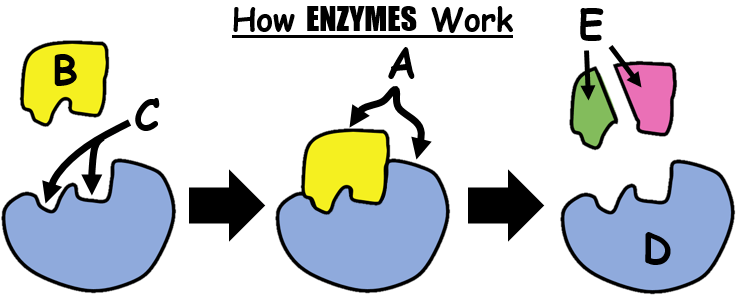
Letter D...
a)
active site
b)
enzyme
c)
substrate
d)
products
68.
Letter B...
a)
active site
b)
enzyme
c)
substrate
d)
products
69.
Letter C...
a)
active site
b)
enzymes
c)
substrate
d)
products
70.
Letter E...
a)
active site
b)
enzyme
c)
substrate
d)
products
71.

Two models for enzyme function are

a)

lock and key

b)

induced fit

c)

dehydration synthesis

d)

hydrolysis

72.
Which of these is NOT true?
a)
Enzymes can denature (change shape) when the temperature gets too high.
b)
Enzymes can only be used once in a chemical reaction. 
c)
Extreme pH can denature enzymes.
d)
Enzymes speed up chemical reactions. 
73.

What is the optimal pH of enzyme A?

a)

8

b)

2

c)

5.7-10

d)

10

74.

High temperatures can (a)   an enzyme, leading to a loss of function.

75.

Changing the pH can alter the shape of an enzyme's (a)   site.

76.

Which of the following does not affect enzyme activity?

a)

temperature

b)

pH

c)

substrate concentration

d)

sugar

77.

Which refers to a molecule upon which an enzyme acts?

a)

cofactor

b)

coenzyme

c)

substrate

d)

substance

78.

What will happen when enzyme is denatured?

a)

A proton is added or removed from the enzyme.

b)

It reaches its temperature at which it exhibits maximum activity.

c)

A substance binds to it which slows or stops its normal catalytic function.

d)

It changes shape and the active site no longer matches the shape of the substrate molecule.

79.

TRUE OR FALSE. Competitive and noncompetitive enzyme inhibitor both slows or stops the normal catalytic function of an enzyme.

a)

True

b)

False

80.

This graph shows the enzyme activity when substrate concentration is increased. What is the reason of this enzyme activity pattern?

a)

There is no available substrate.

b)

The active site changes its shape, thus, preventing the substrate from binding.

c)

High substrate concentration affects the temperature at which enzymes work best.

d)

Enzymes are all occupied, the incoming substrate molecules must wait for an active empty site.

81.

TRUE OR FALSE. All enzymes have a certain pH range at which they work best.

a)

True

b)

False

82.

Why an increased in temperature (up to the optimum temperature) increases the enzyme reaction?

a)

Because kinetic energy of molecules decreases.

b)

Because kinetic energy of molecules increases.

c)

Because denaturation of enzymes occurs.

d)

Because inhibitors are eliminated at this condition.

83.

Which of the following best describes how substrate concentration affects enzyme action?

a)

The more substrate available, the faster the rate of reaction.

b)

As substrate concentration halves, the rate of reaction quadruples.

c)

As substrate concentration doubles, the rate of reaction triples.

d)

The less substrate available, the faster the rate of reaction.

84.

Select the true statement.

a)

Enzymes decouple at pH levels far away from their optimum.

b)

Enzymes deactivate at pH levels far away from their optimum.

c)

Enzymes denature at pH levels far away from their optimum.

d)

Enzymes decompose at pH levels far away from their optimum.

85.
what part do the competitive inhibitors attach to?
a)
subtrate
b)
active site
c)
somewhere other than enzyme
86.

After the enzyme and substrate bind together and perform the reaction, what does the substrate become?

a)

a substrate

b)

an active site

c)

an enzyme

d)

a product

87.
The place, other than the active site, where activators and inhibitors bind to an enzyme is called the ________ site.
a)
competitive
b)
allosteric
c)
alterior
d)
rate
88.

An allosteric inhibitor

a)

decreases the concentration of an inactive enzyme.

b)

changes the shape of an enzyme.

c)

increases the concentration of a product.

d)

changes the shape of a substrate.

e)

increases the concentration of an enzyme–substrate complex.

89.

Non-competitive inhibition involves a molecule binding to a ______ site.

a)

Active

b)

Allosteric

c)

Accompanying

d)

Applied

90.

Competitive inhibition involves a molecule, other than the substrate, binding to the enzyme’s _____ site.

a)

BInding

b)

Allosteric

c)

Kinetic

d)

Active

91.

Cyanide is an example of a _____ inhibitor.

a)

Competitive

b)

Active

c)

Non-competitive

d)

Allosteric

92.

Key metabolic enzymes are often inhibited by the end product of the pathway they control.

a)

Competitive inhibition

b)

Non-competitive inhibition

c)

Feedback inhibition

d)

Cofactors

93.

What is metabolism?

4 lines
94.

*BONUS* Which metabolic pathway involves the breaking down of a certain sugar within the body to form pyruvate?

a)

Cellular Respiration

b)

Kreb's Cycle

c)

Glycolysis

d)

Citric Acid Cycle

95.
Enzymes are...
a)
nucleic acids
b)
proteins
c)
lipids
d)
carbohydrates
96.
What is the purpose  of an enzyme?
a)
give permission for the reaction
b)
raise activation energy
c)
speed up reactions
d)
control how many reactions occur
97.
With what 3 letters do enzymes typically end?
a)
-ose
b)
-ase
c)
-ese
d)
-tic
98.
Which of these is most likely an enzyme?  
a)
Sucrose
b)
Galactose
c)
Fructose
d)
Amylase
99.
Enzymes are composed of what organic molecule?
a)
Sugars
b)
DNA
c)
Proteins
d)
Fatty Acids
100.
What is structure A?
a)
Substrate
b)
Active site
c)
Enzyme
d)
Products
101.
What is structure D?
a)
Substrate
b)
Active site
c)
Enzyme
d)
Products
102.
What is structure C?
a)
Substrate
b)
Active site
c)
Enzyme
d)
Products
103.
What is structure E, F, G?
a)
Substrate
b)
Active site
c)
Enzyme
d)
Products
104.
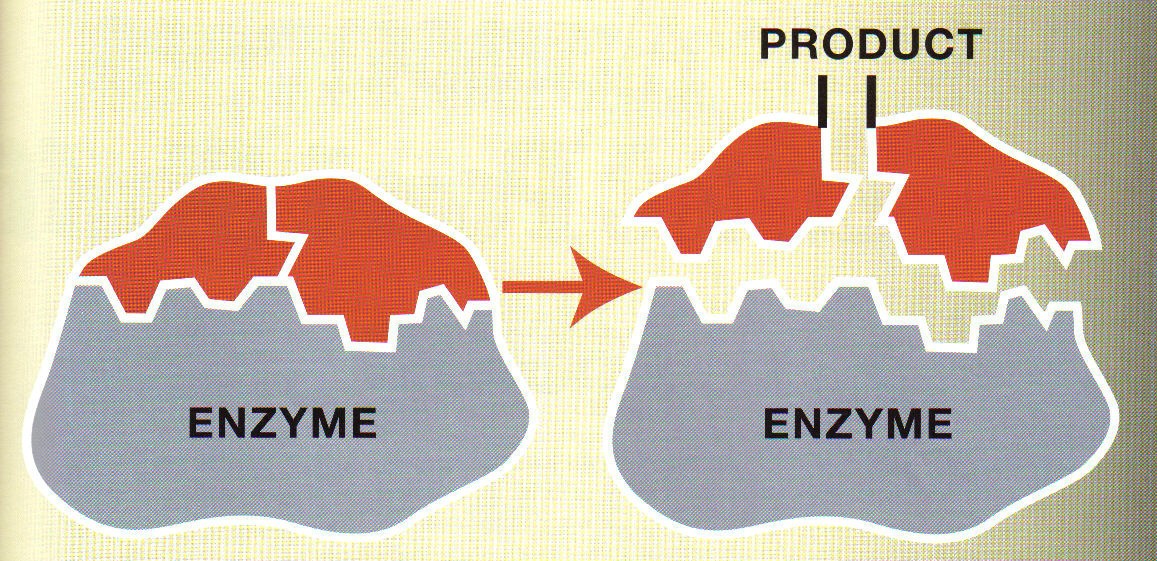
What is the name for the mechanism of enzyme activity?
a)
Lock and key
b)
jigsaw puzzle
c)
hammer and nail
d)
two hands pattern
105.
The "lock and key hypothesis" attempts to explain the mechanism of?
a)
Vacuole formation
b)
Pinocytosis
c)
Sharing of electrons
d)
Enzyme are specific to a substrate
106.

Which substrate would this enzyme catalyze?

a)
b)
c)
d)
107.
Where do substrates bind on an enzyme?
a)
voltage-gated channels
b)
surface receptor
c)
calcium channels
d)
active site
108.
Cells can produce over one thousand different enzymes at a time.  Enzymes are critical to the metabolism of these cells, but why are so many different enzymes needed?
a)
Cells are completely unable to control what enzymes
they produce
b)
The variety of enzymes prevents their actions from being inhibited. 
c)
The active site of an enzyme can only bind to a specific substrate.
d)
The products of a reaction are always converted into new enzymes.
109.

Where are enzymes found?

a)

Only in the digestive system

b)

in animals but not in plants

c)

in all living cells

d)

in plants but not in animals

110.

Which types of enzymes digest starch?

a)

catalase

b)

amylase

c)

lipase

d)

protease

111.
What is another name for enzymes?
a)
chemical catalysts
b)
microorganisms
c)
biological catalysts
d)
inorganic catalysts
112.
An enzyme speeds up a chemical reaction in the cell but can only be used once.  True or False? 
a)
true
b)
false