
 Worksheets
Living Environment Regents DRILL 3
Total questions: 110
Worksheet time: 2hrs 50mins

The diagram below represents the major parts of a growing onion plant. Nutrients are represented in the soil around the onion. Which statement best describes how nutrients enter the root cells of the onion plant?
Only nutrients needed by the plant enter root cells.
The nutrients usually move from an area of high concentration in the soil to an area of low concentration in root cells.
Nutrients always move into the plant cells by active transport.
The nutrients always move from an area of low concentration in the soil to an area of high concentration in root cells.

A and B below represent two different slide preparations of elodea leaves. Elodea is a plant found in streams and ponds in New York State. The water used on slide A contained 1% salt and 99% water. The salt solution used on slide B contained 6% salt and 94% water. Elodea cells normally contain 1% salt. Five minutes after the slides were prepared, a student using a compound light microscope to observe the cells in leaves A and B would most likely see that
water had moved out of the cells of the leaf on slide A
salt had moved into the cells of the leaf on slide A
water had moved out of the cells of the leaf on slide B
salt had moved out of the cells of the leaf on slide B

The diagram represents a laboratory setup. A starch solution in a test tube was separated from the water in a beaker by a dialysis membrane. One hour later, it was observed that the liquid had risen in the test tube. The rise of the liquid in the test tube that was observed after one hour can be explained as a result of the
starch solution moving into the test tube and out of the beaker
water moving from the beaker into the test tube
large starch molecules blocking the dialysis membrane
dialysis membrane acting as a barrier to the water molecules

he diagram below represents the results of the net movement of a specific kind of molecule across a living cell membrane. The movement of molecules from side A to side B is an example of the process of
active transport
chromatography
cellular respiration
diffusion

The diagram below represents a laboratory experiment involving sucrose and water molecules in a cellophane bag which functions in the same way as dialysis tubing. Which statement correctly explains the rise of liquid in the tube at the end of the experiment?
The concentration of sucrose molecules increased as water molecules entered the bag. This concentra- tion increase pushed the liquid up the tube.
Water entered the bag due to the lower concentration of water inside. The extra water pushed the liquid up the tube as the bag filled.
Sucrose indicator entered the bag and reacted with the sucrose molecules. The reaction made the bag increase in size and pushed the liquid up the tube.
Sucrose molecules moved out of the bag and up the tube while water moved out, causing the rise of liquid in the tube.

A cube cut from a potato is placed in a beaker of distilled water. The potato cells have a relatively high concentration of starch and a relatively low concentration of water. The diagram represents the water and starch molecules in and around one of the potato cells in contact with the water in the beaker. Which row in the chart correctly describes what would be expected to occur in the potato cells, with regard to both the starch and water molecules?


The diagram shows an experimental setup using an artificial plant cell. Molecules A and B are commonly found in plant cells. When tested, it was discovered that molecule A quickly passed through the artificial plant cell membrane. Molecule B did not pass through. The locations of molecules A and B at the beginning of the experiment are shown. Which statement best describes what was observed when the setup was examined 20 minutes later?
Molecule A remained inside the artificial cell and molecule B remained outside.
Only molecule A was found both inside and outside the artificial cell.
Only molecule B was found both inside and outside the artificial cell.
Both molecules A and B were found inside and outside the artificial cell.

The diagram represents red blood cells placed in three test tubes, each containing a different salt solution. Which statement best describes solution C?
The concentration of dissolved salt in the solution is greater than the concentration in the cells.
The concentration of dissolved salt in the solution is less than the concentration in the cells.
The concentration of water in the solution is greater than the concentration in the cells.
The concentration of water in the solution is equal to the concentration in the cells.
The diagram represents red blood cells placed in three test tubes, each containing a different salt solution. Which solution would be most similar in concentration to the normal internal environment of the human circulatory system?
solution A, only
solution B, only
solutions A and B
solutions A and C
In order to enter cells and be useful to the body,
starch must be
absorbed through the skin
broken down into fats and water
digested into simple sugars
transported from the respiratory to the circulatory systems
Which group consists entirely of organic molecules?
protein, oxygen, fat
protein, starch, fat
water, carbon dioxide, oxygen
water, starch, protein
Even though human proteins are synthesized
from only 20 different amino acids, there are
thousands of different proteins found in human
cells. This great variety of proteins is possible
because the
size of a specific amino acid can vary within
a protein
chemical composition of a specific amino
acid can vary
sequence and number of amino acids can be
different in each protein
same amino acid can have many different
properties
In living cells, chemical processes, such as synthesis,
all require the action of
specialized antibiotics
hormones
salts
biological catalysts

The diagram below represents the region
between two nerve cells. Cell A releases a
chemical that travels to and binds with structure
X on cell B.
Structure X most likely represents
a receptor molecule
an inorganic substance
a ribosome
an antibody
The hormone adrenaline can affect only cells with
appropriately shaped receptors
the appropriate antibodies
ribosomes that produce adrenaline
genes that break down adrenaline

The graph shows the results of an action
of the enzyme catalase on a piece of meat.
Evidence of enzyme activity is indicated by
bubbles of oxygen.
The enzyme works better at 10°C than at
50°C.
The enzyme works better at 5°C than at
65°C.
The enzyme works better at 35°C than at
either temperature extreme.
The enzyme works at the same level in all
environments.

Which row in the chart contains correct information concerning synthesis?
1
2
3
4

Pepsin works best in which type of environment?
acidic
basic
neutral
sometimes acidic, sometimes basic

The diagram represents a beaker containing a solution of various molecules involved in digestion. Which
structures represent a biological catalyst
A & B
A & D
B & E
D & E
Shrimp that live in the cold waters off Alaska will die if introduced into warm water. One likely reason these shrimp do not survive is that enzymes in the shrimp
start to replicate
change shape
are composed of fat molecules that melt
break down into small starch molecules


Cells can only work if their enzymes are functioning. What can you infer from the graph?
Cells function best at low pH values
Cells function fine at all pH values
Cells function best at high pH values
Cells do not function well if the pH is too high or too low
Organisms living in a bog environment must be able to tolerate nitrogen-poor acidic conditions. Bog plants such as the Venus flytrap and sundew are able to obtain their nitrogen by attacking and consuming insects. These plants produce chemicals that break down the insects into usable compounds.
These chemicals present in the bog plants that break down the insects mentioned in the reading passage are most likely...
hormones
lipids
enzymes
carbohydrates
A mutation occurring in a human can be passed from parent to offspring when it occurs in a
(1) lung cell, due to exposure to a toxic gas
(2) gamete formed in the ovary
(3) body cell undergoing mitosis
(4) heart cell with chromosome damage
If the concentration of sodium is greater outside a cell than inside the cell, which process could move sodium out of the cell?
(1) diffusion
(2) carbohydrate synthesis
(3) active transport
(4) digestion
In an embryo, the formation of many types of tissues and organs occurs as a result of the process of
(1) fertilization
(2) genetic sorting
(3) differentiation
(4) gene recombination
The primary function of the human male reproductive system is to
(1) provide a site for fertilization
(2) produce and transport gametes
(3) protect and nourish the embryo
(4) prevent urine from leaving the body
A DNA segment removed from neurospora (a pink mold) contained the base sequence G-T-C-C-A-T-G-C-A. A similar segment of DNA removed from neurospora that had been exposed to radiation for several hours had the base sequence G-T-C-C-A-T. This change in the base sequence is an example of
(1) a deletion
(2) an insertion
(3) a substitution
(4) a replication
Producers are generally found at the beginning of a food chain. Which statement best explains why this is true?
Producers are usually smaller in size than consumers.
Producers do not rely on other organisms for food.
There are always more consumers than producers in food chains.
Consumers are always more complex organisms than producers.
A lion cub resembles its parents because it inherits genes that produce
DNA identical to all of the DNA found in both parents
proteins identical to all of the proteins found in both parents
ATP identical to some of the ATP found in each parent
enzymes identical to some of the enzymes found in each parent
If body temperature is too high, some blood vessels increase in size and sweat glands will excrete sweat, resulting in a lower body temperature. These changes are an example of
a learned behavior
feedback mechanisms
an inherited disorder
genetic mutations
A farmer grows beans that he sells to local markets. Over a period of 40 years, the farmer has identified the plants that produced the most beans and only used those beans to produce new plants. This procedure is part of the process of
selective breeding
replication
genetic engineering
cloning
Although we rely on coal, oil, and natural gas to produce energy, some environmental scientists have proposed that we use less fossil fuel. One reason to support this proposal is to
enable us to preserve rain forests in tropical areas
help us to reduce the production of carbon dioxide gas
allow us to decrease the use of fertilizers on crops
encourage us to end research on wind and water power sources
Research has shown that treadmill training increases the number of certain energy-releasing structures in the brain cells of rats. The cellular structures referred to in this study are most likely
mitochondria
nuclei
vacuoles
ribosomes

A person would never have pure water put into their veins in a hospital because their cells would...
Shrink/Dehydrate
Expand
Stay the same
If there is 5 percent water inside a cell and 5 percent water outside a cell
more water will move inside the cell
more water will move outside the cell
There will be no net movement of water, it moves into and out of the cell at the same time.
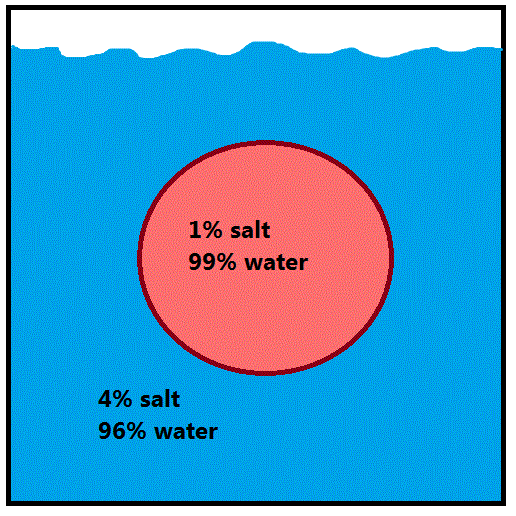
Where will the water go?
Into the cell
Out of the cell
Equally in & out - it's isotonic
There is no water
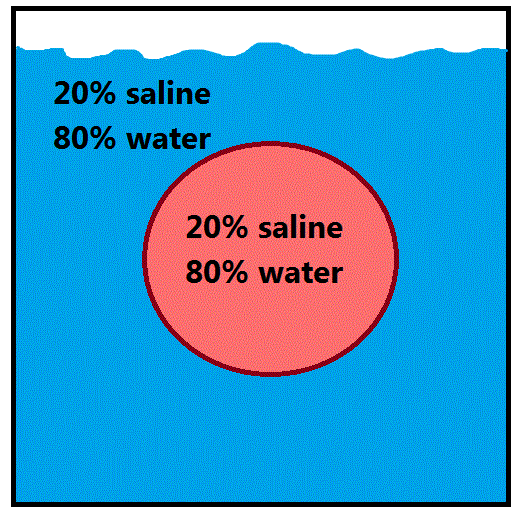
A blood cell is placed into the jar, as seen. Where will the water go?
Into the cell
Out of the cell
Equally in & out - it's isotonic
The water is a lie

Condition that occurs if too much water leaves a plant cell and cell collapses due to the cell membrane pulling away from the cell wall.
Plasmolysis
Osmosis
Cytolysis
Exocytosis
Cutting of trees in a forest is callled
Reforestation
Deforestation
tree fall
None of them
Which gas is mainly responsible for the green house effect?
H2
O2
CO2
Water Vapours
Which of the following is not a renewable source of energy?
Sun energy
Nuclear Energy
Wind Energy
All are renewable sources
Which of the following is biodegradable?
Plastic
Paper
Glass
None of them are biodegradable
Global warming will cause an increase of......
Heat Waves
Hurricanes
Floods
All of them are true
You can ........... plastic bags again and again until they get holes in them.
Reduce
Reuse
Resume
Rewaste
Energy efficient vehicles and appliances use.......
less energy
more energy
much energy
no energy
The major part of our rubbish is taken to...................
landfills
fuel lands
wastelands
rubbish fields
Gases that stop heat from escaping into space are called _______ gases.
green
zero-emission
greenhouse
greenfield
The place in which a plant, animal, bird or fish normally lives is its ........
food chain
habitat
eco-community
eco-friendly
Which of the following is an example of a renewable natural resource?
Copper
Crude Oil
Coal
Wave Energy
1. Sustainability is defined as…
Consuming at a rate to satisfy the current generation.
Rapidly increasing resource consumption over time.
Maintaining a rate of resource consumption that will allow the population to survive indefinitely.
Not consuming any resources at all.

An average person from _______________ would be expected to have a higher ecological footprint than the other two countries.
Country "A"
Country "B"
Country "C"
None of the above; They would have roughly equal ecological footprints.
Which example best illustrates the point behind the Tragedy of the Commons essay?
Various nations overfishing in international waters, leading to a collapse of fish stocks.
A property owner clear-cutting all of the trees on his land to sell for timber
A farmer that overplants his fields one year, leading to a poor harvest
One country declaring war on another
Environmental science applies to all of the following EXCEPT...
How the natural world works
How much greenhouse gas is produced
How our environment affects us
How we affect our environment
Which is a social movement dedicated to protecting the natural world from human actions
Environmental Science
Environmental Policy
Environmental Ethics
Environmentalism

What type of investigation does this represent?
model
experimentation
observation
recording

The picture below shows a microscopic view of cork tissue, which Robert Hooke used to identify the first cell in 1665. Today, it is known that this discovery helped lead to the cell theory. What happened for the cell theory to be created?
Hooke formed an explanation that was so convincing that the scientific community easily agreed that he was correct and made the cell theory.
The scientific community elected the best cell biologist to perform one more experiment on Hooke's work, and he created the cell theory.
The scientific community took Hooke to a court of law, and after many arguments they eventually ruled in favor of the cell theory.
Many scientists performed studies that tested and built upon Hooke's work, eventually forming a unified understanding of cells.
The formal process of submitting research for examination by the scientific community if called...
Science regents
Scientific method
Scientist Review
Peer review
Which of the following types of environmental ethics places an emphasis on human interests?
Anthropocentric
Ecocentric
Biocentric
None of these
A fully functioning enzyme molecule is arranged in a complex three-dimensional shape. This shape determines the...
specific type of molecule it interacts with during a reaction
rate at which the enzyme breaks down during a reaction it regulates
pH of all body systems
temperature of the products of the reaction it regulates
A scientist plans to cut a segment of DNA so that it can be inserted into the DNA of a bacterium, a single-celled organism. The scientist needs to use a special type of organic molecule to perform this cutting process. This molecule is...
a lipid
a carbohydrate
an enzyme
a hormone
Which statement best describes enzymes?
Every enzyme controls many different reactions.
The rate of activity of an enzyme might change as pH changes.
Temperature changes do not affect enzymes.
Enzymes are produced from the building blocks of carbohydrates.

Hydrogen peroxide (H2O2) is a toxic by-product of cellular metabolism in aerobic organisms. The reaction below occurs within the cells to prevent the accumulation of hydrogen peroxide. In the reaction to the right, catalase functions as an...
enzyme in the breakdown of hydrogen peroxide
enzyme in the synthesis of hydrogen peroxide
emulsifier in the digestion of hydrogen peroxide
indicator in the detection of hydrogen peroxide

The graph below represents the effect of pH on three different enzymes at normal body temperature.
The graph illustrates that enzymes 1, 2, and 3
A) B C) D
are not affected by pH
work best at different pH levels
work best in an acidic environment
work best in a basic environment

Base your answer to the following question on the graph below and on your knowledge of biology.
Which section of the graph includes the point at which the enzyme started to denature?
A) I B) II C) III D) IV
I
II
III
IV
Which substance plays a major role in most of the chemical reactions that occur in a living cell?
water
glycogen
glycerol
maltose
Which compound is inorganic?
glucose
carbon dioxide
ethane
stearic acid (Cl8H36O2)
Which elements are present in all organic compounds?
hydrogen and oxygen
nitrogen and oxygen
nitrogen and carbon
hydrogen and carbon

. Base your answer to the following question on the diagram below and on your knowledge of biology. The diagram represents a portion of a starch molecule.
The building blocks for this molecule are...
amino acids
simple sugars
fats
molecular bases

Base your answer to the following question on the diagram below, which represents a chemical reaction that occurs in the human body, and on your knowledge of biology.
Substances X and Y are examples of which kind of molecule?
simple sugar
amino acid
fat
hormone
The basic building blocks of a protein are?
glucose molecules
amino acids
hormones
fats
Enzymes are a type of...
Carbohydrate
Protein
Nucleotide
Fatty Acid
Which pH value indicates the most acidic condition?
1.6
2.1
7.3
11.1

Which life process is indicated by the arrows in the diagram of an amoeba shown to the right?
digestion
excretion
fermentation
transport

The diagram to the right represents a sequence of events that occurs in the human body throughout the day,
These events can best be described as an example of...
an energy cycle
recycling of inorganic materials
a feedback mechanism
a learned behavior

The diagram below represents a cell structure involved in converting energy stored in organic molecules into a form used by animal cells.
The arrows represent the movement of which substances?
carbon dioxide and sugar
oxygen and ATP
ATP and carbon dioxide
oxygen and sugar

. A photograph of human cells as seen with a compound light microscope is shown below. A cell structure is labeled A.
Structure A is most likely a...
mitochondrion that synthesizes food for the cel
nucleus that is the site of food storage
mitochondrion that absorbs energy from the Sun
nucleus that is responsible for the storage of information

The diagram below represents changes in the sizes of openings present in leaves as a result of the actions of cells X and Y.
The actions of cells X and Y help the plant to..
maintain homeostasis by controlling water loss
store excess heat during the day and remove the heat at night
absorb light energy necessary for cellular respiration
detect changes in the biotic factors present in the environment

Methods A and B are classified as methods of passive transport because they do not require
ATP
light
carbon dioxide
DNA
A student lifted weights after school and found that his muscles started to burn. He couldn’t continue to lift the weights after prolonged exercising. This muscle fatigue is most likely due to
the heart beating too fast and tiring out
the lungs accumulating oxygen
lack of oxygen and build up of waste in the muscles
lack of carbon dioxide in the muscles

Identify substance A
water
oxygen
carbon dioxide
ATP

Identify one likely substance in the environment of the cell that caused this response.
water
carbon dioxide
oxygen
salt

Which tree diagram shows the most probable evolutionary relationship between the three species?
1
2

A finch that picks small insects out from cracks in the bark of trees would most likely have a beak that is
sharp and thin
rounded and thin
sharp and thick
rounded and thick
Which statement is a basic assumption from The Beaks of Finches lab?
The type of beak indicates the type of food the finch eats.
Different birds have different songs.
Birds with larger beaks can find mates more easily.
Nesting behavior of finches is an inherited trait.

The process shown in the diagram is
cellular respiration
gene recombination
cellular reorganization
protein synthesis

Structure X is a
mitochondrion
nucleus
vacuole
ribosome
The first species of finch to inhabit the Galapagos Islands thousands of years ago was most likely an insect eater. Today, finch species on these islands feed on a great variety of plants and animals. One early event that probably occurred that led to this feeding diversity was that
members of the ancestral finch species had to decide if they would be better off feeding on seeds rather than on relatively scarce insect species
some of the finch ancestors were born with beaks that were different from the beaks of other finches, and could eat both insects and seeds
some members of the ancestral species that fed on insects began to die off, leaving few offspring
another species of bird, a seed eater, arrived on the islands and began to breed with members of the ancestral species

Based on the information in the chart, which statement is correct?
Finches that eat animals always have larger beaks than finches that eat plants.
Finches that eat plants all have very large beaks.
Finches with crushing bills eat only animals for food.
Finches with grasping bills usually eat animals for food.

Which trial from the chart above provides the best data to support his claim?
1
2

A student wished to determine the evolutionary relationships between three unidentified plant species (X, Y, and Z) and a known species Botana curus. Using an indicator powder to test for the presence of a specific chemical, the student made the observations shown in the data table below. In the space provided in the data table, write an observation the student would expect to make if species Y were more closely related to Botana curus than it was to species X and Z.
produced a lot of bubbles / fizzed
no reaction
inconclusive

Which statement is best supported by the diagram?
Oxygen molecules entered the cell over time by active transport.
Water molecules are too large to enter or leave the cell, so they remained where they were at the start of the investigation.
Protein molecules are kept inside of the cell because the cell needs them.
The protein molecules are too large to diffuse out of the cell.

