wayground logo

Free Printable Worksheets

Font size

S
M
L
XL
Worksheets

Unit 8: Ecology and Cycles

Total questions: 108

Worksheet time: 1hrs 9mins

Name
Class
Date
1.
What does every food chain start with? (Even if it's not drawn or written there!)
a)
producers
b)
sun
c)
consumer
d)
decomposers
2.
An organism that needs to eat other organisms to obtain energy is known as a:
a)
Autotroph
b)
Producer
c)
Consumer
d)
Mutualist
3.
Consumer that eats plants
a)
heterotroph
b)
herbivore
c)
producer
d)
community
4.
What does a food web represent?
a)
All connections of energy flow throughout all organisms in a habitat.
b)
The specific ways that mutualism is carried out.
c)
A single pathway or energy flow between organisms. 
d)
How carnivores get their food. 
5.
relationship in which two species live closely together
a)
resource
b)
mutualism
c)
succession
d)
symbiosis
6.
The rabbit in this food web would be considered a:
a)
Decomposer
b)
Producer
c)
Secondary Consumer
d)
Primary Consumer
7.
What is the term for each step in the transfer of energy and matter within a biological community?
a)
energy path
b)
food web
c)
trophic level
d)
food pyramid
8.
The image provided is an example of a(n):
a)
Carnivore
b)
Herbivore
c)
Producer
d)
Autotroph
9.
The amount of energy that usually transfers from one trophic level to the next...
a)
10%
b)
20%
c)
80%
d)
50%
10.
An illustration that uses arrows to show the MANY possible directions in which matter and energy can pass through the organisms in an ecosystem.
a)
Food chain
b)
Food web
c)
Energy Pyramid
d)
Succession Map
11.
The nonliving aspects of an ecosystem.
a)
Abiotic factors
b)
Biotic factors
12.
The living portions of the ecosystem.
a)
Biotic factors
b)
Abiotic factors
13.
A collection of organisms that make up a community as well as all of the nonliving aspects of the environment.
a)
Population
b)
Community
c)
Habitat
d)
Ecosystem
14.
As you move upward, from level to level, in an energy pyramid, energy _____.
a)
increases
b)
decreases
c)
stays the same
d)
increases exponentially
15.
 plants that convert energy from the sun
a)
decomposer
b)
primary consumer
c)
secondary consumer
d)
producer
16.
What are the Abiotic factors in this image? 
a)
water, sunlight, dirt, air
b)
birds and plants
c)
birds, water, dirt
d)
plants, water
17.
This Age Structure Diagram indicates _______
a)
Rapid Growth
b)
Slowing Growth
c)
Zero Growth
d)
Negative Growth
18.
At what stage does this population reach it's carrying capacity on the Demographic Transition Model
a)
1
b)
2
c)
3
d)
4
19.
The population at Stage 1 is likely in ______
a)
Pre-Industrialization 
b)
Post-Industrialization 
c)
Industrialization
d)
Exponential Growth
20.
Bacteria which convert nitrogen gas into bio-available forms of nitrogen, such as ammonia and nitrate, are known as _____
a)
De-nitrification bacteria 
b)
Nitrogen fixing bacteria
c)
Oxidizers
d)
Buffers
21.
In which reservoir is carbon stored the shortest period of time ______
a)
Limestone rocks
b)
The ocean
c)
The atmosphere
d)
Coal
22.
Phosphorus is an essential nutrient for plants and animals because it is use to make _______
a)
Carbohydrates
b)
Glucose
c)
RNA / DNA
d)
Starches
23.
Fungi are a  ________
a)
Autotrophs
b)
Heterotroopers
c)
Decomposers
d)
Primary Consumers
24.
The image shown is an example of _______ 
a)
Parasitism  
b)
Commensalism 
c)
Mutualism 
d)
Communism 
25.
An important attribute of a K-strategist species is _____
a)
Nurture their young
b)
Exponential Growth
c)
Opportunistic
d)
Relatively low body mass
26.

The first species to appear in an area:

a)

discovering species

b)

pioneer species

c)

new species

d)

colonizing species

27.

Primary succession begins in an area with:

a)

Bare Rock

b)

Soil

28.

Secondary succession begins in an area with:

a)

Bare Rock

b)

Soil

29.

Stable, final stage of succession:

a)

First Community

b)

Climax Community

c)

Pioneer Species

d)

Intermediate Community

30.

Lichen is an example of a __________

a)

Last Species

b)

Pioneer Species

c)

Colonizing Species

31.

this type of succession happens after a fire, tornado or another catastrophic event:

a)

Primary Succession

b)

Secondary Succession

32.

What is formed during primary succession that doesn't need to be formed during secondary succession?

a)

soil

b)

grass

c)

pioneer species

d)

lichen

33.

What is an example of an area that is likely to undergo primary succession?

a)

Glaciers melt and leave exposed rock

b)

Plants die from drought and decompose

c)

Land is bulldozed and soil remains

34.

Which of the following is the correct order of ecological succession?

a)

grass - shrubs - lichens - trees

b)

lichens - shrubs - grasses - trees

c)

lichens - grasses - shrubs - trees

d)

grasses - lichens - shrubs - trees

35.

All of the following contribute directly to soil formation EXCEPT

a)

lichens

b)

decomposition of organisms

c)

volcanic eruptions

d)

erosion of rock by weather

36.

Which compound does NOT contain carbon atoms?

a)

carbon dioxide

b)

ammonium

c)

calcium carbonate

d)

methane

37.
When humans burn fossil fuels, most of the carbon quickly enters the                       as carbon dioxide.
a)
Water
b)
Atmosphere
c)
Sun
d)
Air
38.
Which one of these does not add CO2 to the atmosphere?
a)
cooking with gas
b)
planting trees
c)
burning wood
d)
riding in a bus
39.
What does not produce carbon dioxide?
a)
Photosynthesis
b)
Burning Fossil Fuels
c)
Animal respiration
d)
Plants decaying
40.
How do living organisms return carbon to the atmosphere in the carbon cycle?
a)
respiration and photosynthesis
b)
 decomposition and respiration
41.
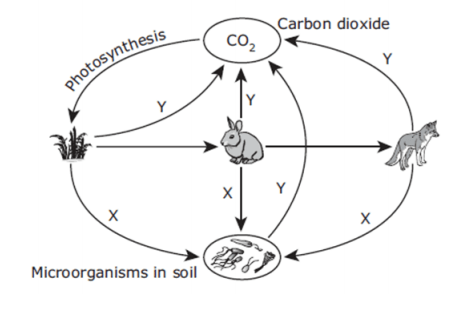
The diagram shows the flow of organic molecules through an ecosystem. What two processes are identified by the labels X and Y?
a)
X : Respiration
Y : Predation
b)
X : Adaptation
Y : Decomposition
c)
X : Fermentation
Y : Nitrogen Fixation
d)
X : Decomposition
Y : Respiration
42.
The average temperature of the surface of Earth has increased approximately 1°C in the past century. Which reason best explains this increase in temperature?
a)
lower levels of ozone in the atmosphere
b)
lower levels of nitrogen in the atmosphere
c)
higher levels of carbon dioxide and other greenhouse gases in the atmosphere
d)
higher levels of oxygen in the atmosphere
43.
How is the burning of fossil fuels related to global warming?
a)
Magic
b)
Fuels are hot
c)
Greenhouse effect
d)
Photosynthesis
44.

How do carbon emissions lead to global warming?

a)

By trapping the sun's heat in the atmosphere.

b)

By causing very hot volcanic eruptions.

c)

Rocks become richer in carbon as time goes by.

d)

By increasing the amount of carbon in the earth's crust

45.
Which of the following is the best conclusion that can be made from this graph?
a)
atmospheric carbon dioxide levels have been decreasing since 1960
b)
Hawaii has a lot of carbon dioxide
c)
humans have been working hard to decrease carbon dioxide levels
d)
atmospheric carbon dioxide levels have increased steadily since 1960
46.
Why does cutting down trees increase global warming?
a)
trees soak up carbon dioxide
b)
trees provide shade which counteracts global warming
c)
trees absorbs the sun's energy without radiating back into the atmosphere
d)
trees drain greenhouse gases like methane from soil
47.
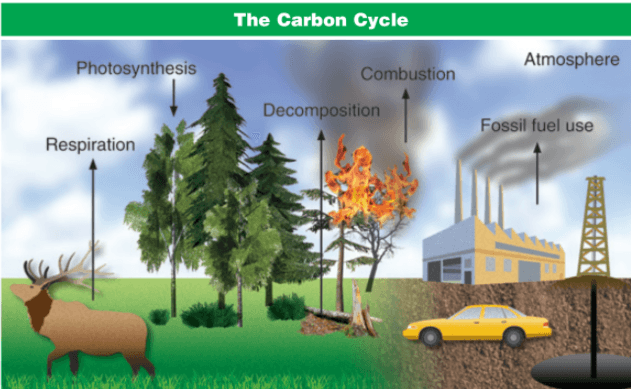
In this diagram, how many ways can carbon enter the living world?
a)
one
b)
two
c)
three
d)
four
48.
Burning fossil fuel has which effect in the carbon cycle?
a)
It removes carbon dioxide from the atmosphere.
b)
It puts carbon dioxide under the ground.
c)
It adds carbon dioxide to the atmosphere.
d)
It has no effect in the carbon cycle.
49.
Which process takes carbon dioxide out of the atmosphere?
a)
respiration
b)
combustion
c)
decomposition
d)
photosynthesis
50.

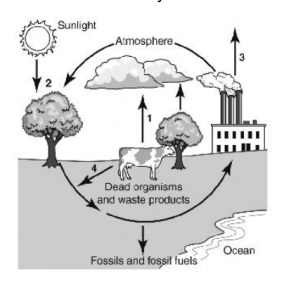
What is happening at 4?

a)

respiration: releasing CO2

b)

decomposing CO2 in the soil

c)

photosynthesis: absorbing CO2

d)

turning CO2 from the atmosphere into organic molecules

51.
What is the process of combining nitrogen gas with other elements to make nitrogen into usable compounds?
a)
nitrogen composition
b)
ammonia 
c)
nitrogen fixation
d)
denitrification
52.
How much of the atmosphere is composed of nitrogen gas?
a)
87%
b)
38%
c)
78%
d)
21%
53.
Organisms that break down dead plants & animals and release nitrogen back into atmosphere...
a)
bacteria
b)
plants
c)
animals
d)
producers
54.
Organisms that need nitrogen to survive
a)
only plants
b)
only animals
c)
only bacteria
d)
all living organisms
55.
If the atmosphere is 78% N2, why can't we just get our nitrogen by breathing?
a)
We have no mechanism to break the triple bond of nitrogen between the atoms.
b)
Our lungs would be damaged by the N2.
c)
We need Oxygen for cellular respiration.
d)
The legumes take it up first.
56.
After plants and animals contain nitrogen, what puts it back into atmosphere and soil?
a)
decomposition
b)
precipitation
c)
condensation
d)
bacteria
57.
_____ is the conversion of organic nitrogen into ammonia
a)
Nitrogen Fixation
b)
Ammonification
c)
Denitrification
d)
Assimilation 
58.

Which nitrogen cycle process is occurring when plant roots absorb ammonium ions and nitrate ions for use in making molecules such as DNA, amino acids, and proteins?

a)

nitrogen fixation

b)

nitrification

c)

denitrification

d)

ammonification

e)

assimilation

59.

Which nitrogen cycle process is occurring when bacteria convert ammonium to nitrite and then into nitrate?

a)

nitrogen fixation

b)

nitrification

c)

denitrification

d)

ammonification

e)

assimilation

60.

Which of these correctly shows the reservoirs where most of Earth's carbon atoms and nitrogen atoms are residing at any given time?

a)
b)
c)
d)
e)
61.

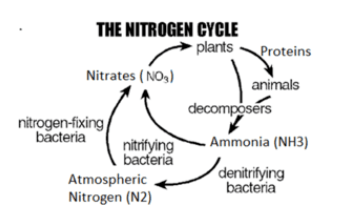
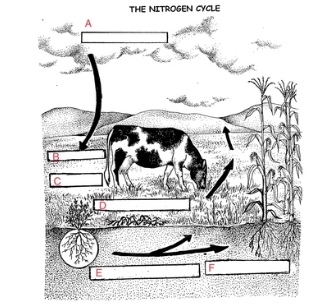
According to this diagram, plants use nitrogen to make _________________________

a)

carbohydrates

b)

cellulose

c)

proteins

d)

unsaturated fats

62.

In the nitrogen cycle, what does label A in the diagram represent?

a)

Gas

b)

Clouds

c)

Carbon dioxide in the atmosphere

d)

Nitrogen in the atmosphere

63.
The process where excess nutrients enter a body of water causing overgrowth of aquatic plants and algae...
a)
Eutrophication
b)
Acid Precipitation
c)
Nitrogen Fixation
d)
Decomposition
64.

What is denitrification?

a)

Conversation of nitrite back to nitrogen gas

b)

Conversation of ammonia back to nitrogen gas

65.

Nitrates are poisonous to fish. What should you add more of to get rid of nitrates without having to change the water in your fish tank?

a)

More fish

b)

Nitrobacter bacteria

c)

Nitrosomonas bacteria

d)

Plants

66.

When fertilizer runs off of fields into streams it causes algae blooms that eventually lead to dead zones or areas that lack oxygen. The nutrients that are found in fertilizer that cause this situation called eutrophication are

a)

carbon and nitrogen

b)

nitrogen and phosphorus

c)

phosphorus and sulfur

d)

carbon and phosphorus

67.

Which Statement is supported by evidence in the model?

a)

Materials are cycled through living organisms only

b)

Materials are cycled through consumers only

c)

Materials are cycled through living and non living components of the ecosystem

d)

Materials are cycled through the physical factors of the environment through evaporation and condensation.

68.

The graph shows the amount of nitrate in various oceans from 1992 to 2010. Based on this data which ocean system has experienced an increase in populations nearby?

a)

Arctic Ocean

b)

Baltic Sea

c)

Black Sea

d)

Celtic Sea, Bay Of Biscay, Iberian Coast

e)

Greater North Sea

69.

Which group of plants contain symbiotic nitrogen fixing bacteria?

a)

Saprobionts

b)

Nitrogen fixing

c)

Leguminous

70.

This is NOT a part of the phosphorus cycle.

a)

Phosphate is incorporated into sedimentary rocks

b)

Phosphate bound to soil

c)

Atmospheric phosphate

d)

Phosphate is absorbed from the soil by plants

71.
Phosphorous is passed from plants to ____ who eat them
a)
plants
b)
animals
c)
scavengers
72.
_____ brings phosphorous into our waterways. .
a)
precipitation
b)
runoff
c)
transpiration
d)
condensation
73.
Which of the following statements is true of the phosphorus cycle?
a)
Phosphorus enters the atmosphere as phosphates.
b)
The phosphorus cycle utilizes the processes of erosion, and weathering.
c)
Phosphates are used in carbohydrate and glucose storage.
d)
The phosphorus cycle utilizes bacteria to breakdown phosphates and make them available for plants.
74.
What role do decomposers play in the phosphorous cycle?
a)
absorb phosphorous 
b)
release phosphorous into atmosphere
c)
return phosphorous into the soil
d)
combustion
75.
This is released by the weathering of rocks.
a)
Carbon
b)
Oxygen
c)
Phosphorus
d)
Nitrogen
76.
Which nutrient is not cycled through the atmosphere and stays only on ground level?
a)
carbon
b)
nitrogen
c)
phosphorus
d)
water
77.

An algal bloom is the rapid growth of a population of

a)

fungi

b)

protozoans

c)

algae

78.

What is the carrying capacity of the graph?

a)

1000

b)

8000

c)

800

d)

600

79.

What happens if a population grows past its carrying capacity?

a)

The population keeps growing

b)

The population starts to die off

c)

The entire species will go extinct

d)

The carrying capacity just increases

80.

All living organisms are mainly composed of what elements?

a)

Oxygen, Carbon, Hydrogen, Nitrogen

b)

Carbon, Phosphorus, Nitrogen, Oxygen

c)

Sodium, Carbon, Nitrogen, Hydrogen

d)

Calcium, Phosphorus, Nitrogen, Oxygen

81.
How much salt water covers the earth?
a)
55%
b)
65%
c)
75%
d)
85%
82.
When water is heated in the ocean by the sun and turns into water vapor
a)
condensation
b)
evaporation
c)
transpiration
d)
runoff
83.
When water vapor s cooled and forms droplets-
a)
Condensation
b)
Evaportation
c)
Transpiration
d)
Run-off
84.
After condensation, the droplets of water in the clouds fall to the earth in different forms
a)
precipitation 
b)
condensation
c)
evaporation 
d)
ground water
85.
The sun's energy 
a)
changes daily
b)
heats the ocean before evaporation
c)
directly causes evaportation
86.

An apparatus used to measure the rate of transpiration

a)

Garreau's potometer

b)

Darwin's potometer

c)

Ganong's potometer

87.

The rate of transpiration in directly proportional to the

a)

humidity

b)

surface area

c)

pressure

d)

carbon dioxide content increase

88.

Adaptation to reduce transpiration

a)

Broader leaves

b)

Stunted growth

c)

More stomata

d)

Narrow leaves

89.

Kidney shaped cells at the border of the stomata

a)

Lenticels

b)

Cuticle

c)

Guard cells

d)

Hydathodes

90.

The rate of transpiration increases with

a)

High atmospheric CO2 level

b)

Low water content of leaf

c)

Shedding of leaves

d)

Dry air

91.

Plants and animals in the tundra must be able to adapt to the extremely ___________ weather

a)

small

b)

cold

c)

perennials

d)

shallow

92.
Very little sun reaches this part of the rainforest.
a)
equal
b)
earth
c)
floor
d)
carnivorous 
93.

Many of the animals in the desert are ______________ to avoid the extreme heat during the day.

a)

cacti

b)

chia

c)

water

d)

nocturnal

94.
What are the two main factors that determine the climate of an area?
a)
precipitation and humidity
b)
temperature and air pressure
c)
wind conditions and humidity
d)
temperature and precipitation
95.
Which two biomes have the least precipitation?
a)
tropical rain forest and temperate grasslan
b)
savanna and tropical dry forest
c)
tundra and desert
d)
boreal forest and temperate woodland
96.
What is this biome?
a)
Deciduous Forest
b)
Tropical Rainforest
97.
What is this biome?
a)
Coniferous Forest
b)
Desert
98.

What do you call the interaction between two different organisms living in close physical association?

a)

photosynthesis

b)

symbiosis

c)

habitat

d)

prey

e)

omnivore

99.

The animal in an ecological relationship that results in another animal being hunted, killed, and eaten…

a)

commensalism

b)

habitat

c)

predator

d)

herbivore

e)

parasite

100.

A relationship between two organisms where one benefits and the other is usually harmed…

a)

parasitism

b)

herbivore

c)

mutualism

d)

carnivore

e)

commensalism

101.

This is the job or role of an organism within its habitat...

a)

producer

b)

prey

c)

carnivore

d)

niche

e)

photosynthesis

102.

What you would call a relationship between two organisms where one benefits, but the other is not helped or harmed?

a)

mutualsim

b)

predator

c)

commensalism

d)

parasitism

e)

herbivory

103.
Which symbiosis is represented in the picture? 
a)
parasitism 
b)
mutualism
c)
commensalism
d)
nonalism 
104.
A symbiotic relationship in which both organisms benefit:
a)
Competition.
b)
Mutualism.
c)
Commensalism.
d)
Parasitism.
105.
______________ occurs when more than one individual or population tries to use the same limited resource.
a)
Niche
b)
Predator-prey
c)
Availability
d)
Competition
106.
This is known as a relationship in which both organisms involved benefit. 
a)
Predator-Prey
b)
Commensalism
c)
Mutualism
d)
Decomposition
107.
Predation is similar to _______________ in that both types of relationship benefit one of the interacting species while the other is harmed.
a)
commensalism
b)
competition
c)
mutualism
d)
parasitism
108.
When predator numbers decrease, prey numbers ____________ because fewer of them are being consumed.
a)
decrease
b)
increase
c)
stay the same
d)
divide in half