wayground logo

Free Printable Worksheets

NEW

Font size

S
M
L
XL
Worksheets

chemistry review 2

Total questions: 70

Worksheet time: 5hrs 57mins

Name
Class
Date
1.
(8.11A) How many organisms in this food web eat only producers? 
a)
1
b)
2
c)
3
d)
4
2.
(8.11B) The graph below shows the percent of seeds from two plant species that sprout when grown in water containing different amounts of salt.
Which of the following best summarizes the effect of saltwater on these plant species?
a)
Species 1 can only sprout in freshwater, and species 2 can sprout only in saltwater.
b)
Both species can sprout in freshwater and saltwater, but Species 2 can sprout in a higher salt concentration than Species 1.
c)
Both species need salt in their water, but Species 2 needs more salt than Species 1.
d)
Species 1 can sprout only in water with a low salt concentration, but Species 2 is not affected by the salt concentration.
3.
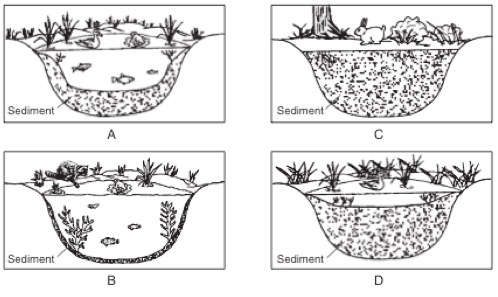
What is the correct order from oldest (happened first) to youngest (happened last) in this pond succession?
a)
A, B, C, D
b)
D, C, B, A
c)
B, A, D, C
d)
C, D, A, B
4.
Highways allow people to travel between towns and cities, but it also divides ecosystems into smaller pieces. Animals can become separated from lakes they use for food and shelter. For example, tiger salamanders use lakes for these reasons. How could the building of highways affect animals such as the tiger salamander?
a)
Tiger salamanders could improve lake ecosystems.
b)
Tiger salamanders may be cut off from important resources.
c)
Tiger salamander habitats may have less pollution.
d)
Tiger salamander habitats within ecosystems would become larger.
5.
a)
Mayflies that were previously abundant are no longer present in the stream
b)
Stone flies and midges thrive and compete for the same food source
c)
Large numbers of crayfish are suddenly dead
d)
Riffle beetles have become more abundant in the stream
6.
a)
The soot-covered trees camouflaged the dark moths
b)
The dark moths prey on the light moths
c)
Bird populations increased in the area near the factories
d)
The dark moths laid fewer eggs than the light moths
7.
a)
A
b)
B
c)
C
d)
D
8.

Use your periodic Table to identify this element?

a)

Helium

b)

Hydrogen

c)

Argon

d)

Silver

9.
What is the mass number of this atom?
a)
1
b)
3
c)
4
d)
7
10.
How many electrons does potassium K contain? (click to see image)
a)
19
b)
39
c)
20
d)
40
11.

True or False - Protons and Electrons have the same mass.

a)

True - They have the same mass

b)

False - They do not have the same mass

12.

Where are the Electrons found in the structure of an atom?

a)

In the nucleus(center)

b)

In spaces around the nucleus ( Electron Cloud)

13.

How do you find the valence electrons of an atom?

a)

Count all the electrons that you will see in the Bohr model of an atom

b)

Count only the electrons in the third energy level

c)

Count only the electrons in the outermost occupied shell

14.

How does an element become stable?

a)

An element is stable if it has 1 valence electron in its outer shell

b)

An element is stable if it has 8 valence electron in its outer shell

c)

An element is stable if it has 18 valence electron in its outer shell

15.

Identify number 14 on the periodic table square below.

a)

atomic mass

b)

chemical symbol

c)

atomic number

d)

element name

16.

Identify number 16 on the periodic table square below.

a)

atomic mass

b)

element name

c)

atomic number

17.

What types of particles are found in the Cloud around the atom's nucleus?

a)

Positively charged particles

b)

negatively charged particles only

c)

Neutral and positively charged particles

18.

This particle determines what element you have = the elements identity.

a)

electron

b)

proton

c)

neutron

d)

valence shell

19.

Where most of the mass of an atom exists; contains protons and neutrons

a)

nucleus

b)

electron shell

c)

proton

d)

electron

20.

Which has the greater REACTIVITY

Cl or Al?

a)

Cl, because it is close to being full of valance electrons

b)

Al, because it is in group 3 on the periodic table.

21.

Which has the greater REACTIVITY

N or C?

a)

C, because it is closest to being full.

b)

N, because it is closest to being full of valance electrons.

22.

Which has the (least) reactivity

Ne or F?

a)

Ne, because it has 8 valance electrons in the outermost energy level.

b)

F, because it has 7 valance electrons in the outermost energy level.

23.

Which has the (least) reactivity

Ne or F?

a)

Ne, because it has 8 valance electrons in the outermost energy level.

b)

F, because it has 7 valance electrons in the outermost energy level.

24.
Which of the following best describes an electron?
a)
It has no charge and about the same mass as a proton.
b)
It has a negative charge and much less mass than a proton
c)
It has a positive charge and much more mass than a neutron. 
d)
It has a negative charge and about the same mass as a neutron. 
25.
An atom has 25 protons, 30 neutrons, and 25 electrons. What is the charge of the atom's nucleus?
a)
+25
b)
+30
c)
-25
d)
-30
26.
Which of these best describes one of the subatomic particles that could be found at location X in the model of an atom shown above?
a)
It has mass but no charge.
b)
It has no mass and a positive charge. 
c)
It has a large mass and a negative charge.
d)
It has no mass and an equal number of positive and negative charges.
27.
A model of an atom is shown above. An atom of which element is represented by this model?
a)
Boron (B)
b)
Carbon (C)
c)
Neon (Ne)
d)
Sodium (Na)
28.
Which of the above models of an atom represents a stable atom that will no react?
a)
A
b)
B
c)
C
d)
D
29.
Which of the above models of an atom represents a reactive metal?
a)
A
b)
B
c)
C
d)
D
30.
The atoms of a certain element each contain 9 protons and 7 valence electrons. Which statement correctly identifies this element and describes its' chemical reactivity?
a)
The element is lithium, and it is highly reactive.
b)
The element is fluorine, and it is not very reactive
c)
The element is lithium, and it is not very reactive.
d)
The element is fluorine, and it is highly reactive.
31.
The model of the periodic table above shows the locations of four elements.  A student is asked to identify an element that is a pale-yellow brittle solid and does not conduct electricity. At which location in this periodic table would the element most likely be found?
a)
1
b)
2
c)
3
d)
4
32.
An element has a metallic-gray appearance. It also has the properties of both a metal and a nonmetal. In which section of the periodic table indicated above would the element most likely be found?
a)
1
b)
2
c)
3
d)
4
33.
Which two elements on the periodic table are in the same period?
a)
Sn and Rb
b)
F and Cl
c)
K and Ba
d)
Se and Te
34.
Which of the following atoms will have the most similar properties to the image above?
a)
Helium
b)
Boron
c)
Carbon
d)
Magnesium
35.
How many valence electrons in group 14?
a)
14
b)
4
c)
5
d)
30
36.
Brittleness is _________
a)
the capability of being broken.
b)
the capability of being bent.
c)
the capability of being stretched.
d)
the capability of being molded.
37.
A "group" is a ____________ on the periodic table.
a)
column
b)
row
38.
A "period" is a ____________ on the periodic table.
a)
column
b)
row
39.
How many Valance electrons does Iodine Have?
a)
6
b)
16
c)
7
d)
17
40.
What is the name of the group that has the MOST reactive METALS in it?
a)
Alkaline earth
b)
Alkali
c)
transition
d)
actinides
41.
What is the name of the group that never reacts--ever ever they are stable with a full outermost ring!!!
a)
noble gases
b)
transition
c)
halogens
d)
borons
42.
Rows on the period table are called _____ while columns are called _____.
a)
groups, families
b)
groups, periods
c)
periods, groups
d)
families, groups
43.

Which group of lists best summarizes the subatomic particles and their electrical charge?

a)

proton, negative

neutron, positive

electron, no charge

b)

proton, positive

neutron, no charge

electron, negative

c)

proton, positive

neutron, negative

electron, no charge

d)

proton, no charge

neutron, positive

electron, negative

44.

Which letter represents the protons?

a)

Q

b)

R

c)

S

d)

T

45.

Which letter represents the nucleus?

a)

Q

b)

R

c)

S

d)

T

46.

Which statement best describes the location of subatomic particles?

a)

The protons and electrons are in the nucleus, while the neutrons are in the cloud outside the nucleus.

b)

The neutrons are in the nucleus, while the protons and electrons are in the cloud outside the nucleus.

c)

The electrons and neutrons are in the nucleus, while the protons are in the cloud outside the nucleus.

d)

The protons and neutrons are in the nucleus, while the electrons are in the cloud outside the nucleus.

47.

Which element would Lithium (Li) most likely react with?

a)

Sodium (Na)

b)

Bromine (Br)

c)

Boron (B)

d)

Nitrogen (N)

48.

A student is looking for an element that is highly reactive and has 4 energy levels. What could that element be?

a)

Potassium (K)

b)

Krypton (Kr)

c)

Potassium (K) and Krypton (Kr)

d)

Potassium (K) and Bromine (Br)

49.

Which of the following about Oxygen (O) is NOT true?

a)

Oxygen most likely reacts with elements from group 14.

b)

Oxygen has 1 energy level.

c)

Oxygen has 6 valence electrons.

d)

Oxygen is a non-metal.

50.

Which statement about Phosphorus (P) is correct?

a)

Phosphorus has 2 energy level.

b)

Phosphorus has 15 valence electrons.

c)

Phosphorus is very reactive.

d)

Phosphorus will most likely react with elements in group 13.

51.
a)
2
b)
8
c)
3
d)
13
52.
a)
2
b)
3
c)
5
53.
a)
3
b)
13
c)
4
d)
14
54.
a)
14
b)
4
c)
3
d)
28
55.
a)
7
b)
5
c)
2
d)
15
56.
What element has 7 valence electrons and 2 shells?
a)
Beryllium
b)
Chlorine
c)
Magnesium
d)
Fluorine
57.
The inner energy level of any atom can hold up to _____ electrons
a)
two
b)
eight
c)
ten
58.
The 2nd energy level of any atom can hold _____ electrons.
a)
Two
b)
Eight
c)
Ten
59.
A valence electron or electrons exist in the ______ energy level.
a)
Farthest in
b)
Middle
c)
Furthest out
60.
The yellow atoms are called 
a)
metals
b)
nonmetals
c)
metalloids
d)
noble gases
61.
Which two groups on the Periodic Table are the MOST reactive?
a)
Group 1 and Group 17
b)
Group 2 and Group 16
c)
Group 13 and Group 15
d)
Group 17 and Group 18
62.
What determines the reactivity of an element?
a)
Size of its nucleus
b)
Number of total electrons
c)
Number of valence electrons
d)
Number of shells
63.
How do you determine the number of valence electrons an element has?
a)
Look at its period
b)
Look at its group
c)
Look at its atomic number
d)
Look at its atomic mass
64.
This element has 6 protons
a)
Nitrogen
b)
Lithium
c)
Carbon
d)
Argon
65.
Name this element
a)
Lithium
b)
Neon
c)
Boron
d)
Flourine
66.
What is the identity of the sample labeled Element 3 in the table above?
a)
Lithium
b)
Krypton
c)
Oxygen
d)
Cadmium
67.
Which fact is the most useful in identifying this element
a)
Fact 1
b)
Fact 2
c)
Fact 3
d)
Fact 4
68.
An atom has 6 valence electrons.  It also has a nucleus that contains 34 protons and 42 neutrons. This atom is a form of the element
a)
Selenium
b)
Molybdeum
c)
Osmium
d)
Carbon
69.
Elements in the same column of the periodic table always have the same # of _______ as one another.
a)
Protons
b)
Neutrons
c)
Electrons
d)
Valence Electrons
70.
The atomic number tells you what?
a)
number of electrons
b)
number of protons
c)
number of neutrons
d)
both electrons and protons in an atom.