Worksheets
Porifera, Cnidarians, & Plathelminthes
Total questions: 76
Worksheet time: 55mins
The elastic fibrous protein that provides support in sponges is called .....
mesohyl
spicules
spongin
tissue
Water enters sponges through the ______.
incurrent pore
oscula/osculum
Which cells in sponges are responsible for nutrient transport?
porocytes
pinacocytes
choanocytes
amoebocytes

Structure C is a
choanocyte
amoeboid cell
spicule
pinacocyte
Structure B is the
choanocyte
osculum
mesohyl
pore


cells have sticky, funnel-shaped collar to collect food particles and a flagellum that creates a water current
amoebocyte
ostiocyte
pinacocyte
choanocyte (collar cell)

What is true about sponges?
They have organs
They have bilateral symmetry
They have a true coelom
They are simplest animals


What do hydra use their Cnidocytes for?
stinging its prey
storing its heart and lungs
feeling its way
digesting its food


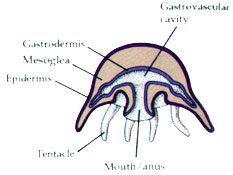
In Cnidarians, digestion occurs in the ______.
epidermis
manubrium
Gastrovascular cavity
tentacles

On a medusa, the mouth points
up
down
Nematocysts are found...
in the mouth
in the bell
in the tentacles
Digestive system of a cnidarian:
Two openings: one for food to enter, one for waste to exit.
Open opening: Food enters and waste exits at the same place
Digestion takes place in the individual cells
No digestive system
Cnidarian reproduction is usually_____________ but can be __________
asexual, sexual
sperm and egg, regeneration
asexual, regeneration
budding, asexual

How do flatworms obtain food?
They have pharynx that extends from the mouth
They have a mouth separate from its anus
They obtain nutrition by absorbing through the environment
They have several openings to their gastrovascular cavity


What phylum do flatworms belong to?
platyhelminthes
nematoda
planarian
cnidaria
What is an animal that has both male and female organs?
Acoelomate
Intersex
Hermaphrodite
Which of the following shows are cnidarians and sponges differ in obtaining food?
Cnidarians are filter feeders; sponges use tentacles and nematocysts to capture food.
Sponges are filter feeders; cnidarians use tentacles and nematocysts to capture food.
Cnidarians only use sexual reproduction; sponges use both asexual and sexual reproduction.
Sponges only use sexual reproduction; cnidarians use both asexual and sexual reproduction.