
 Worksheets
Nuclear Radiation
Total questions: 22
Worksheet time: 20mins
Name
Class
Date
1.
What is an atom that has an unstable nucleus and undergoes radioactive decay?
a)
Radiation
b)
Radioactivity
c)
Radioisotopes
2.
What is the penetrating rays and particles emitted by a radioactive source?
a)
Radiation
b)
Radioactivity
c)
Radioisotopes
3.
What is the process by which nuclei emit particles and rays?
a)
Radiation
b)
Radioactivity
c)
Radioisotopes
4.
When small nuclei combine to produce a nucleus of greater mass
a)
Fusion
b)
Fission
c)
Chain Reaction
5.
The splitting of a nucleus into smaller fragments accompanied by the release of neutrons and a large amount of energy
a)
Fusion
b)
Fission
c)
Chain Reaction
6.
It is the energy producing reaction that takes place in our sun and other stars.
a)
Fission
b)
Chain Reaction
c)
Fusion
7.
The energy produced can be controlled and harnessed to produced electricity.
a)
Chain Reaction
b)
Fission
c)
Fusion
8.
In 5 seconds, 50 g of argon-35 decays to leave only 12.5 g. What is the length of argon-35 half life
a)
12.5g
b)
2.5sec
c)
59g
d)
1.67sec
9.

Arrange in order of increasing ability to penetrate matter.
a)
Beta, gamma, alpha
b)
Alpha, gamma, beta
c)
Gamma, beta, alpha
d)
Alpha, beta, gamma
10.
Arrange in order of increasing ability to penetrate matter.
a)
Beta, gamma, alpha
b)
Alpha, gamma, beta
c)
Gamma, beta, alpha
d)
Alpha, beta, gamma
11.
What is the symbol for an alpha particle?
a)
42He
b)
0-1e
c)
0+1 e
d)
10n
12.
What is NOT a characteristic of a Beta particle?
a)
Stopped by thin metal
b)
The most dangerous type of radiation
c)
High speed, High energy electrons or positrons
d)
can penetrate skin
13.
The half life of iodine-131 is 8 days. What fraction of an iodine-131 sample will remain after 40 days?
a)
1/2
b)
1/64
c)
1/5
d)
1/32
14.
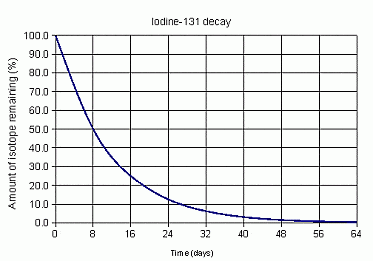
What is the half-life of iodine-131?
a)
32 days
b)
8 days
c)
16 days
d)
24 days
15.

What does this image show?
a)
Nuclear Fission
b)
Nuclear Fusion
c)
Ionic Bonding
d)
Covalent Bonding
16.

What does this image show?
a)
Nuclear Fission
b)
Nuclear Fusion
c)
Ionic Bonding
d)
Covalent Bonding
17.
What do nuclear fission and fusion have in common?
a)
They both break up atoms into small pieces
b)
They most make bigger atoms
c)
They both release lots of energy
d)
They both happen in nuclear power plants?
18.
What is a PRO (an advantage/ good thing) about nuclear energy?
a)
Uranium is cheap
b)
It is very safe and stable
c)
Both of these are true
19.
What is a PRO (an advantage/ good thing) about nuclear energy?
a)
It does not cause global warming
b)
It is very safe and stable
20.
What is a CON (a disadvantage/ bad thing) about nuclear energy?
a)
It causes global warming
b)
It generates hazardous waste that can get people sick
c)
Both of these are true
21.
Which of the following is a CON (a disadvantage/ bad thing) about nuclear energy?
a)
It is an unstable process
b)
It can allow countries to create atomic weapins
c)
Both of these are true
22.
Which is better: Nuclear Power or Fossil Fuels?
a)
Nuclear Power
b)
Fossil Fuels
c)
It depends on your opinion on the pros and cons of each, they both have benefits and drawbacks
100 %

