
 Worksheets
Review for 1st Trimester Moon, Weather, Climate, and Seasons
Total questions: 130
Worksheet time: 2hrs 36mins
Name
Class
Date
1.

What part of the illustration shows Evaporation?
a)
1
b)
2
c)
3
d)
4
2.

Which number illustrates Condensation?
a)
1
b)
2
c)
3
d)
4
3.

What does this symbol on a weather map indicate?
a)
High pressure system
b)
Low pressure system
c)
Cold front
d)
Warm front
4.

What does this symbol indicate on a weather map?
a)
High pressure system
b)
Low pressure system
c)
Cold front
d)
Warm front
5.
What kind of weather is usually associated with a high pressure system?
a)
Sunny weather
b)
Precipitation (rain, snow, etc.)
6.
The boundary between two air masses is known as:
a)
front
b)
storm
c)
climate
d)
flood
7.
Hot air (RISES / FALLS) __________.
a)
RISES
b)
FALLS
8.
Cold air (RISES/ FALLS) _________.
a)
RISES
b)
FALLS
9.

name this front
a)
warm front
b)
cold front
c)
stationary front
d)
occluded front
10.
What does this symbol on a weather map indicate?
a)
High pressure system
b)
Low pressure system
c)
Cold front
d)
Warm front
11.

A _____ is a large, swirling, low-pressure system that forms over the Atlantic Ocean.
a)
blizzard
b)
cold front
c)
tornado
d)
hurricane
12.

A violently rotating column of air called a _____ when it comes in contact with the ground.
a)
hurrican
b)
tornado
c)
trade wind
d)
local wind
13.
Rain, snow, sleet, and hail are all forms of _____.
a)
precipitation
b)
condensation
c)
evaporation
d)
climate
14.

The amount of water vapor present in the air is called ________________.
a)
weather
b)
humidity
c)
air mass
d)
dew point
15.
When a warm air mass gently slides on top of a cold air mass, and you have drizzly rain and then warmer weather, what type of front is it?
a)
warm front
b)
cold front
c)
occluded front
d)
stationary front
16.

What type of storm front is this?
a)
warm front
b)
cold front
c)
stationary front
d)
occluded front
17.

This is the symbol for a...
a)
Stationary Front
b)
Occluded Front
c)
Cold Front
d)
Warm Front
18.

Identify the type of front that is shown in the image.
a)
Occluded Front
b)
Cold Front
c)
Stationary Front
d)
Warm Front
19.

Identify the type of front that is shown in the image.
a)
Occluded Front
b)
Cold Front
c)
Stationary Front
d)
Warm Front
20.

Identify the type of front that is shown in the image.
a)
Occluded Front
b)
Cold Front
c)
Stationary Front
d)
Warm Front
21.

Identify the type of front that is shown in the image.
a)
Occluded Front
b)
Cold Front
c)
Stationary Front
d)
Warm Front
22.
What causes winds to form on Earth?
a)
solar energy
b)
ocean currents
c)
elevation differences
d)
uneven heating of the Earth by the sun
23.
What is the measure of distance in degrees north and south from the equator?
a)
latitude
b)
longitude
c)
elevation
d)
topography
24.
What is the height of an area above sea level?
a)
elevation
b)
topography
c)
latitude
d)
longitude
25.
Which sentence best describes how latitude and temperature are related?
a)
LOWER latitude = COLDER air temperature
b)
HIGHER latitude = COLDER air temperature
c)
HIGHER latitude = WARMER temperatures
26.
What is the weather conditions in an area over a long period of time?
a)
climate
b)
temperature
c)
elevation
d)
precipitation
27.
What causes some areas of Earth to receive less intense solar energy than others?
a)
the mass of earth
b)
the curve of earth
c)
the density of earth
d)
the elevation of earth
28.
Which sentence best describes the relationship between elevation and air temperatures?
a)
LOWER elevation = COLDER temperatures
b)
HIGHER elevation = COLDER temperatures
c)
HIGHER elevations = WARMER temperatures
29.

As these numbers increase, _____
a)
temperatures increase
b)
temperatures decrease
30.

As these numbers increase, _____
a)
temperatures increase
b)
temperatures decrease
31.

Which season is shown in the northern hemisphere?
a)
winter
b)
spring
c)
summer
d)
fall
32.

Which season is shown in the southern hemisphere?
a)
winter
b)
spring
c)
summer
d)
fall
33.
Which is a period of dryer weather than normal?
a)
drought
b)
equinox
c)
monsoon
d)
upswelling
34.
When do equinoxes occur?
a)
mid summer and winter
b)
mid spring and fall
c)
the beginning of summer and winter
d)
the beginning of spring and fall
35.
The average, year-after-year conditions of temperature, precipitation, winds, and cloud in an area are known as its
a)
Climate
b)
Weather
c)
global warming
d)
seasons
36.

Which zones are polar zones?
a)
A and E
b)
B and D
c)
C
d)
B, C and D
37.

What climate zone is this?
a)
polar
b)
mild
c)
desert
d)
tropical
e)
temperate
38.
Which region is the hottest?
a)
polar
b)
mild
c)
temperate
d)
tropical
39.
Which area do we live in?
a)
polar
b)
tropical
c)
mild
d)
temperate
e)
desert
40.
What is the imaginary line drawn around the middle of the Earth?
a)
tropic
b)
pole
c)
equator
d)
continent
41.
What is weather?
a)
The average weather conditions over a long period of time.
b)
The minute by minute conditions outside.
42.
What is climate?
a)
The average weather conditions over a long period of time.
b)
The minute by minute conditions outside.
43.
As altitude _____________ temperature ___________.
a)
decreases, decreases
b)
increases, increases
c)
increases, decreases
d)
decreases, increases
44.
What causes winds to form on Earth?
a)
solar energy
b)
ocean currents
c)
elevation differences
d)
uneven heating of the Earth by the sun
45.
Because Earth's axis is _________________, the hemispheres receive different amounts of solar energy at different times.
a)
straight
b)
titled
c)
bent
d)
not there
46.

Which climate zone is found at the blue X?
a)
Tropical
b)
Temperate
c)
Polar
47.

Which climate zone is found at the red star?
a)
Tropical
b)
Temperate
c)
Polar
48.

Which climate zone is found at the green smiley?
a)
Tropical
b)
Temperate
c)
Polar
49.
Why are temperatures, on average, hotter at the equator?
a)
It receives the most direct sunlight, regardless of the season
b)
The sun is closer to the equator
c)
There aren't any clouds there
d)
The sun is the hottest in Africa
50.
Does cold water sink or rise?
a)
Sink
b)
Rise
51.
Seasons are caused by ___________________.
a)
The Earth facing the Sun
b)
The tilt of the Earth on its axis
c)
Mother Nature
52.
When the Northern Hemisphere is tilted away from the Sun, the United States is in ____________________.
a)
Winter
b)
Summer
53.
The sea takes __________ to warm up and cool down than the temperatures on land.
a)
More time
b)
Less time
c)
The same amount of time
54.
What is the day to day changes in the air?
a)
Weather
b)
Climate
c)
Storms
d)
Earth's Rotation
55.
What is weather over a long period of time?
a)
A tropical vacation
b)
Weather
c)
Climate
d)
Science
56.
Rain, sleet, snow, and hail are all what?
a)
Tempature
b)
Weather
c)
Climate
d)
Precipitation
57.
The pattern of weather over a LONG period of time
a)
weather
b)
temperature
c)
precipitation
d)
climate
58.
The Earth's axis is tilted _____ degrees.
a)
23.5
b)
25.3
c)
30.2
d)
24
59.

At position A, which hemisphere would have summer?
a)
Northern hemisphere
b)
Southern hemisphere
60.

What happens when the area in which you live tilts away from the sun?
a)
It is summer.
b)
It is spring.
c)
It is winter.
d)
It is fall.
61.
The term equinox means....
a)
equal amount of day light and equal amount of night
b)
Equal amount of winter and summer
c)
Equal amounts of hot dogs for everyone
d)
The longest day of the year
62.
What do June 21 and December 21 have in common?
a)
equinox dates
b)
the moon is full
c)
solstice dates
d)
the cold fronts blow in
63.
What is the longest day of the year?
a)
winter solstice
b)
summer solstice
c)
fall equinox
d)
spring equinox
64.

Why is the Equator warmest?
a)
Because it is closest to the sun.
b)
Because it receives the most direct sunlight
c)
Because no clouds form here.
d)
Because it is far from the sun
65.
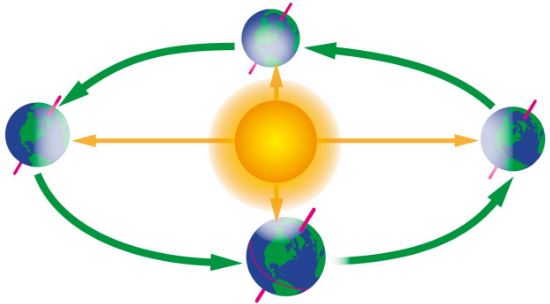
In spring/summer, the axis of the earth is pointed away or toward the sun?
a)
towards
b)
Neither away or toward
c)
away
66.

Which season is taking place in the Southern Hemisphere in Position 1?
a)
Winter
b)
Spring
c)
Summer
d)
Fall
67.

Which season is taking place in the Northern Hemisphere in Position 1?
a)
Winter
b)
Spring
c)
Summer
d)
Fall
68.

Which season is taking place in the Northern Hemisphere in Position 2?
a)
Winter
b)
Spring
c)
Summer
d)
Fall
69.

Which season is taking place in the Northern Hemisphere in Position 3?
a)
Winter
b)
Spring
c)
Summer
d)
Fall
70.

Which season is taking place in the Northern Hemisphere in Position 3?
a)
Winter
b)
Spring
c)
Summer
d)
Fall
71.

Which season is taking place in the Northern Hemisphere in Position 4?
a)
Winter
b)
Spring
c)
Summer
d)
Fall
72.

What causes the seasons to change?
a)
The warming and cooling of Earth's core.
b)
The distance from the sun.
c)
Earth's tilt in relation to the sun.
d)
Earth's rotation on its axis.
73.

What happens when the area in which you live tilts away from the sun?
a)
It is summer.
b)
It is spring.
c)
It is winter.
d)
It is fall.
74.

What season is it in the Southern Hemisphere when it is fall in the Northern Hemisphere?
a)
winter
b)
spring
c)
summer
d)
fall
75.

Why does the area around the equator stay the same temperature all year?
a)
The equator rotates slower than the poles.
b)
The equator remains the same distance from the sun.
c)
The equator always receives direct sunlight.
d)
The equator has 18 hour days.
76.
In the Northern Hemisphere, on which day will you receive the most daylight?
a)
September 21
b)
December 21
c)
March 21
d)
June 21
77.

Which season is taking place in the Southern Hemisphere in Position 1?
a)
Winter
b)
Spring
c)
Summer
d)
Fall
78.

Which season is taking place in the Northern Hemisphere in Position 2?
a)
Winter
b)
Spring
c)
Summer
d)
Fall
79.

Which season is taking place in the Northern Hemisphere in Position 3?
a)
Winter
b)
Spring
c)
Summer
d)
Fall
80.

Which season is taking place in the Southern Hemisphere in Position 4?
a)
Winter
b)
Spring
c)
Summer
d)
Fall
81.
What is Earth's annual motion around the sun called?
a)
Rotation
b)
Revolution
82.
How long does Earth take to make a complete rotation?
a)
365 days
b)
24 hours
83.
What would seasons be like if Earth's axis were straight up and down?
a)
Seasons would be the same.
b)
Seasons would be more extreme.
c)
There would be no seasons.
84.
If Earth rotated slower, we would have...
a)
shorter days.
b)
longer days.
c)
shorter years.
d)
longer years.
85.
Which seasons have an equal amount of daylight and darkness?
a)
Spring and Fall
b)
Winter and Summer
c)
Winter and Spring
d)
Summer and Fall
86.
Which climate zone experiences 4 seasons?
a)
Polar
b)
Temperate
c)
Tropical
d)
None
87.
Where on Earth can you experience entire days of darkness?
a)
The equator
b)
The poles
c)
The Tropic of Cancer
d)
The Tropic of Capricorn
88.
The Northern Hemisphere gets __________ sunlight in the winter, which leads to _________ temperatures.
a)
less direct, hotter
b)
less direct, colder
c)
more direct, hotter
d)
more direct, colder
89.
Which angle of sunlight produces the most heat?
a)
90 degrees
b)
60 degrees
c)
30 degrees
d)
0 degrees
90.
Which movement of Earth causes day and night?
a)
rotation
b)
revolution
91.
Which season has the least amount of daylight in the Northern Hemisphere?
a)
Winter
b)
Spring
c)
Summer
d)
Fall
92.

What are the reasons for the season?
a)
Earth's tilt & rotation
b)
Earth's tilt & revolution
c)
Earth's rotation & rovolution
d)
Earth's tilt & resolution
93.

The hemisphere where you live
a)
equator
b)
southern
c)
northern
d)
eastern
94.

Which season(s) have the same amount of daylight hours as nighttime hours?
a)
More hour of light during spring, less in fall
b)
More hours of light during summer, less in winter
c)
None of the seasons have equal daylight hours
d)
All are equal
95.
What causes there to be longer number of hours of light during the summer
a)
Earth tilt's away from the sun in summer
b)
Earth's revolves slower in summer
c)
Earth tilts toward the sun in summer
d)
Earth is closer to the sun
96.

In summer, the axis of the earth is pointed away or toward the sun?
a)
towards
b)
up
c)
down
d)
away
97.

In winter, the axis of the earth is pointed away or toward the sun?
a)
towards
b)
up
c)
down
d)
away
98.

Why is it warmer in the summer?
a)
Closer to the sun
b)
More direct light from Earth's tilt
c)
Stronger light from the sun
d)
Earth spins slower
99.

Why is the Equator warmest?
a)
Because it is closest to the sun.
b)
Because it receives the most direct sunlight
c)
Because no clouds form here.
d)
Because it is far from the sun
100.

What season is depicted in the picture?
a)
summer
b)
winter
c)
fall
d)
spring
101.

What season is depicted in the picture?
a)
summer
b)
winter
c)
fall
d)
spring
102.

Which season is taking place in the Southern Hemisphere in Position 1?
a)
Winter
b)
Spring
c)
Summer
d)
Fall
103.

Which season is taking place in the Northern Hemisphere in Position 1?
a)
Winter
b)
Spring
c)
Summer
d)
Fall
104.

Which season is taking place in the Northern Hemisphere in Position 2?
a)
Winter
b)
Spring
c)
Summer
d)
Fall
105.

Which season is taking place in the Northern Hemisphere in Position 3?
a)
Winter
b)
Spring
c)
Summer
d)
Fall
106.

Which season is taking place in the Northern Hemisphere in Position 4?
a)
Winter
b)
Spring
c)
Summer
d)
Fall
107.
If its ____ in the Northern hemisphere, then its fall in the Southern hemisphere.
a)
spring
b)
summer
c)
fall
d)
winter
108.

If its ____ in the Northern hemisphere, then its summer in the Southern hemisphere.
a)
spring
b)
summer
c)
fall
d)
winter
109.
Where is the equator?
a)
at the North Pole
b)
halfway between the North and South Poles
c)
at the South Pole
d)
in the Western hemisphere
110.
What causes more heat, indirect sunlight or direct sunlight?
a)
indirect
b)
direct
111.
About how many days does it take to moon to go through a complete cycle?
a)
7 days
b)
365 days
c)
29 days
d)
20 days
112.

When the visible (lit) portion of the moon is increasing, the moon is:
a)
waning
b)
full
c)
waxing
d)
new
113.

When the Earth is between the moon and sun, it is most likely a:
a)
new moon
b)
full moon
c)
waxing crescent
d)
waxing gibbous
114.

Approximately how much time passes between the new moon and full moon?
a)
one month
b)
two weeks
c)
3 days
d)
24 hours
115.
Changes in the moon's appearance are
a)
phases
b)
eclipses
c)
stages
d)
cycle
116.

The Moon orbits Earth in a ________________ direction
a)
clockwise
b)
counterclockwise
c)
upwards
d)
downwards
117.
Define Waxing
a)
Moon is increasing and light part appears to be growing
b)
Completely illuminated
c)
dark side is facing earth
d)
Moon is decreasing and light part appears to be shrinking
118.
Define Gibbous
a)
Less than half of moon visible
b)
More than half of moon visible
c)
All of moon visible
d)
None of moon visible
119.
Define Full Moon
a)
None of moon is visible
b)
Half moon phase is visible
c)
Complete moon face is visible
d)
Less Than half of moon is visible
120.
Define New Moon
a)
None of moon is visible from Earth
b)
All of moon visible from Earth
c)
Moon is 1/2 visible from Earth
d)
Moon is more than Half Visible from Earth
121.
Define Quarter Moon
a)
None of moon visible
b)
Less than Half the moon is visible
c)
More than half of moon is visible
d)
Half of the moon is visible
122.

Name the moon phase
a)
Waxing Gibbous
b)
Waxing Crescent
c)
Waning Crescent
d)
Waning Gibbous
123.
The phase of the moon that occurs between the sun and Earth
a)
Full moon
b)
Waxing crescent
c)
Waning Crescent
d)
New Moon
124.
The 1st Quarter moon is lit on the:
a)
Left Side
b)
Right Side
125.

Name the moon phase
a)
Waning Crescent
b)
Waxing Crescent
c)
Waning Gibbous
d)
Waxing Gibbous
126.
T/F When the moon is waxing,the part that is lit by the sun is getting larger on the right side
a)
TRUE
b)
FALSE
127.
T/F The moon can be seen from Earth because it reflects the sun's light
a)
TRUE
b)
FALSE
128.

When only a small part of the moon is visible, it is probably in what phase?
a)
waxing or waning crescent
b)
first quarter
c)
new moon phase
d)
waxing or waning gibbous phase
129.
What is the correct order of the moon phases?
a)
new, full, 1st quarter, 3rd quarter
b)
new moon, 1st quarter, full moon, 3rd quarter
c)
1st quarter, 3rd quarter, new moon, full moon
d)
new, 1st quarter, 3rd quarter, full
130.
Define Waning
a)
Moon appears to be gradually increasing in size
b)
Moon is completely illuminated
c)
Moon appears to be gradually decreasing in size
d)
More than half illuminated
100 %

