wayground logo

Free Printable Worksheets

Font size

S
M
L
XL
Worksheets

Year 10 Science Revision

Total questions: 101

Worksheet time: 2hrs 20mins

Name
Class
Date
1.
A homozygous dominant dog with brown fur is crossed with a heterozygous dog with brown fur. What are the percentages of the possible genotypes?
a)
100% BB
b)
75% BB and 25%Bb
c)
50 % BB and 50% Bb
d)
50% Bb and 50% bb
2.
Genotype refers to the ...
a)
physical expression of the genes
b)
the possible combination of alleles in a gene
c)
whether an allele is dominant or recessive
d)
how an organism will appear
3.
having two different genes for a trait (sometimes called hybrid).
a)
protein
b)
homozygous
c)
heterozygous
d)
genotype
4.
Magda is a tall, 11 year old drummer. She has a scar on her right cheek. She is good at swimming. Which of her traits did Magda most likely inherit?
a)
height
b)
the scar
c)
ability to swim
d)
ability to play drums
5.
Two brown eyed parents (Bb) have a baby. What is the chance the baby is blue eyed?
a)
0 %
b)
25%
c)
50%
d)
75%
6.
G = green, g = yellow
The genotype for a yellow plant is...
a)
GG
b)
Gg
c)
gg
d)
all of the choices result in yellow
7.
An allele whose trait only shows up when no dominant allele is present.
a)
hidden allele
b)
dominant allele
c)
recessive allele
d)
present allele
8.
Two heterozygous (Tt) tall pea plants are crossed. Which describes their offspring?
a)
50% tall and 50% short
b)
75%tall and 25% short
c)
100%short
9.
Which of the following genotypes is a purebred?
a)
Bb
b)
Gg
c)
bb
d)
Dd
10.
One form of a gene is called_______________
a)
a DNA
b)
a Phenotype
c)
a trait
d)
an allele
11.
the condensed form of DNA is called________________
a)
an allele
b)
a gene
c)
a chromosome
d)
a phenotype
12.
Where, in the eukaryotic cell, is DNA located?
a)
ribosomes
b)
nucleus
c)
E.R.
d)
cytoplasm
13.
Which of the following will only show if two alleles are present?
a)
a dominant trait
b)
a recessive trait
14.
A homozygous dominant dog with brown fur is crossed with a heterozygous dog with brown fur. What are the percentages of the possible genotypes?
a)
100% BB
b)
75% BB and 25%Bb
c)
50 % BB and 50% Bb
d)
50% Bb and 50% bb
15.
An allele whose trait always shows up in the organism when the allele is present.
a)
recessive allele
b)
dominant allele
c)
hidden allele
d)
present allele
16.
An allele whose trait only shows up when no dominant allele is present.
a)
hidden allele
b)
dominant allele
c)
recessive allele
d)
present allele
17.
one of the alternative forms of a gene that governs a characteristic, such as hair color
a)
allele
b)
gene
c)
trait
d)
DNA
18.
having two of the same genes for the trait (sometimes called purebred).
a)
homozygous
b)
hetrozygous
c)
protein
d)
chromosome
19.
A characteristic that an organism can pass on to its offspring through its genes
a)
protein
b)
trait
c)
DNA
d)
gene
20.
Particles in an atom that are neutral and have no charge are 
a)
negatrons 
b)
electrons 
c)
neutrons 
d)
protons 
21.
If an atom has 3 electrons, how many protons does it have?
a)
1
b)
2
c)
4
d)
3
22.
If the number of protons equal the number of _____, the atom will have no charge
a)
protons
b)
neutrons
c)
electrons
d)
nucleus
23.
The subatomic particle with a negative charge is the
a)
electron
b)
proton
c)
neutron
d)
nucleus 
24.
What is the atomic number?
a)
the number of protons
b)
the number of protons and neutrons
c)
the number of neutrons
d)
the number of protons and electrons
25.
What is the mass number?
a)
the number of protons
b)
the number of protons and neutrons
c)
the number of neutrons
d)
the number of protons and electrons
26.
Ions are: 
a)
atoms with a positive or negative charge
b)
atoms with no charge
c)
atoms with ONLY a positive charge
d)
atoms with ONLY a negative charge
27.
How many neutrons does the isotope of lithium have?
a)
8
b)
3
c)
4
d)
5
28.
How many protons does this isotope of titanium have?
a)
48
b)
22
c)
26
d)
70
29.
How many electrons does Si contain? (click to see image)
a)
14
b)
28
c)
2
d)
None of these
30.
In a chemical equation, is it true that -
a)
the reactant side and product side can have different numbers of atoms for each element
b)
there can be different elements on the reactant side and the product side
c)
an element or compound must be accompanied by a phase change
d)
the coefficients indicate the number of molecules of each reactant used and the number of molecules of each product made
31.
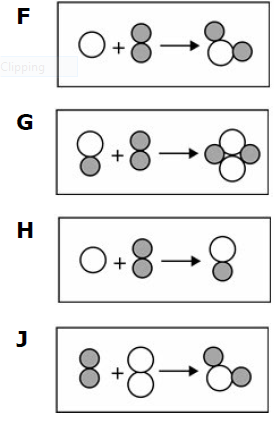
Which of the following models best demonstrates a balanced chemical equation?
a)
F
b)
G
c)
H
d)
J
32.
The chemical formula for glucose, a simple sugar, is C6H12O6. The formula for ethanol is C2H6O. What accounts for the differences in these compounds?
a)
The elements that make up glucose are different than the elements that make up ethanol
b)
The ratio of the elements is different in ethanol than in glucose
c)
The chemical properties of the elements are different in glucose and ethanol
d)
Glucose has more elements than the ethanol
33.
Which of these formulas contain equal numbers of nitrogen atoms?
a)
Formulas I and III
b)
Formulas I and IV
c)
Formulas II and III
d)
Formulas I, II, and V
34.
The reactants are on the left side of the chemical equation.
a)
True
b)
False
35.
Two clear colorless solutions were combined.
The student observed that the temperature changed from 25 •C to 23 •C when the solutions were combined and that a white substance rapidly formed and settled to the bottom of the container. What most likely happened to produce these results?
a)
One of the original compounds came out of solution
b)
The solutions reacted chemically
c)
Some of the water froze into ice crystals
d)
Rapid evaporation of water occurred, leaving a solid
36.
In which of these compounds are there twice as many oxygen atoms as hydrogen atoms?
a)
H3PO4
b)
H2SO4
c)
HCIO3
d)
H20
37.
All of the following reactions are correctly balanced except-
a)
A
b)
B
c)
C
d)
D
38.

Which of these is NOT a sign that a chemical change has occurred?

a)

A loss of transparency

b)

An unexpected color change

c)

A temperature change

d)

The formation of a precipitate

39.

The Law of Conservation of Mass states

a)

that matter exists in all states and reacts the same

b)

that matter can only be changed into new substances by introducing a catalyst

c)

that matter exists in the same state throughout any chemical change

d)

that matter cannot be created or destroyed and that the mass of the products must equal the mass of the reactants

40.
In the equation,          2Mg + O2 ---> 2MgO, which are the reactants?
a)
Mg and O
b)
MgO
c)
Mg and MgO
d)
O and MgO
41.

What must go in the blank space to balance the equation?

4Fe + ____O2 --> 2Fe2O3

a)

1

b)

2

c)

3

d)

4

42.
The substances to the right of the arrow in a chemical equation are called-
a)
coefficient
b)
reactant
c)
subscript
d)
product
43.

2Ca + O2 > 2CaO 

What is the 2 located in front of calcium (Ca) called? 

a)
coefficient
b)
subscript
c)
reactant
d)
product
44.
Which of the following describes a precipitate?
a)
a liquid forms when a block of metal is heated
b)
a solid forms when one liquid is poured into another
c)
a gas forms when a solid is placed in a liquid
d)
bubbles form when an acid is poured on a rock
45.

Balance the following chemical equation:

____KClO3 → ____KCl + ____O2

a)

2KClO3 → 4KCl + O2

b)

4KClO3 → 2KCl + 3O2

c)

2KClO3 → 2KCl + 3O2

46.

Balance the following chemical equation:

____Al + ____O2 → _____Al2O3

a)

4Al + 3O2 → 2Al2O3

b)

Al + O2 → Al2O3

c)

2Al +1 O2 → 4Al2O3

47.

Which of the following is an example of synthesis?

a)

SO3 + H2O --> H2SO4

b)

KClO3 --> KCl + O2

c)

HgO + Cl2-->HgCl + O2

d)

Cl2 + NaBr --> NaCl + Br2

48.

Which reaction type is the following:

C5H10 + O2 --> CO2 + H2O

a)

Decomposition

b)

Synthesis

c)

Complete Combustion

d)

Double Replacement

49.

Which chemical reaction forms Carbon Dioxide and Water?

a)

Synthesis

b)

Single Replacement

c)

Complete Combustion

d)

Decomposition

50.

Which reaction type is the following:

2Al + 6HCl --> 2AlCl3 + 3H2

a)

synthesis

b)

combustion

c)

single replacement

d)

double replacement

51.

Which reaction type is the following:

FeS + 2HCl → H2S + FeCl2

a)

synthesis

b)

combustion

c)

single replacement

d)

double replacement

52.

In a ______________________ reaction, one element replaces another element in a compound

a)

single replacement

b)

double replacement

c)

sythesis

d)

decomposition

53.

Chemical reactions in which two substances combine to form one compound are called _________________ reactions.

a)

single replacement

b)

double replacement

c)

synthesis

d)

decomposition

54.
Reactions that give out heat to the surrounding are classified as one of the following:
a)
Spontaneous
b)
Sluggish
c)
Exothermic
d)
Endothermic
55.
One of the signs of a chemical reaction taking place is:
a)
Bubbles are produced in the reacting vessel
b)
Reactants are not combining
c)
Products are not forming
d)
Colour is not changing
56.
Speed is equal to the distance divided by
a)
position
b)
time
c)
height
d)
motion
57.
The unit speed is measured in is
a)
m/s
b)
ft/min
c)
m/hr
d)
m/s^2
58.
Carlos lives 100 meters from his friend's house. What is his average speed if he reaches his friends house in 50 seconds?
Distance= 100 m
time = 50 seconds
a)
1 m/s
b)
2 m/s
c)
3 m/s
d)
4 m/s
59.
A bird flies from tree to tree. It leaves on branch and flies 100 meters to another branch. It takes him 10 seconds to get there. What is his speed?
d= 100 meters
t= 10 seconds
a)
1 m/s
b)
10 m/s
c)
100 m/s
d)
1000 m/s
60.
Speed in a specific direction is called
a)
speed
b)
acceleration
c)
position
d)
velocity
61.
A vector is a quantity that has both size and 
a)
speed
b)
altitude
c)
acceleration
d)
direction
62.
In a distance time graph, the steeper the line the...
a)
greater the speed
b)
slower the speed
c)
speed has reached zero
d)
speed has not changed
63.
True or False
It is possible for two objects to have the same speed but different velocities
a)
true
b)
false
64.
If a train travels 30 km/h north then turns around and travels 27 km/h back south, how far is the train from its original location?
a)
1 km
b)
3 km
c)
57 km
d)
4 km
65.
A car goes from 0 m/s to 60 m/s in a period of 5 seconds find its acceleration.
a)
10 m/s^2
b)
12 m/s
c)
12 m/s^2
d)
11 m/s
66.
A train slows from 20 m/s to 10 m/s over a time period of 5 seconds. Find the acceleration
a)
2 m/s
b)
2 m/s^2
c)
-2 m/s
d)
-2 m/s^2
67.
If a train slows down what type of acceleration does it have
a)
positive
b)
negative
c)
none
68.
When you tell the direction and speed of an object, you give its
a)
motion
b)
velocity
c)
acceleration
d)
mass
69.
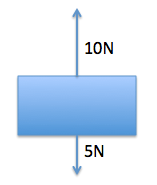
What is the net force on the block? (click on the words to view the picture)
a)
5 Newtons up
b)
5 Newtons down
c)
15 Newtons up
d)
15 Newtons down
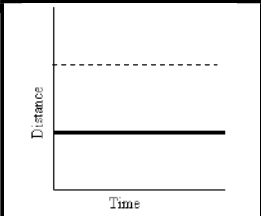
70.
What does this graph represent?
a)
Constant speed
b)
Acceleration
c)
Not moving
71.
Which of the following objects has the least acceleration?
a)
a. an empty shopping cart pushed with a hard force
b)
b. a full shopping cart pushed with a hard force
c)
c. an empty shopping cart pushed with a light force
d)
d. a full shopping cart pushed with a light force
72.
A baseball is thrown a distance of 50 meters. What is the speed if it takes 2 seconds to cover that distance?
a)
100 m/s2
b)
25 m/s2
c)
52 m/s2
d)
100 seconds
73.
Speed is equal to 
a)
Distance/Time
b)
Time/Distance
c)
Time x Distance
d)
Acceleration
74.
What is this graph showing?
a)
Constant Speed
b)
Acceleration (speeding up)
c)
Deceleration (slowing down)
d)
No motion
75.
8 N to the left , and 4 N to the right. Find the net force. Is this balanced 
a)
12 N Right  No
b)
4 N Left  No
c)
12 N Right  Yes
d)
4 N Left  Yes
76.
The ____________ is the energy that flows from the battery, through the wire in it’s path through the circuit.
a)
Electric Current
b)
Conductor
c)
Electromagnet
d)
Insulator
77.
What is the power source for this circuit?
a)
Battery
b)
Electric socket
c)
Wires
d)
Magic
78.
The red and black plastic wire coverings are excellent ______. 
a)
Conductors
b)
Insulators
c)
Currents
d)
Magnets
79.
) What would happen if an extra battery cell is added?
a)
A)The lights will glow dim
b)
The wire will glow
c)
The lights will glow brighter
d)
None of the above
80.
Which of the following does not conduct electricity?
a)
gloves
b)
penny
c)
paper clip
d)
key
81.
A flow of electrons through a conductor is called:
a)
A river
b)
A spark
c)
An electron flow
d)
A current
82.
What kind of circuit is this?
a)
series
b)
parallel
83.
What kind of circuit is this?
a)
Series
b)
Consecutive
c)
Parallel
d)
Training
84.
A material in which electrons are not able to move easily 
a)
Circuit 
b)
Insulator 
c)
Resistance 
d)
Conductor
85.
A material in which electrons are able to move easily
a)
Circuit
b)
Insulator 
c)
Resistance 
d)
Conductor 
86.
To complete a circuit the switch must be
a)
unattached
b)
open
c)
closed
87.
Two batteries in a circuit make the lights in the circuit brighter than one battery.
a)
true
b)
false
88.
An example of a parallel circuit is
a)
the wiring in a house
b)
a flashlight
c)
a single circular path
89.
the type of current that is used in  outlets
a)
apparating current
b)
diverting current
c)
AC
d)
DC
90.
measure of electric current
a)
watt
b)
ohm
c)
volt
d)
amp
91.
measure of resistance
a)
watt
b)
ohm
c)
volt
d)
amp
92.
measure of power
a)
watt
b)
ohm
c)
volt
d)
amp
93.
What does the switch do in a circuit?
a)
It supplies the power.
b)
It carries electricity.
c)
It opens and closes the circuit.
d)
It is an insulator.
94.
_____ are materials that electric current CANNOT pass through.
a)
Conductors
b)
Insulators
95.
What type of circuit is this?
a)
series
b)
parallel
96.
tiny particles that have a negative charge
a)
protons
b)
neutrons
c)
electrons
d)
circuits
97.
Electricity is the flow of ______.
a)
electrons
b)
protons
c)
neutrons
d)
atoms
98.
What is a benefit of using a parallel circuit?  
a)
It gets confusing.
b)
There are no problems.
c)
If one light goes out, it does not affect the others. 
d)
If one light goes out, they all go out. 
99.
What is one problem with using a series circuit? 
a)
It has a lot of series. 
b)
If one light goes down, they all go down! 
c)
It doesn't work properly.
d)
There are no problems. 
100.
In most electrical circuits, the pathway is made of:
a)
Wood
b)
Plastic
c)
Metal
d)
Static
101.
What are the two poles of a magnet called?
a)
North and South
b)
East and West
c)
Up and Down
d)
Red and Blue