
 Worksheets
E.M. spectrum and light waves
Total questions: 100
Worksheet time: 33mins

Which electromagnetic waves have the highest frequencies and the shortest wavelengths?
microwaves
visible light
gamma rays
x-rays

Which electromagnetic waves are used in ovens and cell phone communications?
microwaves
infrared rays
gamma rays
ultraviolet rays

A wave with a large wavelength will have a ______ frequency and _____ energy
high, low
low, high
high, high
low, low

Which type of waves are used in broadcasting?
infrared rays
X-rays
radio waves
gamma rays

Select the correct order of waves on the EMS from the longest wavelength to the shortest wavelength
Radio, Micro, Infra, Visible, Ultra, X-ray, Gamma
Gamma, X-ray, Ultra, Vis, Infra, Micro, Radio
Vis, Micro, Infra, Ultra, X-ray, Gamma, Radio
Micro, Radio, Vis, Infra, Ultra, X-ray, Gamma

Electromagnetic waves that help your body produce vitamin D are called?
Ultraviolet rays
X-rays
Radio waves
Gamma rays

Which has the SHORTEST wavelength and, therefore, the highest frequency/most energy
Ultraviolet Rays
Radio Waves
Gamma Rays
X-Rays
How are electromagnetic waves different from other waves?
They have very short wavelengths
They transmit energy instead of matter
They can travel through empty space
They can change direction by reflection

Which section of the spectrum is the ONLY one we can see?
Ultraviolet Rays
Gamma Rays
X-Rays
Visible Light

As the frequency of an electromagnetic wave increases, the amount of energy in that wave...
increases.
stays the same.
decreases.

High frequency waves have _________ wavelengths.
varying
long
the same
short

How much of the electromagnetic spectrum is visible?
All of it
None
Only a small part
Most of it

What are electromagnetic waves?
sound waves
electric & magnetic fields (energy) that travel through empty space very quickly
ocean waves
things like longitudinal waves

Which electromagnetic waves are used in devices such as heat lamps & TV remote controls?
Ultraviolet Rays
Microwaves
Infrared Rays
Gamma Rays

The electromagnetic spectrum includes the complete range of electromagnetic waves placed in order of:
increasing amplitude
increasing frequency
increasing wavelength
Radio waves
Has the longest wavelengths and the lowest frequency
Microwaves
Used in cell phone communication and police radar systems
Infrared rays
It is used in thermal imaging
UV rays
Overexposure to this can result in sunburns and skin cancer
Gamma Rays
Has the highest energy of all electromagnetic radiation and is the most damaging to human tissue
Radiant energy spreads out from its source in all directions.
True
False
Both X-rays and gamma rays have higher frequencies than ultraviolet rays.
True
False
Communicating with satellites is an application of gamma rays.
True
False
Reorder the following according to the spectrum
red
orange
yellow
green
blue
Reorder the following from shortest wavelength to the longest wavelength.
gamma waves
x-rays
ultraviolet waves
visible light
infrared rays
Reorder the following from shortest wavelength to the longest wavelength.
radio waves
microwaves
infrared
x-rays
gamma waves
The electromagnetic spectrum is a continuous range of ______ for electromagnetic radiation.
light
frequencies
particles
magnestism
Which has more energy?
radio/tv waves
infrared
Which has a higher frequency?
visible light
ultraviolet rays
What is the difference between frequency and wavelength?
The shorter wavelength, the less frequency.
The longer the wavelength, the frequency is greater.
The longer the wavelength, the frequency is less.
Electromagnetic waves that you can see
radio waves
visible light
x-rays
ultraviolet rays
Used for medical imaging to diagnose health issues in bones and teeth
visible light
ultraviolet rays
x-rays
gamma rays
Reorder the following according to the spectrum
yellow
green
blue
indigo
violet



Which electromagnetic waves are used in devices such as heat lamps?
ultraviolet rays
microwaves
infrared rays


This type of electromagnetic wave can be used to see inside luggage at an airport or in hospitals to see your bones.
Gamma Rays
Visible Light
X Rays
Infrared Rays
Which of the following is not an example of a mechanical wave?
Light wave
Sound wave
Water wave
Seismic wave
What type of wave is a light wave?
A sound wave
A seismic wave
A electromagnetic wave
A mechanical wave
Why is a light wave not considered a mechanical wave?
A light wave is visible to humans.
A light wave moves faster than most waves.
A light wave does not have a wavelength.
A light wave travels through the vacuum of space.
How is an electromagnetic wave different from a mechanical wave?
An electromagnetic wave travels slower than a mechanical wave.
An electromagnetic wave has a larger amplitude than a mechanical wave.
An electromagnetic wave can travel through a vacuum, but a mechanical wave cannot.
An electromagnetic wave has no wavelength, but a mechanical wave has a wavelength.
Which of the following are not a part of the Electromagnetic Spectrum?
Gamma Rays
Radio waves
Magnetic waves
x-rays
Gamma Rays are
High energy
Low energy
Medium energy
Just right
A light wave is considered to be an electromagnetic wave. But what other kind of wave is it?
Surface wave
Longitudinal wave
Transverse wave

Why does this car appears red under a white light?
The car is absorbing the red light and reflecting the blue and green.
The car is reflecting only the red light while absorbing the blue and green.
The car is absorbing the red and green light while reflecting the blue.
The car is absorbing the red, blue and green, but our eyes can only see the red.

Reflect

Absorb

Transmit


Which type of light wave can cause sunburns or even skin cancer?
x-ray
visible
ultraviolet

Which type of light wave contains powerful energy made in nuclear explosions and stars?
gamma
x-ray
visible
True or False:
Light travels in a straight line.
True
False
What does the term reflection mean?
When an object takes in the light
When light passes through an object
When Light bounces off an object
True or False:
Light can travel through matter (gas, liquid, solid) and empty space.
True
False

DROP DOWN: The skin taking in the sun is an example of
(a)
Name the type of light wave we can see.
visible
gamma
ultraviolet

(a) is a type of wave that carries energy from one place to another even through an empty space.

Which letter is an example of reflection?
A
B
C


The bending of waves around a barrier.
refraction
diffraction
resonance

What is happening to the RED light?
reflected
absorbed
refracted
What is happening to every color BUT RED?
reflected
absorbed
refracted
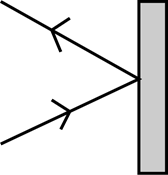
In the illustration, the light ray striking the object is-

Why do we see grass as green?
Green light is absorbed
Green light is reflected

What would you call this?
Bounce back
Reflection
Diffraction
Refraction


How does a concave lens differ from a convex lens?
A convex lens is another way to describe a plane mirror; a concave lens is curved
A concave lens is curved inward on both sides; a convex lens is on only one side
A convex lens has a thick center and thin edges, a concave lens has a thin center and thicker edges
A convex lens has a thin center and thick edges. a concave lens has a thick center and thinner edges

What colors are being reflected?
all of the colors in the color spectrum
none of the colors in the color spectrum

reflection
refraction

A black shirt capturing light waves and making a person feel hot in the summer is an example of:
Reflection
Refraction
Absorption
If you see the color orange, this means:
The colors red, yellow, green, blue, indigo, and violet have been absorbed and orange has been refracted.
The colors red, yellow, green, blue, indigo, and violet have been absorbed and orange has been reflected.
The color orange has been absorbed and red, yellow, green, blue, indigo, and violet are refracted.
The color orange has been absorbed and red, yellow, green, blue, indigo, and violet are reflected.
A white object
Reflects all colors
Absorbs all colors

