
 Worksheets
7th grade - BJU Life Science ch 5
Total questions: 65
Worksheet time: 51mins
Which picture represents a chromosome?


Describe the relationship between a gene and a chromosome.
A gene is a section of DNA and a chromosome is just a long strand of DNA.
A chromosome does not contain genes, it contains DNA.
A gene is a smaller version of a chromosome.
They are not related.


budding is a form of asexual reproduction where new individuals split off from the existing one
True
False
fertilized egg
Hereditary
Genes
Mitosis
idk
Zygote
Reproduction that requires two parents and creates offspring genetically different from parents
Sexual reproduction
Asexual reproduction
Apoptosis
GTAGTCA
ATG GGA ACT CCA
The shape of a DNA molecule was first described by Watson and Crick to be a
double helix
loop-de-loop
spiral shell
trapeze swing
Which of the following is not a part of a nucleotide?
a base
a gene
a phosphate
a sugar
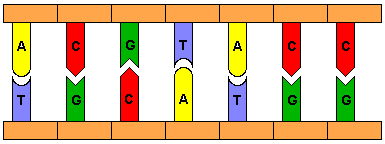
What base forms a base pair with guanine in DNA?
adenine
cytosine
thymine
uracil
Which RNA is produced during TranSCRIPtion?
mRNA (messenger)
pRNA (protein)
rRNA (ribosomal)
tRNA (transfer)
RNA uses ___ instead of thymine
adenine
cytosine
guanine
uracil
The process of duplicating the DNA molecule is
replication
transcription
translation
transliteration
The process that cells use to make RNA copies of a gene is
replication
transcription
translation
Transcription is the process of duplicating the DNA molecule
True
False
Replication is the process of duplicating the DNA molecule
True
False
DNA is able to store information and build cellular structures itself.
True
False
Transfer RNA (tRNA) is responsible for carrying amino acids to the ribosome.
True
False
The process of forming RNA from DNA is called transcription
True
False
Engineered Systems do not appear to be
planned
designed
built to work together
random chance
The complex structure of DNA is evidence for a powerful Creator.
True
False
Engineered systems in our body point to evidence of a Creator
True
False
RNA differs from DNA in which ways? (Check all that apply.)
RNA has only a since strand of nucleotides
RNA contains the sugar ribose instead of deoxyribose
RNA contains uracil in place of thiamine
RNA is a nucleic acid
DNA differs from RNA in which ways?
DNA has a double helix of nucleotides
DNA contains deoxyribose instead of ribose for the sugar.
DNA contains thymine instead of uracil
DNA is a nucleic acid.
There are __ different kinds of bases in DNA
2
3
4
5
A group of 3 nucleotides form a(n) ______, these are the "words" of the DNA or RNA molecule.
codon
anticodon
codex
anticodex
Name the 4 bases found in a DNA nucleotide.
adenine
uracil
guanine
thymine
cytosine
Name the 4 bases found in an RNA nucleotide.
adenine
uracil
guanine
thymine
cytosine
A way RNA and DNA are different. (Choose 2)
RNA has the sugar ribose
DNA has the sugar ribose
RNA has the sugar deoxyribose
DNA has the sugar deoxyribose
A way RNA and DNA are different. (Choose 2)
RNA has the base uracil
DNA has the base uracil
RNA has the base thymine
DNA has the base thymine
A way RNA and DNA are different. (Choose 2)
RNA has a single strand of nucleotides
DNA has a single strand of nucleotides
RNA has a double helix
DNA has a double helix
DNA and RNA are the SAME because they both
are nucleic acids
are made of the same sugar
are the same shape
have the same 4 base
In a DNA molecule with, what mRNA would it pair with if it was:
adenine-cytosine-guanine-adenine-thymine
thymine-guanine-cytosine-thymine-adenine
uracil-guanine-cytosine-uracile-cytosine
uracil-guanine-cytosine-uracil-adenine
How do tRNA molecules know how to line up their amino acids in the correct order at the mRNA strand.
Codons on the mRNA match with Anticodons on the tRNA
Codons on the tRNA match with anticodons on the mRNA
Amino acids on the tRNA match with the anti-amino acids on the mRNA
What happens first in transcription ?
The mRNA leave the nucleus.
An enzyme unzips part fo the DNA molecule
An enzyme adds nucleotides to form the new mRNA
An enzyme reads the order of the nucleotides in the DNA
What happens second in transcription ?
The mRNA leave the nucleus.
An enzyme unzips part fo the DNA molecule
An enzyme adds nucleotides to form the new mRNA
An enzyme reads the order of the nucleotides in the DNA
What happens third in transcription ?
The mRNA leave the nucleus.
An enzyme unzips part fo the DNA molecule
An enzyme adds nucleotides to form the new mRNA
An enzyme reads the order of the nucleotides in the DNA

