
Font size
 Worksheets
BIODIVERSITY - SUBTOPICS 1.1, 1.2 & 1.4
Total questions: 41
Worksheet time: 24mins
Process by which bacteria reproduce asexually
binary fission
transduction
transformation
conjugation

Name this bacteria based on its shape
bacillus
coccus
spirillum
vibrio

Name this bacteria based on its shape
coccus
bacillus
spirillum
vibrio


How does this protist move?
Pseudopods
Cilia
Flagellum
Chemotaxis

A protist that can not make its own food is called........
Autotroph
Heterotroph
What is level of cell organization for Kingdom Protista?
Prokaryotic
Eukaryotic
Choose 2 groups of organisms classified under Kingdom Protista
Algae
Protozoa
Palazoa
Perifera
Mode of nutrition for Algae is...
photosynthetic
holozoic
mixotrophic
heterotrophic
The following statements is true about the importance of Kingdom Protista EXCEPT...
as food source
can be used in sewage treatment
can affect human health
symbiotic in human intestine

I am eukaryotic
I reproduce sexually
I am multicellular
What kingdom do I belong to?
I have cell walls
I am an autotroph
I am multicellular
What Kingdom am I?
Plantae
Animalia
Eubacteria
Archaebacteria
I am prokaryotic
I am found in extreme ecosystems
What kingdom do I belong to?
What is the lowest category in the hierarchical classification?
Species
Genus
Family
Order
Why Gram-Negative is more pathogenic?
Due to its negative charge on cell wall
Due to thin cell wall
Due to its staining which makes them become virulent
Due to outer membrane that consist of lipopolysachharide which is toxic
Protozoa is classified based on its locomotion. How Amoeba sp. moves?
It cannot move. Need its own host
It move by its euglena
It move by its cilia
It move by its pseudopodia
Bacteria are
prokaryotic and multicellular
prokaryotic and unicellular
eukaryotic and multicellular
eukaryotic and unicellular
The variety of genes within a population of cheetahs is an example of
genetic diversity
species diversity
ecosystem diversity
classification diversity
In the biological classification system, which is not a domain?
Archaea
Eukarya
Animalia
Bacteria
Which taxonomic level has the most species?
kingdom
genus
phylum
family
Peptidoglycan is the main structural compound found in the cell walls of what kinds of creatures?
Slime molds
Bacteria
Algae
Archaea


______________ often live where nothing else can, such as in hot springs and in extremely acidic or salty habitats.
Archaea
Bacteria
Protists
Fungi
the Gram-positive bacteria stain purple because
they form endospore
they have cellulose layer
they have thick peptidoglycan layer
they have thin peptidoglycan layer
which of the following statements about the TWO Domains of Prokaryotes is NOT TRUE
the lipid composition of the plasma membrane in archaebacteria is different from eubacteria
both archaebacteria and eubacteria has cell wall but archaebacteria lack peptidoglycan
of the two groups, eubacteria are more closely related to domain eukarya
eubacteria includes the blue green algae
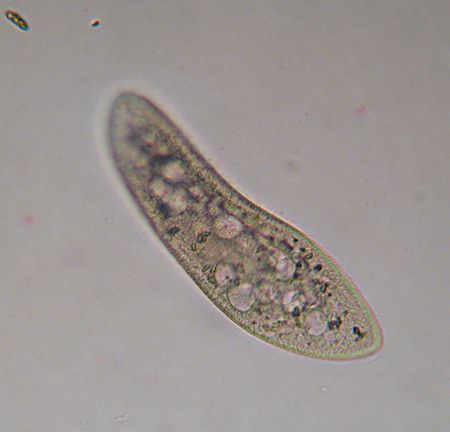
The image shows a Paramecium. What structure is utilized by the Paramecium for movement?
Cilia
Flagella
Pseudopods
Pili

How is the Amoeba (seen in the image) able to move?
Pseudopods
Cilia
Flagella
Pili
What is the function of the eyespot, seen in the diagram of a Euglena?
Detects light
Removes excess water
Movement
Photosynthesis
The mode of nutrition found in most Protozoa is
autotrophic
chemotrophic
photosynthetic
heterotrophic
Which of the following correctly pairs protists with its phylum?
Amoeba sp. - Ciliophora
Plasmodium sp. - Apicomplexa
Euglena sp. - Rhizopoda
Paramecium sp. - Euglenophyta

