wayground logo

Free Printable Worksheets

Font size

S
M
L
XL
Worksheets

Molecular Genetics

Total questions: 85

Worksheet time: 1hrs 11mins

Name
Class
Date
1.
In the mRNA sequence: AUGUGGAACAGAUAC, what would happen if in the last codon, Guanine was substituted with Cytosine? 
a)
A stop codon would be inserted
b)
A frameshift mutation would occur
c)
A stop codon would be removed
d)
Valine would be substituted for tyrosine
2.
A single substitution in the third position would have the greatest probability of mutational effect on which codon?
a)
GUU
b)
AUU
c)
CGU
d)
AUG
3.
The illustration shows two scenarios for production of proteins.  Which of the following statements is true?
a)
The DNA gene that is the template for theius pre-mRNA has been mutated by deletion.
b)
Two different splicesomes were used in the production of this mRNA.
c)
This alternative splicing allows for the produciton of two different proteins from the same DNA gene
d)
ONe protein will be functional and the second protein will be nonfunctional.
4.
What product gets made at the end of the process pictured?
a)
mRNA
b)
tRNA
c)
polypeptides
d)
ribosomes
5.
A tobacco plant can be made to express a gene from fireflies, resulting in the emission of light.  Which of the following is the basis for this phenomenon?
a)
Chloroplasts can be made to produce light if firefly proteins are injected into plant cells.
b)
Fireflies and tobacco plants share a recent common ancestor.
c)
Transcription and translation are fundamentally similar in both fireflies and tobacco plants.
d)
Most enzymes in fireflies have the same amino acid sequence as the enzymes in tobacco plants. 
6.
Transcribe the following DNA sequence:
TAT GGC ACT 
a)
TAT GGC ACT
b)
ATA CCG TGA
c)
AUA GGC UGA
d)
UAU GGC ACU
7.
Translate the following RNA sequence:
AUG AAU UGU UGA
a)
Met-Phe-Cys-Stop
b)
Met-Asn-Cys-Stop
c)
Met-Asn-Cys-Trp
d)
Tyr-Leu-Thr-Thr
8.
The genetic code is essentially the same for all organisms. From this, one can logically assume which of the following?
a)
The same codons in different organisms translate into the different amino acids.
b)
A gene from an organism can theoretically be expressed by any other organism.
c)
All organisms have experienced convergent evolution.
d)
DNA was the first genetic material.
9.
The anticodon of a particular tRNA molecule is 
a)
complementary to the corresponding mRNA codon.
b)
complementary to the corresponding triplet in rRNA.
c)
the part of tRNA that bonds with a specific amino acid.
d)
catalytic, making the tRNA a ribozyme.
10.
Which of the following does not occur in prokaryotic gene expression but does occur in eukaryotic gene expression?
a)
mRNA, tRNA, and rRNA are transcribed
b)
RNA polymerase binds to the promotor
c)
a poly-A tail is added to the ends of the mRNA
d)
Transcription can begin as soon as translation has begun even alittle
11.
Transcription in eukaryotes requires which of the following in addition to RNA polymerase?
a)
the protein  product of the promotor
b)
start and stop codons
c)
ribosomes and tRNA
d)
several transcription factors
12.
Which of the follwoing best describes the significance of the TATA box in eukaryotic promoters?
a)
it is the recognition site for a specific transcription factor
b)
it sets the reading frame of the mRNA
c)
it is the recognition site for ribosomal binding
d)
it signals the end of the nucleotide sequence of the gene
13.
RNA polymerase moves in which direction along the DNA?
a)
5' to 3' 
b)
3' to 5' along the template strand
c)
3' to 5' along nontemplate(coding) strand
d)
5' to 3' along the template strand
14.
What is the function of the poly-A tail in mRNA?
a)
to add modified guanin to the 3' end of the mRNA
b)
to indicate the site of translational termination
c)
to code for the binding of RNA polymerase to the DNA
d)
to help protect the mRNA from degradation by hydrolytic enzymes 
15.
Accuracy in the translation of mRNA into the sequence of amino acids in a polypeptide depends on specificity in which of the following?
a)
binding of ribosomes to mRNA
b)
shape of the A and P sites of ribosomes
c)
attachment of amino acids to tRNAs
d)
bonding of the anticodon the codon and the attachment of amino acids to tRNAs
16.
Which of the following events in translation is the first to occur in eukaryotes?
a)
elongation of the polypeptide
b)
base pairing of activated methionine-tRNA to AUG of the messenger RNA
c)
binding of the larger ribosomal subunit to smaller ribosomal subunits
d)
the small subunit of the ribosome recognizing and attaching to the 5'cap
17.
A possible sequence of nucleotides in the template strand of DNA that would code for the polypeptide sequence phe-leu-ile-val would be?
a)
5'-TTG-CTG-CAG-TAG-3'
b)
3'-AAC-GAC-GUC-AUA-5'
c)
3'-AAA-AAT-ATA-ACA-5'
d)
3'-AAA-GAA-TAA-CAA-5'
18.
What is the effect of a nucleotide-pair substitution that results in a nonsense mutation in a gene?
a)
it changes an amino acid in the encoded protein
b)
It has no effect on the amino acid sequence of the encoded protein
c)
it introduces  premature stop codon into the mRNA
d)
it alters the reading frame of the mRNA
19.

Suppose a gene has the DNA nucleotide sequence


1 2 3 4 5 6 7 8 9 10 11 12 13 14 15 16 17

C T G G C A T G C T T C G G A A A


(No real gene could be this short, but for our purposes, this will suffice.) Which one of the following mutations would probably produce the greatest change in the activity of the protein for which this gene codes?

a)

substitution of A for G in position 3

b)

deletion of the C at position 5

c)

deletion of the A at position 15

d)

addition of G between position 14 and 15

e)

substitution of A for T at position at 11

20.
Muscle cells and nerve cells in one species of animal owe their differences in structure to
a)
having different genes
b)
having different chromosomes
c)
using different genetic codes
d)
differential gene expression
21.
Which of the following statements concerning the eukaryotic chromosome is false?
a)
It is composed of DNA and protein.
b)
The nucleosome is the most basic structural subunit.
c)
The number of genes on each chromosome is different in different cell types.
d)
It consists of a single linear molecule of double-stranded DNA.
22.
What is the anticodon on the object labeled I?
a)
try
b)
met
c)
AUG
d)
GUA
23.
Examine the image.  What type of organism would most likely contain this DNA segment?
a)
E coli bacteria
b)
Purple loostrife plant
c)
An Elk
d)
A beefsteak mushroom
24.
Examine the image.  What would most likely occur if a mutation took place in the promoter sequence?
a)
No proteins could be made
b)
Proteins would be made continuosly
c)
Repressors would not be able to effectively bind to the DNA
d)
The trp C gene would be amplified
25.

What are bacteriophages

a)

Viruses

b)

Carbohydrates

c)

Protein

d)

Lysosomes

26.

Who was Rosalind Franklin

a)

The Only Real Scientist

b)

She Discovered Pluto

c)

She Discovered that DNA was a double helix

d)

She Discovered the Nucleus of the Cell

27.

How did she discover the shape of DNA?

a)

Photosynthesis

b)

Distillation

c)

X-ray Crystallography

d)

PCR

28.

What Prize did Rosalind Franklin Receive?

a)

Nobel

b)

Olympic Gold Medal

c)

Oscar

d)

Nothing

29.

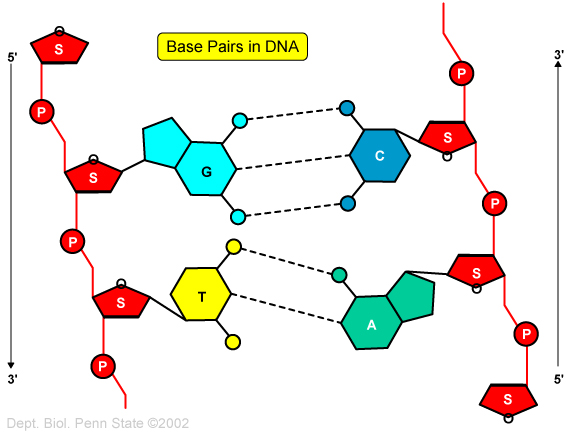
What base does Adenine pair with?

a)

Thymine

b)

Thimine

c)

Thiamine

d)

Thy mean

30.

Which option has the bases paired correctly?

a)

Adenine and Guanine

b)

Guanine and Thymine

c)

Guanine and Cytosine

d)

Adenine and Cytosine

31.
type of protein around which DNA coils
a)
histone
b)
ubiquitin
c)
transcription factor
d)
operon
32.
How do the leading, and the lagging strands differ?
a)
The leading strand is synthesized in the same direction as the movement of the replication fork, and the lagging strand is synthesized in the opposite direction.
b)
The leading strand is synthesized at twice the rate of the lagging strand.
c)
The leading strand is synthesized in short fragments that are ultimately stitched together, whereas the lagging strand is synthesized continuously. 
d)
The leading strand is synthesized by adding nucleotides to the 3' end of the growing strand, and the lagging strand is synthesized by adding nucleotides to the 5? end. 
33.
Suppose a double-stranded DNA molecule was shown to have 15% adenine bases. What would be the expected percentage of guanine bases in that molecule?
a)
15%
b)
35%
c)
85%
d)
Not enough information
34.
Consider the replication bubble diagrammed at the right. Which letters represent leading strands? 
a)
W and X
b)
Y and Z
c)
W and Z
d)
X and Y
35.
Which enzyme is not working correctly if new DNA bases are not added to the template strand?
a)
DNA Polymerase
b)
Topoisomerase
c)
Ligase
d)
Primase
36.
Which enzyme is responsible for proofreading the newly composed DNA strand?
a)
DNA Polymerase
b)
Topoisomerase
c)
Ligase
d)
Primase
37.
What is meant by the description "antiparallel" regarding the strands that make up DNA?
a)
The twisting nature of DNA creates nonparallel strands.
b)
One strand is positively charged and the other is negatively charged.
c)
The 5' to 3' direction of one strand runs counter to the 5' to 3' direction of the other strand.
d)
Base pairings create unequal spacing between the two DNA strands
38.
What is meant that DNA replication follows a “semi-conservative” model?
a)
After DNA replication, each strand contains one side that is a parental strand and the other side is a daughter strand.
b)
After DNA replication, one completed strand contains only parental DNA while the other contains only daughter DNA.
c)
None of these identify the “semi-conservative” model.
d)
After DNA replication, one completed strand contains a mixture of both parental DNA and daughter DNA dispersed throughout the strand.
39.

Which enzyme seals the Okazaki fragments together

a)

DNA Polymerase

b)

ligase

c)

helicase

d)

primase

40.
Nitrogenous bases are joined by which type of bond?
a)
polar bonds
b)
ionic bonds
c)
covalent bonds
d)
hydrogen bonds
41.
Which 2 molecules form the sides (backbone) of the DNA ladder?
a)
deoxyribose sugar and adenine
b)
deoxyribose sugar and a hydrogen bond
c)
deoxyribose sugar and the nucleus
d)
deoxyribose sugar and phosphate
42.
Replicate the following strand of DNA: 
AATCATGGA
a)
AATCATGGA
b)
TTAGTACCT
c)
UUAGUACCU
d)
GGATAUCUA
43.
How many different DNA nucleotides are there?
a)
impossible to count
b)
12
c)
6
d)
4
44.
Enzyme that unwinds the DNA
a)
ligase
b)
DNA Polymerase
c)
primase
d)
helicase
45.
synthesizes a short fragment of RNA that allows DNA polymerase III to bind
a)
ligase
b)
DNA polymerase I
c)
primase
d)
helicase
46.
direction new nucleotides are synthesized on the new strand
a)
5' to 3' (new nucleotides added to the 3' end)
b)
3' to 5' (new nucleotides added to the 5' end)
47.
repetitive sequences of DNA on the ends of chromosomes (TTAGGG)
a)
telomeres
b)
telomerase
c)
Okazaki fragments
d)
primer
48.
In what phase of the cell cycle does DNA replication take place?
a)
G1
b)
S
c)
G2
d)
M
49.
What are the three components of a nucleotide?
a)
sugar, hydrogen, nitrogen base
b)
sugar, oxygen, nitrogen base
c)
sugar, phosphate, nitrogen base
d)
sugar, phosphate, protein
50.
Which is larger guanine or cytosine
a)
guanine because it's a purine
b)
guanine because it's a pyrimidine
c)
cytosine because it's a purine
d)
cytosine because its a pyrimidine
51.
what kind of bond holds one nucleotide to another one above it or below it?
a)
ionic
b)
glycosidic
c)
hydrogen
d)
phosphodiester
52.
What do viruses need to reproduce?
a)
they need genetic material
b)
They need a host cell
c)
They need  bacteria
d)
They need insulin
53.
A(n) _____ is a virus that enters a bacterial cell.
a)
endospore
b)
decomposer
c)
plasmid
d)
bacteriophage
54.
When a virus invades a living cell, its _______
takes over the cell's functions.
a)
outer coat
b)
genetic material
c)
core
d)
cytoplasm
55.
What part of the phage is the DNA?
a)
A
b)
B
c)
C
d)
D
56.
Antibiotics kill viruses
a)
True
b)
False
57.
Which viral life cycle kills its host cell by lysing?
a)
lytic
b)
mitosis
c)
lysogenic
d)
S phase
58.
Which viral life cycle allows viral genetic material to lay dormant while the host cell reproduces?
a)
lytic
b)
mitosis
c)
lysogenic
d)
S phase
59.
Reasons that viruses are considered to be nonliving is because
a)
They are not cellular
b)
They cannot reproduce on their own
c)
They cannot make proteins
d)
all of the above
60.
Viruses are...
a)
prokaryotic
b)
eukaryotic
c)
non-living
d)
endospores
61.
How do viruses reproduce?
a)
They copy their own genetic material inside a protein coat.
b)
They kill a cell and reproduce inside it
c)
They invade a living cell and use the cell's functions to replicate their genetic material
d)
They do not reproduce because they are not technically living things
62.
Which best describes stem cells? 
a)
 stem cells can only come from embryos 
b)
stem cells can only come from adult bone marrow 
c)
stem cells do not ever change
d)
stem cells can develop into different specialized cells 
63.
The blood stain most likely belongs to 
a)
Bob
b)
Sue
c)
John
d)
Lisa
64.

Which of the following about plasmids is wrong?

a)

Double-stranded

b)

independent replication

c)

found in viruses

d)

serve as vector for gene transfer

65.

In gel electrophoresis, smaller DNA fragments

a)

move at a higher speed

b)

end up closer to the starting point

66.

Restriction enzymes are mostly likely used in

a)

Recombinant DNA technology

b)

DNA fingerprinting

c)

PCR

d)

Animal cloning

67.

PCR requires all of the following except

a)

dNTPs

b)

thermal cycler

c)

DNA polymerase

d)

restriction enzyme

68.
Which technique was used to produce these bands?
a)
Cloning
b)
Gel electrophoresis
c)
Gene splicing
d)
Genetic engineering
69.
What process allows scientists to create a group of genetically identical organisms?
a)
Cloning
b)
DNA fingerprinting
c)
DNA recombination
d)
Genetic modification
70.
Which is an example of a transgenic organism?
a)
An earthworm with both male and female parts
b)
a bacterial cell with immunity against an antibiotic
c)
an earthworm with a DNA mutation that gave it eyes
d)
a bacterial cell with human genes for producing insulin
71.
How would genetically altering crops for pest resistance be economically beneficial?
a)
Erosion of topsoil would no longer be a concern
b)
Crops would be more easily protected from weeds
c)
Crop-eating pest would not ruin crops
d)
Abnormal plant growth would be eliminated
72.
Which is a use genetically modified bacteria?
a)
Identifying the remains of an unknown person.
b)
developing a DNA fingerprint for blood left at a crime scene
c)
making human insulin for diabetics
d)
producing corn that is resistant to herbicides
73.
How is DNA cut into small, usable pieces so it can be used in gel electrophoresis?
a)
By using restriction enzymes
b)
By dissolving the DNA in blue stain
c)
By centrifuging the DNA into a small bead
d)
By surgically cutting the DNA under a microscope
74.
Great caution must be exercised with recombinant DNA technology. What is the main reason for this concern?
a)
Possible patent violations from competing companies
b)
Possibility of the fragile recombinant organisms dying
c)
Possible release of genetically engineered organisms into the environment with unpredictable results
d)
Possibility of producing medicine at a lower cost than with current technology
75.
What is the advantage of using embryonic stem cells, as opposed to adult stem cells?
a)
Adult stem cells can differentiate into all cell types
b)
Embryonic stems cells can differentiate into all cell types
c)
The use of embryonic stem cells is less controversial than the use of adult stem cells
d)
Embryonic stem cells are limited to differentiating into cell types of their tissue of origin
76.
Which BEST explains the purpose of the Human Genome Project?
a)
To clone humans
b)
To create perfect humans
c)
To produce a map of human genes
d)
To eliminate all human genetic disorders
77.
A crime scene contains both the blood of a victim and the assailant. Which technique of biotechnology would be MOST appropriate for analyzing the blood?
a)
DNA cloning
b)
Light microsopy
c)
Electron microscopy
d)
Gel electrophoresis
78.
the creation of genetically identical organisms
a)
Bioremediation
b)
Cloning
c)
Gene Therapy
d)
Tissue Culturing
79.
Which of the following is not a concern of biotechnology?
a)
Ethics concerns with cloning humans.
b)
Health concerns about eating genetically modified foods.
c)
Concerns that we will harvest too much food for the global population.
d)
Environmental concerns of releasing genetically modified organisms into an ecosystem.
80.
Using biotechnology to change the genetic makeup of an organism is called
a)
Tissue Culturing
b)
Biotechnology
c)
Cloning
d)
Genetic Engineering
81.
GMO stands for
a)
Genetically Made Organism
b)
Growing More Organisms
c)
Genetically Modified Organism
d)
Growing Many Organisms
82.
All of the following are advantages of GMO's except
a)
pest resistant crops
b)
more nutritional foods
c)
unknown long term health effects
d)
creating more human insulin
83.
______ is the manipulation of organisms or their parts to produce useful products.
a)
Genetics
b)
Heredity
c)
Biotechnology
d)
Recombinant Technology
84.
What is the definition of mutation?
a)
A random change in the genes of an organism
b)
Natural Breeding
c)
Natural Selection 
d)
Breeding two animals to create a new one
85.
______ is the manipulation of organisms or their parts to produce useful products.
a)
Genetics
b)
Heredity
c)
Biotechnology
d)
Recombinant Technology