wayground logo

Free Printable Worksheets

NEW

Font size

S
M
L
XL
Worksheets

Test Review VSEPR, Electronegativity, Empirical Formula, Hydrate

Total questions: 51

Worksheet time: 2hrs 35mins

Name
Class
Date
1.

Large differences in electronegativity result in __________ bonding between atoms.

a)

Covalent

b)

Metallic

c)

Ionic

d)

Hydrogen

2.

Use your electronegativity chart to determine if the bond between these two is Ionic or non-polar covalent or polar covalent?

H - O

a)

Ionic

b)

polar covalent

c)

non-polar covalent

d)

polar ionic

3.
Chlorine and Fluorine are both very electronegative, as they are both missing a single electron from their valence energy level.  Why is Fluorine more electronegative than Chlorine? 
a)
Fluorine has less energy levels.
b)
Chlorine has more electrons in its outer shell
c)
Fluorine has more protons.
d)
None of these
4.

As you look from left to right across a period, electronegativity

a)

increases

b)

decreases

5.

As you look down a group, electronegativity

a)

increases

b)

decreases

6.
According to VSEPR, molecules adjust their shapes to keep which of the following as far away as possible?
a)
Pairs of valence electrons
b)
Inner shell electrons
c)
Mobile Electrons
d)
Electrons closest to the nucleus
7.

2 bonded atoms and 0 lone pairs

a)

linear

b)

trigonal planar

c)

bent

d)

tetrahedral

e)

trigonal pyramidal

8.

What shape would this have?

a)

Trigonal planar

b)

Pyramidal

c)

Tetrahedral

d)

Bent

9.

What is the molecular shape of CH3Cl? (Hint: Count the atoms)

a)

trigonal pyramidal

b)

trigonal bipyramidal

c)

tetrahedral

d)

not enough information

10.
What molecular shape is the structure shown here? (H2O)
a)
tetrahedral
b)
trigonal planar
c)
bent
d)
trigonal pyramidal
11.
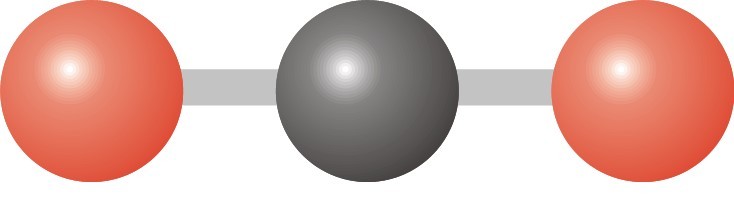
Which molecule would have this shape?
a)
BF3
b)
CH4
c)
PCl5
d)
CO2
12.

Which shapes are altered by unshared pairs of electrons?

a)

Bent and Pyramidal

b)

Trigonal Planar and Bent

c)

Tetrahedral and pyramidal

d)

Pyramidal and Linear

13.
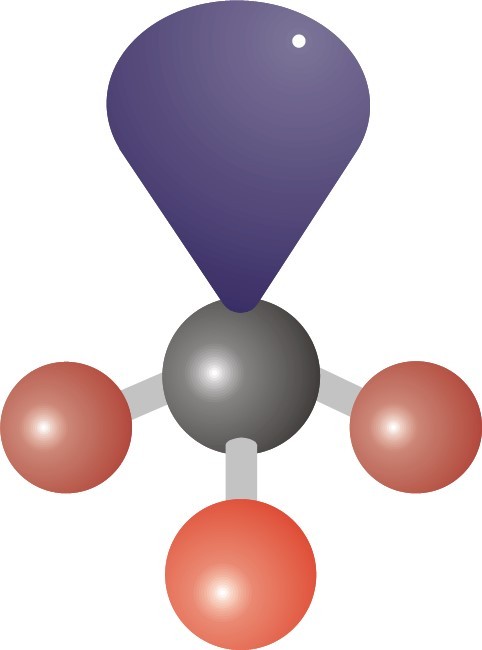
Who could this be?
a)
H2O
b)
NH3
c)
CO2
d)
CH4
14.

What shape would PH3 have?

a)

Trigonal Planar

b)

Trigonal pyramidal

c)

Bent

d)

Linear

15.

What is the molar mass of PbSO4

a)

303 g/mol

b)

295 g/mol

c)

164 g/mol

d)

372g/mol

16.
What is the mass of one mole of aluminum?
a)
27 g
b)
13 g
c)
54 g
d)
14 g
17.
How many molecules are in 2.5 mol of NaCl?
a)
1.51x10²³
b)
146
c)
4.15
d)
1.51x1024
18.
How many grams of Hydrogen are there in 25 moles of water?
a)
25 g
b)
450 g
c)
18 g
d)
50 g
19.
How many grams are inn 9.4 x 1025  molecules of H2
a)
1.98 g
b)
200g
c)
315g
d)
452g
20.

How many grams are in 3.3 mol of Potassium Sulfide?

a)

363 g

b)

450 g

c)

263 g

d)

454 g

21.

Which sample has hydrogen bonding?

a)

H2S

b)

CH4

c)

NH3

d)

HI

22.

Water has an unusually high boiling point for a molecular compound because it has

a)

hydrogen bonding

b)

ion-ion attractions

c)

a high density

d)

a large gram formula mass

23.

The weaker the intermolecular forces of a substance the _____________ the boiling point

a)

higher

b)

lower

24.

Which of these has London dispersion forces?

a)

I2

b)

NH3

c)

OCl2

d)

SH2

25.
Rank these in order of strength:
covalent bond
London forces
hydrogen bond
dipole-dipole attraction
a)
dipole-dipole>covalent bond>hydrogen bond>London
b)
London>dipole-diple>hydrogen bond>covalent bond
c)
covalent bond>hydrogen bond>dipole-dipole>London
d)
hydrogen bond>dipole-dipole>London>covalent bond
26.
Intermolecular forces are the forces
a)
within molecules
b)
between molecules
27.

What intermolecular force is present in a sample of pure HCl?

a)

dipole-dipole attraction

b)

London dispersion forces

c)

H-bonds

d)

molecule-ion attraction

28.
Hydrogen bonding is a special type of what force?
a)
London dispersion forces
b)
dipole-dipole forces
c)
ion-dipole forces
d)
covalent force
29.
H2S has what kind of intermolecular force?
a)
dipole dipole
b)
dispersion
c)
H-bond
d)
ionic
30.
You are given the following percentages: 40.05% S and 59.95% O. Find the empirical formula for these elements. (keep two decimal places throughout calculations)
a)
SO
b)
SO2
c)
SO3
d)
SO4
31.
What is the empirical formula if you have 36.84% nitrogen and 63.16% oxygen?
a)
NO
b)
N2O3
c)
N2O4
d)
N2O5
32.
Which one is empirical?
a)
H2O2
b)
C2H6O12
c)
CaCl2
d)
N2O8
33.
Which pair has the same empirical formula?
a)
NaCrO4 and Na2Cr2O7
b)
C2H4O2 and C6H12O6
c)
C3H6Oand C2H6O2
d)
CH4 and C2H6
34.
A compound came out with the following ratio
3 Carbon: 1.49 Phosphorus: 2 Oxygen- what would be the empirical formula?
a)
Ca6P3O4
b)
C3PO2
c)
C6P3O4
d)
C3P3O2
35.
Which expression below show the correct method of determining the percent composition of Sodium in Na2CO3?
a)
%Na = (22.99g/106g) x 100
b)
%Na = (22.99g/106) / 100
c)
%Na = (45.98g/106g) x 100
d)
%Na = (106/45.98g) x 100
36.
What are the units for molar mass?
a)
grams
b)
amu
c)
grams/mole
d)
liters
37.
What is the percent by mass of sodium in NaCl?
a)
39%
b)
61%
c)
35%
d)
65%
38.
What is the empirical formula for the following molecular formula: C6H14
a)
C6H14
b)
C3H7
c)
CH2
d)
CH3
39.

What is the percent composition of a compound that contains 40.8 g carbon and 54.4 g oxygen?

a)

42.9 %; 57.1% oxygen

b)

52.9 %; 57.1% oxygen

c)

42.9 %; 45.23% oxygen

d)

55.9 %; 99.1% oxygen

40.

Glycerol has a molar mass of 92.09g/mol. Its percent composition is: 39.12% C, 8.76% H, and 52.12% O. What is the molecular formula for glycerol?

a)

C2H3O2

b)

CH2O

c)

C2H4O2

d)

C3H8O3

41.
What is the molecular formula if the empirical formula is C2H5 and the molecular molar mass is 58.14 g/mol?
a)
C2H5
b)
C4H10
c)
C1H2.5
d)
C4H8
42.
What is the molecular formula if the empirical formula is CH2O and the molecular molar mass is 180.18?
a)
CH2O
b)
C2H4O2
c)
C4H8O4
d)
C6H12O6
43.
What is the molecular formula of a compound with an empirical formula of C2OH4 and a molar mass of 88 grams per mole?
a)
C2O4H8
b)
C8O2H4
c)
C4O2H8
d)
C4O8H2
44.
Name the following ionic compound: MgSO4*7H2O
a)
magnesium sulfate * hexahydarte
b)
magnesium sulfate hexahydarte
c)
magnesium sulfate heptahydrate
d)
magnesium sulfate* heptahydrate
45.
Na2CO3 · 10H2O is known as sodium sulfate ______
a)
Hydroxide
b)
Hydrate
c)
Decahydrate
d)
None of the above
46.

What is the correct chemical formula for barium hydroxide octahydrate?

a)

Ba(OH)2 . 8H2O

b)

Ba(OH)2 . H2O

c)

8Ba(OH)2 . H2O

d)

Ba . 8(OH)2

47.

What is the best method for removing water from a hydrated compound?

a)

freezing

b)

filtration

c)

distillation

d)

heating

48.
A 15.67 g sample of a hydrate of magnesium carbonate was heated to drive off the water. The mass was reduced to 7.58 g. What is the formula of the hydrate?
a)
MgCO3 · 5H2O
b)
MgCO3 · 4H2O
c)
MgCO3 · 6H2O
d)
MgCO3 · 1H2O
49.

A hydrate of magnesium chloride is present and the following data is collected:

mass of evaporating dish = 22.130 grams

mass of dish + hydrate = 25.290 grams

mass of dish and contents after heating = 23.491 grams

What is the mass of the anhydrous MgCl2?

a)

1.799 g

b)

3.160 g

c)

1.361 g

d)

23.491 g

50.
What is the empirical formula for the following:
32.40% sodium, 22.5% sulfur; 45.1 % oxygen, 37.75% water?

a)
Na2SO4H6O3
b)
Na2SO4 . 2H2O
c)
Na2SO4 . 3H2O
d)
Na2SO4 . (H2O)3
51.
A 15.67 g sample of a hydrate of magnesium carbonate was heated to drive off the water. The mass was reduced to 7.58 g. What is the formula of the hydrate?
a)
MgCO3 · 5H2O
b)
MgCO3 · 4H2O
c)
MgCO3 · 6H2O
d)
MgCO3 · 1H2O