wayground logo

Free Printable Worksheets

Font size

S
M
L
XL
Worksheets

Skeletal System

Total questions: 225

Worksheet time: 3hrs 27mins

Name
Class
Date
1.

What bone is highlighted?

a)

Skull (Cranium)

b)

Mandible

c)

Clavicle

d)

Scapula

2.

What bone is highlighted?

a)

Skull (Cranium)

b)

Mandible

c)

Scapula

d)

Clavicle

3.

What bone is highlighted?

a)

Skull (Cranium)

b)

Scapula

c)

Clavicle

d)

Mandible

4.

What bone is highlighted?

a)

Skull (Mandible)

b)

Clavicle

c)

Mandible

d)

Scapula

5.

What bone is highlighted?

a)

Radius

b)

Ulna

c)

Humerus

d)

Carpals

6.

What bone is highlighted?

a)

Vertebrae

b)

Radius

c)

Pelvis

d)

Ribs

7.

What bone is highlighted?

a)

Radius

b)

Ulna

c)

Humerus

d)

Carpals

8.

What bone is highlighted?

a)

Radius

b)

Ulna

c)

Humerus

d)

Carpals

9.

What bone is highlighted?

a)

Femur

b)

Tibia

c)

Fibula

d)

Humerus

10.

What bone is highlighted?

a)

Patella

b)

Pelvis

c)

Clavicle

d)

Femur

11.

What bone is highlighted?

a)

Patella

b)

Pelvis

c)

Clavicle

d)

Mandible

12.

What bone is highlighted?

a)

Tibia

b)

Fibula

c)

Femur

d)

Humerus

13.

What bone is highlighted?

a)

Tibia

b)

Fibula

c)

Radius

d)

Ulna

14.

From wrist to fingertip, what is the order of bones?

a)

Carpals, metacarpals, phalanges

b)

Phalanges, metacarpals, carpals

c)

Carpals, phalanges, metacarpals

d)

Metacarpals, carpals, phalanges

15.

From ankle to toe, what is the order of bones?

a)

Tarsals, metatarsals, phalanges

b)

Phalanges, metatarsals, tarsals

c)

Metatarsals, phalanges, tarsals

d)

Tarsals, phalanges, metatarsals

16.
What is the place where two bones meet?
a)
hinge
b)
bone
c)
spot
d)
joint
17.
What is the name for the connector that attaches muscle to bone?
a)
ligament
b)
tendon
c)
patella
d)
string
18.
What is the name for the connector that attaches bone to bone?
a)
ligament
b)
tendon
c)
patella
d)
string
19.
Ligaments connect:
a)
Bone to bone
b)
Muscle to bone
c)
Joint to joint
d)
Bone to joint
20.

Which of the following is not a function of bones?

a)

Protection

b)

Blood cell formation

c)

Storage

d)

Absorption

21.
Bone formed by needlelike pieces of bone and lots of space are called
a)
Spongey bone
b)
Cartilage
c)
Compact bone
22.
The skeletal system is composed of what as well as bones?
a)
Joints, ligaments, and tendons
b)
Joints, ligaments, and cartilage
c)
Cartilage, ligaments, and tendons
d)
Ligaments and joints
23.
The adult skeletal system is composed of how many bones?
a)
216
b)
371
c)
206
d)
199
24.
The shaft of the bone
a)
diaphysis
b)
epiphysis
c)
medullary cavity
d)
matrix
25.
Tissue found in some bones that makes blood cells
a)
red marrow
b)
yellow marrow
c)
canaliculi
d)
lamellae
26.
What do the bones create?
a)
white blood cells
b)
platlets
c)
red blood cells
d)
flying turkeys
27.
Which type of joint give you the largest range of motion?
a)
pivot
b)
ball-and-socket
c)
hinge
d)
gliding
28.
The joints in your knees and elbows are most similar to:
a)
a clock
b)
a screw
c)
a wheel
d)
a door hinge
29.
what is the fatty tissue inside bones
a)
cartilage
b)
marrow
c)
blood
d)
chocolate cake
30.
how many bones are in the ears total
a)
6
b)
83
c)
126,000
d)
7
31.
How many bones are in a human foot
a)
38
b)
26
c)
194
d)
25
32.
Mr Swatter has a fly on his shoulder, the poor thing. He reaches his right hand over to his left shoulder to try and squish the fly.  Which movement is occurring at his ELBOW joint?
a)
Extension
b)
Circumduction
c)
Flexion
d)
Supination
33.
Mark is sitting in a chair, legs out in front of him resting on an ottoman. His knees are.....
a)
Hyperextended
b)
Rotated
c)
Flexed
d)
Extended
34.
When doing a star jump, what is the type of movement of the arms when the move outwards from the body?
a)
Abduction
b)
Adduction
c)
Extension
d)
Flexsion
35.
The diaphysis, epiphysis, and medullary cavity are
a)
formed by osteons.
b)
filled with bone marrow.
c)
structures of a long bone.
d)
More than one of the above is true.
36.
Injury to the epiphyseal disc of a long bone
a)
˜makes the bone more susceptible to greenstick fractures.
b)
˜impairs longitudinal bone growth.
c)
˜impairs the production of blood cells.
d)
˜impairs the bone response to parathyroid hormone (PTH). 
37.
A synovial joint
a)
˜is found only within the appendicular skeleton.
b)
˜is a freely movable joint.
c)
˜forms as the fontanels fuse.
d)
˜More than one of the above is true.
38.
The maxilla
a)
is the cheekbone.
b)
is a cranial bone.
c)
contains the upper teeth. 
d)
articulates with the temporal bone at the TMJ.
39.
Which bone is found in the skull but not in the cranium?
a)
Occipital
b)
Parietal
c)
Sphenoid
d)
Mandible
40.
Which of the following word(s) is (are) related to the ribs?
a)
Acetabulum
b)
True, false, and floating
c)
Supination and pronation
d)
Fontanels
41.
Identify the structures labeled #1
a)
carpals
b)
phalanges
c)
tarsals
d)
metacarpals
42.
Identify the structures labeled #2
a)
phalanges
b)
tarsals
c)
metarsals
d)
metacarpals
43.
Identify the structures labeled #3 through #10.
a)
phalanges
b)
tarsals
c)
carpals
d)
metacarpals
44.
Identify the structures labeled #8
a)
metatarsals
b)
carpals
c)
phalanges
d)
tarsals
45.
Identify the structures labeled #6
a)
phalanges
b)
carpals
c)
tarsals
d)
metacarpals
46.
The bones highlighted in blue make up the ________ skeletal system.
a)
Appendicular
b)
Axial
c)
Atlas
d)
Axis
47.
The bones highlighted in red make up the ________ skeletal system.
a)
Axial
b)
Appendicular
c)
Atlas
d)
Axis
48.
Identify the structure labeled #8.
a)
Mandible
b)
Maxilla
c)
Sphenoid
d)
Ethmoid
49.
Identify the structure labeled #9.
a)
Maxilla
b)
Mandible
c)
Sphenoid
d)
Ethmoid
50.
 Functions of the skeletal system include all of the following except
a)
gives shape and support
b)
allows for movement
c)
regulates body temperature
d)
protects internal organs
51.
Cartilage is flexible connective tissue found on the ends of bones to help reduce
a)
bone spurs
b)
movement
nerves
c)
movement
d)
friction
52.
A joint that is fixed and cannot move is called
a)
immoveable
b)
pivot
c)
ball and socket
d)
hinge
53.
This type of joint provides movement around a certain point
a)
hinge
b)
immoveable
c)
ball and socket
d)
pivot
54.
This type of joint allows movement in an open and close motion
a)
hinge
b)
immoveable
c)
ball and socket
d)
pivot
55.
This joint allows movement in 360 degree motion
a)
hinge
b)
immoveable
c)
ball and socket
d)
pivot
56.
Which of the following is NOT a function of the skeleton?
a)
Production of blood cells
b)
Gives the body form
c)
Protects internal organs
d)
Generates heat
57.
Which of these is a long bone?
a)
Femur
b)
Patella
c)
Scapula
d)
Carpal
58.
Which of these is an irregular bone(s)?
a)
Pelvis
b)
Humerus
c)
Phalanges
d)
Tarsals
59.
Which of these is a flat bone?
a)
Vertebra
b)
Tibia
c)
Fibula
d)
Frontal
60.
The primary mineral stored by compact bone is
a)
Calcium
b)
Selenium
c)
Zinc
d)
Magnesium
61.

Which of these is a short bone?

a)

Femur

b)

Patella

c)

Scapula

d)

Ulna

62.
These are immovable joints that hold the skull bones together
a)
Facial
b)
Sutures
c)
Squamous
d)
Vomer
63.
Creates a smooth surface for motion within the joints and protects the ends of bones.
a)
Cartilage
b)
Bone Marrow
c)
Ligaments
d)
Bursa
64.

Another name for the backbone is the _________.

a)

Joint

b)

Spine

c)

Knee

d)

Shinbone

65.

The skull protects the ________.

a)

Eyes

b)

Teeth

c)

Heart

d)

Brain

66.

The ends of a long bone are called the

a)

diaphysis

b)

epiphyses

c)

periosteum

d)

endosteum

67.

Bone forming cells:

a)

osteocytes

b)

osteoblasts

c)

osteoclasts

d)

osteomasts

68.

Process of bone formation before birth:

a)

ossification

b)

hematopoiesis

c)

appositional growth

d)

atrophy

69.
Which of the following is NOT a classification of bone?
a)
Square
b)
Flat
c)
Long
d)
Short
70.
The __________ is like the "skin" of the bone.
a)
Epiphysis
b)
Periosteum
c)
Diaphysis
d)
Medullary cavity
71.
How many vertebrae are in the cervical portion of the spine?
a)
5
b)
7
c)
12
d)
10
72.
How many vertebrae are in the lumbar portion of the spine?
a)
5
b)
12
c)
7
d)
10
73.
How many vertebrae are in the thoracic portion of the spine?
a)
5
b)
12
c)
10
d)
7
74.
An ___________ is a mature bone cell.
a)
Osteoblast
b)
Osteoclast
c)
Osteocyte
75.
An __________ is a bone destroyer.
a)
Osteoblast
b)
Osteoclast
c)
Osteocyte
76.
An _____________ is a bone builder.
a)
Osteoclast
b)
Osteoblast
c)
Osteocyte
77.
Simple and compound are two types of fractures.
a)
True
b)
False
c)
Maybe
d)
Idk
78.
The ____________ pelvis is wider, shallower, and lighter.
a)
Male
b)
Female
79.
How many pairs of ribs are there in the adult body?
a)
6
b)
12
c)
10
d)
15
80.
___________ joints are immovable.
a)
Fibrous
b)
Cartilaginous
c)
Synovial
81.
Arthritis refers to a group of disorders where one or more joints are inflamed.
a)
True
b)
False
c)
Maybe
d)
Idk
82.
___________ cause the growth of long bones during childhood.
a)
Epiphyseal plates
b)
Periosteum
c)
Endosteum
d)
Medulla
83.
Half of the human bones in our body are located in which two areas? 
a)
Knees and Elbows
b)
Hands and Feet
c)
Thigh and forearm
d)
Skull and Ribs
84.
The tiniest bones in our body are located where? 
a)
Fingers
b)
Toes
c)
Ear
d)
Elbow
85.
pain in the bone
a)
arthralgia
b)
ostealgia
c)
fibromyalgia
d)
rheumatoid arthritis
86.
Osteo means?
a)
Bone
b)
Bone tissue
c)
skin
d)
tissue
87.
how many true ribs do humans have?
a)
12
b)
7
c)
3
d)
2
88.
What is this:
a)
Cranium
b)
Tendon
c)
Joint
d)
Vertibra
89.
Osteoporosis is too much bone being made.
a)
true 
b)
false
90.
What month do the bones begin to form in the womb?
a)
9th
b)
6th
c)
3rd
d)
1st
91.
What is hemopoiesis? 
a)
blood cell production
b)
fat production
c)
bone production 
d)
all the above
92.
Structure #5 is the 
a)
medullary cavity
b)
periosteum
c)
epiphysis
d)
diaphysis
93.
Spongy bone would primarily be found where in a bone?
a)
diaphysis
b)
epiphysis
c)
periosteum
d)
endosteum
94.
Structure C
a)
yellow bone marrow
b)
diaphysis
c)
periosteum
d)
growth plate (growth line)
95.
Structure #7 is a/n 
a)
canaliculi
b)
perforating (Volkmann's canals
c)
central (Haversian) canals
d)
osteocytes
96.
Structure #3 is a/n
a)
osteon
b)
perforating (Volkmann's) canals
c)
Central (Haversian) canals
d)
canaliculi
97.
Identify the joint action being performed.
a)
Extension
b)
Flexion
c)
Abduction
d)
Adduction
98.
Identify the joint action being performed.
a)
Extension
b)
Flexion
c)
Abduction
d)
Adduction
99.
Identify the joint action being performed.
a)
Extension
b)
Flexion
c)
Abduction
d)
Adduction
100.
Identify the joint action being performed.
a)
Extension
b)
Flexion
c)
Abduction
d)
Adduction
101.
Identify the joint action being performed.
a)
Circumduction
b)
Lateral Rotation
c)
Medial Rotation
d)
Eversion
102.
Identify the joint action being performed.
a)
Circumduction
b)
Lateral Rotation
c)
Medial Rotation
d)
Eversion
103.
Identify the joint action being performed.
a)
Circumduction
b)
Lateral Rotation
c)
Medial Rotation
d)
Eversion
104.
Identify the joint action being performed.
a)
Inversion
b)
Eversion
c)
Plantarflexion
d)
Dorsiflexion
105.
Identify the joint action being performed.
a)
Inversion
b)
Eversion
c)
Plantarflexion
d)
Dorsiflexion
106.
Identify the joint action being performed.
a)
Inversion
b)
Eversion
c)
Plantarflexion
d)
Dorsiflexion
107.
Identify the joint action being performed.
a)
Inversion
b)
Eversion
c)
Plantarflexion
d)
Dorsiflexion
108.
Identify the joint action being performed.
a)
Pronation
b)
Supanation
c)
Inversion
d)
Eversion
109.
Identify the joint action being performed.
a)
Pronation
b)
Supanation
c)
Inversion
d)
Eversion
110.
How many types of synovial joints are there?
a)
2
b)
4
c)
6
d)
8
111.
The ribs are an example of a:
a)
synovial joint
b)
cartilaginous joint
c)
fibrous joint
d)
hinge
112.
Which of the following is a fixed or fibrous joint?
a)
Hip
b)
Vertebrae
c)
Skull
d)
Ribs
113.
There are more fibrous joints in the body than any other kind of joint.
a)
True
b)
False
114.
Joints can be classified into 4 main categories.
a)
True
b)
False
115.
Carpals and tarsals (flat bones) are examples of this type of joint
a)
condyloid
b)
gliding
c)
hinge
d)
saddle
116.
Which of the following is a joint that can freely move?
a)
fibrous
b)
cartilaginous
c)
synovial
117.
Moving a part forward (thrusting the head forward).
a)
protraction
b)
retraction
c)
elevation
d)
supination
118.
This type of joint allows the your first two vertebrate to rotate as in shaking your head no
a)
condyloid
b)
gliding
c)
pivot
d)
saddle
119.
The elbows, knees and phalanges are examples of this type of joint
a)
ball and socket
b)
condyloid
c)
gliding
d)
hinge
120.
Movement away from the mid-line is called _____________.
a)
abduction
b)
adduction
c)
internal rotation
d)
external rotation
121.
Turning the hand so that the palm is upward or facing anteriorly (in anatomical position).
a)
supination
b)
pronation
c)
flexion
d)
dorsiflexion
122.
Cartilagenous joints are connected by  
a)
synovial fluid
b)
fibrous connective tissue. 
c)
hyaline cartilage or fibrocartilage
d)
a joint capsule
123.

Arm Flexion

a)
b)
c)
d)
124.

Arm Extension

a)
b)
c)
d)
125.

Sagittal Plane

a)
b)
c)
126.

Horizontal Plane

a)
b)
c)
127.

Frontal Plane

a)
b)
c)
128.

Head Flexion

a)
b)
129.

Head Extension

a)
b)
130.

Abduction

a)
b)
131.

Adduction

a)
b)
132.

Dorsiflexion

a)
b)
133.

Planterflexion

a)
b)
134.

Inversion

a)
b)
135.

Eversion

a)
b)
136.

Supination

a)
b)
137.

Pronation

a)
b)
138.

Retraction

a)
b)
139.

Protraction

a)
b)
140.
a)
compression
b)
simple
c)
compound
d)
spiral
141.
 a fracture in which the bone breaks diagonally. 
a)
Oblique Fracture
b)
Fracture
c)
Diagonal Fracture
d)
Horizontal Fracture 
142.
Bone breaks into many fragments.
a)
Shattered Fracture
b)
Traction Fracture 
c)
Comminuted Fracture
d)
The Magic School Bus
143.
Bone breaks incompletely, occurs most commonly during the infantile stages of life.
a)
Greenstick Fracture
b)
Stable Fracture
c)
Bluestick Fracture
d)
Comminuted Fracture 
144.
What kind of fracture is shown in the picture?
a)
Open or compound
b)
Closed or simple
145.
What is an open fracture?
a)
A break with two or more fractures of the same bone
b)
A break of a bone joint
c)
One in which the two sides of the break do not touch each other
d)
One in which the sharp edges of the bone cut through the skin
146.
Broken bone in which the bone is twisted apart or spiraled apart.
a)
Spiral Fracture
b)
Compression Fracture
c)
Physeal Fracture
d)
Avulsion Fracture
147.
Using the photos on the screen, which Pelvis belongs to a male?
a)
1
b)
2
148.
Osteoporosis is:
a)
thinning and weakening of bones
b)
wear and tear on a joint
c)
a severe sprain in a joint
d)
soreness surrounding a joint
149.
What is a device used in the healing process? 
a)
A Stick
b)
A Splint
c)
A Bandana
d)
Some Skinny Jeans
150.
What is a general cause of a bone fracture?
a)
Mr. Plotke
b)
Finals 
c)
Falling at an awkward angle
d)
All of the above 
151.
What are common ways to treat a bone fracture in therapy?
a)
Jumping Jacks
b)
Weight- Bearing
c)
Flintstone Gummies
d)
Compression of afflicted area
152.
Your wrist and hand consist of how many bones?
a)
56
b)
46
c)
36
d)
26
153.
The functional unit that makes up compact bone is called the
a)
Osteon
b)
Trabeculae
c)
Central Canal
d)
Osteocyte
154.
What part of an osteon is number 3 pointing to?
a)
Lamellae
b)
Central Canal
c)
Osteocyte
d)
Canaliculi
155.
What part of an osteon is number 4 pointing to?
a)
Lamellae
b)
Central Canal
c)
Osteocyte
d)
Canaliculi
156.
What is B pointing to?
a)
Osteocyte
b)
Canaliculi
c)
Lacunae
d)
Lamellae
157.
What is D pointing to?
a)
Osteocyte
b)
Canaliculi
c)
Lacunae
d)
Lamellae
158.
A mature bone cell is called a _________.
a)
osteon
b)
osteocyte
c)
osteoclast
d)
osteoblast
159.
Bone formed by needlelike pieces of bone and lots of space are called
a)
Spongey bone
b)
Cartilage
c)
Compact bone
160.

What can be found in the central canal of the haversian canal system?

a)

osteocytes

b)

lamella

c)

blood vessels and nerves

d)

red blood cells

161.

Compact bone is made of

a)

trabeculae

b)

osteons

c)

canaliculi

d)

central canals

162.
This lines the medullary cavity
a)
Periosteum 
b)
Endosteum 
c)
Diaphysis 
d)
Osteoblasts 
163.
Covering on the end of the bones as represented in structure D. Also on the end of B.  Provides protection
a)
red bone marrow
b)
yellow bone marrow
c)
articular cartilage
d)
medullary cavity
164.
What bone is #1?
a)
Atlas
b)
Axis
c)
Parietal
d)
Clavicle
165.
What bone is #2?
a)
Atlas
b)
Axis
c)
Parietal
d)
Clavicle
166.
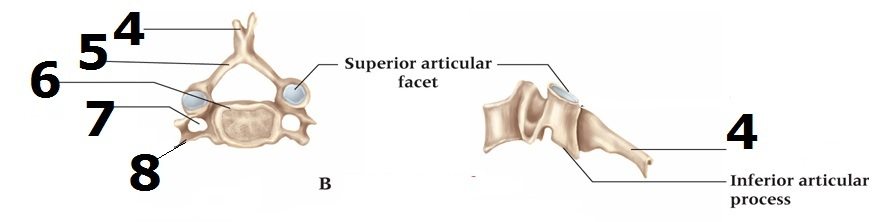
What process is #3?
a)
Spinous
b)
Transverse
c)
Occipital
d)
Vertebral
167.
What process is #4?
a)
Spinous
b)
Transverse
c)
Occipital
d)
Vertebral
168.
What vertebral section is #6?
a)
Cervical
b)
Thoracic
c)
Lumbar
d)
Sacral
169.
What vertebral section is #8?
a)
Thoracic
b)
Lumbar
c)
Sacral
d)
Coccyx
170.
What vertebral section is #9?
a)
Thoracic
b)
Lumbar
c)
Sacral
d)
Coccyx
171.
WHAT IS #7
a)
TRANSVERSE FORAMEN
b)
BODY
c)
TRANSVERSE PROCESS
d)
LAMINA
172.
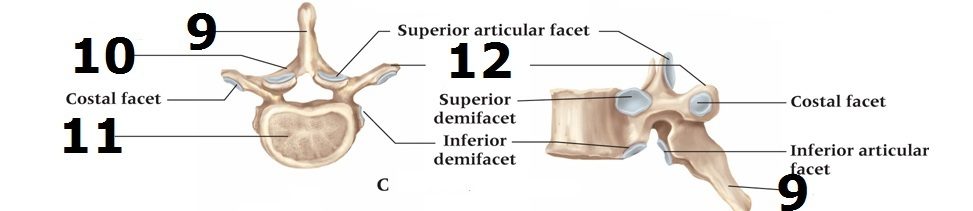
WHAT IS #9
a)
SPINOUS PROCESS
b)
BODY
c)
TRANSVERSE PROCESS
d)
LAMINA
173.
Which bone does the sternal end of the clavicle attach to?
a)
Body
b)
Manubrium
c)
Xiphoid Process
d)
Vertebral Rib 1
174.
How many pairs of true ribs are there? 
a)
12
b)
2
c)
5
d)
7
175.
Inferior portion of the sternum; made of cartilage; cone shaped
a)
coracoid process
b)
acromion process
c)
xiphoid process
d)
scapula
176.

What is number 6? C'mon. EASY!

a)

Pedicle

b)

Body

c)

Transverse Process

d)

Inferior Articular Facet

177.

What is number 3? Bony projection laterally from the vertebra.

a)

Demifacet

b)

Superior Articular Facet

c)

Transverse Process

d)

Lamina

178.
What bone is the name of the bone that is colored?
a)
manubrium
b)
sternum
c)
xiphoid process
179.
What is the name of the part in green?
a)
manubrium
b)
sternum
c)
xiphoid process
d)
body
180.
What is the name of the section in purple?
a)
manubrium
b)
sternum
c)
xiphoid process
d)
body
181.
The bone indicated by #2 is the 
a)
parietal bone
b)
temporal bone
c)
ethmoid bone
d)
occipital bone
182.
The bone indicated by #3 is the 
a)
frontal bone
b)
nasal bone
c)
ethmoid bone
d)
temporal bone
183.
The bone indicated by #4 is the 
a)
frontal bone
b)
nasal bone
c)
ethmoid bone
d)
temporal bone
184.
The bone indicated by #5 is the 
a)
frontal bone
b)
sphenoid bone
c)
ethmoid bone
d)
temporal bone
185.
forms sides and roof of skull; Curved bones; joined together at the sagittal suture
a)
temporal 
b)
parietal 
c)
occipital 
d)
frontal 
186.
thin, flat bones that form the back of the nasal septum 
a)
ethmoid 
b)
lacrimal 
c)
inferior nasal conchae 
d)
vomer
187.
a)
Frontal
b)
Sphenoid
c)
Zygomatic
d)
Maxilla
188.
______ is found at letter A?
a)
Temporal Suture
b)
Sagital Suture
c)
Coronal Suture
d)
Squamous Suture
189.
_____ is found at letter B? 
a)
Tepmoral Bone
b)
Zygomatic Bone
c)
Parietal Bone
d)
Ethmoid Bone
190.
_____ is found at letter C?
a)
Sagital Suture
b)
Coronal Suture
c)
Occipital Suture
d)
Lamboidal Suture
191.
_____ is found at letter F?
a)
Frontal Bone
b)
Occipital Bone
c)
Nasal Bone
d)
Vomer
192.
_____ is found at letter G?
a)
Squamous Suture
b)
Temporal Bone
c)
Parietal Bone
d)
Occipital Bone
193.
The bone indicated by #1 is the 
a)
parietal bone
b)
temporal bone
c)
ethmoid bone
d)
occipital bone
194.
a)
Mandible 
b)
Vomer
c)
Inferior nasal conchae 
d)
Temporal bone
195.
a)
Zycomatic foramen
b)
Zygomattic arch
c)
Zygomatic process
d)
Zygomatic bone
196.
a)
Parietal bone
b)
Coronal suture
c)
Saggital suture
d)
Frontal suture
197.
a)
Styloid process
b)
Mastoid process
c)
Occipital bone
d)
Lacrimal bone
198.
a)
Foramen magnum
b)
Occipital condyle
c)
Mandibular fossa
d)
Hypoglossal canal
199.
a)
Zygoma process
b)
Styloid arch
c)
Zygomatic arch
d)
Zygomatic bone
200.
a)
Sella Turcica
b)
Sela Turcica
c)
Sela Tursica
d)
Sella Turista
201.
_______ can be found at letter C?
a)
Foramen Magnum
b)
Mental Foramen
c)
Mandibular Fossa
d)
Mental Groove
202.
_______ can be found at letter D?
a)
Maxilla
b)
Mandible
c)
Auditory Meatus
d)
Sphenoid Bone
203.
_______ can be found at letter E?
a)
Mandible 
b)
Maxilla
c)
Inferior Nasal Conchae
d)
Vomer
204.
two bones, side-by-side that make up the bridge of the nose; 
a)
sphenoid bones
b)
zygomatic bones 
c)
lacrimal bones 
d)
nasal bones 
205.
a)
Zygomatic
b)
Temporal
c)
Parietal
d)
Lacrimal
206.
a)
Zygomatic
b)
Temporal
c)
Parietal
d)
Occipital 
207.
a)
Zygomatic
b)
Frontal
c)
Parietal
d)
Lacrimal
208.
a)
Zygomatic
b)
Frontal
c)
Nasal
d)
Lacrimal
209.
a)
Zygomatic
b)
Temporal
c)
Parietal
d)
Lacrimal
210.
a)
Zygomatic
b)
Vomer
c)
Ethmoid
d)
Lacrimal
211.
a)
Zygomatic
b)
Vomer
c)
Ethmoid
d)
Lacrimal
212.
a)
Zygomatic
b)
Vomer
c)
Ethmoid
d)
Lacrimal
213.
located on the sides of the head; houses the internal portion of the ear
a)
temporal bone 
b)
occipital bone 
c)
zygomatic bone 
d)
frontal bone 
214.
a)
Clavical
b)
Sacrum
c)
Sternum
d)
Cervical Vertebrae
215.
What is the name of the 2 special cervical vertebrae found in the vertebral column?
a)
Atlas and Dens
b)
Axis and Dens
c)
Pythagorus and Titan
d)
Atlas and Axis
216.
Butterfly shaped bone; houses the pituitary gland; base of the skull
a)
Parietal 
b)
Temporal 
c)
Sphenoid
d)
Occipital 
217.
What part of the bony pelvis articulates with the head of the femur?
a)
Ilium
b)
Acetabulum
c)
Obturator Foramen
d)
Sacrum
218.
What is the cartilage disk called that joins the two pelvic bones in front of the urinary bladder?
a)
Ischial spine
b)
Ischial tuberosity
c)
Intervertebral disks
d)
Pubic Symphysis
219.
Which is the correct list of tarsal bones?
a)
Calcaneous, Talus, Navicular, Cuboid, Cuneiform
b)
Scaphoid, Lunate, Pisiform, Trapezium
c)
Metatarsal, Phalanges, Tibia, Fibula
d)
Sleepy, Dopey, Happy and Grumpy
220.
What bones make up the shoulder girdle? 
a)
Scapula and Clavicle 
b)
Tibia and Fibula 
c)
Carpal and Metacarpal
d)
Deltoid and Scapula 
221.
What bones does the hand consist of? 
a)
Carpal, metacarpal, and phalanges
b)
Tarsal, metatarsal, and phalanges
c)
clavicle, sternum, ribs
d)
Pelvis, illium, and lilac crust. 
222.
a)
metacarpals
b)
phalanges
c)
tarsals
d)
metatarsals
223.
a)
metatarsals
b)
carpals
c)
tarsals
d)
metacarpals
224.

Which of these images is your Tibia bone?

a)
b)
c)
d)
225.

What is the proper name of your "tail bone?"

a)

Pelvis

b)

Calcaneus

c)

Cranium

d)

Coccyx