wayground logo

Free Printable Worksheets

Font size

S
M
L
XL
Worksheets

Physics and Astronomy

Total questions: 100

Worksheet time: 1hrs 11mins

Name
Class
Date
1.

Are you ready for section 1, Astronomy?

a)

Yes!

b)

No!

c)

I'm not sure.

2.

How many planets are there?

a)

Nine, Murcury, Venus, Earth, Mars, Jupiter, Saturn, Uranus, Neptune, Pluto

b)

Eight, Murcury, Venus, Earth, Mars, Jupiter, Saturn, Uranus, Neptune

c)

Millions

d)

Nine,Murcury, Venus, Earth, Moon, Mars, Jupiter, Saturn, Uranus, Neptune

3.

How big is space?

a)

Billions of light years

b)

Trillions of light years

c)

Trillions of parsecs

d)

I don't know

4.

What is the closest star besides our sun?

a)

Alpha Cenuturi, a relativly dim star

b)

Polaris, the north star

c)

Beetljuce, the brightest star in our sky

d)

Beyoncé, the loudest star

5.

In the center of most galaxies are...

a)

Black holes

b)

Super-massive stars

c)

Nebulae

d)

A pit of dark matter

6.

What caused the Big Bang?

a)

Dark Matter

b)

Dark Energy

c)

God

d)

Kevin's Birth

e)

No clue

7.

How far is the nearest star?

a)

Far

b)

Very far

c)

100 lightyears

d)

4.2 lightyears

8.

Where is the most pretigous telescope?

a)

Florence, Italy (Galileo's Telescope)

b)

Mauna Kea, HI

c)

Florence, Italy (Galilei Galileo Telescope)

9.
What color of star is the coolest?
a)
Red
b)
Yellow
c)
Blue
d)
White
10.
What color of star is the hottest?
a)
Blue
b)
Red
c)
Yellow
d)
Orange
11.
What is the name of the largest stars?
a)
Protostars
b)
Supergiants
c)
Red Giants
d)
Dwarf Stars
12.
Why does the sun look small in the sky to us?
a)
It is 93,000,000 miles away
b)
It is smaller than Earth
c)
It is not very bright
d)
It travels around Earth
13.
What is the name of baby stars?
a)
Dwarf
b)
Supergiant
c)
Protostars
d)
Nebulas
14.
What is the name of the gas/dust clouds that form stars?
a)
Nebulas
b)
Protostars 
c)
Supernova
d)
Neutron Star
15.
True or False
Stars are really close together in outer space.
a)
True
b)
False
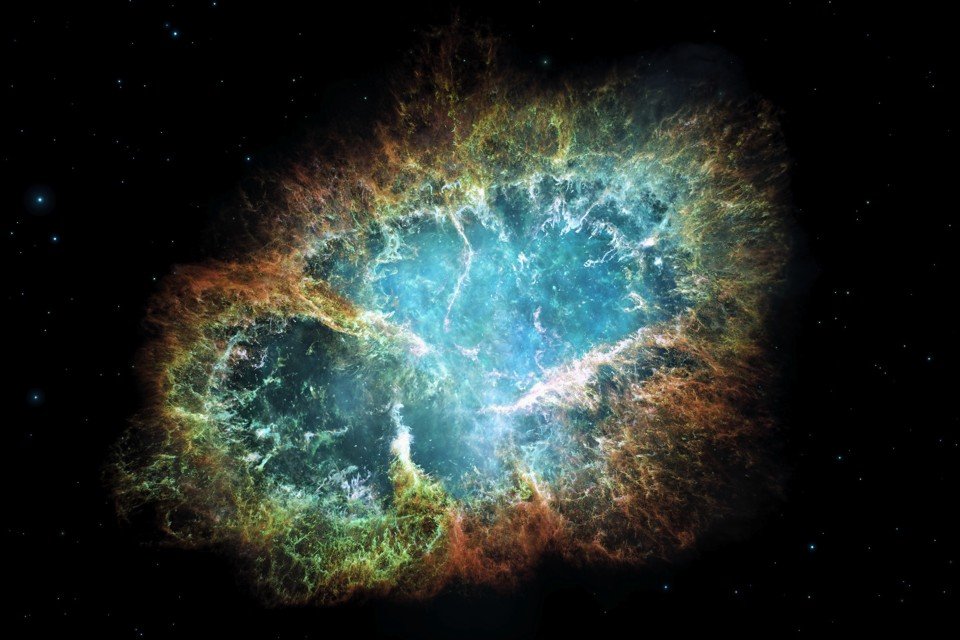
16.
True or False
Constellations are stars that appear to be in a pattern.
a)
True
b)
False
17.
What is the name of the explosion at the death of a massive star?
a)
Supergiant
b)
Supernova
c)
Black Hole
d)
Nebula
18.
The color of the star tells us its 
a)
composition
b)
Temperature
c)
Luminosity 
d)
Mass
19.
What do we use to classify the temperature, brightness, and size of stars?
a)
Color
b)
The star's shape
c)
H-R Diagram
20.
Which measurements allows astronomers to compare the brightness of stars?
a)
parallax
b)
red shift
c)
absolute magnitude
d)
apparent magnitude
21.
A White Dwarf is a
a)
star in its dying stages
b)
recently formed and growing star
c)
star on the main sequence
d)
star that will become a Black Hole
22.
A protostar is a
a)
star in its dying stages
b)
recently formed and growing star
c)
star on the main sequence
d)
star that will become a Black Hole
23.
Our Sun is a
a)
star in its dying stages
b)
recently formed and growing star
c)
star on the main sequence
d)
star that will become a Black Hole
24.
Our Sun will become
a)
a white dwarf, then a red giant
b)
a red giant then a supergiant
c)
a red giant then a black hole
d)
a red giant then a white dwarf
25.
The explosion from a giant star is called
a)
Galactic cannibalism
b)
supernova
c)
nova
d)
neutron explosion
26.
When a massive star explodes it could form a
a)
black hole or neutron star
b)
Seyfert galaxy or black hole
c)
Seyfert galaxy or neutron star
d)
black hole or protostar
27.
Which spectral class comes next? O B A F
a)
O
b)
K
c)
G
d)
M
28.
When two star orbit each other, the larger one is called the
a)
Primary star
b)
Companion star
c)
Secondary star
d)
Protostar
29.
The corona is
a)
glowing hot gasses surrounding the sun
b)
hot gasses on the sun’s surface
c)
hot gasses just beneath the sun’s surface
d)
the hottest gasses at the sun’s core.
30.
The further a star is from Earth, the ____________________ the parallax.
a)
Smaller
b)
Greater
c)
Same as
d)
Parallax
31.
When measuring a stars parallax, the observer views the star’s apparent movement in relation to
a)
West Islip
b)
Itself
c)
Earth
d)
Background stars
32.
The temperature of blue-white star is cooler
a)
true
b)
false
33.

Stars are

a)

small spheres of cold water.

b)

huge spheres of hot gas.

34.

All stars are the same size.

a)

Right.

b)

Wrong.

35.

Stars generate a lot of energy deep in their centers.

a)

Right.

b)

Wrong.

36.

When the energy travels out of a star in the forms of heat and light...

a)

it gives the star its colour.

b)

it gives the star its size.

c)

it gives the star its glow.

37.

The Sun is a star.

a)

Right.

b)

Wrong.

38.

Shooting stars are not stars.

a)

Right.

b)

Wrong.

39.

Shooting stars are...

a)

pieces of wood.

b)

pieces of rock and dust.

c)

balls of fire.

40.

The professional who studies the stars is...

a)

an astronaut.

b)

an astrologer.

c)

an astronomer.

41.

What does the Big Bang theory explain?

a)

the beginning of our solar system

b)

the beginning of the Milky Way galaxy

c)

how the Earth was formed

d)

the beginning of our Universe

42.

How far is 1 AU? (astronomical unit)

a)

90,000,000 miles

b)

93,000,000 kilometers

c)

93,000,000 miles

d)

140,000,000 miles

43.

How far away is the Earth from the Sun?

a)

90,000,000 miles

b)

93,000,000 meters

c)

140,000,000 kilometers

d)

93,000,000 miles

44.

What is a light year?

a)

A light year is how far light can travel in a day

b)

A light year is how far light can travel in miles per hour

c)

A light year is how far light can travel in a year.

45.

What other things are in space besides planets and stars? (more than one applies)

a)

stardust

b)

interstellar medium

c)

nebulae (nebulas)

d)

space junk

e)

comets

46.

A light year is about how many miles?

a)

5.8+ trillion miles

b)

7.5 trillion miles

c)

about 6 billion miles

d)

8.5 trillion miles

47.
Where are stars the most stable?
a)
Supergiant
b)
Main sequence
c)
White dwarf
d)
black dwarf
48.
Which star has the lowest luminosity?
a)
A
b)
B
c)
C
d)
D
49.
Which star has the lowest temperature?
a)
A
b)
B
c)
C
d)
D
50.
What layer of the Sun can we see?
a)
Corona
b)
Photosphere
c)
Chromosphere
d)
Radiative zone
51.

Are you ready to start Physics now?

a)

No.

b)

Seriously?

c)

Umm... I guess.

d)

Yeah!

52.
With unbalanced forces, the object will move in the direction of the _______ force.
a)
larger 
b)
smaller 
c)
equal 
d)
cannot be determined
53.
If there are two forces going in the same direction how would you find the net force?
a)
Subtract
b)
Add
c)
Neither
d)
Multiply
54.
You and your dad are moving the couch from one side to another. Your dad pushes with a force of 35 N to the right and you push with a force of 25 N right. What is the net force on the couch?
a)
60 N right
b)
10 N left
c)
60 N right
d)
50 N left
55.
Which one is balanced?
a)
Top
b)
Bottom
c)
Both
d)
Cannot be determined
56.
Which one is balanced?
a)
Top
b)
Bottom
c)
Both
d)
Cannot be determined
57.
What is the net force?
a)
17 N Right
b)
3 N Right
c)
3 N Left
d)
17 N Left
58.
If a man and woman push each other in opposite directions at both 9 N, what is the net force?
a)
81 N
b)
18 N
c)
1 N
d)
0 N
59.
What is velocity?
a)
the quickness of an object
b)
the location of an object
c)
acceleration
d)
speed in a specific direction
60.
Acceleration is
a)
increasing speed
b)
decreasing speed
c)
changing direction
d)
all of the above
61.
Which type of force(s) will cause a change in an object's motion?
a)
equal forces
b)
zero net force
c)
balanced forces
d)
unbalanced forces
62.
What is the name for a push or pull?
a)
A movement
b)
A force
c)
Speed
d)
Density
63.
What is the name for a push or pull?
a)
A movement
b)
A force
c)
Speed
d)
Density
64.
A ____ force is the sum of forces felt by an object.
a)
sum
b)
net
c)
strong
d)
balanced
65.
Calculate the net force.
a)
5 N
b)
10 N
c)
45 N
d)
500 N
66.
What is speed?
a)
how far you go
b)
how much distance is covered over a period of time
c)
how fast you accelerate
d)
the change in the location of a object
67.
Alan travels 100km in 5hrs. Find his average speed in km/h
a)
5km/hr
b)
10km/hr
c)
50km/hr
d)
20km/hr
68.
What is the net force?
a)
5000 N right
b)
4000 N right
c)
40 N left
d)
4000 N left
69.
If there are two forces going in opposite directions, would you add or subtract them to find the net force?
a)
Add
b)
Subtract
c)
Multiply
d)
Neither
70.
When a car goes around a corner at 20 mph, why do we say it  accelerates?
a)
The car is accelerating because of the velocity is constant
b)
The car accelerates because it's going 20 mph
c)
Cars always accelerate when they are in motion
d)
The car is accelerating because it's changing direction
71.
What does this graph represent?
a)
Constant speed
b)
Acceleration
c)
Not moving
d)
Turning around
72.
What is happening at C?
a)
Stationary
b)
Accelerating
c)
Fast steady speed; moving away from the starting position
d)
Slower steady speed; moving away from the starting position
73.
What is happening at D?
a)
Stationary
b)
Accelerating
c)
Fast steady speed; moving away from the starting position
d)
Slower steady speed; moving away from the starting position
74.
What is happening at B?
a)
Stationary
b)
Accelerating
c)
Slower steady speed; moving away from the starting position
d)
Steady speed; returning to start position
75.
What is happening at A?
a)
Stationary
b)
Accelerating
c)
Slower steady speed; moving away from the starting position
d)
Steady speed; returning to start position
76.
LT4: The graph shows Ashley riding her bike to Maria's house. 
What was occurring from point B to point C?
a)
She was increasing her speed.
b)
She stopped for 4 minutes.
c)
She was decreasing in speed.
d)
She turned around and went home.
77.
What is the net force?
a)
10 N left
b)
10 N right
c)
30 N left
d)
30 N right
78.
Which car is accelerating?
a)
A car that is not moving
b)
A  car that rounds a curve at a constant speed
c)
A car traveling at a constant speed 
d)
A car that has a set speed of 60mph
79.

name one type of collision::

a)

inertia

b)

elastic

c)

plastic

80.

what is inelastic collision?

a)

conserved energy

b)

energy is not conserved

81.

what is an example of elastic collision?

a)

nail in wood

b)

basketball hitting ground

82.

example of inelastic collision:

a)

baseball hitting a ball

b)

jumping in water

c)

a bullet hitting wood

83.

momentum can be transferred from one object to another

a)

true

b)

false

84.

what is the formula for momentum?

a)

p=vm

b)

p=mv

c)

i=mv

85.

when objects collide some momentum is lost:

a)

false

b)

true

86.

a tiny bullet can have more momentum than a huge truck:

a)

false

b)

true

87.

what is the formula for impulse?

a)

F=IT

b)

I=FT

88.

FOR EVERY REACTION THERE IS AN OPPOSITE OR EQUAL REACTION:::

a)

1ST LAW

b)

3RD LAW

89.
Metals are good conductors of electricity because
a)
they contain free electrons
b)
the atoms are lightly packed 
c)
they have high melting point
d)
all of the above
90.
Planets do not twinkle because
a)
they emit light of a constant intensity
b)
Their distance from the earth does not change the  time
c)
They are very far away from the earth resulting in decrease in intensity of light
d)
They are nearer to earth and hemce we recieve a greater amount of light and, therefore minor variations in the intensity are not noticeable
91.
Pa (Pascal) is the unit for
a)
Thrust
b)
Pressure
c)
Frequency
d)
Conductivity
92.
Stars appears to move from east to west because
a)
All stars move from east to west
b)
The earth rotates from west to east
c)
The earth rotates from east to west
d)
The background of the stars moves from west to east
93.
Light from the sun reaches us in nearly
a)
2 minutes
b)
4 minutes
c)
8 minutes
d)
16 minutes
94.
Light year is a unit of
a)
Time
b)
Distance
c)
Light
d)
Intensity of light
95.
Large transformers, when used for some time, become very hot and are cooled by circulating oil. The heating of the transformer is due to
a)
The heating effect of current alone
b)
Hysteresis loss alone
c)
both the heating effect of current and hysteresis loss
d)
intense sunlight at noon
96.
The absorption of ink by blotting paper involves 
a)
Viscosity of ink
b)
Capillary action phenomenon
c)
Diffusion of ink through the blotting
d)
Siphon action
97.
It is easier to roll a stone up a sloping road than to lift it vertical upwards because
a)
work done in rolling is more than in lifting
b)
work done in lifting the stone is equal to rolling it
c)
Work done in both is same but the rate of doing work is less in rolling
d)
work done in rolling a stone is less than in lifting it
98.
When exposed to lower air pressure, the boiling point of water
a)
Decreases
b)
Increases
c)
Remains the same
d)
All of the above
99.
The orbits of the planets around the sun are 
a)
Circular
b)
Horizontal
c)
Elliptical
d)
Diagonal
100.

Isn't Physics so fun?

a)

No way!

b)

Ehhhh...

c)

Lord help me, Yes!

d)

You're not springing another hundred questions on us, are you?