
 Worksheets
Earthquakes and Volcanoes!!!
Total questions: 69
Worksheet time: 2hrs 18mins
Name
Class
Date
1.
What is the shaking of the Earth’s crust caused by a release of energy?
a)
Earthquake
b)
Epicenter
c)
Fault
d)
Plate
2.
What is a break in the lithosphere along which movement in an earthquake has first occurred?
a)
Earthquake
b)
Epicenter
c)
Fault
d)
Focus
3.
Where is the point at which the first movement occurs during an earthquake?
a)
Epicenter
b)
Focus
c)
Fault
d)
Plate
4.
Where is the point on the Earth’s surface directly above the focus of an earthquake?
a)
Epicenter
b)
Fault
c)
Hypocenter
d)
Tremor
5.
Which type of wave is the first to arrive after an earthquake occurs?
a)
P Wave
b)
Rayleigh Wave
c)
S Wave
d)
Shear Wave
6.
Which body waves cause particles of rock material to move at right angles to the direction in which the waves are traveling?
a)
Body Waves
b)
P Waves
c)
S Waves
d)
Surface Waves
7.
What is another term for P Wave?
a)
Compression Wave
b)
Principal Wave
c)
Shear Wave
d)
Secondary Wave
8.
P Waves can move through which of the following?
a)
Gas
b)
Liquid
c)
Solid
d)
All of these
9.
S Waves can move through which of the following?
a)
Gas
b)
Liquid
c)
Solid
d)
All of these
10.
What is an instrument that detects and records waves produced by earthquakes? (This piece of equipment can measure the magnitude of an earthquake.)
a)
Epicenter
b)
Fault
c)
Seismogram
d)
Seismograph
11.
What is the measure of the amount of energy released in an earthquake?
a)
Earthquake
b)
Epicenter
c)
Magnitude
d)
Seismogram
12.
Which scale rates earthquakes based on the amount of damage done?
a)
Mercalli Scale
b)
Richter Scale
c)
Seismogram Scale
d)
Bernoulli Scale
13.
Which scale measures the intensity of the ground movement?
a)
Mercalli Scale
b)
Richter Scale
c)
Seismogram Scale
d)
Bernoulli Scale
14.
What is a smaller earthquake that follows a larger earthquake?
a)
Aftershock
b)
Liquefaction
c)
Seismic Gap
d)
Tsunami
15.
What is a large ocean wave that results from an underwater earthquake, landslide, or volcanic eruption?
a)
Aftershock
b)
Liquefaction
c)
Seismic Gap
d)
Tsunami
16.

The outside layer of the earth is called ______________________.
a)
core
b)
crust
c)
mantle
d)
outer core
17.

The huge pieces of the earth's crust are called ____________________________.
a)
crust
b)
plates
c)
directions
d)
seismos
18.

This famous transform fault is located in the western United States creates significant earthquake activity for California
a)
New Madrid
b)
Denali Fault
c)
Ramapo Seismic Zone
d)
San Andreas
19.
The Richter scale measures:
a)
the amount of radon gas released
b)
the movement of plates
c)
the strength of an earthquake
d)
the weight of tectonic plates
20.
An earthquake scored high on the Richter scale but low on the Mercalli scale. Why?
a)
it probably happened in an area with no people
b)
it was a fast earthquake
c)
because it damaged a lot
d)
impossible to tell
21.
How much bigger is a magnitude 8 earthquake compared to magnitude 7 one on the Richter Scale?
a)
1 time bigger
b)
10 times bigger
c)
100 times bigger
d)
1000 times bigger
22.
The epicenter of an earthquake is
a)
The point below the surface where rock begins to break and the first motion occurs
b)
The seismic station closest to the earthquake
c)
The place where the greatest damage occurs
d)
The point on the surface directly above the focus
23.

Earthquakes happen every day. Most are too small for humans to notice.
a)
True
b)
False
24.

What type of fault is this?
a)
Normal
b)
Reverse
c)
Strike-slip
25.

What type of fault is this?
a)
Normal
b)
Reverse
c)
Strike-slip
26.
where do tsunami's occur?
a)
land
b)
sky
c)
forest
d)
ocean
27.
what causes a tsunami?
a)
plates collide underground
b)
a large gust of wind
c)
ocean animals
d)
ocean currents
28.
Plates move
a)
true
b)
false
29.
Tsunamis can be different sizes and strengths
a)
true
b)
false
30.
What leaks from the earth's core and goes into the earth's mantles to cause a shift in the plates?
a)
hot lava
b)
cold water
31.

What is the definition of dormant?
a)
sleeping
b)
extinct
c)
active
d)
invisible
32.

What are scientists that study volcanoes called?
a)
doctor
b)
vet
c)
volcanologist
d)
volcano scientist
33.

What is the opening that extends from the magma chamber to the top of the volcano called?
a)
magma
b)
lava
c)
vent
d)
crater
34.

What is Magma when it reaches the surface of Earth?
a)
Lava
b)
Mafic Magma
c)
Felsic Magma
d)
None of these
35.

A volcano that has gentle sloping sides and is formed from runny lava
a)
Shield volcano
b)
Cinder cone
c)
Composite
d)
None of these
36.
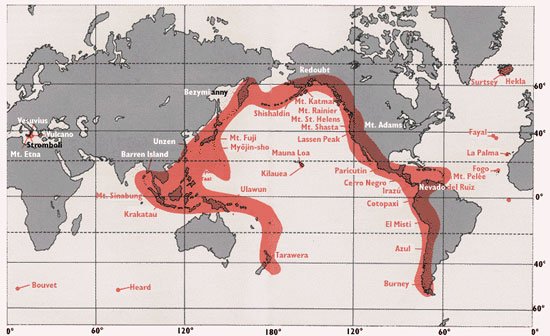
This is the name for the chain of volcanos around the edge of the Pacific Plate.
a)
Circle of Fire
b)
Ring of Lava
c)
Ring of Fire
d)
Circle of Magma
37.

A volcano that has steep sides and is formed from lava chunks is called
a)
a shield volcano
b)
a cinder cone volcano
c)
a composite volcano
38.

A volcano that is made from layers of both runny lava and lava chunks is called
a)
a shield volcano
b)
a cinder cone volcano
c)
a composite volcano
39.

Dormant volcanoes might erupt in the future.
a)
True
b)
False
40.

This city was destroyed in 79 A.D. by the eruption of Mt. Vesuvius.
a)
Rome
b)
Munich
c)
Pompeii
d)
Naples
41.

Volcanoes are found...
a)
on land
b)
under water
c)
on islands
d)
all of the above
42.
The volcanoes on the Hawaiian Islands form due to which of the following?
a)
Divergent Boundary
b)
Hot Spot
c)
Subduction Boundary
d)
Transform Boundary
43.
What do you call a large crater formed by the collapse of a volcano?
a)
Caldera
b)
Cinder Cone
c)
Composite Volcano
d)
Shield Volcano
44.
Where do volcanoes come from?
a)
Places where plates move apart
b)
Places where plates are moving together
c)
Hot Spots
d)
All of these options
45.

What is the vent of a volcano?
a)
magma chamber
b)
magma flow
c)
opening at surface
46.

What is a collapsed volcano called?
a)
dike
b)
neck
c)
crater
d)
caldera
47.
What was the name given to all the continents when they were joined as one super continent?
a)
Supreme Continent
b)
Eurasia
c)
Plate tectonics
d)
Pangea
48.
This layer of Earth is the thickest part
a)
crust
b)
outer core
c)
mantle
d)
inner core
49.
Which of these layers is ALL solid iron and nickle?
a)
inner core
b)
outer core
c)
lithosphere
d)
mesosphere
50.
Which of the following occurs because of convection currents?
a)
Tectonic plates on the crust move.
b)
The mantle increases in size.
c)
Pressure in the crust increases.
d)
Pressure in the crust decreases.
51.
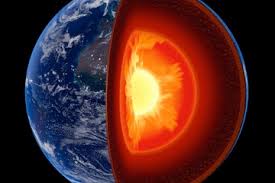
As you travel from the inner core to the crust, how would temperature, pressure and density of the material change?
a)
The would all increase
b)
The would all decrease.
c)
They would stay the same.
d)
Temperature would decrease, but pressure and density would increase.
52.
Where does the heat come from that drives this convection current in the mantle?
a)
The sun
b)
The crust
c)
the mantle
d)
the core
53.
What does the theory of continental drift state?
a)
The continents were once joined in a super-continent and have moved over time
b)
Continents are stationary and do not move
c)
The Earth is broken into lithospheric plates that move due to convection currents
d)
none of the above
54.
This land formation occurs at a divergent continental/ continental boundary.
a)
mid ocean ridge
b)
deep ocean trench
c)
pacific hot spot
d)
rift valley
55.
Mountains form from ...
a)
plates sliding past one another
b)
collision of plates
c)
plates moving away from each other
56.
Earth's plates are...
a)
constantly moving and changing the face of the earth
b)
Never moves
c)
Moves seldom and very fast
d)
Moves when it feels like it
57.
Pressure ______________________ as you go deeper into the Earth
a)
increases
b)
decreases
c)
goes up or down depending on the layer
d)
stays the same
58.
What are the two types of crust?
a)
top crust,bottom crust
b)
oceanic crust, continental crust
c)
water,land
d)
none of the above
59.
At what zone does a volcano form?
a)
Transforming
b)
Divergent
c)
Convergent
d)
Subduction
60.
What type of rock is made when lava cools?
a)
Sedimentary
b)
Igneous
c)
Metamorphic
d)
Quartz
61.
Sediments have to be ________ together to form sedimentary rocks
a)
Squeezed
b)
Melted
c)
Mixed
d)
Compacted
62.
What are layers of rock broken down into?
a)
Igneous Rocks
b)
Sediments
c)
Crystals
d)
Lava
63.
Continental Glaciers are found
a)
at the tops of mountains
b)
only in Florida
c)
Pompton Lakes
d)
at the poles
64.
What's the name for a fear of snow?
a)
Chionophobia
b)
Snowphobia
c)
Nevephobia
65.
What colour are snowflakes?
a)
White
b)
Yellow
c)
Transparent
66.

Who is Olaf?
a)
A lumberjack
b)
A Snowman
c)
A Snow Angel
d)
A Wendigo
67.

Who is Elsa's sister?
a)
John Cena
b)
Daisy
c)
Anna
d)
Hans
68.

What is the name of the reindeer?
a)
Sven
b)
Sben
c)
Svhen
d)
Sveen
69.

What happend to Elsa?
a)
She cant control her ice power.
b)
Everything she touches turns to gold.
c)
She is allergic to kissing boys.
d)
She dies again.
100 %

