
 Worksheets
AP Bio Module 14: Enzymes
Total questions: 37
Worksheet time: 52mins


Enzymes act by
providing energy to a chemical reaction
removing energy from a chemical reaction
lowering the amount of energy needed for a chemical reaction
eliminating the need for energy in a chemical reaction
Fireflies emit light. The production of light by an organism is called bioluminescence. To generate visible light, cells in a firefly’s tail produce thousands of luciferase enzymes. Luciferase binds to a chemical called luciferin. Once bound, the luciferase enzyme speeds up a chemical reaction that combines an oxygen molecule and luciferin to produce oxyluciferin. This reaction requires energy and releases light. Which of the following best describes how the luciferase enzyme speeds up the chemical reaction?
Luciferase increases the amount of time the light is visible.
Luciferase decreases the amount of energy required for the reaction to start.
Luciferase increases the number of sites on luciferin that must bind to oxygen.
Luciferase decreases the temperature of the environment inside the body of the firefly.
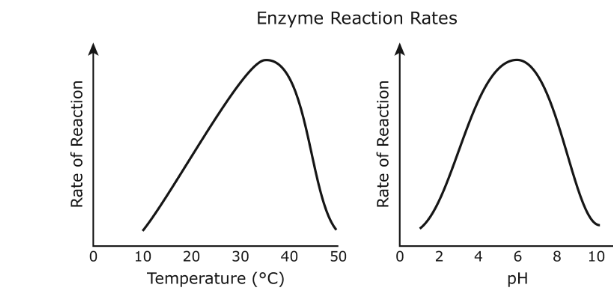
The graphs show the reaction rate for an enzyme across a range of temperatures and pH.
Based on these data, this enzyme functions best as what temperature and pH?
Temperature of 27oC and a pH of 4
Temperature of 37oC and a pH of 6
Temperature of 40oC and a pH of 8
Temperature of 50oC and a pH of 10

Pepsin and trypsin are two of the digestive enzymes that break down protein. A group of students studied the pH requirements of these enzymes. The graph below shows the results.
The students found that pepsin functions best in an acid environment and trypsin functions best in a neutral environment. Based on their observations, pepsin most likely aids in digestion in which part of the human body?
Pancreas
Intestines
Mouth
Stomach

The diagram represents one way an enzyme can be inhibited.
Which statement explains the effect of an inhibitor on an enzyme?
A substrate will be able to bond with the enzyme.
The enzyme will likely be attacked by immune cells.
The enzyme will be unable to produce more enzymes.
A substrate will be unable to attach to the enzyme.
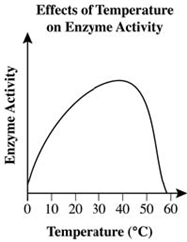
Based on the graph above, at what temperature range is enzyme activity at its greatest?
15-25 ºC
25-35 ºC
35-45 ºC
45-55 ºC
When a piece of liver is dropped into hydrogen peroxide, the peroxide will form bubbles vigorously as a result of what reaction?
Peroxide destroying the bacteria in the liver.
Additional peroxide created by the liver once the initial peroxide is added.
Bacteria cells exploding as peroxide dissolves their cell membranes.
Liver cells decomposing to produce carbon dioxide.
Peroxide being broken into water and oxygen.
What happens to the rate of reaction in a test tube when a competitive inhibitor is added?
The reaction speeds up because the competitive inhibitor helps the enzyme
The reaction rate speeds up because the enzyme’s shape is changed
There is no impact on the reaction rate because the inhibitor is competitive
The reaction slows down because the enzyme’s shape is changed
The reaction slows down because the competitive inhibitor binds to the enzyme
If nerve gasses are inhaled, they will temporarily bind to an area on many enzymes that will change the shape of the enzyme. This prevents the enzymes from interacting with other substances and interferes in proper nervous system functioning resulting in death. The nerve gas is an example of a(n):
Substrate
Activation Inhibitor
Production Inhibitor
Competitive Inhibitor
Non-competitive Inhibitor

The change in shape between structures 1 and 2 below can best be described as the:
Lock & Key Model
Induced Fit Model
Latch & Key Model
Molding Model
Optimal Fit Model
Net release of energy
endergonic
exergonic
Net intake of energy
endergonic
exergonic

What number represents the activation energy?
1
2
3
What number represents the change in free energy of the reactions?
1
2
3
This reaction is
endergonic
exergonic
Endergonic reactions are _____________; exergonic reactions are ____________
non-spontaneous; spontaneous
spontaneous; non-spontaneous
spontaneous; spontaneous
non-spontaneous; non-spontaneous
All enzymes have...
a specific substrate in which they act upon
an optimum temperature
an optimum ph
all of the above
Where is energy stored in ATP?
in the bonds between phosphate
in oxygen
in sugar
in nitrogenous base
A + B --> AB + Energy
This is what type of reaction?
exergonic
endergonic
Which molecule has the highest potential energy?
ATP
ADP
AMP

