wayground logo

Free Printable Worksheets

Font size

S
M
L
XL
Worksheets

Midterm Review Africa

Total questions: 81

Worksheet time: 1hrs 20mins

Name
Class
Date
1.
What country is highlighted?
a)
Uganda
b)
Tanzania
c)
Congo
d)
Kenya
2.
What country is highlighted?
a)
Zambia
b)
Cameroon
c)
Republic of the Congo
d)
Democratic Republic of Congo
3.
What country is highlighted?
a)
Liberia
b)
Egypt
c)
Morocco
d)
Botswana
4.
What country is highlighted?
a)
Madagascar
b)
Uganda
c)
Botswana
d)
Nigeria
5.
What physical feature is highlighted?
a)
Zambezi River
b)
Congo Basin
c)
Sahara Desert
d)
Nile River
6.
What physical feature is highlighted?
a)
Congo River
b)
Lake Chad
c)
Mt. Kilimanjaro
d)
Sahel
7.
What physical feature is highlighted?
a)
Kalahari Desert
b)
Lake Victoria
c)
Sahara Desert
d)
Cape of Good Hope
8.
What physical feature is highlighted?
a)
Ethiopian Highlands
b)
Mt. Kilimanjaro
c)
Niger River
d)
Atlas Mountains
9.
What physical feature is highlighted?
a)
Kalahari Desert
b)
Sahara Desert
c)
Niger River
d)
Lake Victoria
10.
What physical feature is highlighted?
a)
Congo Basin
b)
Lake Chad
c)
Mt. Kilimanjaro
d)
Sahel
11.
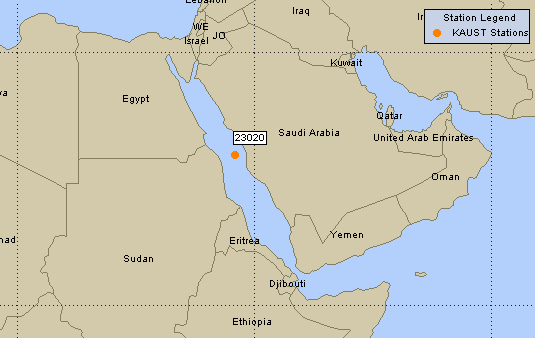
What body of water is shown on the map? It is narrow and separates Africa from the Arabian peninsula (Asia).
a)
Straits of Comoros
b)
Red Sea
c)
Dead Sea
d)
Mediterranean Sea
12.
What is located at number 14 (click on the words to see the map and ZOOM IN!)?
a)
Madagascar
b)
Indian Ocean
c)
Atlantic Ocean
d)
Pacific Ocean
13.
What physical feature is highlighted?
a)
the Atlas Mountains
b)
the Great Rift Valley
c)
the Congo Rainforest
d)
the Horn of Africa
14.
Which part of Africa are you most likely to find the Sahara desert?
a)
East
b)
South
c)
Central
d)
North
15.
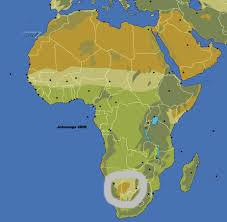
What is the name of the desert represented by the red oval?
a)
Sahara Desert
b)
Namib Desert
c)
Kalahari Desert
d)
Mohave Desert
16.
What is the name of the country that is colored orange?
a)
Namibia
b)
Zambia
c)
Botswana
d)
South Africa
17.
What country is highlighted?
a)
Sudan
b)
Nigeria
c)
Democratic Republic of Congo
d)
Gabon
18.
The shaded area of the map represents which physical feature of Africa?
a)
Sahara
b)
Sahel
c)
Rainforest
d)
Kalahari Desert
19.
What physical feature is highlighted on the map?
a)
Mt. Kilimanjaro
b)
Congo River
c)
Atlas Mountains
d)
Niger River
20.
What physical feature is highlighted?
a)
Red Sea
b)
Nile River
c)
Salt Sea
d)
Mediterranean Sea
21.
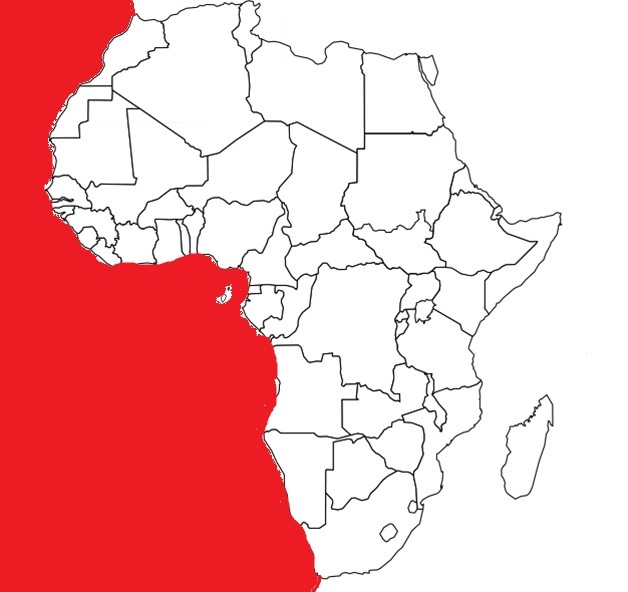
What landform is shaded red in the image? 
a)
Mediterranean Sea
b)
Atlantic Ocean
c)
Indian Ocean
d)
Red Sea
22.
What country is highlighted?
a)
Sudan
b)
South Sudan
c)
Egypt
d)
South Africa
23.
What type of biome is located at number 3?
a)
Sahara
b)
Sahel
c)
Savanna
d)
Rainforest
24.

What physical feature is the arrow pointing to?

a)

Atlas Mountains

b)

Mount Kilimanjaro

c)

Kalahari Desert

d)

Red Sea

25.
The way that the Bantu-speaking peoples spread their culture throughout Africa is an example of —
a)
cultural diversity
b)
cultural borrowing.
c)
cultural traits
d)
cultural diffusion
26.
In 1923, there was only one ethnic minority represented in the British Parliament, a man of Indian descent. As of 2010, there are 19 members from India, Pakistan, Africa, and the Middle East. Which of the following conclusions can be drawn from the above facts?
a)
Multicultural government will soon replace the monarchy in Britain.
b)
The British colonial system still has great influence in that country.
c)
Britain's government represents everyone fairly.
d)
Britain's government has become increasingly multicultural.
27.
Which of the following was a South African anti-apartheid leader and politician who served as president of South Africa from 1994 to 1999?
a)
Nelson Mandela
b)
Margaret Thatcher
c)
Fidel Castro
d)
Golda Meir
28.
Which of the following was a South African anti-apartheid leader and politician who served as president of South Africa from 1994 to 1999?
a)
Nelson Mandela
b)
Margaret Thatcher
c)
Fidel Castro
d)
Golda Meir
29.
Until 1994, South Africa was an apartheid state. Apartheid is an Afrikaans word meaning "apartness" or "separateness." Under Apartheid, black and Asian South Africans had fewer freedoms and rights than white South Africans. Apartheid South Africa was LEAST similar to —
a)
the treatment of American colonists by the English monarchy.
b)
the treatment of the Hutu by the Tutsi during the Belgian rule of Rwanda.
c)
the treatment of Jews in Nazi Germany.
d)
the treatment of African Americans in the Jim Crow era American South
30.
Many conflicts in Sub-Saharan Africa resulted from the way the European colonists —
a)
mined the region for resources
b)
educated different ethnic groups
c)
distributed farm land amongst the settlers
d)
established boundary lines between nations
31.
In what way did European colonization of Sub-Saharan Africa affect economic development in the region?
a)
Most economies primarily export natural resources.
b)
Command economies became a common institution.
c)
Traditional economies were encouraged to continue.
d)
Industrial economies were established in most nations.
32.
English and French have become common languages spoken in Sub-Saharan Africa because of —
a)
a history of European colonization in the region
b)
the migration of many missionaries to the region
c)
a tradition of learning multiple languages in the region
d)
an established system of Christian schools in the region
33.
African folktales reflect traditional Sub-Saharan Africa culture because they have been —
a)
carved in stone monuments for all to see
b)
recreated by moviemakers and playwrights
c)
preserved in African libraries for centuries
d)
passed on orally from generation to generation
34.
Many nations in the world established trade relationships with countries in Southwest Asia and North Africa because of the —
a)
growth in the population of the world
b)
increasing demand for oil in the world
c)
lack of water resources in Southwest Asia and North Africa
d)
decrease in agricultural outputs in Southwest Asia and North Africa
35.
How has the history of Sub-Saharan Africa contributed to political instability in some nations of the region?
a)
The devastation of the Second World War has left some nations struggling to recover. 
b)
The end of foreign aid to the region is leaving many without proper food and medicine.
c)
The end of European colonization left some nations struggling to form effective governments.
d)
The migration of the Bantu-speaking people across national boundaries has caused a clash of cultures.
36.
Which major geographic factor dominates nations in the region of North Africa?
a)
A huge fresh water sea
b)
A set of high mountains
c)
A system of large canyons
d)
A collection of vast deserts
37.
How has the distribution of natural resources in Southwest Asia and North Africa affected economic patterns in the region?
a)
A growing lumber industry has developed in the region
b)
The region is home to many factories producing exports.
c)
A majority of the people living in the region work in diamond mines.
d)
Some nations in the region have significant wealth from the sale of oil.
38.

the percentage of people who can READ

a)

ethnic group

b)

literacy rate

c)

medicinal plant

39.

a GROUP of people who share a common culture, language and sometimes racial heritage

a)

ethnic group

b)

literacy rate

c)

medicinal plant

40.

stories shared verbally from one generation to another

a)

oral tradition

b)

reserve

41.

A religion deeply rooted in the Ashanti culture that teaches that plants and animals have souls and should be respected. they also believe in witches and forest monsters.

a)

Bantu Migration

b)

Akan Religion

c)

islam

d)

Amulets

42.

Characteristics include Creation stories Kings are seen as gods, ancestor worship, rituals including art, music, fire, dance, food, drink, charms and amulets.

a)

Traditional Religion

b)

Relic worship

c)

Amulets

d)

Islam

43.

Live mostly in northern Africa and speak Arabic and most practice Islam.

a)

Jews

b)

Arabs

c)

Bantu

d)

Ashanti

44.

This group of people believe in animism and the Golden Stool, found mostly in Ghana, West Africa, and speak 'Asante', or 'Twi'.

a)

Ashanti

b)

Bantu

c)

Muslims

d)

Swahili

45.

The belief that natural physical entities, including animals, plants, and features of the earth, have a spiritual essence.

a)

Spiritualism

b)

Amulet

c)

Judaism

d)

Animism

46.

This group of people in Africa are made up of 400 ethnic groups found throughout central and southern parts of the continent, mostly practice Islam, but some practice Christianity or animism.

a)

Ashanti

b)

Bantu

c)

Muslims

d)

South Africans

47.

this people group mostly inhabit the southern coast of East Africa, in Kenya, Tanzania, & Mozambique. Practice mostly Islam. Name means "one who lives on the coast".

a)

Ashanti

b)

Swahili

c)

Bantu

d)

Hulu

48.

This is one of the largest movements of people in Africa's history and intermingled and accepted other traditions and cultures.

a)

The Journey of the Swahili

b)

The Great Rift Valley

c)

African Native Movement

d)

Bantu Migration

49.

Most African cultures practice this religion.

a)

Judaism

b)

Christianity

c)

Shintoism

d)

Islam

50.

a group of people who share a belief system. They believe in the same god (or gods) and have a common sacred text with a specific set of rules about how to live.

a)

religious group

b)

ethnic group

c)

polytheistic

d)

monotheistic

51.

the belief in or worship of one God.

a)

religious group

b)

ethnic group

c)

polytheistic

d)

monotheistic

52.

the belief in or worship of more than one god.

a)

religious group

b)

ethnic group

c)

polytheistic

d)

monotheistic

53.

live mostly in northern Africa, speak Arabic and most practice Islam.

a)

Ashanti

b)

Arabs

c)

Swahili

d)

Bantu

54.

inhabit the southern coast of East Africa, in Kenya, Tanzania, & Mozambique; practice mostly Islam and their name means "one who lives on the coast".

a)

Ashanti

b)

Arabs

c)

Swahili

d)

Bantu

55.

made up of 400 ethnic groups found throughout central and southern parts of the continent; mostly practice Islam, but some practice Christianity or animism.

a)

Ashanti

b)

Arabs

c)

Swahili

d)

Bantu

56.

one of the largest movements of people in Africa's history; they intermingled and accepted other traditions and cultures.

a)

Islam

b)

Bantu Migration

c)

Akan religion

d)

traditional religion

57.

the belief that natural physical entities, including animals, plants, and features of the earth, have a spiritual essence.

a)

Islam

b)

animism

c)

Akan religion

d)

traditional religion

58.

Most African cultures practice this religion.

a)

Islam

b)

animism

c)

Akan religion

d)

traditional religion

59.

language of Arab culture and necessary in order to practice Islam.

a)

Ashanti

b)

Swahili

c)

Arabic

d)

Bantu

60.
Type of government in which the power to govern is held by one person
a)
Autocracy
b)
Democracy
c)
Presidential Democracy
d)
Judaism
61.
Type of government in which the people (citizens) have the highest level of citizen participation.
a)
Democracy
b)
Autocracy
c)
Dictatorship
d)
Pan Africanism
62.
In this type of government, citizens have little to no citizen participation.
a)
Autocracy
b)
Democracy
c)
Presidential Democracy
d)
Judaism
63.
In this type of Democracy, voters elect legislators through a popular vote.  Voters also elect the leader who is both chief of state and head of government.
a)
Presidential Democracy
b)
Parliamentary Democracy
c)
Autocracy
d)
Autocratic Democracy
64.
In this type of Democracy, voters elect members to the Parliament (legislature), which is the lawmaking body of the government. Then, the legislature selects the Head of Government (Prime Minister)
a)
Parliamentary Democracy
b)
Presidential Democracy
c)
Autocracy
d)
Autocratic Democracy
65.
In South Africa, citizens elect members to the National Assembly (house of Parliament), then parliament selects one of its members to be the president.  South Africa has what type of government?
a)
Parliamentary Democracy
b)
Presidential Democracy
c)
Dictatorship
d)
Communist
66.
Citizens directly vote for the President in Kenya.  Therefore, Kenya has a _________________________.
a)
Presidential Democracy
b)
Parliamentary Democracy
c)
Autocracy
d)
Communist Government
67.
Which BEST describes the two predominant forms of a democratic government?
a)
dictatorship and autocratic
b)
presidential and dictatorship
c)
presidential and prime minister
d)
parliamentary and presidential
68.
How is the president of South Africa chosen?
a)
He is appointed by the king.
b)
He is elected by the National Assembly.
c)
He is chosen by the country's religious leaders.
d)
He is identified by the people in a national election.
69.
Kenya & Nigeria: Presidential Democracy :: South Africa: _______________.
a)
Absolute Monarchy
b)
Federal Republic
c)
Constitutional Monarchy
d)
Parliamentary Democracy
70.
How are Nigeria and Kenya similar?
a)
both autocracies
b)
both parliamentary democracies
c)
both presidential democracies
d)
citizens can only vote for legislature
71.
Which statement is TRUE for Kenya, South Africa and Nigeria?
a)
Vote for legislature
b)
Presidential democracies
c)
Vote for executive
d)
All of the above
72.
Things that were not made by humans and are found in nature
a)
natural resources
b)
human resources
c)
capital resources
d)
services
73.
What is the person who comes up with an idea for a good or service?
a)
A Creator
b)
Good
c)
Smart
d)
Entrepenuer
74.
In the economy of the Bushmen of the Kalahari Desert the people follow the examples of their ancestors.  This is what kind of economy? 
a)
Traditional 
b)
Market 
c)
Command 
d)
Centrally planned 
75.
The Country of North Korea has a dictator that makes all of the economic decisions. What type of economy is this?
a)
Traditional 
b)
Market 
c)
Command 
d)
Centrally Planned 
76.
The government controls the factors of production in which type of economic system
a)
Command
b)
Mixed
c)
Market
d)
Traditional
77.
What type of economic system allows private businesses to decide what to produce, how to produce and for whom to produce?
a)
Market
b)
Mixed
c)
Command
d)
Traditional
78.
What term describes the tools and technology used to make a product?
a)
capital goods
b)
human capital
c)
exports
d)
imports
79.
In 2010, Mexico imposed a limit of 250,000 tons of sugar that could be imported into Mexico.
a)
Tariff
b)
Quota
c)
Embargo
80.
In 1962, the United States prohibited all imports and exports to and from Cuba.
a)
Tariff
b)
Embargo
c)
Quota
81.
Company XYZ produces cheese in Scotland and exports the cheese, which costs $100 per pound, to the U.S.  A 20% tax would require company XYZ to pay the United States government $20 to export the cheese
a)
Tariff
b)
Embargo
c)
Quota