Wayground logo

Free Printable Worksheets

Font size

S
M
L
XL
Worksheets

Earth Diversity and History Benchmark Review

Total questions: 60

Worksheet time: 58mins

Name
Class
Date
1.
People who study fossils are called ____.
a)
meterologists
b)
fossilologists
c)
paleontologists
d)
fossil hunters
2.
In which kind of rock do we usually find a fossil?
a)
sedimentary  rock
b)
metamorphic rock
c)
igneous rock
3.
What happens when a group of animals become extinct?
a)
All of its members have died.
b)
Only a few of its members are still living.
c)
The animals can no longer lay eggs.
d)
All of its members move to another place.
4.
I found a fossil that looked like footprints. What kind of fossil did I most likely find?
a)
Cast
b)
Trace
c)
Mold
d)
Igneous
5.
Which type of fossil would look exactly like an actual body part of a once living thing?
a)
A mineral
b)
A trace
c)
A cast
d)
A footprint
6.
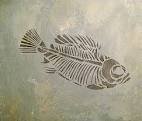
If scientists found this fossil, what could they infer?
a)
what fish are like today
b)
that this fish lacked oxygen
c)
what kind of animal ate this fish
d)
that water once covered the area
7.
Which of the following is NOT something you could learn from a fossil?
a)
The size of the animal
b)
What the animal ate
c)
The color of the animal
d)
Where the animal lived
8.
A fossil is ____.
a)
a dead rotten animal
b)
the remains of things that lived a long, long time ago
c)
a plant that dried up
9.
How are fossils created?
a)
Traces of organisms get turned into stone.
b)
Dead organisms are quickly buried for millions of years.
c)
Animals get trapped.
d)
All of the above
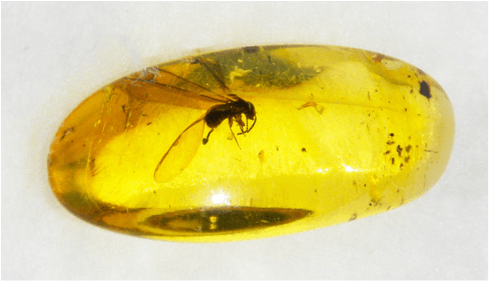
10.
this material does an excellent job of preserving insect remains
a)
cast
b)
amber
c)
mold
d)
carbon film
11.

Jacob has one older brother and one younger sister. He wants to explain relative dating to them using their ages as an example. Which statement describes their ages using relative dating?

a)

Their ages are 14, 12, and 9.

b)

They are all about the same age.

c)

The boys have different ages from the girl.

d)

Jacob is younger than his brother but older than his sister.

12.

Which method of finding the relative age of rocks do scientists often use?

a)

Igneous rock is older than nearby sedimentary rock, which is older than nearby metamorphic rock.

b)

A sedimentary rock layer in its original position is older than the layers above it and younger than the layers below it.

c)

Metamorphic rock is older than nearby sedimentary rock because sedimentary rock is deposited before metamorphic rock forms.

d)

The exact age of a sedimentary rock layer can be found using the layers above and below it, even if the layers are not in their original positions.

13.

Which statement best describes an index fossil?

a)

a fossil of an animal captured in ice

b)

a fossil of an insect captured in amber

c)

a fossil used to establish the absolute age of a rock layer

d)

a fossil formed in soft sediment by the movement of an animal

14.

In which time period are we currently living?

a)

Precambrian time

b)

Paleozoic Era

c)

Mesozoic Era

d)

Cenozoic Era

15.

Dinosaurs, small mammals, and birds are found in this time period.

a)

Precambrian Time

b)

Paleozoic Era

c)

Mesozoic Era

d)

Cenozoic Era

16.

Which time period is the longest?

a)

Precambrian Time

b)

Paleozoic Era

c)

Mesozoic Era

d)

Cenozoic Era

17.

What are the four characteristics of index fossils

a)

Easily recognizable

b)

Abundant

c)

Wide geographic distribution

d)

Live a long time

e)

Live a short time

18.

Which rock layer is the oldest?

a)

A

b)

B

c)

C

d)

D

19.

Scientist use absolute and relative dating of rocks and fossils and the fossil record to determine the age of the earth.

a)

True

b)

False

20.

Saying that you are younger than your sibling is an example of

a)

relative age

b)

absolute age

21.

If the same index fossils are found in different rock strata miles apart, what is probably true about the rock layers?

a)

The rocks are probably the same age.

b)

The age of the index fossil is 8 days old

c)

The rock layer is made of granite

d)

The rock layer is siltstone

22.

Which fossil would make the best index fossil?

a)

Beetle

b)

Flower

c)

Frog

d)

Fish

23.
Which of the following correctly lists the layers of rock in order from youngest to oldest?
a)
A, B, C, D, E
b)
B, C, D, E, A
c)
E, D, A, B, C
d)
C, B, A, D, E
24.
Which period are we currently in?
a)
Quaternary
b)
Holocene
c)
Jurassic
d)
Tertiary
25.
The geologic time scale is a record of....
a)
the history of fossils only
b)
the history of rocks
c)
the history of rock layers and fossils
d)
geologist notes
26.
According to the law of superposition, the oldest fossils are found 
a)
At the top of the rock layers
b)
Near the bottom of the rock layers
c)
In the middle of the rock layers
d)
Somewhat near the surface
27.

when minerals replace the remains and they become rock; things like wood.

a)

Petrified

b)

Mold

c)

Cast

d)

Index

e)

Trace Fossil

28.

when the shell remains and the contents dissolve

a)

Petrified

b)

Mold

c)

Cast

d)

Index

e)

Trace Fossil

29.

Uses radioactive elements near the fossils to determine the actual age of the fossils.

a)

Relative Dating

b)

Absolute Dating

30.
A bug stuck in amber is an example of what type of fossil?
a)
cast
b)
mold
c)
trace
d)
preserved remains
31.
The fossil record shows that life on Earth has changed over time.  For example, paleontologists have found that older rocks contain fossils of
a)
organisms that are more complex than those alive today
b)
both simple and complex organisms
c)
only organisms that are alive today
d)
organisms that are simpler than those alive today
32.
What do most scientists think caused the mass extinction of dinosaurs and other organisms at the end of the Cretaceous period?
a)
an object from space struck Earth
b)
volcanic eruptions covered large areas with lava
c)
an ice age covered most of Earth with ice
d)
The dinosaurs ate too many other organisms and then starved
33.
An inherited trait that helps those organisms that have it to survive
a)
niche
b)
structure
c)
characteristic
d)
adaptation
34.
Coloring or another physical characteristic that help an organism blend in with its environment
a)
mimicry
b)
camouflage
c)
hibernation
d)
migration
35.
When an organism copies a characteristic of something else in order to better its chances for survival and reproduction
a)
hibernation
b)
camouflage
c)
mimicry
d)
migration
36.
The seasonal movement of an organism from one place to another
a)
camouflage
b)
migration
c)
hibernation
d)
function
37.
When an organism slows its life functions for a period of time to better its chances for survival during harsh conditions
a)
camouflage
b)
migration
c)
mimicry
d)
hibernation
38.
The place or environment where an organism naturally lives
a)
function
b)
habitat
c)
community
d)
ecosystem
39.
A group of organisms which are similar to each other and can combine to have offspring
a)
species
b)
characteristic
c)
club
d)
organisms
40.
A giraffe has a long neck in order to better reach leaves to eat.  This is an example of _____. 
a)
an adaptation
b)
environment
c)
response
d)
stimulus
41.
Which of the following is a physical adaptation for the underlined animal?
a)
A butterfly has bright colors to warn predators that it is poisonous.
b)
A hognose snake rolls over, slows its breathing, and hangs its tongue out to play dead.
c)
A herd of buffalo encircle their young to protect them from a pack of wolves.
d)
A dung beetle rolls a piece of dung across the desert.
42.
Which adaptation (for the underlined animal) serves the function of defense?
a)
A walking stick looks like the twig on which it rests.
b)
A porcupine’s quills cause a predator to seek another meal.
c)
A whale filters plankton and krill from the water in which it swims.
d)
A penguin is dark on top and white below to blend in with the water.
43.
How do adaptations help animals?
a)
To escape animals
b)
to hunt for food
c)
to survive in their habitats
d)
All of these are correct
44.
 A giraffe has a long neck.  Why would the giraffe need this adaptation?
a)
to keep warm
b)
to reach food high above the ground
c)
to have room to eat more
d)
to catch birds
45.
A Porcupine has sharp quills.  Why would a porcupine need this adaptation?
a)
to protect itself
b)
to keep warm
c)
to kill its prey
d)
to cover its skin
46.
Behavioral changes of individuals of a species that allow for better survival. (Acquired traits)
a)
Variation
b)
Adaptation
c)
Behavior
d)
Environment
47.
When every organism of a species has died.
a)
Evolution
b)
Natural Selection
c)
Extinction
d)
Artificial Selection
48.
Where the better adapted organisms survive to pass traits along to offspring.
a)
Evolution
b)
Natural Selection
c)
Extinction
d)
Artifical Selection
49.
The theory of evolution by natural selection means that what is changing over time?
a)
The inherited traits of a population.
b)
The acquired traits of a population.
c)
Hair color and eye color
d)
Attractive features.
50.
Which organisms are most likely to survive?
a)
the best adapted
b)
the fastest
c)
the strongest
d)
the most domesticated (tamed)
51.
Almost all adaptations started off as?
a)
selective breeding
b)
physiological
c)
structural
d)
mutation
52.
Which of the following means "genetic change over time"
a)
natural selection
b)
speciation
c)
evolution
d)
fitness
53.
Do organisms "decide" to evolve and change?
a)
Yes, they know they need to change to survive 
b)
No, they change because of natural selection
54.
The differences among a species, like different bird beaks, are called
a)
genes.
b)
variations.
c)
traits.
d)
theories.
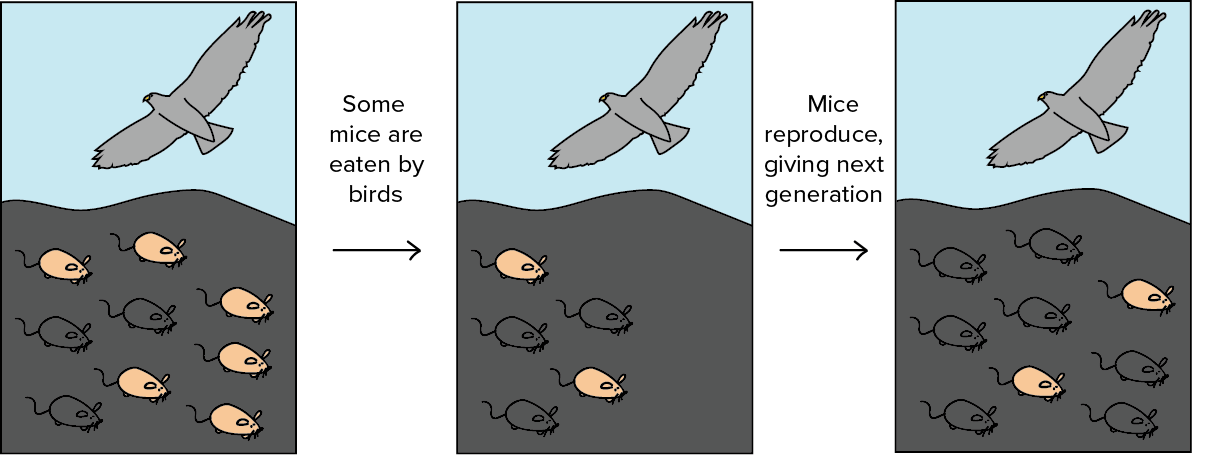
55.
What process is being shown in this image?
a)
Variation
b)
Natural Selection
c)
Selective Breeding
d)
Homeostasis
56.
Why is the mouse population changing over time?
a)
The light mice can reproduce more successfully than the dark mice
b)
The hawks eat more dark mice than light mice because the dark mice taste better
c)
The hawks eat more light mice than dark mice because they can see the light mice more easily
d)
The hawks eat more dark mice than light mice because they can see the dark mice more easily
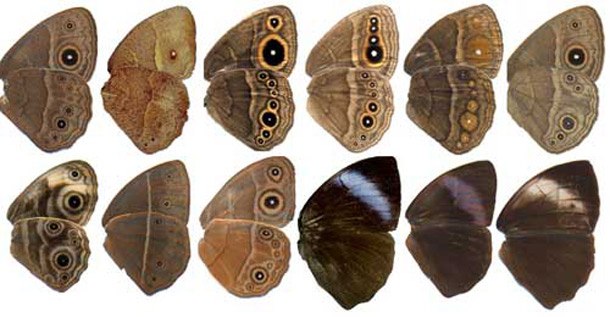
57.
These moths are all the same species. The differences between their wings is an example of ________________
a)
Natural Selection
b)
Variation
c)
Homeostasis
d)
Extinction
58.
Which of the following correctly lists the layers in order from oldest to youngest?
a)
A, B, C, D, E
b)
E, B, C, D, A
c)
E, D, C, B, A
d)
C, B, A, D, E
59.
What is the youngest layer in the outcrop?
a)
A
b)
B
c)
C
d)
D
60.
The rock formation labeled "P" is a(n)...
a)
fault
b)
intrusion
c)
inclusion
d)
unconformity