
 Worksheets
AP Human Geo Exam Review
Total questions: 60
Worksheet time: 35mins
Name
Class
Date
1.
The location of a place using the latitude-longitude grid is called:
a)
A. referenced location
b)
A. central location
c)
A. relative location
d)
A. absolute location
2.
The location of a place in relationship to other places or features around it is called:
a)
absolute location
b)
relative location
c)
site
d)
situation
3.
The process of the spread of an idea and/or dissemination of an innovation from its source area to other cultures, is the process of cultural:
a)
diffusion
b)
simultaion
c)
adaptation
d)
movement
4.
The process of the spread of an idea and/or dissemination of an innovation from its source area to other cultures, is the process of cultural:
a)
diffusion
b)
simultaion
c)
adaptation
d)
movement
5.
The physical qualities of the original location for a city is referred to as the
a)
site
b)
situation
c)
relative location
d)
absolute location
6.
What is it called when you take a 3D image and put it onto a 2D surface?
a)
Cartogram
b)
Projection
c)
Globe
d)
Instagram
7.
Places that share similar characteristics are called
a)
human systems
b)
environments
c)
regions
d)
physical systems
8.
Which of the following shows places on the Earth's surface the most accurately?
a)
thematic maps
b)
globes
c)
general-purpose maps
d)
physical maps
9.
What are lines on a globe drawn in an east-west direction and measured in degrees?
a)
longitude
b)
latitude
c)
grid
d)
equator
10.
Environment influences, but does not strictly determine, how a culture interacts with the environment.
a)
Environmental Determinism
b)
Environmental Possibilism
c)
Cultural Determinism
d)
Cultural Environmentalism
11.
The physical environment causes social and cultural development.
a)
Cultural Environmentalism
b)
Environmental Possibilism
c)
Environmental Determinism
d)
Cultural Possibilism
12.
Culture is spread by...
a)
Movement of people
b)
TV and Internet
c)
War and conquest
d)
All are correct
13.
The location of a place based on nearby characteristics.
a)
site
b)
regionalism
c)
situation
d)
place
14.
Which stage of the DTM is the US in
a)
1
b)
2
c)
3
d)
4
15.

ARABLE land is land suitable for ____________.
a)
raising livestock, like cattle
b)
Agriculture, or farming
c)
growing cactus, it means desert
d)
wind farming
16.
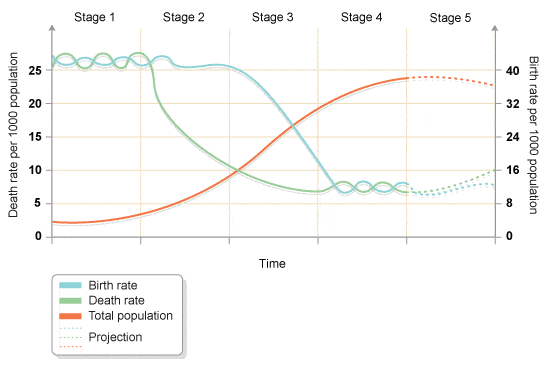
A characteristic of stage Three of the DTM shows?
a)
High birth and death rates
b)
Low death and high birth rates
c)
Declining birth and death rates
d)
High death and low birth rates
17.
The portion of earth's surface occupied by permanent human settlement.
a)
Ecumene
b)
Census
c)
Cohort
d)
Pandemic
18.

Whose model is this?
a)
Colin Renfrew
b)
Julian Simo
c)
Thomas Malthus
d)
John Snow
19.
This caused a jump in the worlds' population in the late 1700's and helped send England into stage 2 of the Industrial Revolution:
a)
the Renaissance
b)
the Industrial Revolution
c)
the Medical Revolution
d)
the Scientific Revolution
20.
Which of the following are part of EG Ravenstein’s (The Beard) Laws of Migration?
a)
most migrants are male
b)
most migrants move short distances
c)
most long distance migrants move to large urban areas
d)
all of the above
21.
Since the 1980's, most US In-Migration has come from
a)
Europe
b)
East Asia
c)
Latin America
d)
South Asia
22.
The process of migrants moving to a specific location because relatives or members of the same culture have already migrated and settled there is known as
a)
chain migration
b)
emigration
c)
immigration
d)
step migration
23.
Highest population growth occurs during stage
a)
1
b)
2
c)
3
d)
4
24.
ZPG stands for
a)
Zero population growth
b)
Zero pending growth
c)
Zero pollution growth
d)
Zero pounds growth
25.
What is urbanization?
a)
the loss of countryside
b)
the increase and growth of cities
c)
the movement from rural to urban
d)
the migration of urban to rural
26.
A repetitive act performed by an individual is a
a)
custom
b)
popular culture
c)
habit
d)
taboo
27.
In contrast to folk culture, popular culture is more likely to vary
a)
from place to place at a given time
b)
from time to time at a given place
c)
both from place to place and from time to time in equal measure
d)
neither from place to place nor time to time
28.
In contrast to folk culture, popular culture is typical of large and
a)
homogeneous groups
b)
heterogeneous groups
c)
groups living in isolated rural areas
d)
groups that have little interaction with other groups
29.
Typically, popular culture
a)
originates in a number of locations at the same time.
b)
reflects the characteristics of a distinctive physical environment.
c)
experiences frequent changes through time and space.
d)
is practiced by small homogeneous groups.
30.
Folk cultures are spread primarily by
a)
contagious diffusion
b)
hierarchical diffusion
c)
relocation diffusion
d)
stimulus diffusion
31.
The global diffusion of popular culture may threaten folk culture by
a)
being less responsive to the diversity of local environments.
b)
threatening local environments through the diffusion of information by technology.
c)
serving as a catalyst for the advancement of folk culture.
d)
being more responsive to the diversity of local environments.
32.
Hip hop music demonstrates an interplay between globalization and local diversity because
a)
it is a form of folk culture responsible for the globalization of modern music.
b)
it is a part of popular culture which threatens to overwhelm local folk cultures.
c)
artists may be widely popular yet still make local references in their song lyrics.
d)
some lyrics can't be transmitted over the radio and television.
33.
Like hip hop music, music from the border region between the southwestern United States and northern Mexico might be expected to
a)
reflect almost exclusively on themes of drug culture and violence.
b)
be an aspect of popular culture which threatens to overwhelm local folk cultures.
c)
incorporate local, national, and global themes as it demonstrates an interplay between globalization and localism.
d)
feature potentially offensive lyrics in order to guarantee its widespread transmission via radio and television.
34.
A restriction on behavior imposed by social custom is a
a)
folk culture
b)
habit
c)
popular culture
d)
taboo
35.
A taboo against pork is a characteristic of
a)
Judaism and Islam.
b)
Judaism and Buddhism.
c)
Christianity and Buddhism.
d)
Christianity and Hinduism.
36.
) The ________ is an important source area for U.S. folk house types.
a)
Lower Chesapeake
b)
Southern Atlantic
c)
Northeast
d)
Upper New York Highland
37.
What is monotheism?
a)
The belief or worship of more than one god.
b)
The belief of the existence of only one god.
c)
The belief that objects or natural events have a discrete spirit and conscious life.
d)
The belief that an aspect of a living being starts a new life in a different physical body/form after death.
38.
Who is the founder of Judaism?
a)
Muhammad
b)
Abraham
c)
Jesus of Nazareth
d)
Siddhartha Gautama
39.
What is a major symbol in Christianity?
a)
Star of David
b)
Eight spoked wheel
c)
Moon with Star
d)
Cross, fish, martyr
40.
What is polytheism?
a)
The belief or worship of more than one god.
b)
The belief of the existence of only one god.
c)
The belief that objects or natural events have a discrete spirit and conscious life.
d)
The belief that an aspect of a living being starts a new life in a different physical body/form after death.
41.
What is animism?
a)
The belief that objects or natural events have a discrete spirit and conscious life.
b)
The belief of the existence of only one god.
c)
The belief or worship of more than one god.
d)
The belief that an aspect of a living being starts a new life in a different physical body/form after death.
42.
Name 3 monotheistic religions:
a)
-Judaism
-Christianity
-Islam
-Christianity
-Islam
b)
-Hinduism
-Taoism
-Shintoism
-Taoism
-Shintoism
43.
At what hearth did Buddhism originate from?
a)
Mecca
b)
Jerusalem
c)
Nepal
d)
Israel
44.
What country has a majority of Jews?
a)
Israel
b)
Mecca
c)
Nepal
d)
India
45.
In which of the following countries are inhabitants subject to Sharia law?
a)
Venezuela
b)
Ethiopia
c)
Turkey
d)
Saudi Arabia
46.

Which religion believed in the Eightfold Path?
a)
Legalism
b)
Hinduism
c)
Jainism
d)
Buddhism
47.
This is the oldest polytheistic religion in the world.
a)
Hinduism
b)
Judaism
c)
Christianity
d)
Buddhism
48.
This religion follows the teachings of Muhammad.
a)
Islam
b)
Shintoism
c)
Hinduism
d)
Buddhism
49.

What Chinese school of thought teaches respect to elders and the law as the best way to maintain a peaceful society?
a)
Taoism
b)
Christianity
c)
Confucianism
d)
Buddhism
50.
Where did both Hinduism and Buddhism begin?
a)
India
b)
China
c)
Sumer
d)
Egypt
51.
Which branch of Islam is the minority?
a)
Sunni
b)
Shia
c)
Farsi
d)
Arab
52.
Which of the following cities is a holy place to three of the world's main religions?
a)
Mecca
b)
Medina
c)
Jerusalem
d)
Delhi
53.
Which of the following region is an ethnic religion?
a)
Judaism
b)
Christianity
c)
Islam
d)
Sikhism
54.
The religion that most shaped early Japanese history would be
a)
Hinduism
b)
Buddhism
c)
Shintoism
d)
Daoism
55.

This map shows the spread of
a)
Islam
b)
Christianity
c)
Buddhism
d)
Hinduism
56.
Which one is E.G. Ravenstein?
a)
b)
c)
d)
e)
57.

Who dis?
a)
E.G. Ravenstein
b)
Thomas Malthus
c)
Lil Baby
d)
Taeyang
e)
Coolio
58.
Mr. Bruce has lived in which of these cities?
a)
Philadelphia
b)
San Diego
c)
Miami
d)
Chicago
e)
Washington D.C.
59.
What is Mr. Bruce's favorite meal at the cafe?
a)
Tacos
b)
Pizza
c)
Guo Bao Rou (东北鍋包肉)
60.
Fill in the blank: You ______ !!!
a)
Rock
b)
...
100 %

