
 Worksheets
Chapter 4 Review for Midterm
Total questions: 48
Worksheet time: 41mins

People leaving (moving away from) a country is called
Immigration
Emigration
Mass migration
Urbanization

To enter and live in (moving into) a new country
Emigration
Immigration
Urbanization
Industrialization
The amount of individuals in a population that die is called:
Death Rate (Mortality)
RIP
Death Decrease
Decline in Population
All of the following are examples of Density-Independent Factors except
The 1918 Flu
Hurricane Milton
The Great Floods of China in 1931
2011 Japan Earthquake and Tsunami
Besides the birth rate, this term will also help a population increase.
Immigration
Emigration
Food
Friends
The number of people an area can support on a sustained basis is called its...
Population
Carrying Capacity
Equilibrium
Happy Place

What happens in this graph?
Logistic Growth
Exponential Growth
S-Curve
Death

Which Age Structure shows slow growth?
Left
Middle
Right

Which population is clumped?
Image to the left
Image in the middle
Image to the right
What does a country's "Carrying Capacity" mean?
The capacity for globalization within ethnic groups.
How much weight a country can carry.
The amount of life that can be supported and sustained.
The ability of immigrants to provide resources to host.
Humans will reach zero population growth when...
birth rate equals death rate
carrying capacity is reached
humans stop giving birth
the world's population stops growing

The life expectancy in the United States is younger than 70 years old.
True
False
Since the early 1800s, the world’s population has...
increased slowly
exponentially grown
decreased slowly
decreased quickly
All of the following are reasons for the population explosion except:
babies surviving infancy
modern medicine
the Industrial Revolution
a higher population density
If a population grows larger than its environmental carrying capacity, then
death rate may rise.
death rate may fall significantly.
birth rate may rise significantly.
immigration rate may increase.
Human population still shows exponential growth.
true
false
The number of births compared to the total number of people in a population
death rate
birth rate
baby boom
doubling time

If a population grows too large, too quickly, then this can happen:
disease can spread easily
world can run out of resources
basic health care will be difficult to provide
All of these answers

The number of organisms per unit area is
Dispersion
Population Growth Rate (PGR)
Population Density
Population
All of the following are examples of Density-Independent Factors except
Hurricane Helene
2011 Japan Earthquake and Tsunami
The Great Floods of China in 1931
1918 Influenza (The 1918 Flu)
All of the following are examples of Density-Dependent Factors except
Ebola
1918 Influenza (The 1918 Flu)
Hurricane Milton
The Black Plague

Besides the birth rate, this term will also help a population increase.
Friends
Immigration
Emigration
Food
The amount of individuals in a population that die is called:
Death Rate (Mortality)
RIP
Death Decrease
Decline in Population

When the population reaches its _____the growth rate slows down (or humans can die).
Tolerance
Carrying Capacity
Population Growth Rate
Statistical Deviation
Which organism follows a k-strategy for reproduction?
dolphin
mouse
mayfly
mosquito
TRUE or FALSE: The 1918 Influenza Epidemic killed over 600,000 American and 20 to 40 million people worldwide. This is an example of a density-independent factor.
True
False
TRUE or FALSE: Competition between organisms for resources such as food or space may increase when population size increases.
True
False
A change in population from high birth and death rates to low birth and death rates.
Demography
Demographic Transition
Population Change
Mortality
One reason the world is growing so quickly is because...
The world has infinite resources for everyone
Birth rate is higher than death rate
There are more and more places for people to live
Death rate is higher than birth rate

This population pyramid shows...
Rapid growth
Slow growth
Negative growth

This population pyramid shows...
Rapid growth
Slow growth
Negative growth

This population pyramid shows...
Rapid growth
Slow growth
Negative growth
Countries with a rapidly growing population are..
Developed
Developing
Largest number of individuals of a population that the environment can support...
carrying capacity
population crash
lag phase
mutualism
An environmental factor such as predation, disease, and competition that depends on the number of members in a population per unit
dispersion
density- independent factor
density- dependent factor
Carrying Capacity is
the capacity of what one person can carry per day
how many animals you have in your daily bag limit at the end of the year
wildebeest at a watering hole with zebras
the maximum number of individuals that the environment can support
Which country is projected to be the most populous in 2050?
India
China
USA
Mexico
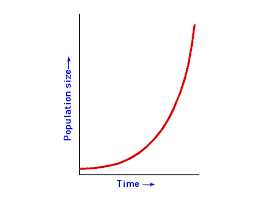
What type of growth is shown in the diagram?
exponential growth
logistic growth
predator-prey cycle
boom-bust curve

The approximate population of the world today is..
less than 7 Million
6 Billion and holding
6.7 Million and slowing
8.1 Billion and growing

The pattern of spacing of a population within an area is called
Emigration
Immigration
Dispersion
Population Density
The number of individuals moving away from a population.
Carrying Capacity
Emigration
Immigration
Population Density
Dispersion
The number of individual moving into a population.
Carrying Capacity
Emigration
Immigration
Population Density
Dispersion
Any factor in the environment that does not depend on the number of members in the population per unit area. (For example: weather-related events)
Dispersion
Population
Density-Independent Factors
Density-Dependent Factors
Population Density
Any factor in the environment that depends on the number of members in a population per unit area.
Population Density
Density-Independent Factors
Density-Dependent Factors
Dispersion
Carrying Capacity
Which organism follows an r-strategy for reproduction?
human
mosquitoes
elephants
dolphins
none of these choices
Which organism follows a k-strategy for reproduction?
elephant
mosquitoes
mouse
fly
none of these choices
Which is a characteristic of exponential population growth?
Growth rate is inversely proportional to population size.
Initial population growth is rapid.
Resources are consumed exponentially during all phases.
The lag phase follows rapid growth.

Which correctly describes the term demographic transition?
The transition from low birth rates and death rates to high birth rates and death rates as a country develops.
The transition from high birth rates and death rates to low birth rates and death rates as a country develops.
The transition from high birth rates to low death rates as a country develops.
The transition from low birth rates to high death rates as a country develops.

